3rd Grade Solve Word Problems Worksheets
All worksheets are created by the team of experienced teachers at Cazoom Math.
What Types of Word Problems Should Third Graders Solve?
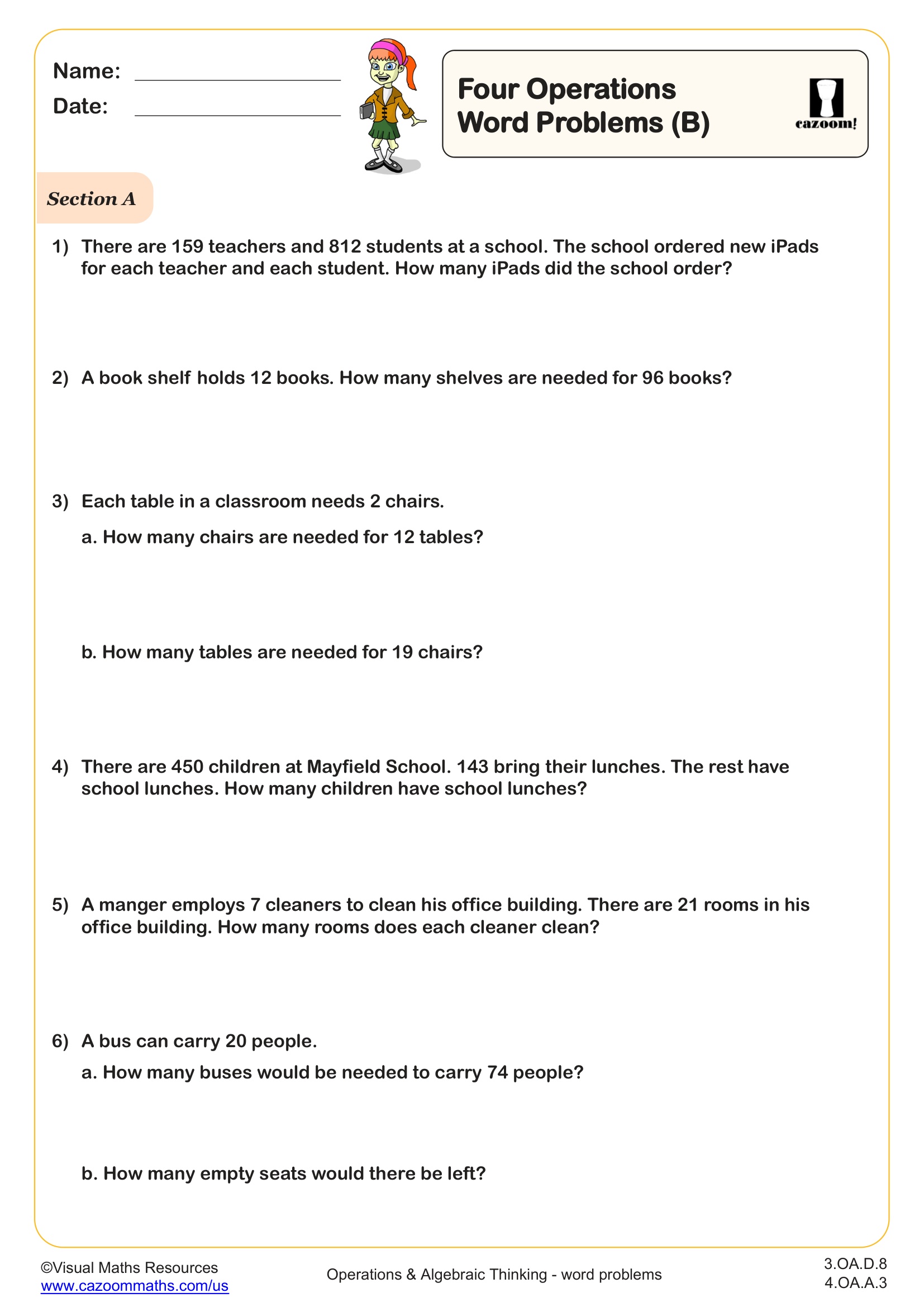
Third graders should solve single-step and beginning two-step word problems involving addition, subtraction, multiplication, and division within 1,000. According to Common Core State Standards (3.OA.D.8), students need to solve problems using all four operations and identify the arithmetic patterns that emerge. Problems typically involve situations like comparing quantities, finding totals, determining equal groups, and calculating differences.
Students lose points on assessments when they perform the correct computation but answer the wrong question. For example, a problem asking "How many are left?" might lead a student to calculate the total instead of the difference. Teachers notice that having students underline what the question actually asks before solving significantly reduces this error, especially on state tests where word problems make up a substantial portion of the assessment.
What Word Problem Skills Are Expected in Third Grade?
By third grade, students should read a problem independently, determine which operation makes sense, write an equation to represent the situation, and explain their reasoning. They're expected to solve problems involving multiplication and division for the first time, recognizing situations like equal groups or array arrangements. Students should also estimate to check if their answers are reasonable, a skill explicitly tested on many state assessments.
This builds directly on second grade work with addition and subtraction word problems within 100. The jump to four operations and larger numbers represents significant cognitive growth. Success with third grade word problems prepares students for the multi-step problems and fraction contexts they'll encounter in fourth grade, making this a pivotal year for developing problem-solving stamina and strategic thinking.
How Do Students Identify Which Operation to Use?
Students learn to match problem situations with operations by recognizing key contexts rather than hunting for keywords. Addition signals combining or finding totals, subtraction indicates comparing or taking away, multiplication represents equal groups or arrays, and division means splitting into equal parts or finding how many groups. Teachers emphasize reading the entire problem twice before deciding, as keyword strategies fail when problems become more complex.
This skill connects directly to scientific thinking and data analysis. When students measure plant growth over three weeks and need to find the total change, or when they calculate how many boxes of supplies a classroom needs if each table gets three pencils, they're using the same reasoning required in STEM fields. Engineers constantly translate real situations into mathematical operations, making word problem proficiency an authentic career skill, not just an academic exercise.
How Do These Worksheets Help Students Improve at Word Problems?
These worksheets present problems across varied contexts so students practice recognizing which operation fits different situations. The mix of all four operations on a single sheet prevents students from assuming every problem uses the same strategy, which happens when worksheets focus on only one operation. Answer keys allow students to check not just their final answer but also their equation setup, helping them catch reasoning errors early.
Many teachers use these worksheets during math workshop rotations, pairing stronger readers with students who struggle with text comprehension so the focus stays on mathematical reasoning rather than decoding. They work well as warm-up problems to start math class, as intervention material for students who compute accurately but struggle with application, or as homework that families can support using the answer key. Some teachers have students create their own word problems using the worksheet scenarios as models, deepening understanding of operation meanings.