3rd Grade Subtracting with Single Digits Worksheets
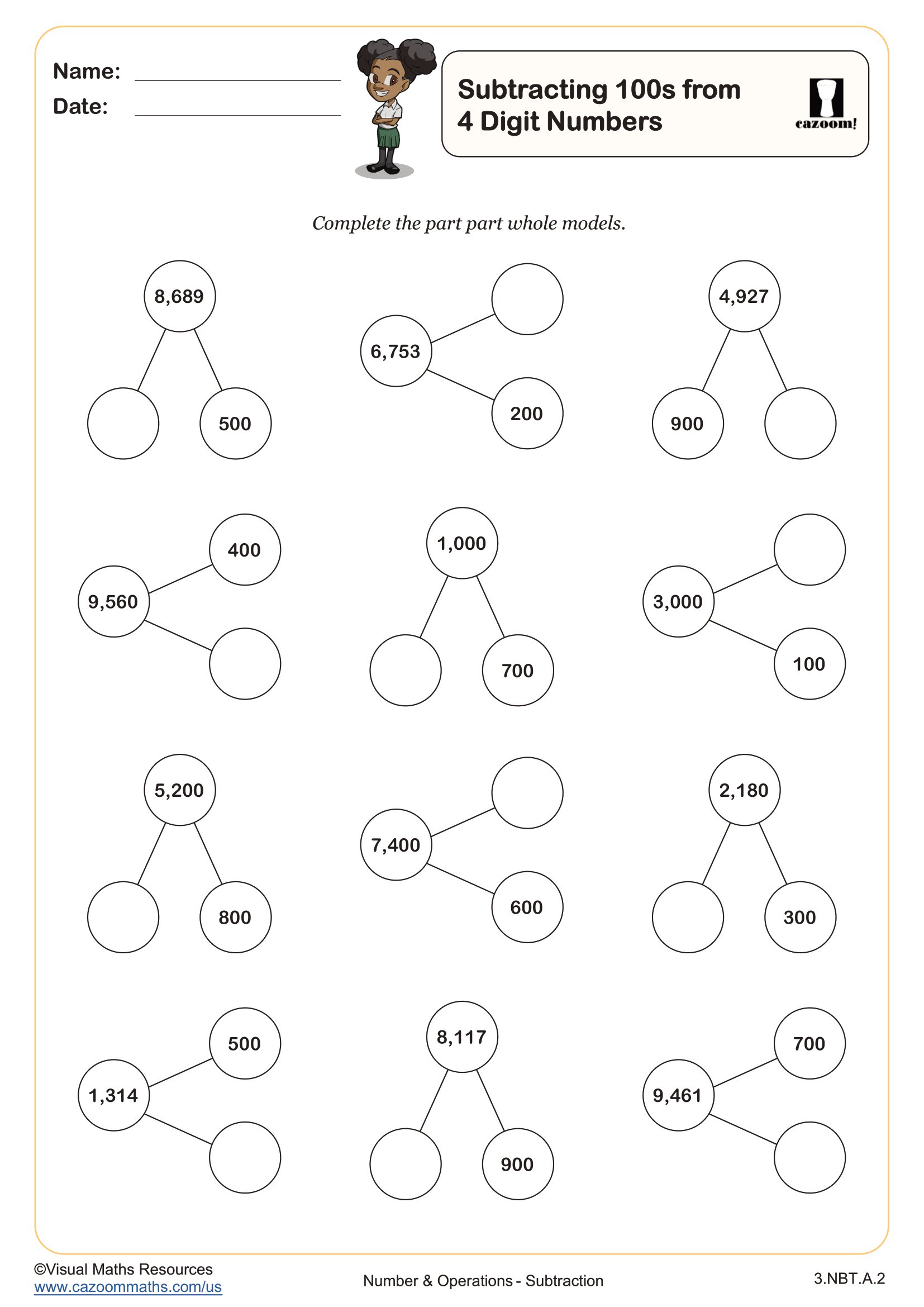
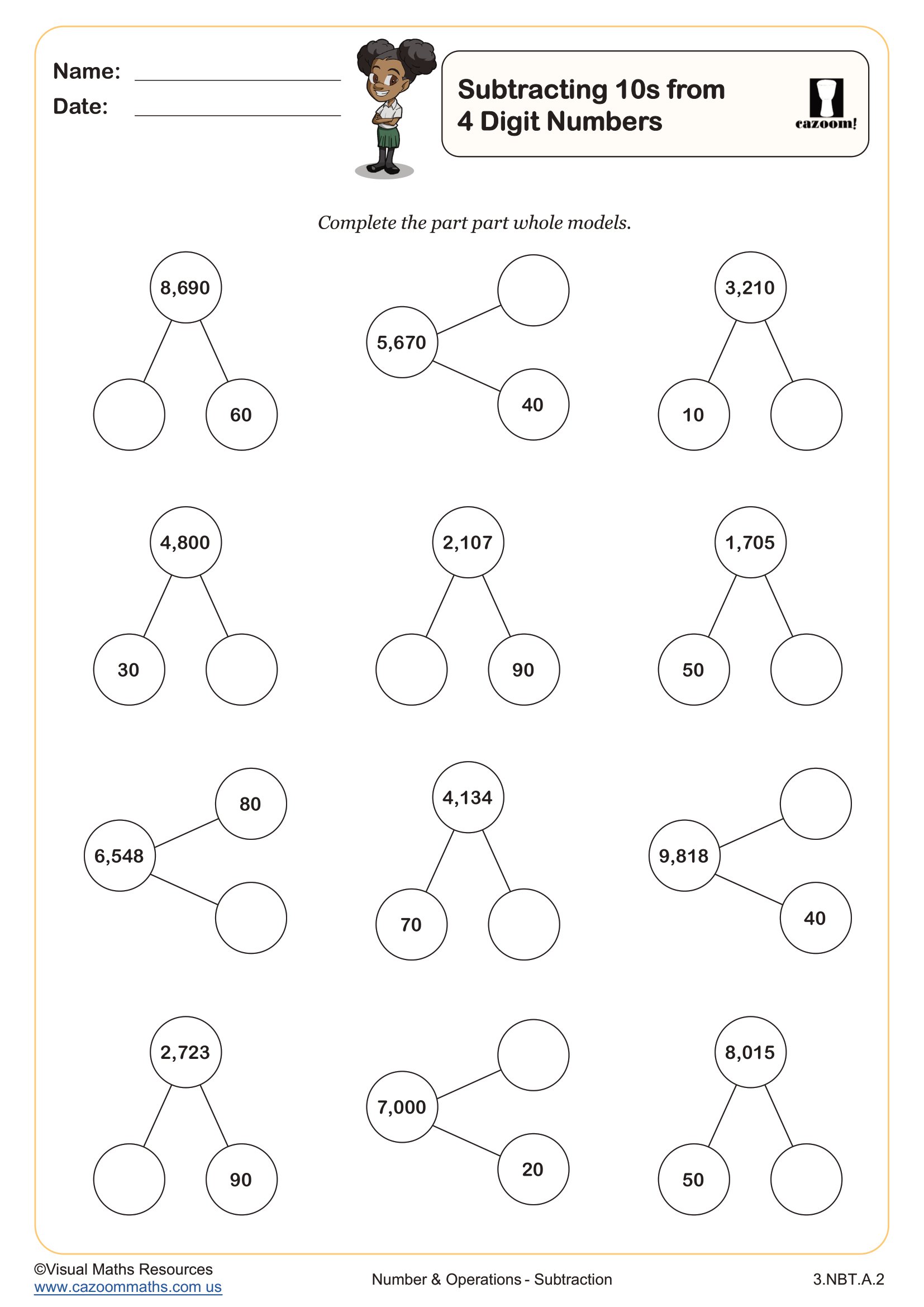
All worksheets are created by the team of experienced teachers at Cazoom Math.
What Does Subtracting with Single Digits Mean in 3rd Grade?
In 3rd grade, subtracting with single digits extends beyond simple facts like 9 - 4 to include subtracting single-digit multiples of 10 or 100 from larger numbers. Students work with problems like 3,456 - 200 or 5,782 - 30, where they subtract in specific place value positions while keeping other digits unchanged. This aligns with Common Core Standard 3.NBT.A.2, which requires students to fluently add and subtract within 1,000 using strategies based on place value.
A common error occurs when students subtract from every digit instead of the target place value. For example, in 4,567 - 300, some students incorrectly calculate 1,267 by subtracting 3 from each digit. Teachers often use base-ten blocks or place value charts to help students visualize that only the hundreds place changes, reinforcing that 4,567 - 300 equals 4,267.
Why Is This Skill Important for 3rd Grade Students?
Third graders should master subtracting single-digit multiples of 10 and 100 from four-digit numbers without regrouping as a foundation for more complex subtraction. This skill demonstrates understanding that our number system is organized by place value, where each position represents a different quantity. Students who recognize that subtracting 400 means removing four hundreds become more flexible mental math users and can estimate differences quickly.
This topic builds directly on 2nd grade work with three-digit numbers and prepares students for 4th grade multi-digit subtraction with regrouping across multiple places. Teachers notice that students who struggle here often missed foundational place value concepts in earlier grades, particularly the idea that 2,000 represents 20 hundreds or 200 tens. Strong performance with these worksheets indicates readiness for the standard subtraction algorithm.
How Do Students Use Place Value to Subtract Efficiently?
Place value subtraction relies on understanding that each digit's position determines its value, allowing students to subtract in one column without affecting others. When solving 6,824 - 600, students recognize they're only changing the hundreds place (8 hundreds become 2 hundreds), leaving 6,224. This mental math strategy is significantly faster than traditional algorithms for certain problems and strengthens number sense that standardized tests frequently assess through multiple-choice estimation questions.
This skill connects to real-world money applications, particularly when making change from large bills. If a purchase costs $38 and a customer pays with a $50 bill, understanding that $50 - $30 = $20 helps quickly determine most of the change. Scientists and engineers use similar mental subtraction when estimating measurements or calculating differences in large datasets, making this a practical STEM skill beyond basic arithmetic.
How Can Teachers Use These Worksheets Effectively?
These worksheets provide focused practice on specific place value subtraction patterns, with problems organized to help students recognize that subtracting hundreds affects only the hundreds place and subtracting tens affects only the tens place. The systematic structure allows teachers to identify exactly where confusion occurs by examining which types of problems students answer correctly. Answer keys enable quick checks during independent work time or immediate feedback during math stations.
Many teachers use these worksheets during small-group instruction with students who need extra support with place value concepts before tackling regrouping. They work well as warm-up activities to reinforce mental math strategies or as homework that families can support without confusion about complex algorithms. Some teachers assign them as timed practice once students demonstrate accuracy, building both fluency and confidence that transfers to standardized test settings where efficient problem-solving matters.