4th Grade 3D Shapes Worksheets
All worksheets are created by the team of experienced teachers at Cazoom Math.
What 3D shapes concepts do 4th graders need to master?
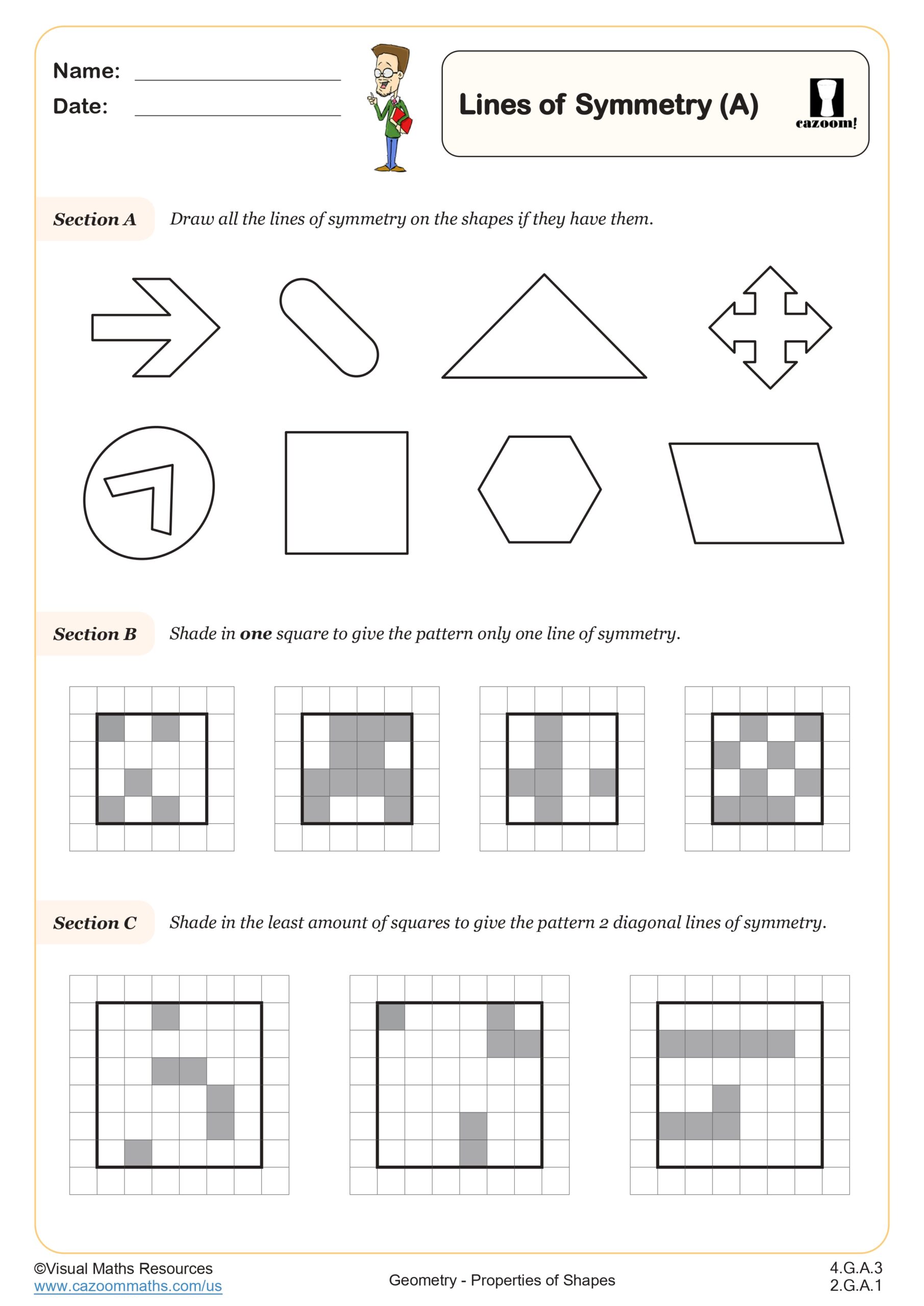
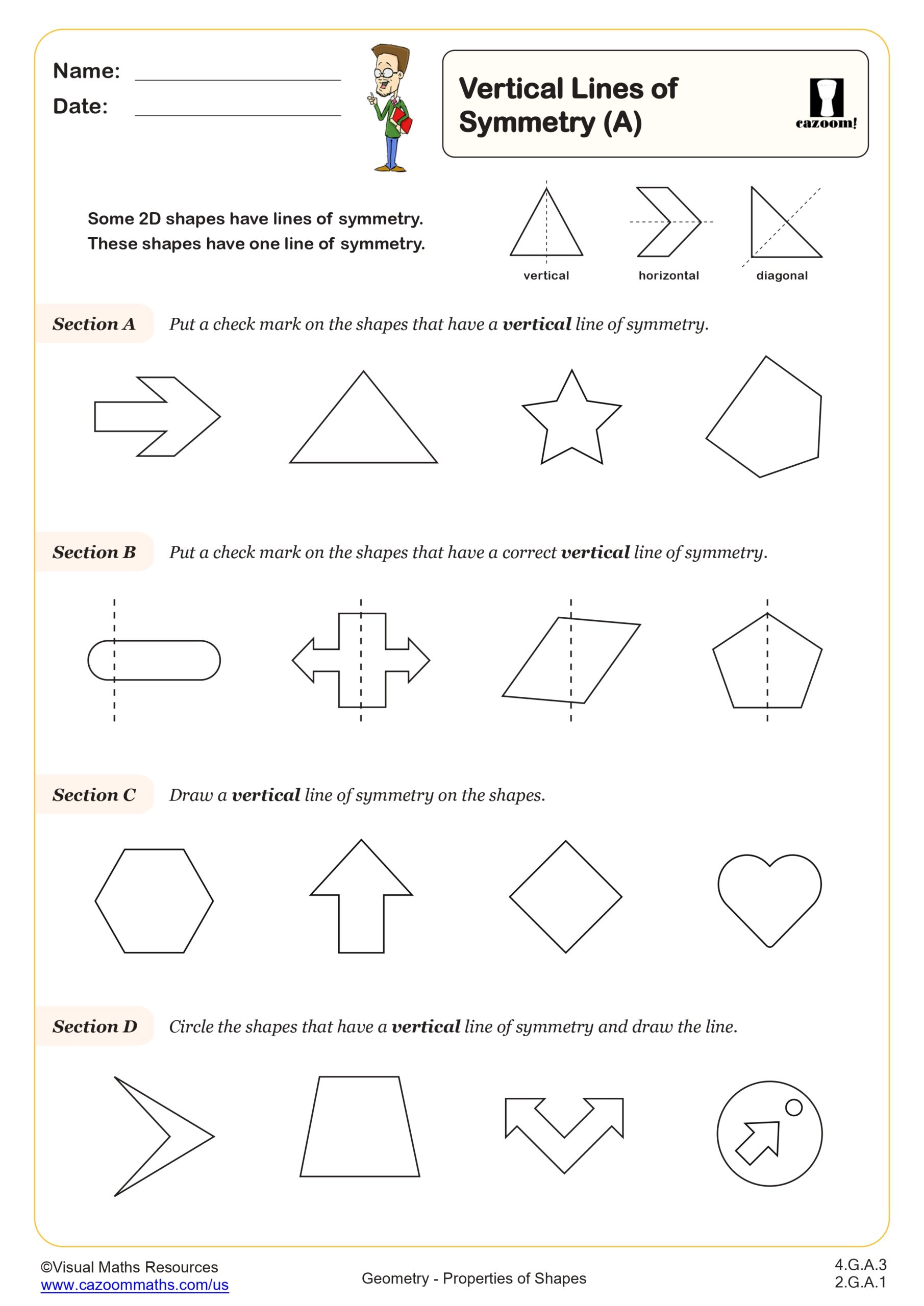
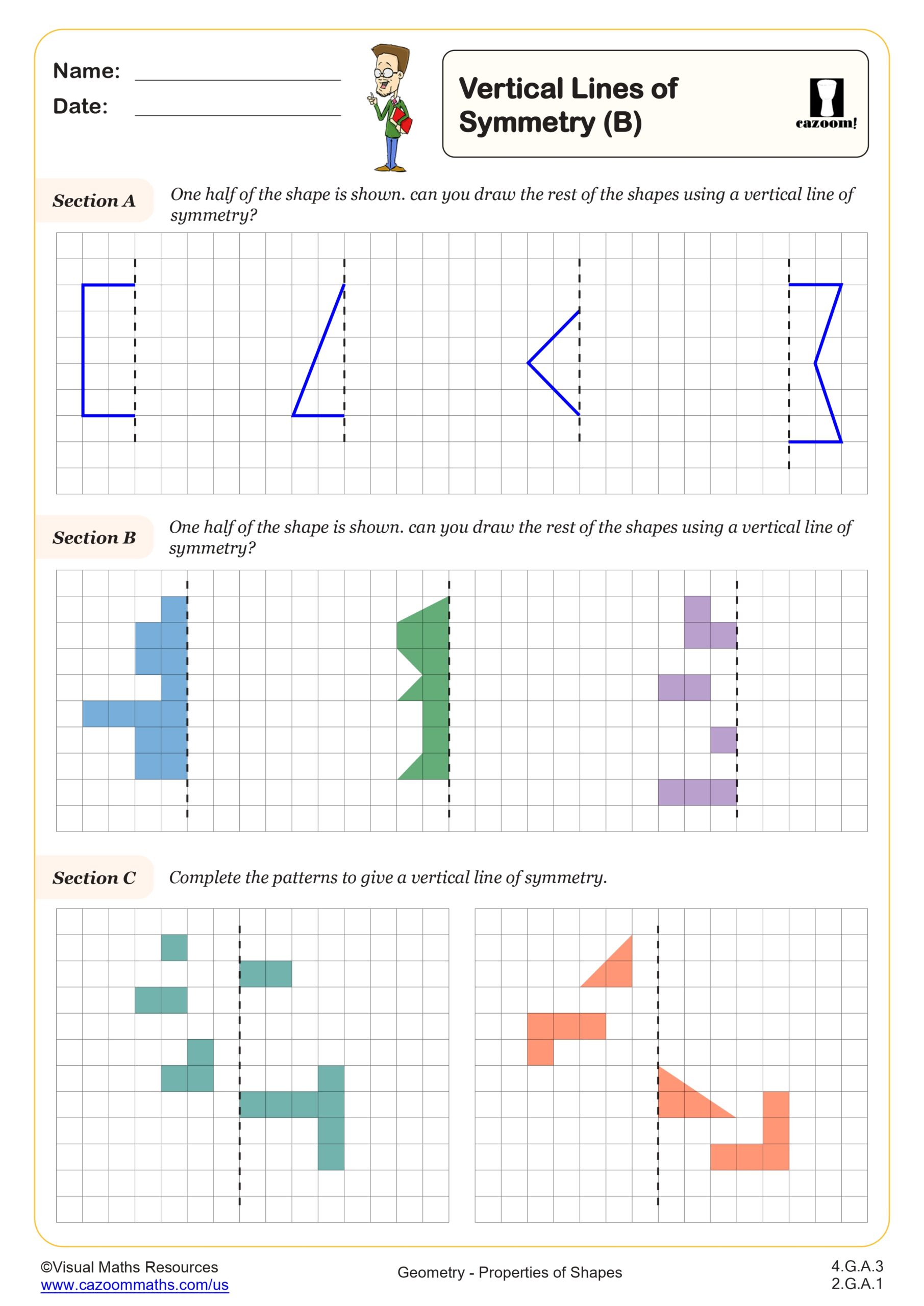
Fourth graders build on their earlier work with basic 3D shapes by moving beyond simple identification to analyzing properties, visualizing different perspectives, and understanding how these shapes appear in space. The Common Core State Standards expect students at this level to recognize and draw lines of symmetry, understand how 3D objects look from different viewpoints (plans and elevations), and connect geometric shapes to real-world structures.
A common misconception occurs when students confuse faces, edges, and vertices when counting these attributes on complex shapes like rectangular prisms or pyramids. Teachers often see students count the same edge twice or miss hidden vertices on the back of a shape. Providing isometric paper for students to sketch their own 3D shapes helps them internalize these properties through active construction rather than passive observation.
What grade level are these 3D shapes worksheets appropriate for?
This collection specifically targets 4th grade students in elementary school, aligning with the geometric reasoning standards introduced at this level. Fourth grade represents a critical transition point where students move from simply naming shapes to analyzing their properties and spatial relationships in more sophisticated ways.
At this grade level, the difficulty increases as students progress from basic shape recognition to more challenging tasks like drawing 3D objects on specialized paper, identifying multiple lines of symmetry, and interpreting two-dimensional representations of three-dimensional objects through plans and elevations. Students who master these visualization skills in 4th grade find geometry topics in middle school, particularly surface area, volume, and coordinate geometry, significantly more accessible.
How do plans and elevations help students understand 3D shapes?
Plans and elevations teach students to visualize three-dimensional objects by showing what they look like from different viewpoints: the plan shows the top view, while elevations show front and side views. This multi-perspective approach strengthens spatial reasoning by requiring students to mentally rotate objects and understand that the same shape appears differently depending on viewing angle. Students typically make a breakthrough when they realize that the plan always shows the footprint or base of an object.
This skill connects directly to architecture, engineering, and construction fields where professionals create blueprints and technical drawings. Architects design buildings using plans and elevations before construction begins, and engineers use orthographic projections to communicate how manufactured parts should look from multiple angles. Understanding these representations early gives students insight into how STEM professionals translate ideas from three-dimensional reality to two-dimensional drawings and back again.
How can teachers use these 3D shapes worksheets effectively in the classroom?
The worksheets provide structured practice that builds from concrete experiences with physical shapes to abstract visualization tasks. Triangle grid paper and isometric paper worksheets give students the tools to accurately represent 3D shapes on flat surfaces, while the symmetry and plans/elevations activities challenge them to think critically about spatial relationships. Complete answer keys allow teachers to quickly check student understanding and identify which concepts need reteaching.
Many teachers use these worksheets during small group instruction for students who need additional support with spatial reasoning, or as independent practice after hands-on activities with manipulatives like geometric solids. The finding shapes in everyday objects worksheets work particularly well as homework assignments since students can walk around their homes identifying real-world examples, making the connection between classroom learning and their environment. Paired work on the plans and elevations sheets encourages mathematical discussion as students justify their reasoning about different viewpoints.