4th Grade Properties of Shapes Worksheets
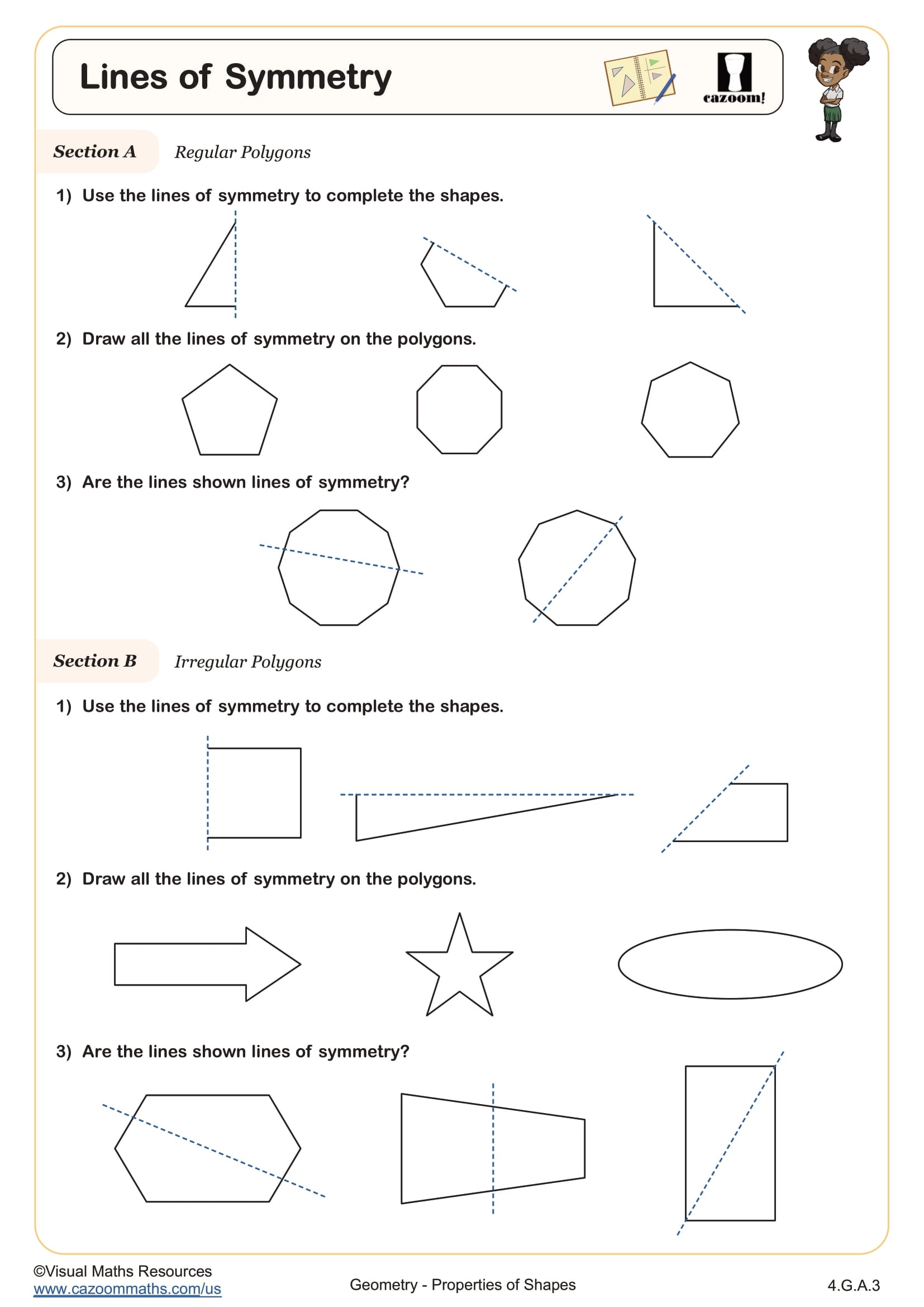
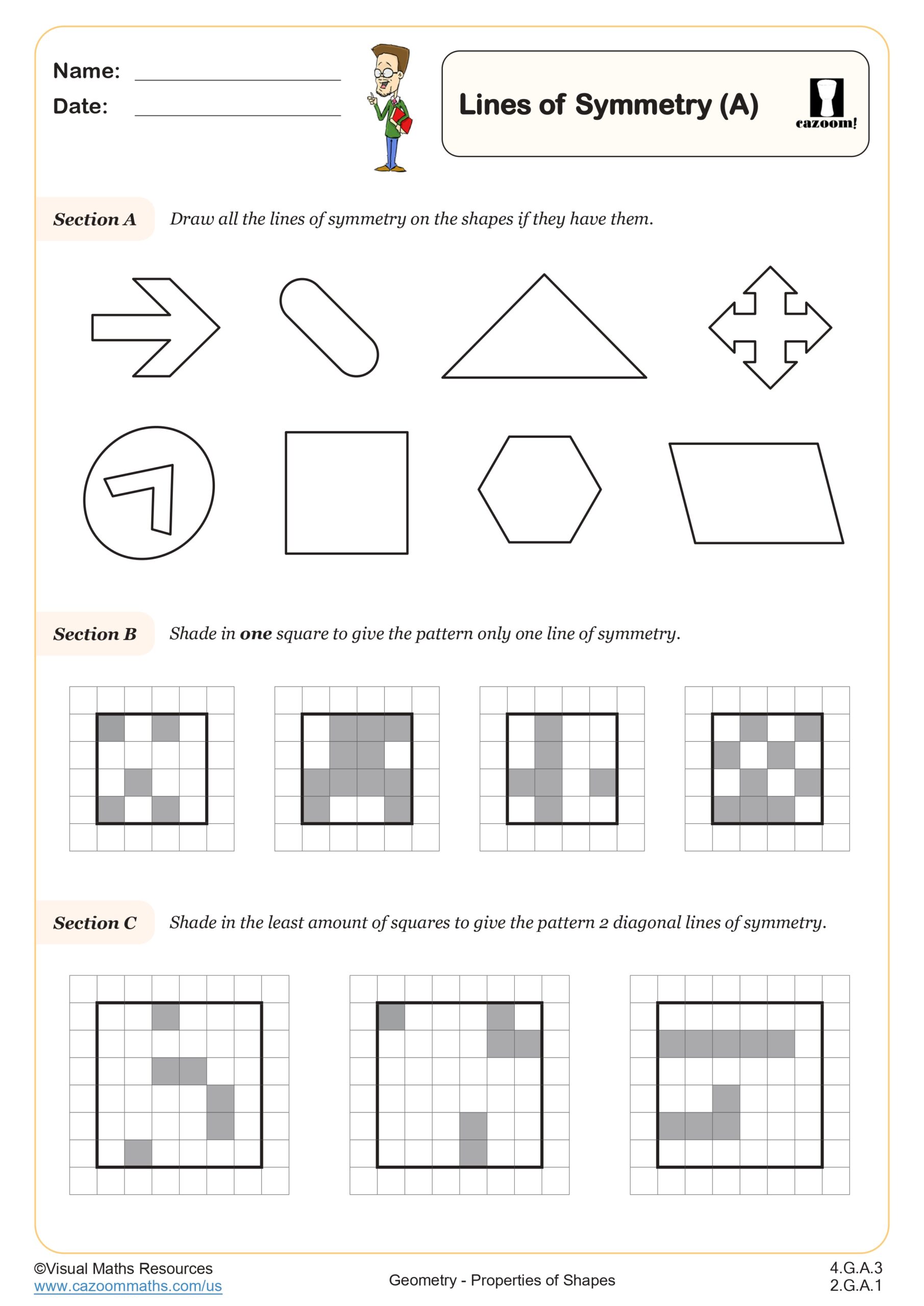
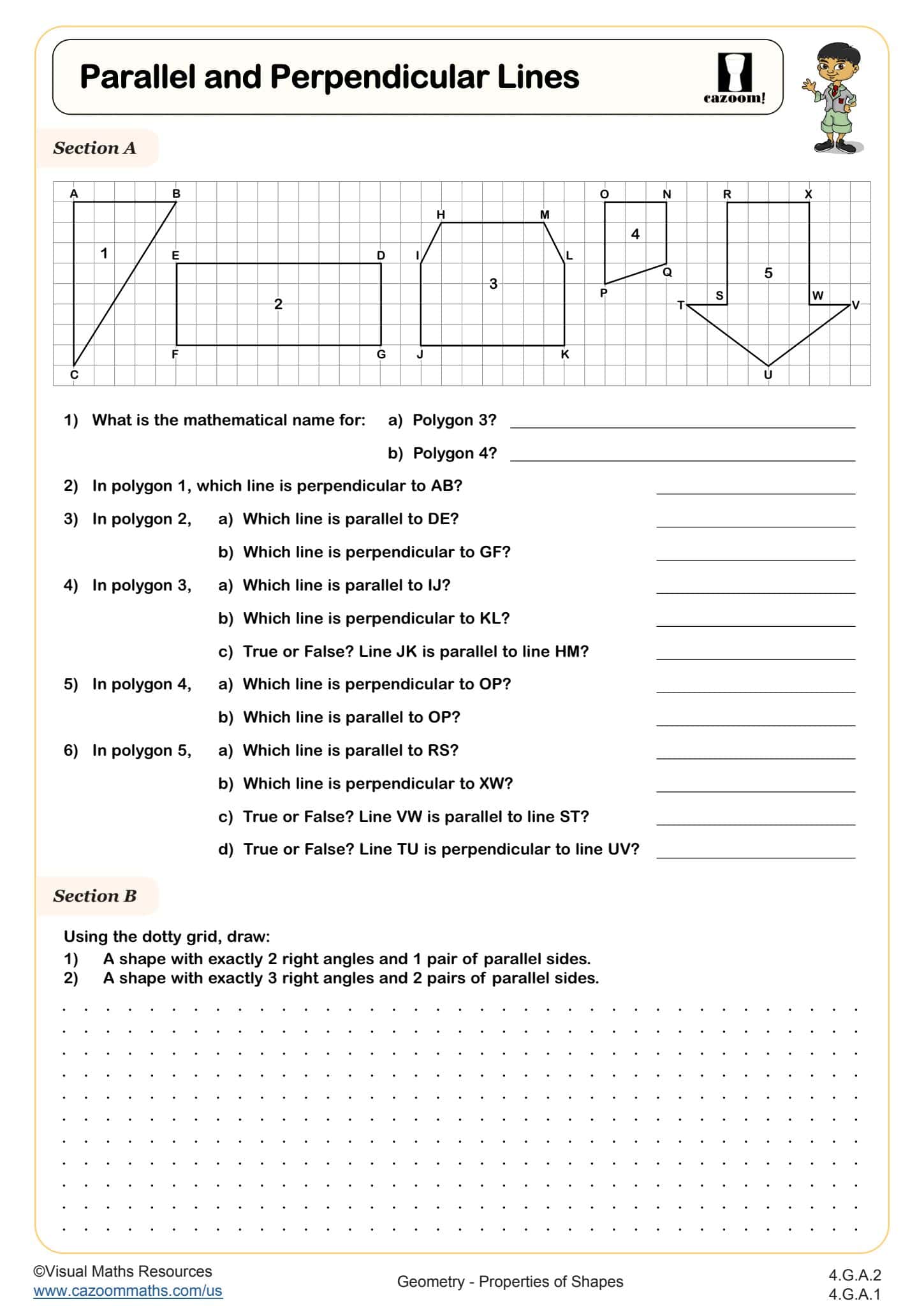
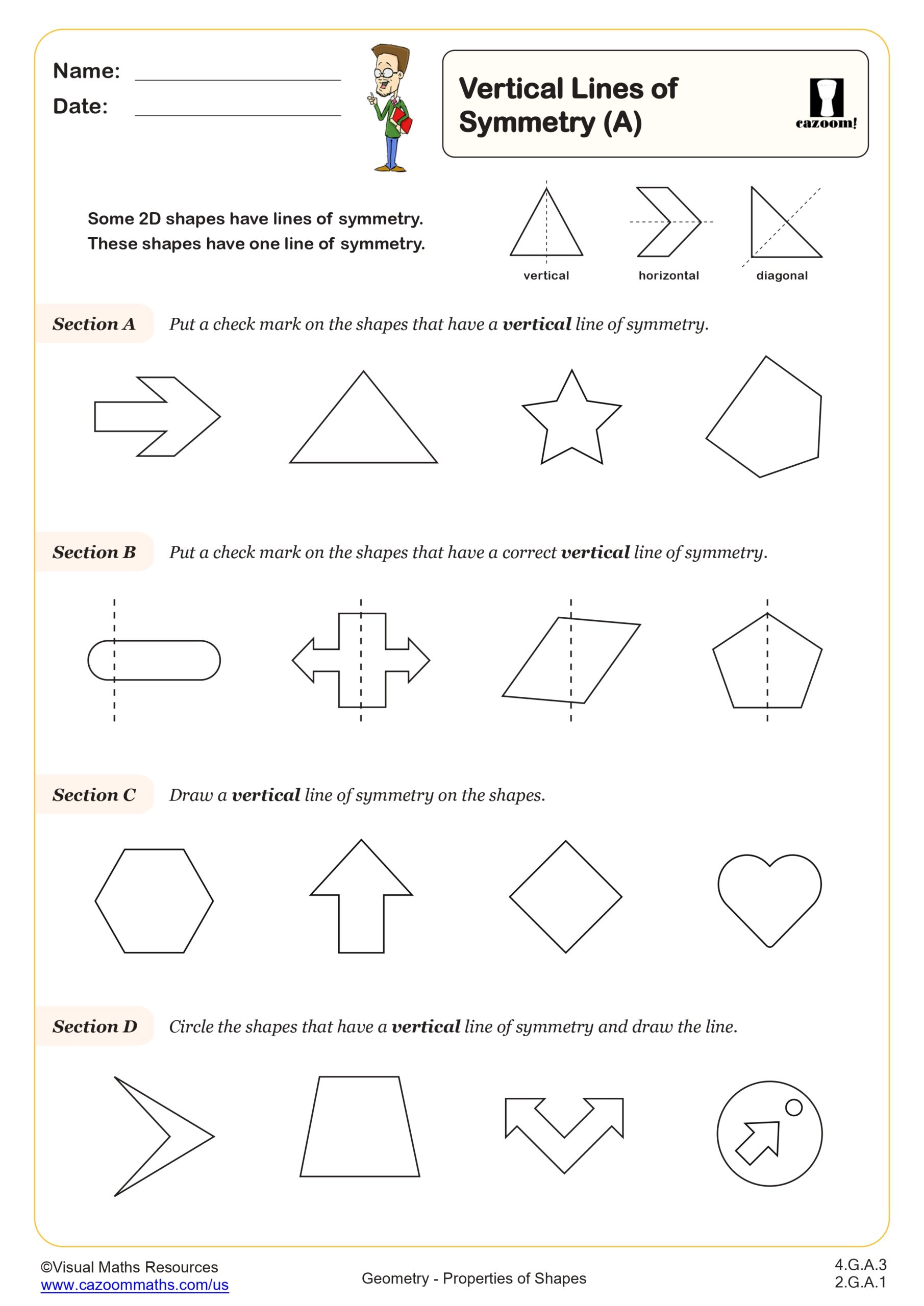
All worksheets are created by the team of experienced teachers at Cazoom Math.
What Are the Key Properties of Shapes That 4th Graders Need to Know?
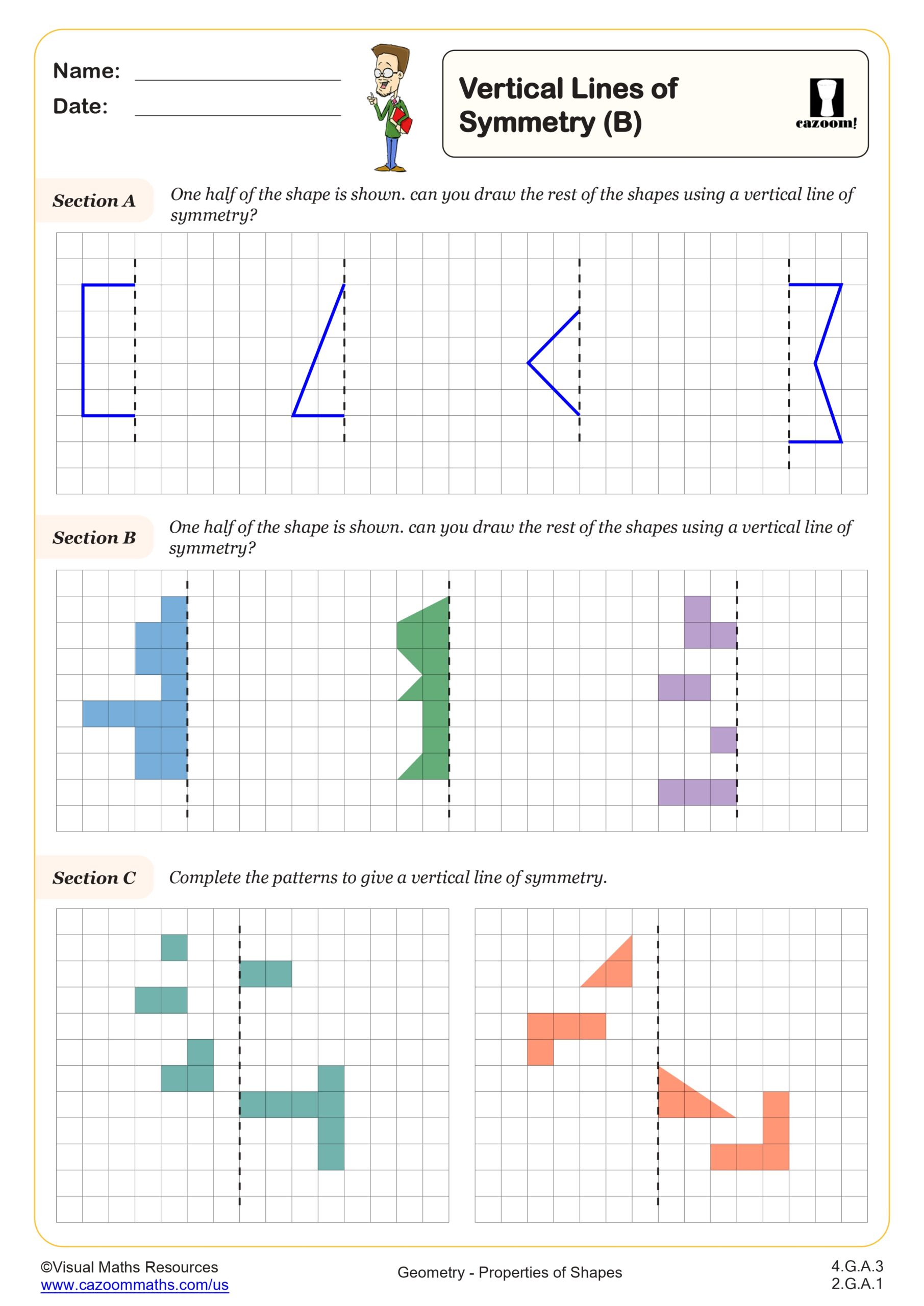
Fourth graders focus on identifying and describing the defining attributes of two-dimensional shapes, including the number of sides, types of angles (right, acute, obtuse), parallel and perpendicular lines, and lines of symmetry. The Common Core State Standards expect students to classify shapes based on these properties rather than appearance alone, recognizing that a square is also a rectangle because it has all the properties of rectangles.
Students frequently confuse necessary versus sufficient properties—for example, assuming all rectangles are squares because squares have right angles. Teachers notice this misconception surfaces when students sort shapes into categories. Worksheets that require students to explain why a shape belongs or doesn't belong to a category help reinforce the hierarchical relationships between quadrilaterals, where squares are special rectangles, and rectangles are special parallelograms.
Which Grade Levels Study Properties of Shapes?
This collection addresses 4th grade elementary school standards, where students deepen their understanding of two-dimensional figures through both basic and advanced geometric concepts. At this level, students move beyond simple shape identification to analyzing properties, calculating areas of complex polygons, and understanding transformations like enlargements.
The progression within 4th grade starts with foundational activities like word searches that reinforce shape vocabulary, then advances to area calculations for regular hexagons that require formula application, and extends to coordinate-based transformations using column vectors. This scaffolding helps students build from concrete shape recognition to abstract mathematical descriptions of how shapes change under transformations. The variety in difficulty allows teachers to differentiate instruction based on student readiness while maintaining grade-level rigor.
How Do Students Calculate the Area of Regular Hexagons?
Finding the area of regular hexagons introduces students to polygons beyond the standard rectangles and triangles they've mastered. The most accessible method at this level involves dividing the hexagon into six equilateral triangles, calculating the area of one triangle using the formula (base × height) ÷ 2, then multiplying by six. Students need to recognize that regular hexagons have all sides equal and all angles equal, making this decomposition strategy work consistently.
This skill connects directly to real-world applications in architecture, engineering, and nature. Honeycomb structures use hexagonal cells because they maximize storage space while minimizing the wax needed for construction—an efficient design principle engineers apply when creating lightweight, strong materials for aircraft and buildings. Understanding hexagonal geometry helps students see how mathematical properties translate into practical design solutions in STEM fields, where efficient use of materials matters for both cost and structural integrity.
How Can Teachers Use These Properties of Shapes Worksheets in the Classroom?
The worksheets provide structured practice that builds from vocabulary reinforcement through word searches to computational challenges like area calculations and transformation mapping. This range supports differentiated instruction, allowing teachers to assign appropriate challenges based on formative assessment results. The answer keys enable students to check their work independently, promoting self-correction and mathematical reasoning as they identify where their thinking diverged from the correct solution.
Teachers use these worksheets effectively for multiple purposes: as warm-up activities to activate prior knowledge before introducing transformations, as paired work where students explain their reasoning to partners, as homework that reinforces classroom instruction without requiring parent expertise, or as intervention materials for students who need additional practice with specific concepts. The finding-shapes-in-everyday-objects worksheets work particularly well as exit tickets, revealing whether students can apply geometric thinking beyond abstract diagrams to recognize mathematical properties in their physical environment.