4th Grade Transformations Worksheets
All worksheets are created by the team of experienced teachers at Cazoom Math.
What Are Transformations in 4th Grade Math?
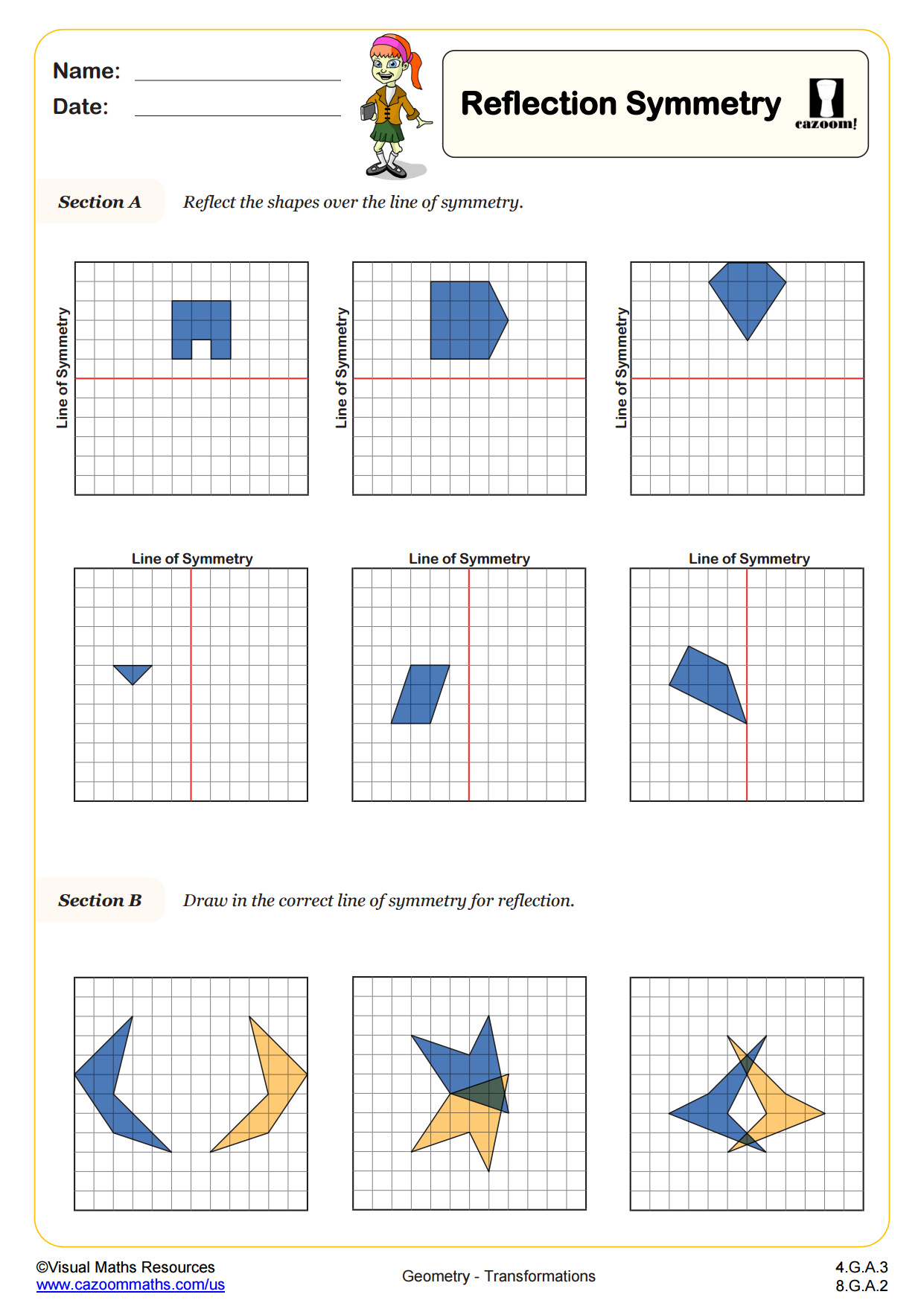
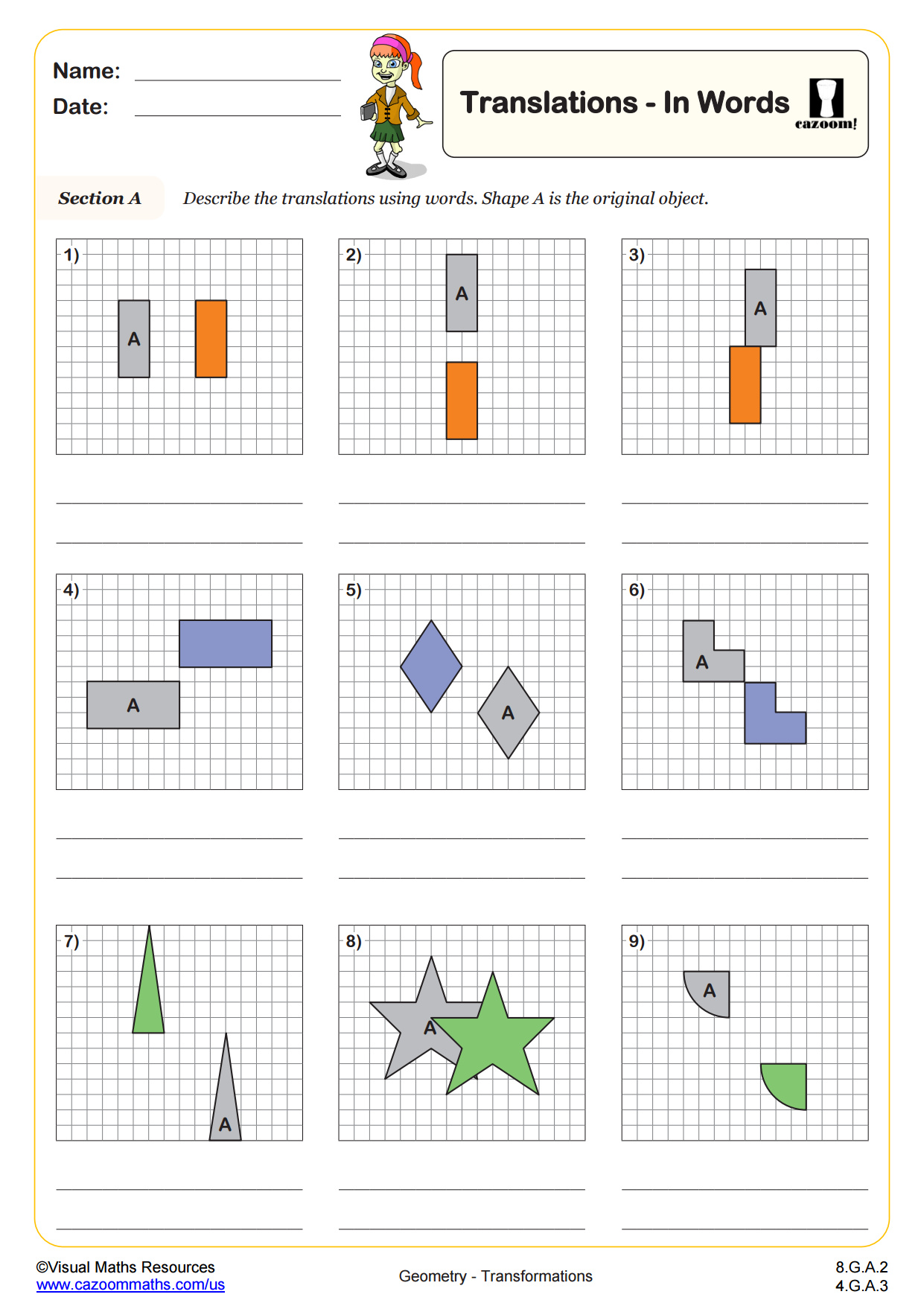
Transformations in 4th grade introduce students to three fundamental movements: translations (slides), reflections (flips), and rotations (turns). According to Common Core State Standards, fourth graders learn to identify and draw lines of symmetry, recognize congruent shapes, and understand how shapes change position without changing size or shape properties. This foundational work prepares students for coordinate plane transformations in middle school.
A common misconception is that a shape becomes "different" after transformation. Students often struggle with understanding that a triangle rotated 90 degrees is still congruent to the original, just in a new position. Teachers notice students lose points on assessments when they incorrectly identify transformed shapes as non-congruent simply because the orientation changed. Using grid paper helps students track corresponding vertices and verify that side lengths remain equal through transformations.
Which Grade Levels Cover Transformations Worksheets?
This collection addresses 4th grade elementary school standards, where students first encounter formal transformation vocabulary and systematic exploration of how shapes move. Fourth grade marks the transition from informal observation of symmetry to precise identification and creation of symmetric patterns, rotations, and understanding congruency relationships.
The worksheets progress from basic symmetry identification to more complex rotation challenges. Early activities focus on recognizing single lines of symmetry in familiar shapes, while advanced worksheets present rotation problems at various angles and multi-step transformations. Students build spatial reasoning skills gradually, moving from concrete examples with visual support to more abstract representations that require mental visualization of shape movements.
How Do Rotations Work in Transformation Geometry?
Rotation involves turning a shape around a fixed point, called the center of rotation, by a specific number of degrees. Fourth graders typically work with 90-degree, 180-degree, and 270-degree rotations, learning to visualize how shapes appear after clockwise or counterclockwise turns. Students practice identifying rotation angles and predicting final positions without always drawing every intermediate step.
Rotational transformations appear throughout STEM fields, from mechanical engineering where gears rotate to transfer motion, to computer graphics where programmers rotate objects on screen. Architecture relies heavily on rotational symmetry when designing structures like domes and circular buildings. Understanding rotation helps students recognize patterns in tire treads, fan blades, and propellers—everyday objects where repeated rotational patterns create functional designs that balance forces and distribute weight evenly around a central axis.
How Can Teachers Use These Transformation Worksheets Effectively?
The worksheets provide scaffolded practice starting with visual examples and progressing to independent problem-solving. Early problems include grid backgrounds and dotted guidelines that support students learning to count spaces accurately during translations or locate reflection lines. Answer keys allow students to self-check their work, particularly useful when identifying multiple lines of symmetry or verifying rotation accuracy.
Many teachers use these worksheets during math stations, pairing students to compare their transformed shapes and discuss strategies. The symmetry pattern worksheets work well as bell-ringers or quick formative assessments to gauge spatial reasoning development. Teachers frequently assign rotation worksheets for homework after hands-on classroom activities with manipulatives, reinforcing the connection between physical shape movement and paper representations. The variety of subtopics allows targeted intervention for students who grasp reflection but struggle with rotation, or vice versa.