5th Grade 2D Shapes Worksheets
All worksheets are created by the team of experienced teachers at Cazoom Math.
What makes triangles and quadrilaterals class 5 worksheet with answers pdf effective for teaching geometry?
A triangles and quadrilaterals class 5 worksheet with answers pdf provides structured practice aligned with Common Core standards 5.G.3 and 5.G.4, focusing on classifying shapes by their properties. The PDF format ensures consistent formatting across devices while answer keys allow teachers to provide immediate feedback during guided practice.
Teachers report that students often confuse scalene and isosceles triangles when working with angle measurements. Effective worksheets include visual cues and step-by-step classification processes that help students systematically examine side lengths and angle measures before making determinations about triangle types.
How do grade 5 2d shapes worksheets differ from earlier elementary geometry work?
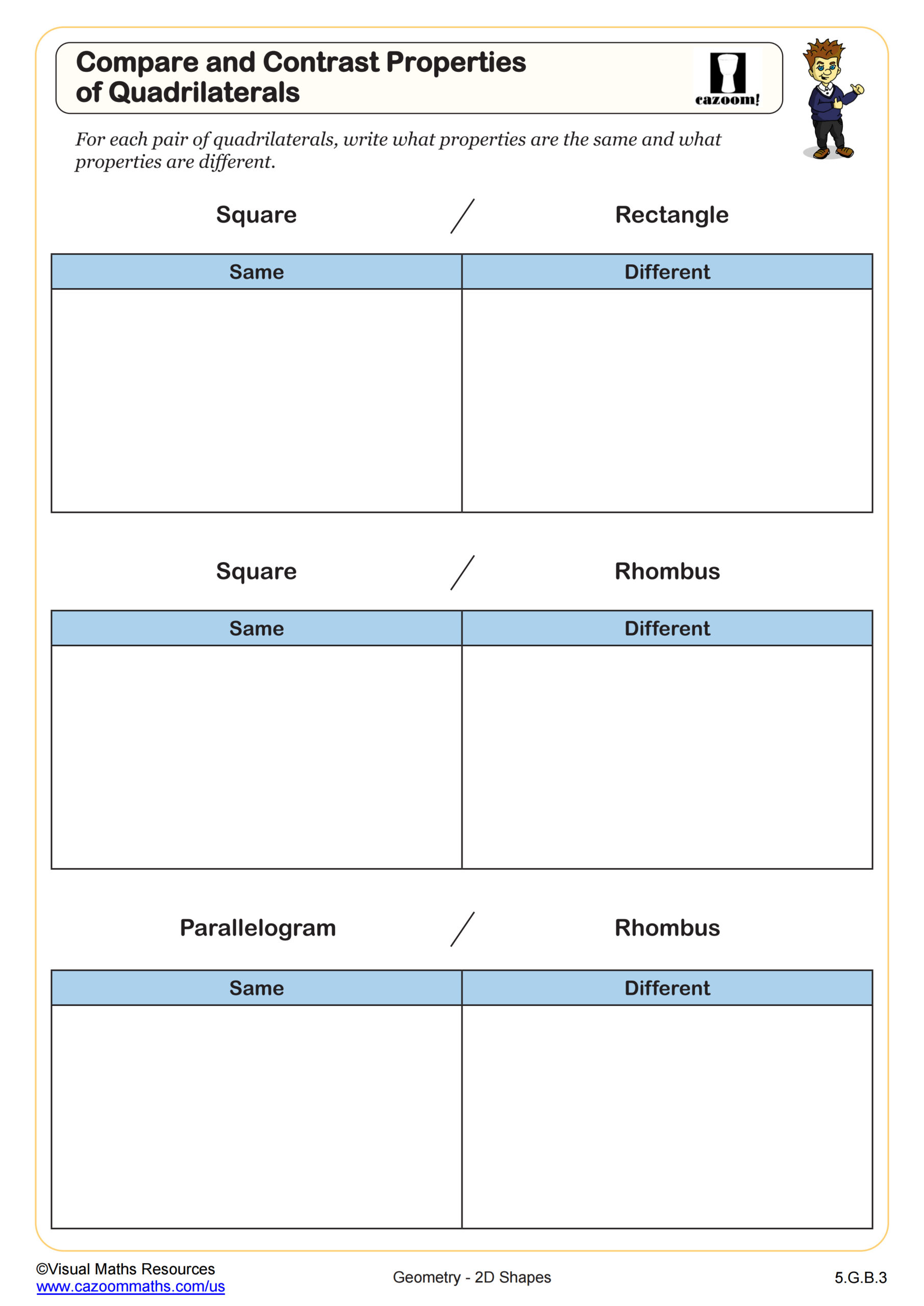
Grade 5 2d shapes worksheets introduce formal classification systems and hierarchy concepts that weren't emphasized in earlier grades. Students move beyond simple identification to analyzing relationships between shape categories, understanding that parallelograms include rectangles, rhombi, and squares as special cases.
This progression challenges students who previously memorized shape names without understanding underlying properties. Teachers notice that students need explicit instruction in using attributes like parallel sides, equal angles, and congruent sides to make logical classifications rather than relying on visual appearance alone.
Why do students struggle with the hierarchy of shapes 5th grade worksheets address?
The hierarchy of shapes 5th grade worksheets tackle represents a significant conceptual leap from concrete to abstract thinking. Students must understand that shapes can belong to multiple categories simultaneously, such as a square being both a rectangle and a rhombus, which contradicts their earlier black-and-white categorization approach.
Teachers observe that students frequently create mutually exclusive categories, insisting that squares cannot be rectangles because they "look different." Effective practice requires students to use attribute lists and Venn diagrams to visualize how shape categories overlap and nest within each other.
How can teachers maximize learning from shape grade 5 worksheet activities?
Teachers find success by incorporating manipulatives alongside shape grade 5 worksheet practice, allowing students to physically sort and compare geometric figures before completing paper exercises. This hands-on approach helps students internalize property relationships and builds confidence with abstract classification tasks.
The most effective implementation involves having students explain their reasoning aloud during worksheet completion. When students articulate why a rhombus belongs in the parallelogram family, they strengthen their understanding of geometric relationships that will support success in middle school coordinate geometry and proof writing.