5th Grade Measurement Worksheets
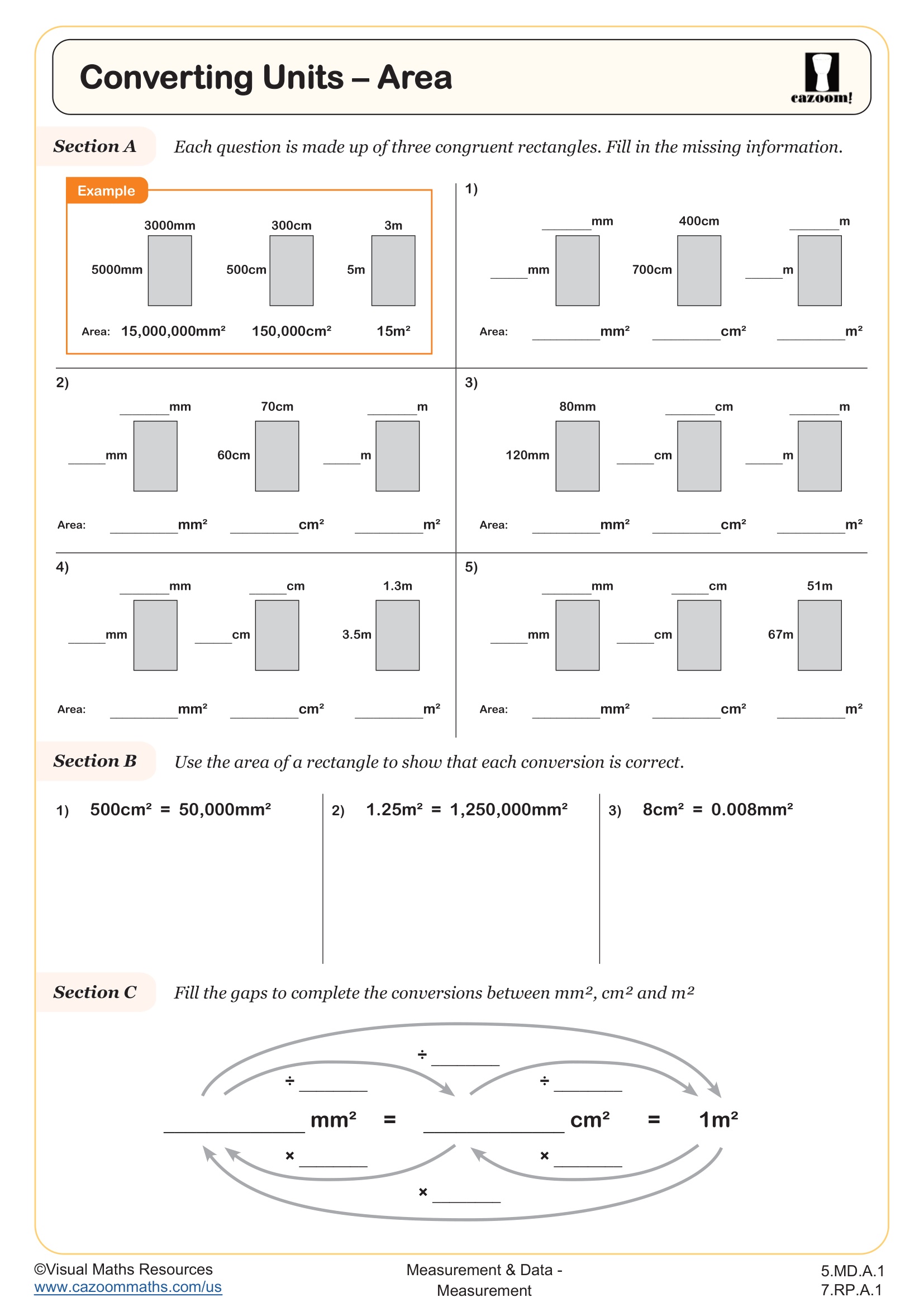
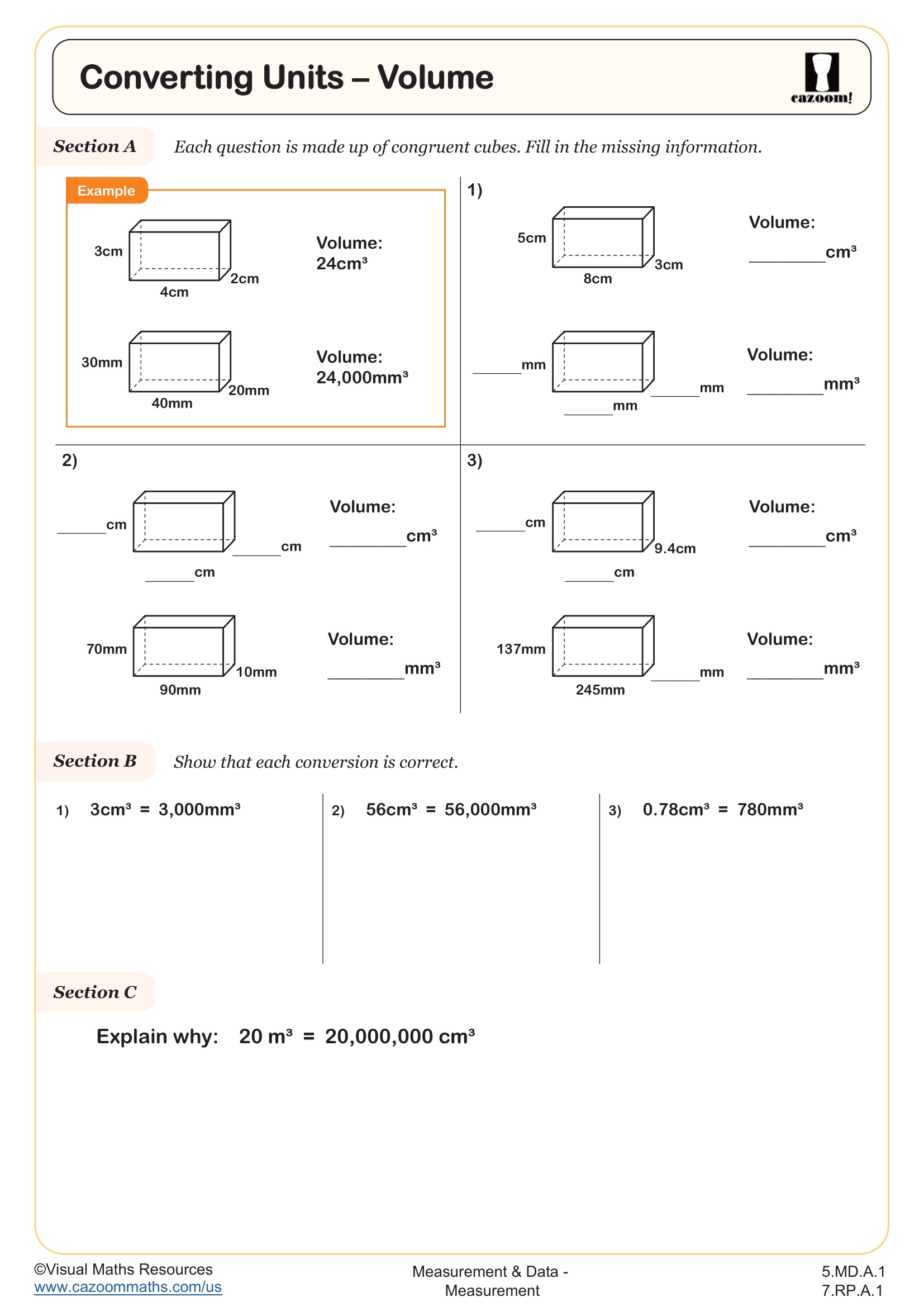
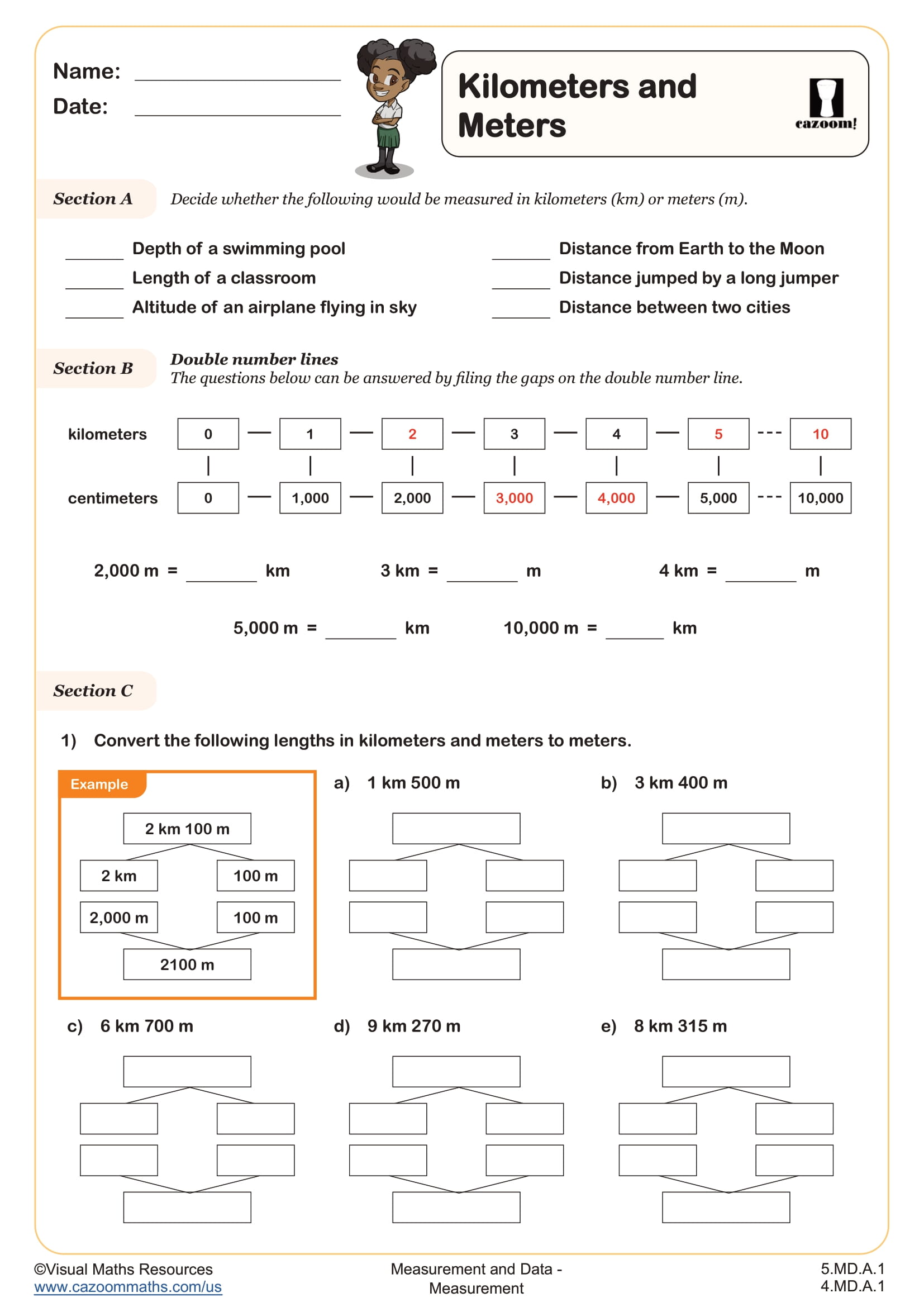
All worksheets are created by the team of experienced teachers at Cazoom Math.
What Measurement Skills Do Fifth Graders Need to Master?
Fifth grade measurement focuses on angle concepts, unit conversions within the imperial system, and developing estimation skills that support problem-solving. Students work with protractors to measure and draw angles, calculate missing angle measures using properties of straight lines and triangles, and select appropriate units when measuring length, weight, and capacity in real-world contexts.
Teachers often notice that students lose points on assessments when they estimate angle sizes without considering benchmark angles like 45°, 90°, and 180°. A common error involves choosing incorrect units, such as measuring a person's height in inches when feet would be more practical, or describing liquid capacity in ounces when gallons make more sense. Worksheets that require students to justify their unit choices help reinforce this critical thinking skill.
What Grade Level Uses These Measurement Worksheets?
These measurement worksheets target fifth grade students in elementary school, aligning with Common Core standards that emphasize angle measurement and unit conversions. At this stage, students transition from basic measurement concepts learned in earlier grades to more sophisticated applications involving protractor use and geometric reasoning.
The difficulty progression within fifth grade measurement moves from concrete tasks like comparing weights and estimating angles to abstract calculations involving unknown angle measures. Students start by building visual intuition about angle size, then learn precise measurement techniques with protractors, and finally apply angle relationships to solve problems. This scaffolded approach ensures students develop both procedural fluency and conceptual understanding before moving to middle school geometry.
How Do Students Calculate Unknown Angles?
Calculating unknown angles requires students to apply geometric relationships, particularly that angles on a straight line sum to 180° and angles in a triangle total 180°. Students use given angle measures and these properties to set up equations, then solve for missing values. This skill bridges measurement and algebraic thinking, preparing students for formal geometry in later grades.
Architects and engineers constantly calculate angles when designing structures, from determining roof pitches to ensuring wheelchair ramps meet accessibility codes. Construction workers use angle calculations to cut materials at precise angles for framing and trim work. When students recognize that calculating angles isn't just a math exercise but a skill used daily in STEM careers, they often show increased engagement and ask more thoughtful questions about practical applications.
How Can Teachers Use These Measurement Worksheets Effectively?
These worksheets provide structured practice with progressive difficulty levels, allowing teachers to match problems to individual student needs. Each worksheet focuses on a specific measurement skill, making it easy to assign targeted practice after initial instruction or to address gaps revealed through formative assessment. The included answer keys enable students to self-check their work and identify errors immediately.
Many teachers use these worksheets during math stations, pairing students to measure and compare their answers, which builds both accuracy and mathematical discussion skills. They work well for homework when students need additional repetition with protractor techniques or unit selection. Teachers also find them valuable for intervention groups where students need focused practice on one aspect of measurement, such as distinguishing between the two scales on a protractor or remembering conversion relationships within the imperial system.