5th Grade Metric Measures Worksheets
All worksheets are created by the team of experienced teachers at Cazoom Math.
What Are the Most Common Mistakes Students Make with Metric Conversions?
Students often move the decimal point in the wrong direction when converting between metric units, particularly when converting from smaller units to larger ones. Many students correctly identify that converting 5,000 meters to kilometers requires dividing, but then divide by 10 instead of 1,000, arriving at 500 kilometers instead of 5 kilometers. This error stems from uncertainty about how many place values to move rather than confusion about the operation itself.
Another frequent error occurs when students mix up the metric prefixes and their values. Teachers notice that students lose points on assessments when they confuse milli- (one-thousandth) with centi- (one-hundredth), especially when working with less familiar measurements like centimeters versus millimeters. Creating a reference chart that shows the prefix meanings alongside powers of ten helps students visualize the relationships between units and reduces these errors during independent practice.
What Should 5th Grade Students Know About Metric Measures?
By 5th grade, students should convert metric measurements within a single system of measurement, such as converting 3.5 meters to 350 centimeters or 2,500 grams to 2.5 kilograms. The Common Core State Standards (5.MD.A.1) expect students to use place value understanding and properties of operations to perform these conversions. Students work with all three metric measurement categories—length (millimeters, centimeters, meters, kilometers), mass (grams, kilograms), and capacity (milliliters, liters)—and solve multi-step word problems involving these conversions.
This work builds directly on 4th grade experience with relative sizes of measurement units and prepares students for 6th grade ratio and proportion work. Students who develop strong metric conversion skills in elementary school find middle school science labs significantly easier, since most scientific measurements use the metric system exclusively. The decimal-based structure of metric units also reinforces understanding of place value operations with decimals, creating connections between measurement and number sense that support overall mathematical thinking.
How Does Dividing by Decimals Connect to Metric Conversions?
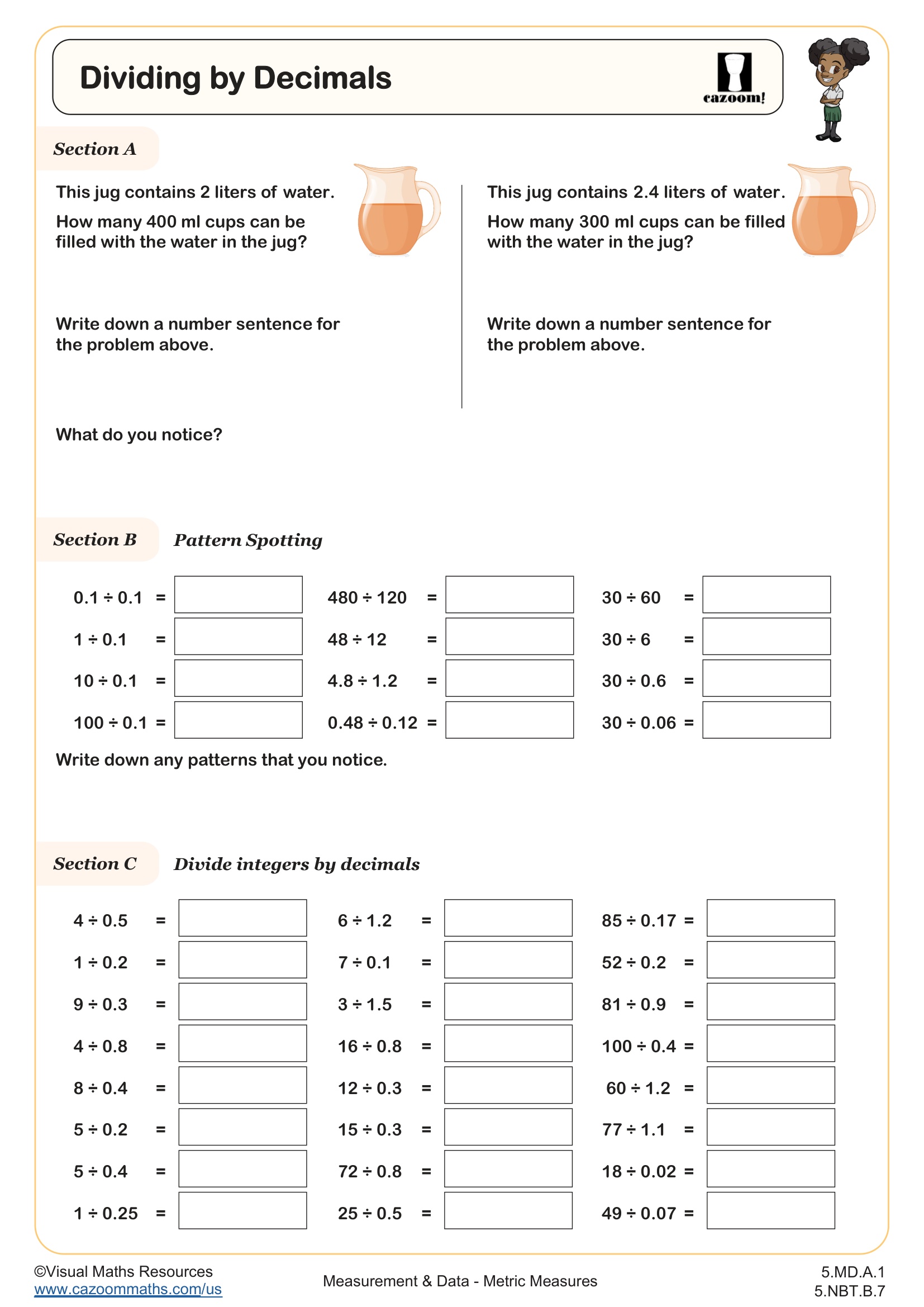
Dividing by decimals becomes necessary when students convert metric measurements that involve decimal values, such as finding how many 0.5-liter bottles can be filled from 3.75 liters of juice. Students use their understanding of decimal division to solve 3.75 ÷ 0.5, which requires either converting the divisor to a whole number or recognizing that dividing by 0.5 is the same as multiplying by 2. Teachers notice that students confidently tackle these problems once they recognize the pattern that dividing by a decimal less than one produces a quotient larger than the dividend.
This skill has direct applications in scientific research and engineering, where precise measurements are critical. Pharmaceutical researchers divide medication volumes by decimal dosages to calculate proper administration amounts, and environmental scientists divide water samples by decimal concentration levels to determine pollutant presence. Understanding decimal division within metric contexts prepares students for STEM careers where accuracy in measurement calculations can have significant real-world consequences, from medical dosing to construction specifications.
How Can Teachers Use These Worksheets Most Effectively?
The worksheets provide structured practice that moves students from basic conversions to more complex multi-step problems involving decimal operations. Teachers can use the problems to assess whether students understand both the conceptual reasoning behind metric conversions and the procedural skills needed to execute them accurately. The answer keys allow students to check their own work during independent practice, helping them identify error patterns before those mistakes become habitual.
Many teachers use these worksheets during math workshop rotations, pairing students who struggle with metric conversions alongside peers who can explain their thinking process. The worksheets also work well as pre-assessment tools before introducing measurement word problems or as targeted review before state assessments. Some teachers assign specific problems for homework after introducing new conversion relationships in class, then use student responses to guide the next day's instruction based on common errors observed across the class.