5th Grade PEMDAS Worksheets
All worksheets are created by the team of experienced teachers at Cazoom Math.
What makes effective PEMDAS worksheets 5th grade?
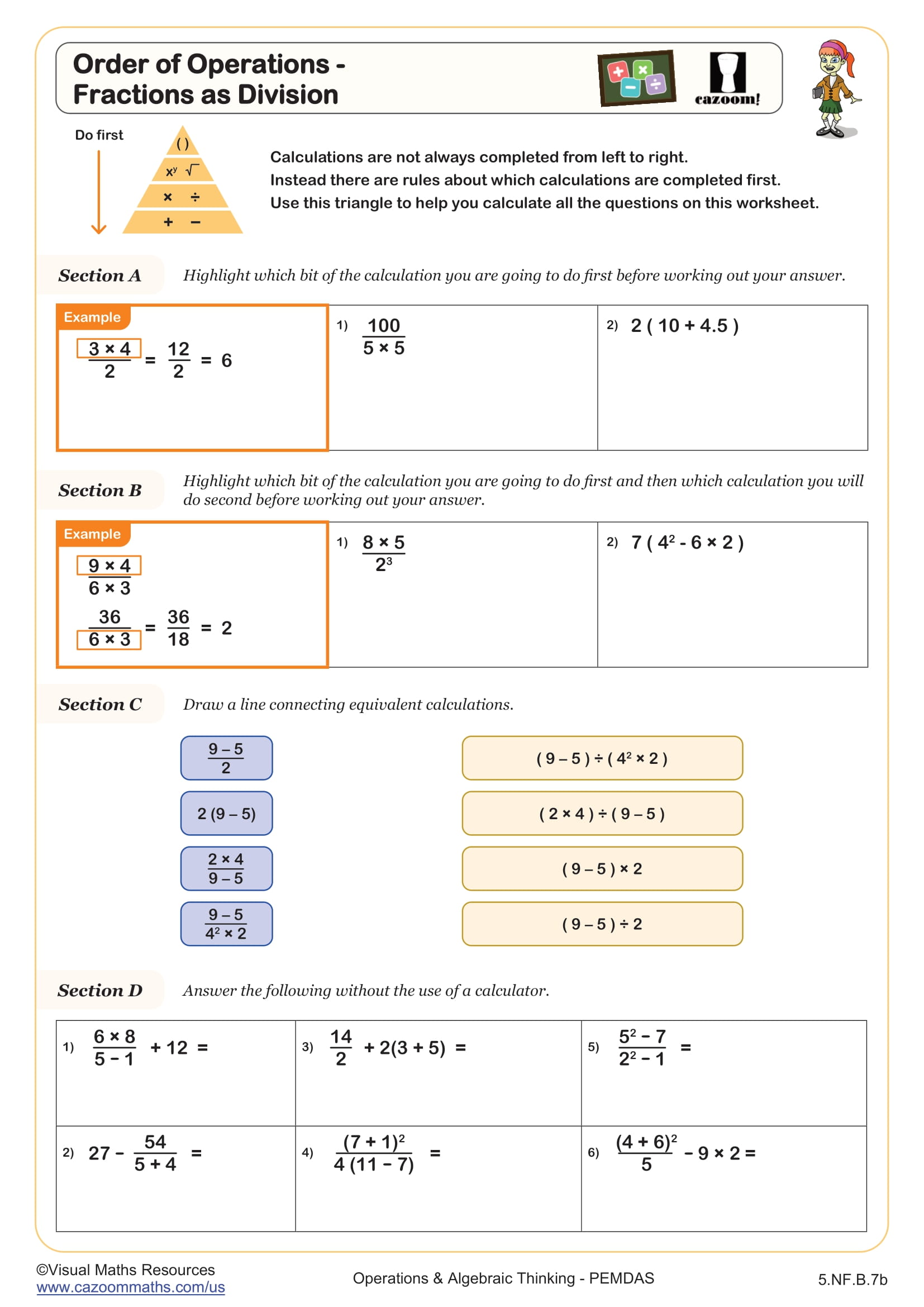
Effective pemdas worksheets 5th grade align with Common Core Standard 5.OA.A.1, which requires students to use parentheses, brackets, or braces in numerical expressions and evaluate expressions with these symbols. Quality worksheets progress from simple two-step problems to more complex multi-step expressions that include all PEMDAS components.
Teachers report that students frequently make errors when expressions contain both multiplication and division or both addition and subtraction, forgetting to work left to right within equal priority operations. The most successful worksheets include plenty of practice with these specific combinations alongside clear visual reminders of the order of operations.
How do PEMDAS skills progress from 4th to 6th grade?
Fourth graders typically work with basic two-step expressions using parentheses and simple operations, while 5th grade pemdas worksheets introduce exponents and more complex nested parentheses. Sixth graders extend these skills to algebraic expressions and rational numbers, making fifth grade a critical bridge year for order of operations mastery.
Many teachers observe that students who struggle with PEMDAS in fifth grade often lack fluency with basic multiplication and division facts. When computational skills are shaky, the cognitive load of remembering operation order becomes overwhelming, leading to frequent errors in middle school math courses.
Why do students struggle with exponents in PEMDAS problems?
Fifth graders often confuse exponents with multiplication, writing 2³ as 2 × 3 instead of 2 × 2 × 2. This misconception creates significant errors in PEMDAS calculations since exponents must be evaluated before multiplication and division. Students need explicit instruction that exponents represent repeated multiplication of the base number.
Classroom experience shows that using concrete examples helps students understand exponential notation. When teachers connect exponents to real-world contexts like calculating area of squares or volume of cubes, students develop stronger conceptual understanding that supports accurate PEMDAS application in complex expressions.
How should teachers introduce PEMDAS worksheet practice?
Teachers find success by starting with expressions that use only two operations before progressing to full PEMDAS problems. Students benefit from working through several examples as a class, verbalizing each step of the process before attempting independent pemdas worksheet grade 5 practice. Color-coding different operation types initially helps students visualize the sequence.
Many educators recommend having students write out each step of their work rather than trying to calculate mentally. This approach reveals misconceptions early and helps students develop systematic problem-solving habits that transfer to more advanced mathematics. Regular practice with varied problem types builds the automaticity students need for success.