5th Grade Proportion Worksheets
All worksheets are created by the team of experienced teachers at Cazoom Math.
What Are Proportions and Why Do 5th Graders Learn Them?
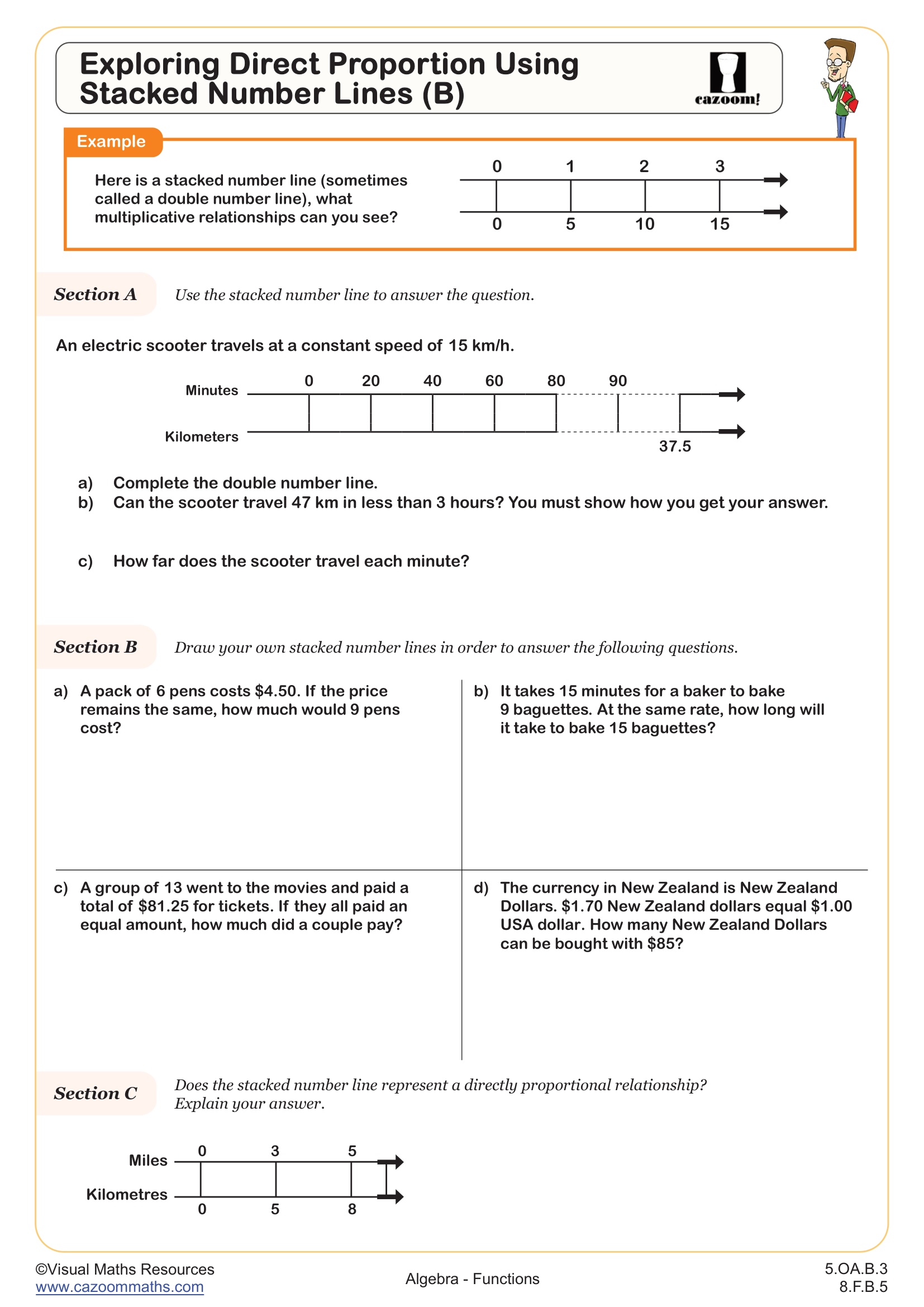
Proportions describe the multiplicative relationship between two quantities that increase or decrease at the same rate. In 5th grade, students encounter proportional relationships through real-world scenarios like recipe scaling, unit pricing, and measurement conversions. The Common Core State Standards introduce proportional reasoning at this level to prepare students for formal ratio work in 6th grade.
Students frequently make the error of treating proportional situations as additive problems. For example, when doubling a recipe that calls for 3 cups of flour and 2 eggs, many students incorrectly calculate 5 cups of flour and 4 eggs by adding 2 to each quantity. Teachers notice that using stacked number lines helps students visualize how both quantities multiply by the same factor, creating those crucial "aha" moments when students recognize the pattern.
What Should 5th Grade Students Know About Proportion?
By the end of 5th grade, students should recognize when two quantities are in direct proportion and use visual models to solve simple proportion problems. They should understand that in proportional relationships, if one quantity doubles, the other doubles too. Students at this level aren't expected to use cross-multiplication or formal proportion equations—those skills develop in 6th and 7th grades—but they should reason through proportion situations using multiplication and division.
This work builds directly on 4th grade multiplication and division fluency, particularly with multi-digit numbers. Students who confidently multiply and divide whole numbers transition more smoothly to proportional thinking. The proportion concepts learned in 5th grade create the foundation for 6th grade ratios, 7th grade proportional relationships in the coordinate plane, and 8th grade linear functions. Many teachers find that solid proportion understanding in elementary school prevents ratio struggles later.
How Do Stacked Number Lines Help Students Understand Proportion?
Stacked number lines place two parallel number lines above each other, showing how quantities in a proportional relationship correspond. Students can see that when one quantity reaches a certain point, the other quantity reaches a predictable corresponding point. This visual model makes the multiplicative relationship concrete before students work with abstract numbers alone. Teachers notice that stacked number lines particularly help visual learners grasp why proportion problems can't be solved by simple addition.
Proportional reasoning appears constantly in STEM fields and everyday life. Engineers use proportions when scaling blueprints, chemists work with proportional ingredient mixtures, and nutritionists calculate serving sizes based on proportional relationships. Students encounter proportion when converting measurement units in science class, calculating speeds in different units, or determining how much paint covers a wall area. Understanding that relationships can be multiplicative rather than additive changes how students approach problem-solving across subjects.
How Can Teachers Use These Proportion Worksheets Effectively?
These worksheets use stacked number lines to scaffold proportion understanding, allowing students to visualize the relationship before calculating. The visual approach helps students identify the constant factor connecting the quantities, which many students miss when working with numbers alone. Complete answer keys let teachers quickly identify whether students are applying multiplicative thinking or reverting to additive strategies, making targeted intervention more efficient.
Many teachers use these worksheets during guided math groups to support students who need extra practice with proportional relationships. The visual nature makes them particularly effective for intervention with students who haven't yet developed strong proportional reasoning. Teachers also assign them as independent practice after introducing proportion concepts, or as homework with the answer key provided to families. Some teachers find success with paired work, where one student explains their reasoning using the number line while their partner checks the logic.