5th Grade Reason with Shapes Worksheets
All worksheets are created by the team of experienced teachers at Cazoom Math.
What Does Reasoning with Shapes Mean in Fifth Grade Math?
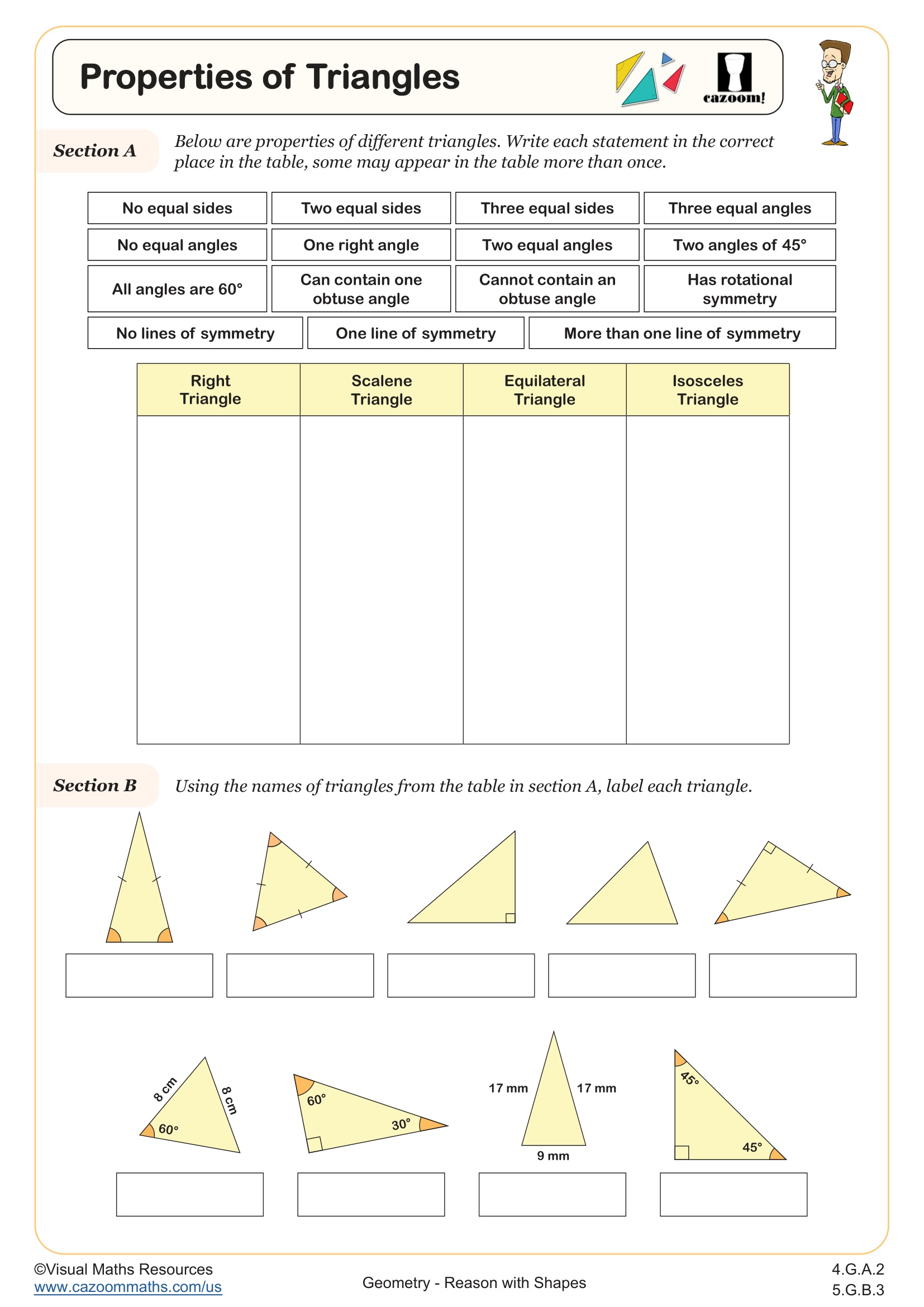
Reasoning with shapes involves analyzing geometric figures by their attributes rather than just recognizing them visually. Fifth graders move beyond naming shapes to justifying classifications using properties like angle measures, side lengths, parallel lines, and symmetry. This aligns with Common Core standards for geometry that emphasize understanding why a square is always a rectangle but a rectangle isn't always a square.
Students often lose points on assessments when they identify a shape correctly but cannot explain their reasoning using mathematical vocabulary. Teachers notice this gap especially with triangle classification, where students might call a figure an "isosceles triangle" without referencing that two sides have equal length. The worksheets address this by requiring students to connect visual information with property-based reasoning, building the logical thinking skills needed for proofs in later grades.
Which Grade Levels Use These Geometry Reasoning Worksheets?
These worksheets target fifth grade students in elementary school, addressing the geometric reasoning standards introduced at this level. Fifth grade marks an important transition where students apply their understanding of shape properties to solve problems and make mathematical arguments about why classifications are correct.
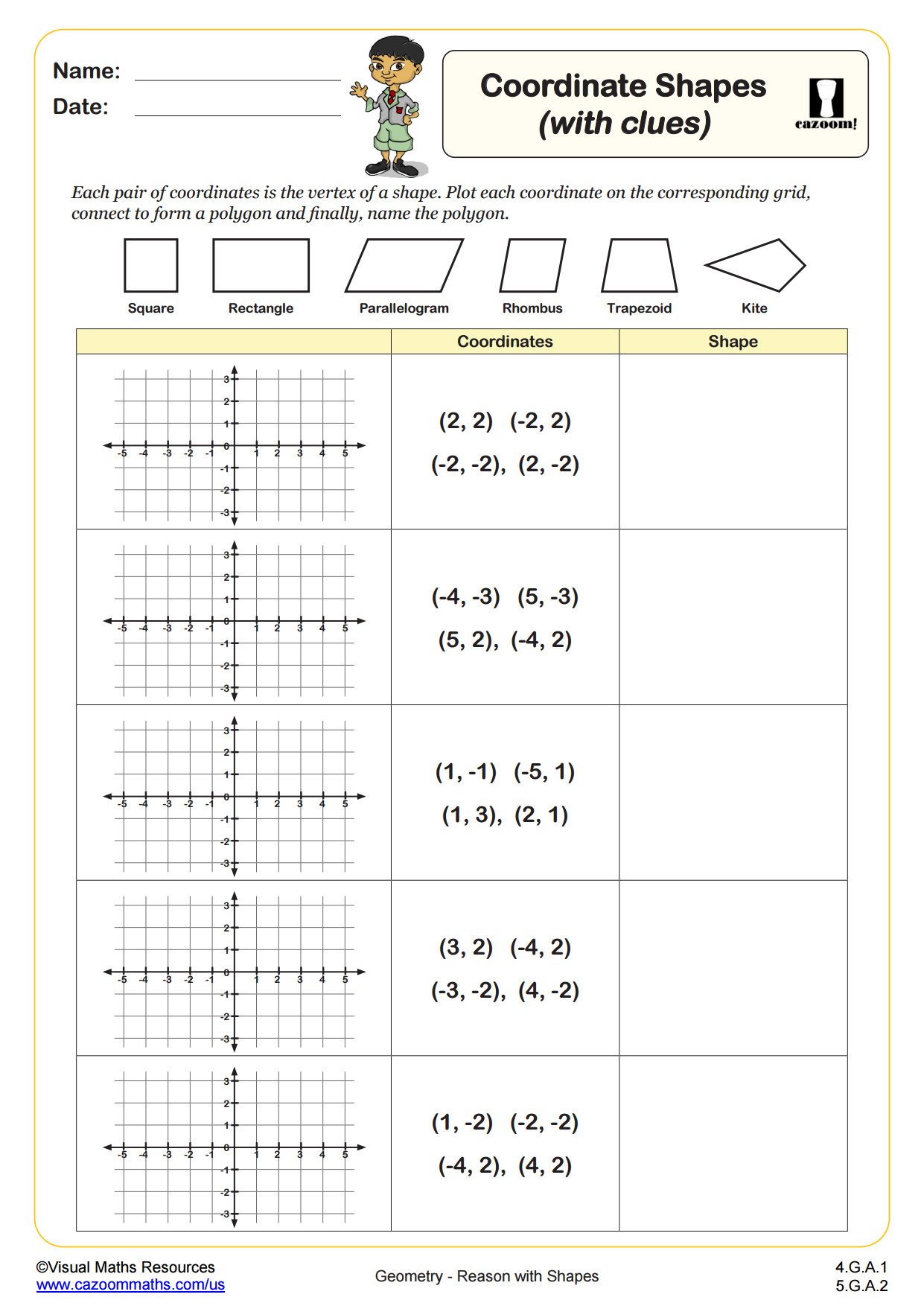
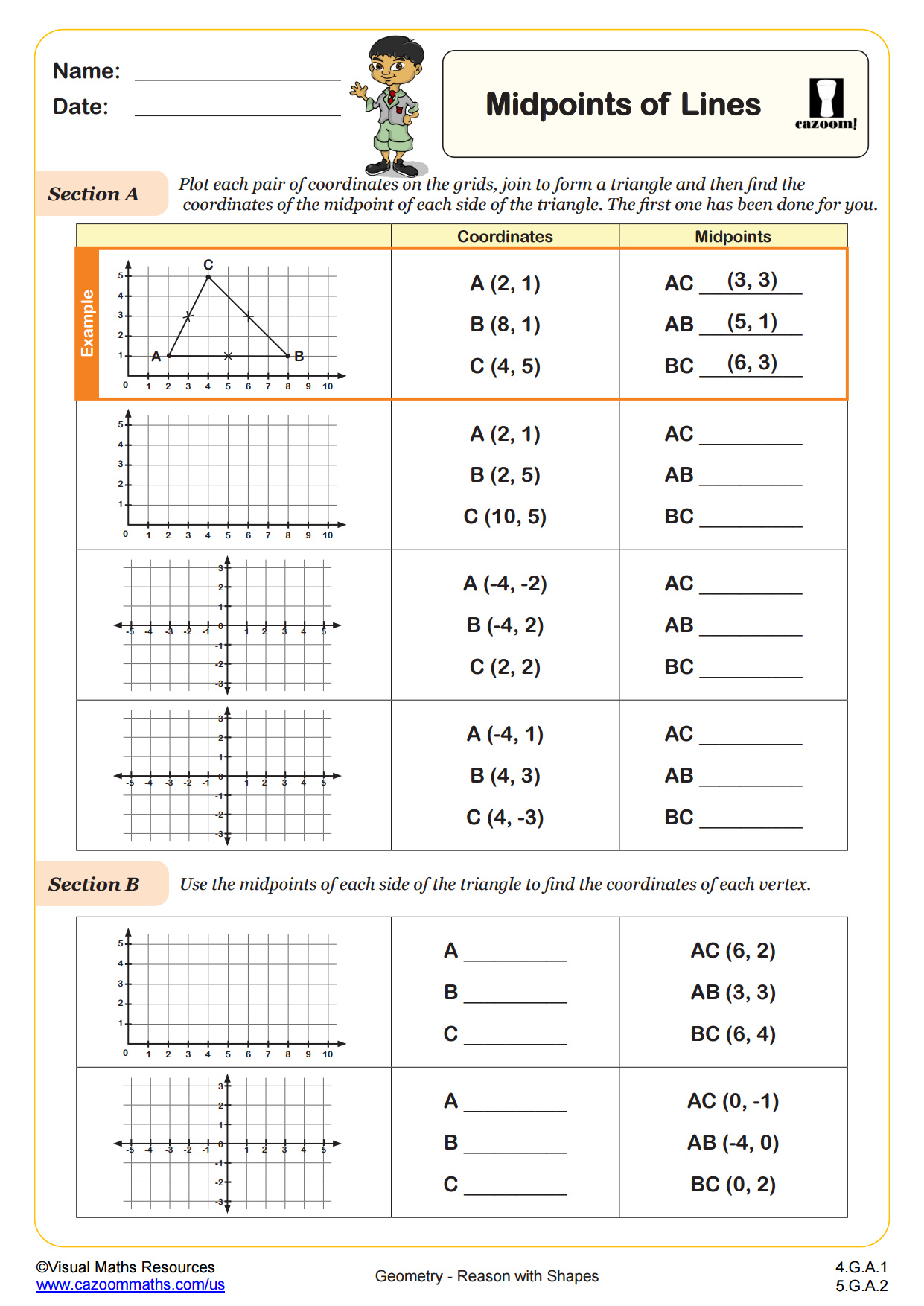
The collection progresses in complexity, starting with identifying basic fractional parts of shapes and advancing to coordinate plane work where students must use multiple clues to determine vertices. Teachers find that students who struggle with coordinate shapes often need to revisit plotting ordered pairs first. The midpoint exercises build toward understanding of bisectors and measurement concepts that appear in middle school geometry, making these worksheets valuable preparation for sixth grade mathematical thinking.
How Do Students Find Midpoints of Line Segments?
Finding midpoints requires students to identify the exact center point of a line segment, which can be done by measurement or calculation. On a coordinate grid, students find the midpoint by averaging the x-coordinates and averaging the y-coordinates of the endpoints. For example, the midpoint between (2, 4) and (8, 10) is ((2+8)/2, (4+10)/2) = (5, 7). Without coordinates, students measure the total length and divide by two.
This skill connects directly to architecture and engineering, where midpoints help determine balance points and structural centers. Urban planners use midpoint concepts when designing roads that connect two locations efficiently. In computer graphics and game design, midpoints help create smooth curves and position objects precisely between other elements on screen. Students who master midpoint reasoning develop spatial sense that transfers to CAD software and technical drawing applications they may encounter in STEM coursework.
How Can Teachers Use These Reasoning Worksheets in Class?
The worksheets build reasoning skills through structured practice that moves from concrete shape identification to abstract property analysis. Each problem type includes examples that help students understand what mathematical justification looks like, scaffolding them toward independent geometric reasoning. The coordinate shapes with clues work particularly well for developing logical thinking since students must combine multiple pieces of information to solve each problem.
Many teachers use these worksheets during small group instruction to target students who need additional support with geometric vocabulary and property identification. The answer keys make them practical for independent work stations or homework assignments where students can check their understanding. Teachers also find them valuable for intervention before state assessments, since the mix of coordinate work, fractional reasoning, and property identification mirrors the multi-step geometry problems that appear on standardized tests.