5th Grade Substitution Worksheets
All worksheets are created by the team of experienced teachers at Cazoom Math.
What Is Substitution in 5th Grade Math?
Substitution in 5th grade math means replacing a variable (usually a letter like x, y, or n) with a given number, then calculating the result. Students work with simple algebraic expressions such as n + 7 or 4x, finding the value when n = 5 or x = 3. This directly supports Common Core standard 5.OA.A.2, which asks students to write and interpret numerical expressions.
Many teachers notice students initially want to skip the substitution step and jump straight to an answer. A common error occurs when students see 2n where n = 6 and write 26 instead of calculating 2 × 6 = 12. Emphasizing that the variable truly becomes the number, creating an expression like 2(6), helps students understand that substitution transforms the abstract into concrete arithmetic they already know.
What Should 5th Graders Know About Substitution?
By the end of 5th grade, students should comfortably substitute single values into one-variable expressions and evaluate them using order of operations. They should recognize that expressions like 3x + 2 require multiplication before addition, applying PEMDAS consistently after substitution. Fifth graders typically work with whole numbers and simple operations, building fluency before encountering more complex algebraic thinking.
This skill builds directly on 4th grade work with factors, multiples, and patterns, where students saw relationships between numbers without formal variables. Substitution prepares students for 6th grade, when they'll solve equations by determining which value makes an equation true. Students who master substitution in 5th grade transition more smoothly to evaluating expressions with multiple variables and working with formulas in middle school science and math courses.
How Does Substitution Connect to Real-World Problem Solving?
Substitution teaches students that formulas and expressions are practical tools for solving real problems. When students substitute values, they're using the same process engineers use with formulas like distance = rate × time or scientists use with temperature conversion formulas. Understanding that variables represent changeable quantities helps students see math as flexible rather than fixed, a critical mindset for STEM fields.
In everyday contexts, substitution appears when calculating costs (if each ticket costs $12, then 5 tickets cost 5 × 12), determining measurements (if each side of a square is s inches, the perimeter is 4s), or following recipes (if one batch needs 2 cups of flour, then n batches need 2n cups). These connections help students recognize that the abstract notation they're learning represents concrete situations they encounter regularly, making algebraic thinking feel accessible and purposeful.
How Can Teachers Use These Substitution Worksheets Effectively?
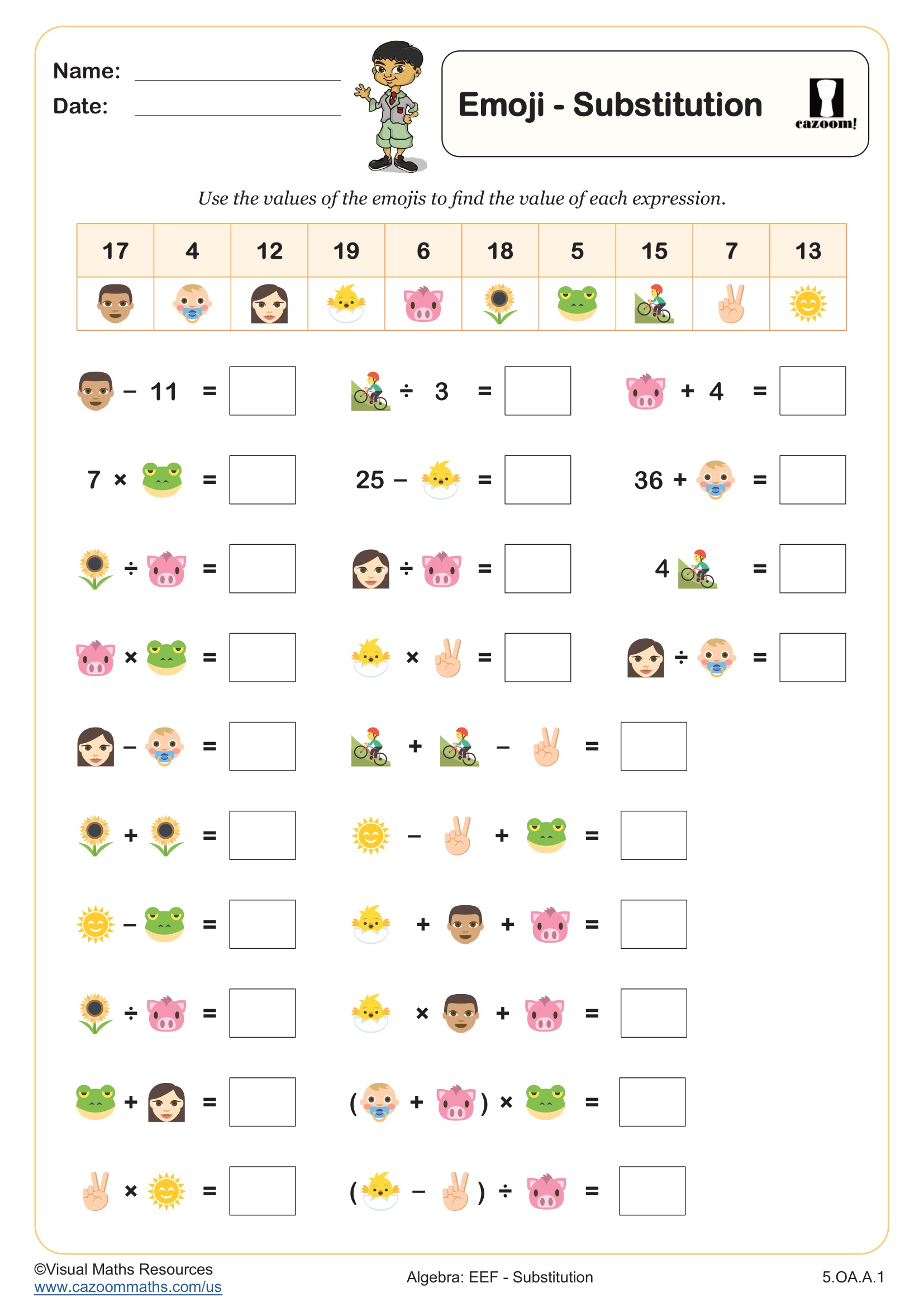
These substitution worksheets provide structured practice that moves students from basic variable replacement to evaluating more complex expressions. The emoji-themed format engages students while maintaining mathematical rigor, offering problems that require careful attention to both substitution and order of operations. The included answer keys allow teachers to quickly assess understanding and identify patterns in student errors, such as multiplication mistakes or order of operations confusion.
Teachers find these worksheets valuable for differentiated instruction, assigning them during independent work time while meeting with small groups, or using them as warm-up activities to reinforce previous lessons. They work well as homework when students need additional practice before assessments or as intervention tools for students who need to solidify variable concepts before moving to equation solving. Paired work often helps, as students catch each other's substitution errors and discuss the correct calculation sequence together.