6th Grade 2D Shapes Worksheets
All worksheets are created by the team of experienced teachers at Cazoom Math.
What 2D shapes concepts should 6th graders focus on?
Sixth graders move beyond basic shape identification to work with composite figures, coordinate plane graphing of polygons, and understanding relationships between different shape properties. Students should calculate area and perimeter of triangles, quadrilaterals, and other polygons, and begin exploring how changing dimensions affects these measurements proportionally.
A common error occurs when students apply the wrong formula to composite shapes, treating an L-shaped figure as a single rectangle rather than breaking it into component parts. Teachers often observe that students who sketch and label each section before calculating consistently achieve higher accuracy on assessment questions involving irregular polygons.
How do 6th grade 2D shapes standards build on earlier learning?
By sixth grade, students apply the foundational shape recognition and basic area formulas from elementary school to more complex problems. They work with fractional and decimal dimensions, solve multi-step problems involving multiple shapes, and connect geometric concepts to algebraic thinking through formulas and variables.
This grade level bridges concrete geometry and the abstract reasoning required in high school. Students who master decomposing composite figures and working flexibly with formulas in sixth grade find pre-algebra and geometry courses significantly more manageable. State assessments typically include multi-step problems where students must identify which formulas apply before performing calculations.
Why is understanding polygon properties important for middle schoolers?
Classifying polygons by properties like parallel sides, angle measures, and symmetry develops logical reasoning and prepares students for formal geometric proofs in high school. Sixth graders learn to identify quadrilaterals using multiple attributes simultaneously—recognizing that a square is also a rectangle, rhombus, and parallelogram based on shared properties.
Architects and engineers rely on polygon properties when designing structures, from determining load-bearing angles in roof trusses to calculating material requirements for flooring. Computer graphics programmers use polygon meshes to create 3D models, where understanding how 2D shapes tessellate and transform is fundamental to animation and game design.
How can teachers use these 2D shapes worksheets effectively?
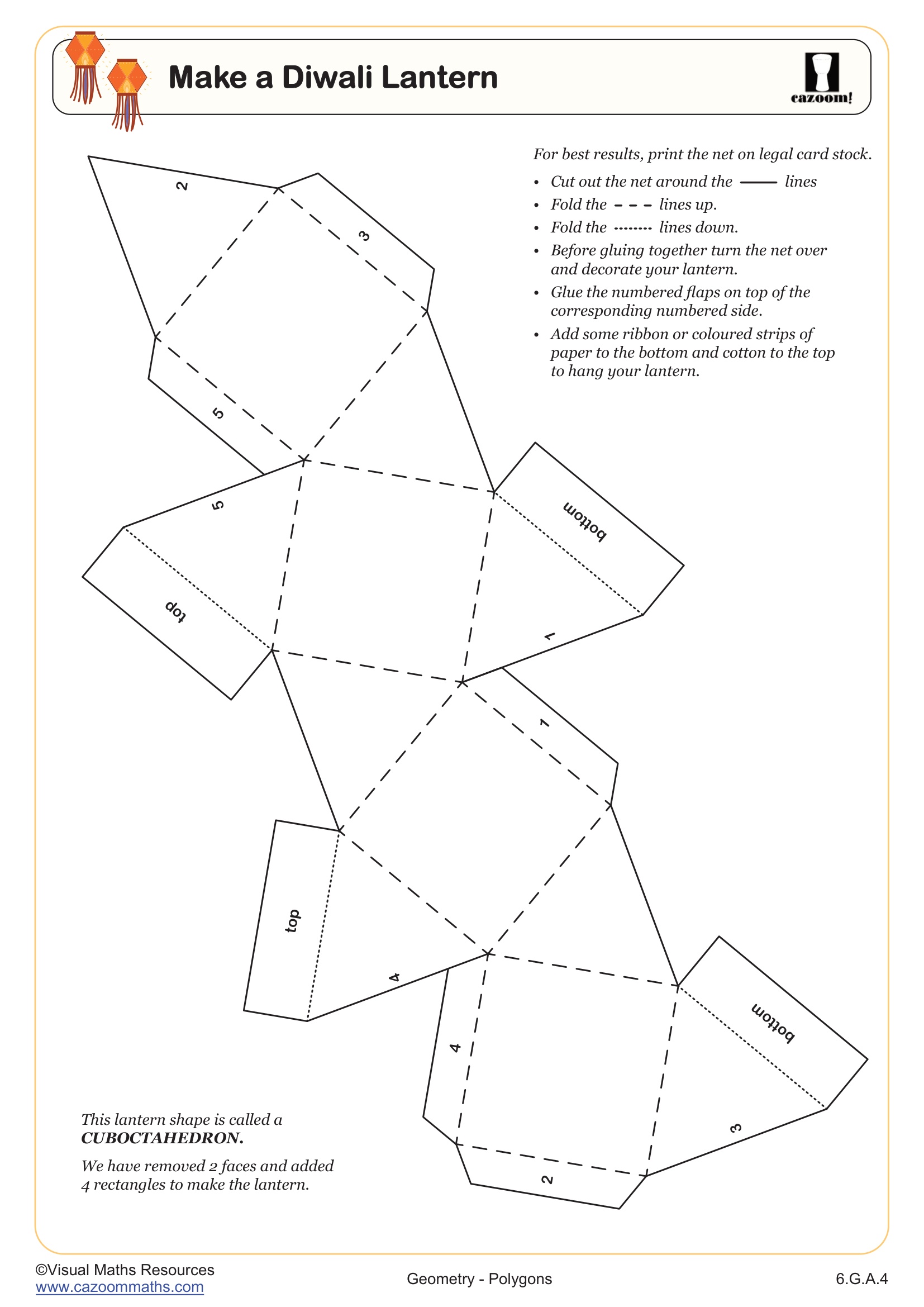
The worksheets provide structured practice that reinforces classroom instruction while offering hands-on applications like the Diwali lantern project, which requires students to apply measurement skills and shape properties to construct a three-dimensional object from two-dimensional patterns. This combination of calculation practice and physical construction helps students connect abstract formulas to tangible results.
Many teachers use these worksheets during small group intervention to identify specific gaps—whether students struggle with formula selection, calculation errors, or unit conversions. The answer keys allow for peer checking activities where students explain their reasoning to partners, strengthening both procedural fluency and conceptual understanding. The cultural connection through Diwali also creates opportunities for interdisciplinary lessons linking mathematics with social studies and art.