6th Grade PEMDAS Worksheets
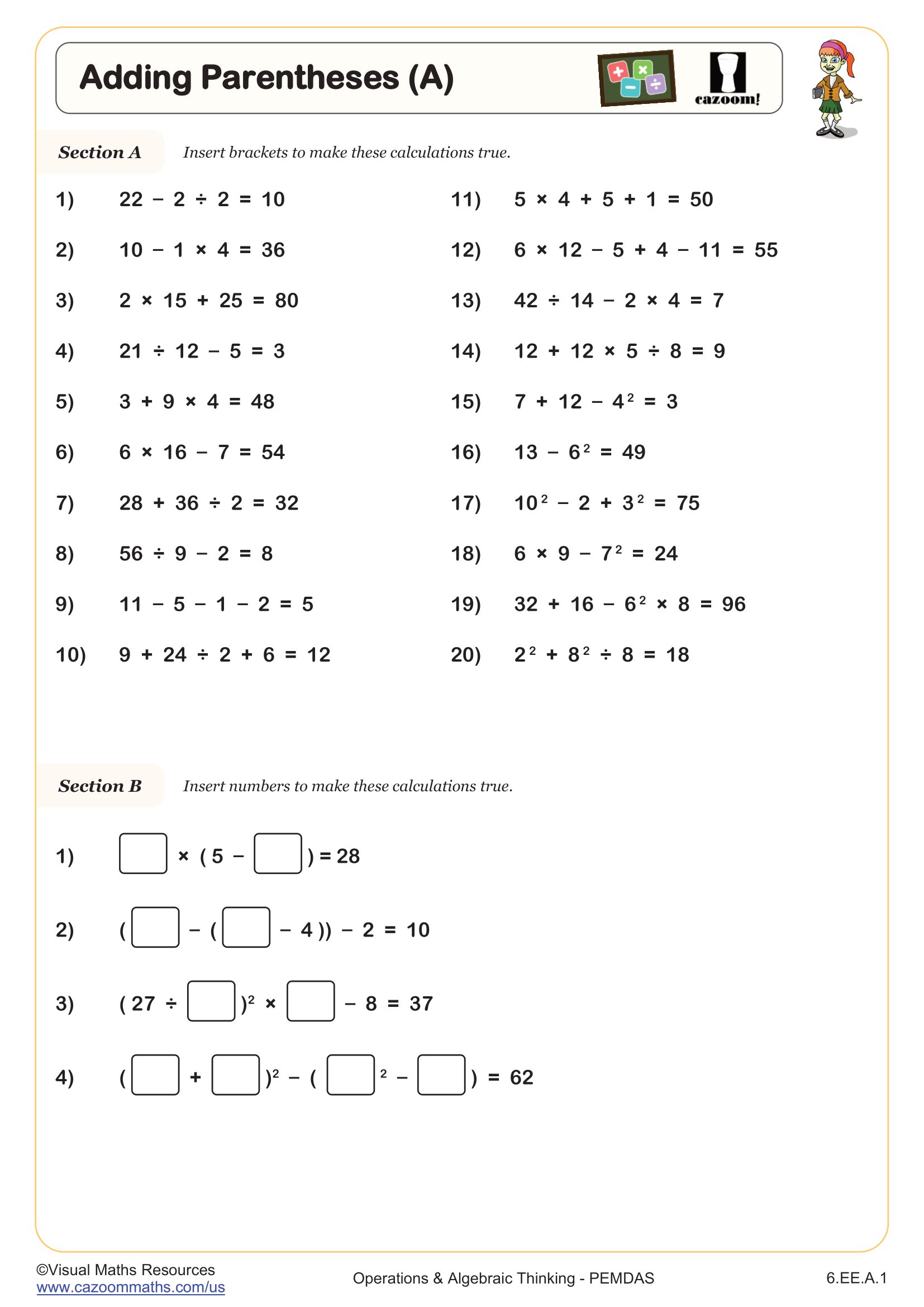
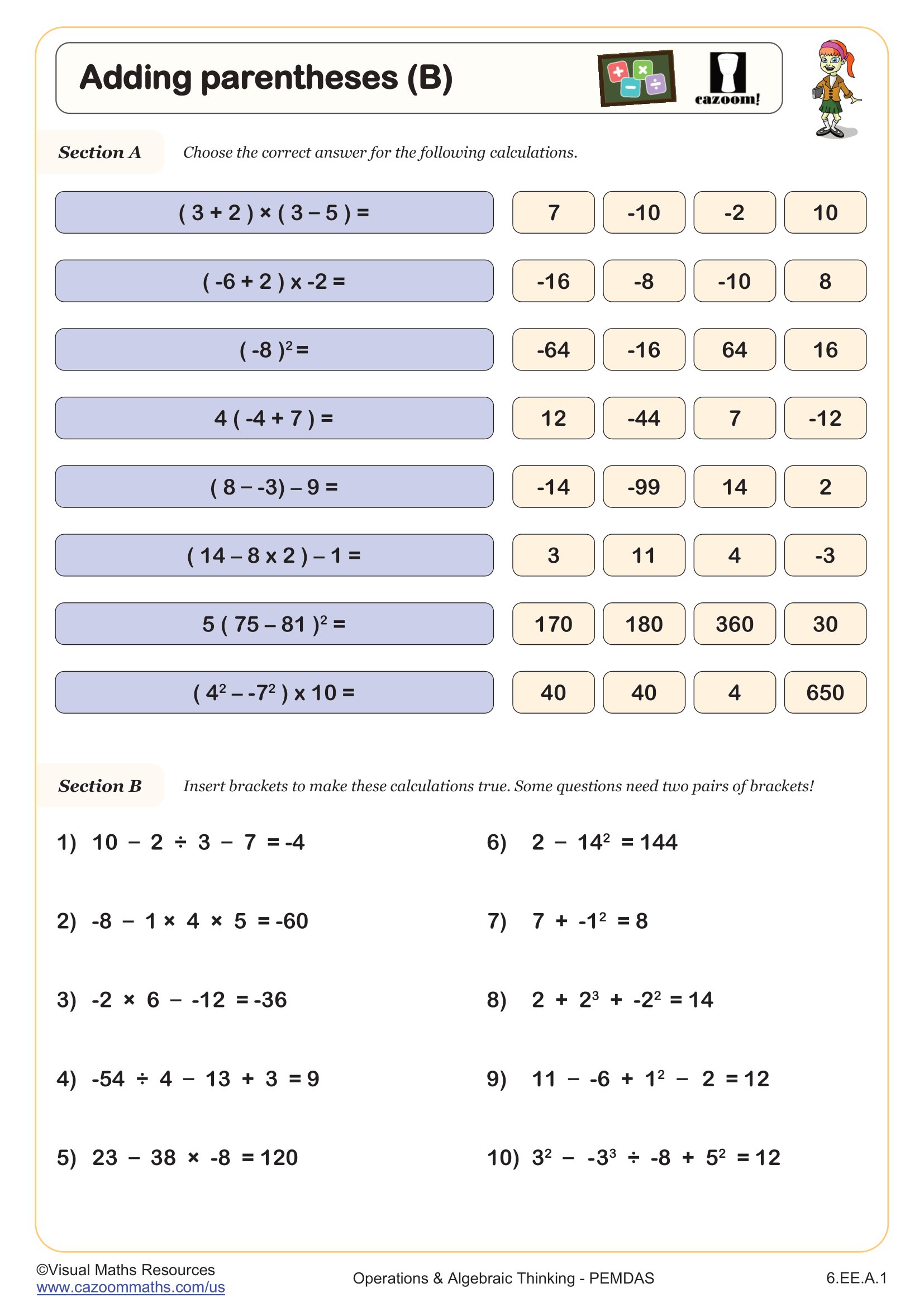
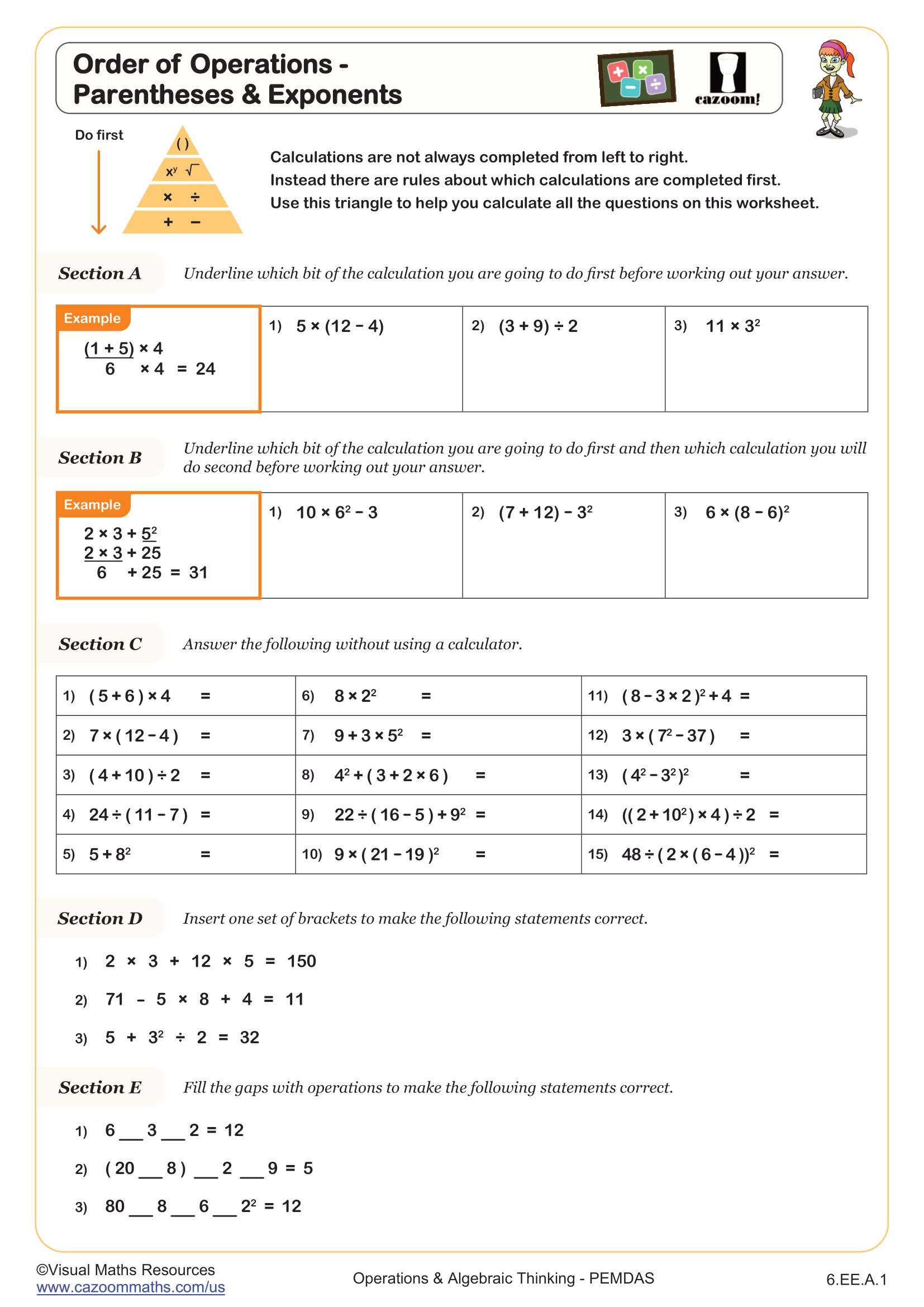
All worksheets are created by the team of experienced teachers at Cazoom Math.
What makes effective pemdas worksheets 6th grade appropriate?
Effective 6th grade pemdas problems align with Common Core Standard 6.EE.A.1, which requires students to evaluate numerical expressions involving whole numbers and the order of operations. The worksheets should include a mix of problems with and without grouping symbols, covering all six operations systematically.
Teachers find that students often memorize the acronym but forget to apply it correctly when faced with expressions like 3 + 4 × 2. A quality pemdas worksheet grade 6 will include problems that specifically address this misconception, helping students understand that multiplication comes before addition regardless of position in the expression.
Why is 6th grade the right time to focus intensively on PEMDAS?
Sixth grade represents a critical transition point where students move from arithmetic to algebraic thinking. At this level, students have typically mastered basic operations and are ready to tackle more complex expressions that require systematic problem-solving approaches. The 6th grade pemdas curriculum builds directly on fifth grade work with simple expressions.
This timing also prepares students for seventh and eighth grade algebra concepts where order of operations becomes focused for solving equations and working with variables. Teachers observe that students who struggle with PEMDAS in sixth grade often face significant challenges in pre-algebra courses the following year.
How should teachers address common exponent mistakes in PEMDAS practice?
Many sixth graders confuse exponents with multiplication, writing 3² as 3 × 2 instead of 3 × 3. Teachers notice this error frequently appears when students encounter expressions like 2 + 3² × 4, where they might calculate 2 + 6 × 4 instead of 2 + 9 × 4. Clear visual representations and step-by-step modeling help address this misconception.
Effective worksheets include problems that isolate exponent practice before combining them with other operations. Teachers find success when they require students to rewrite exponential expressions in expanded form before continuing with the rest of the problem, reinforcing that exponents represent repeated multiplication rather than simple multiplication.
What strategies help students use pemdas worksheets with answers most effectively?
Teachers recommend having students work through problems step-by-step, writing out each operation as they complete it rather than trying to solve everything mentally. This approach helps identify exactly where errors occur and builds systematic problem-solving habits. The answer keys allow for immediate feedback and self-correction.
Many educators find success when students work in pairs, comparing their step-by-step work before checking the final answers. This peer review process often catches mistakes that individual students miss, particularly with parentheses and exponent calculations. The detailed solutions in the answer keys also serve as teaching tools for reviewing common error patterns across the class.