6th Grade Percentages Worksheets
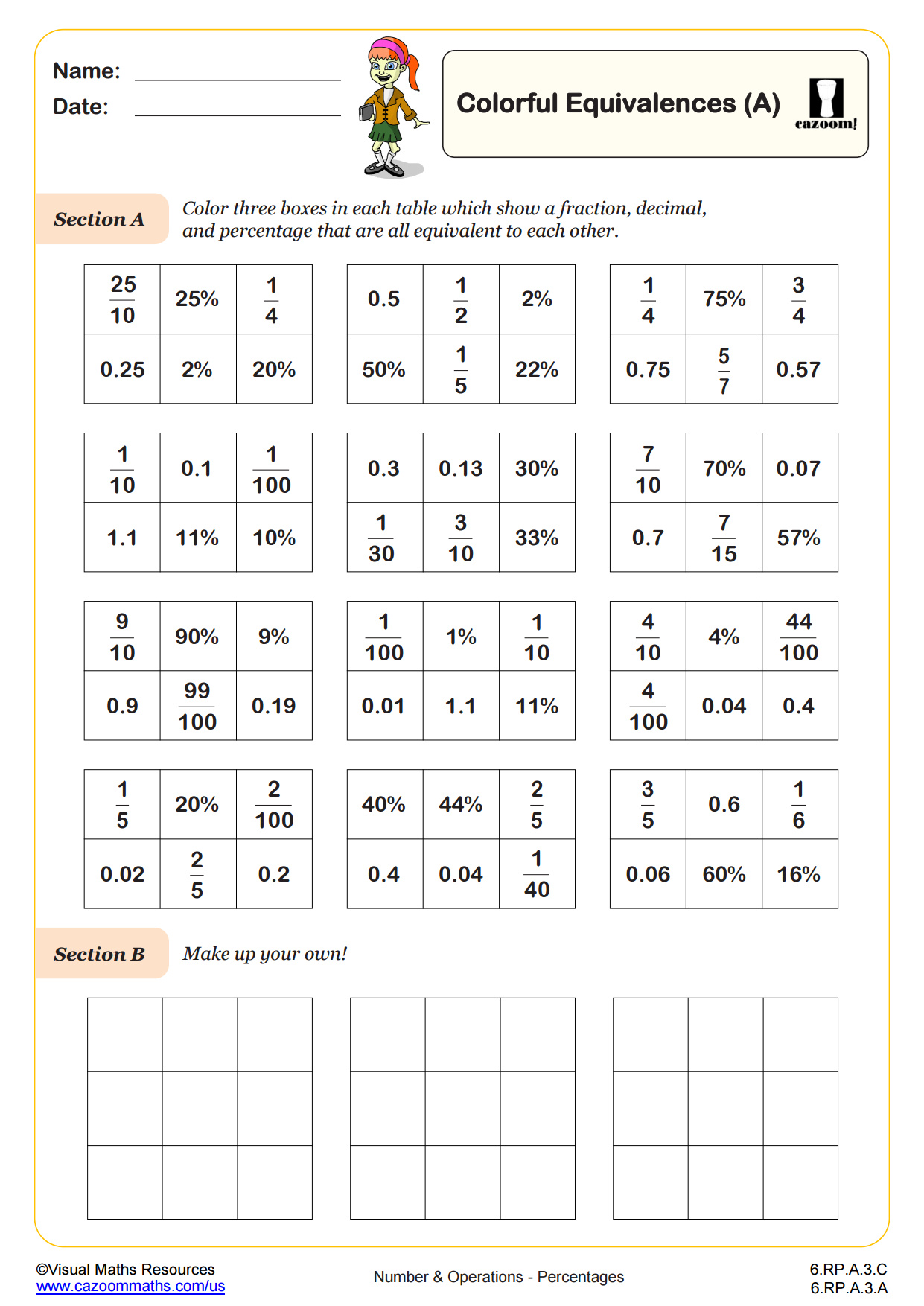
Colourful Equivalances (A)
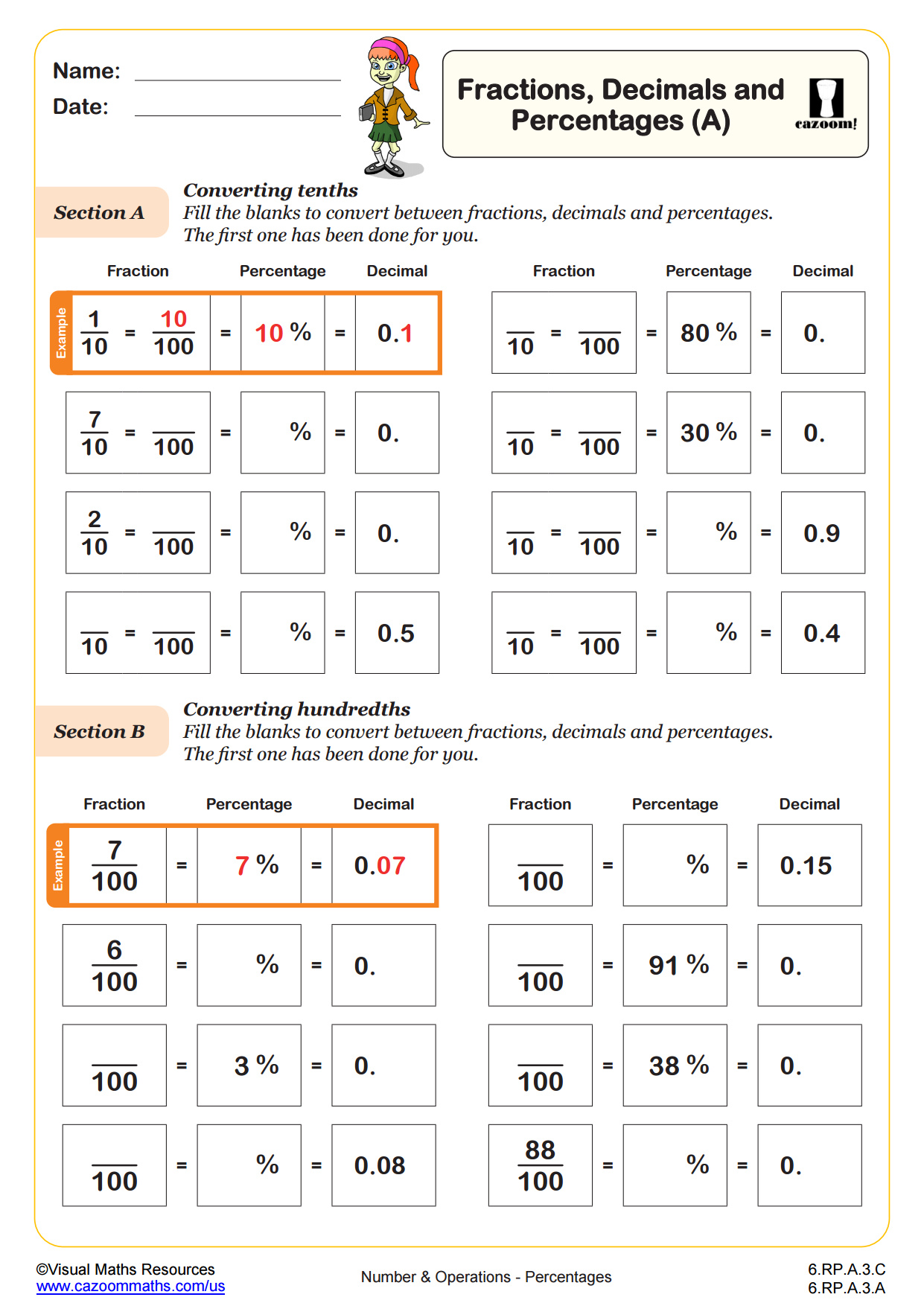
Fractions, Decimals and Percentages (A)
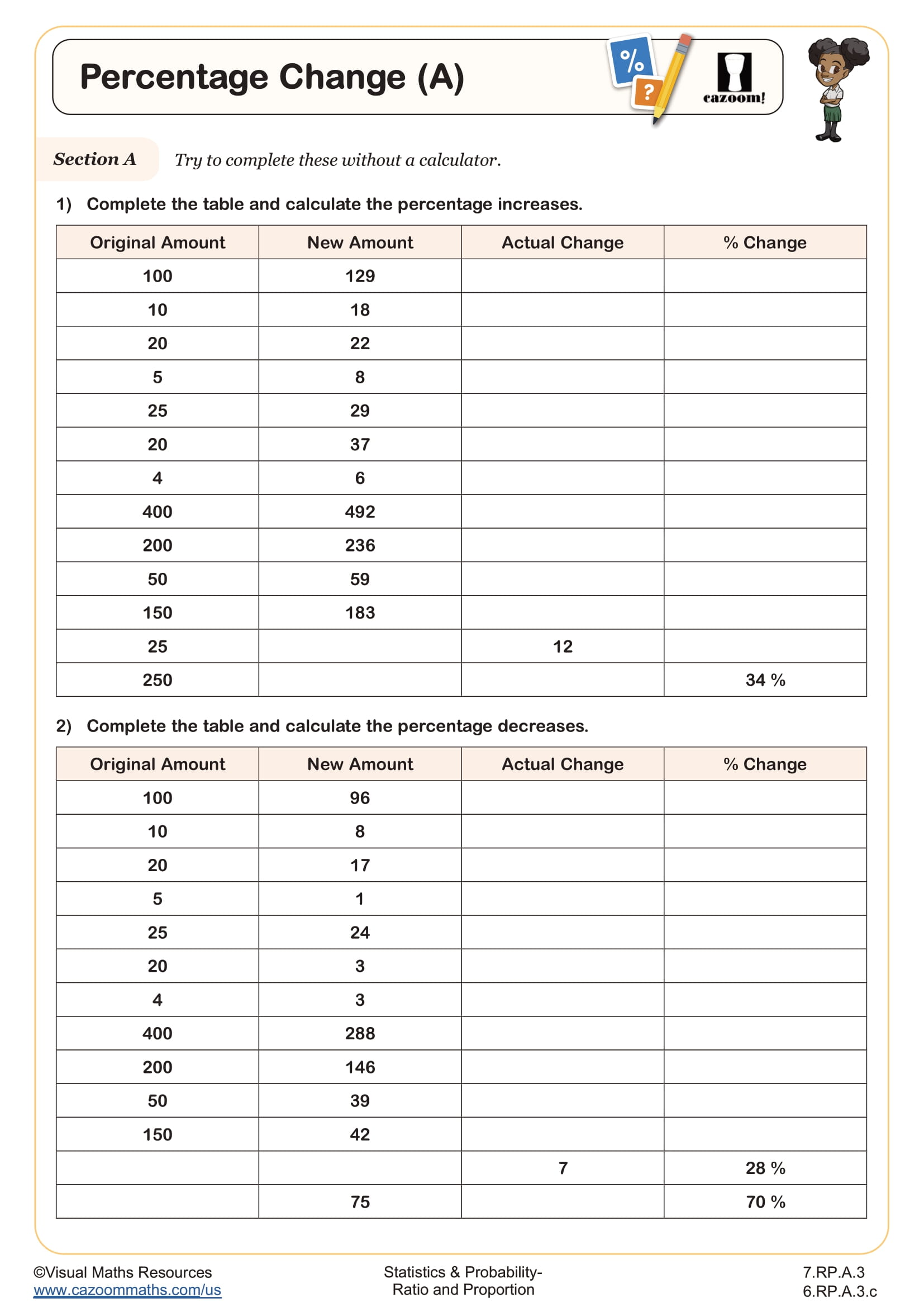
Percentage Change (A)
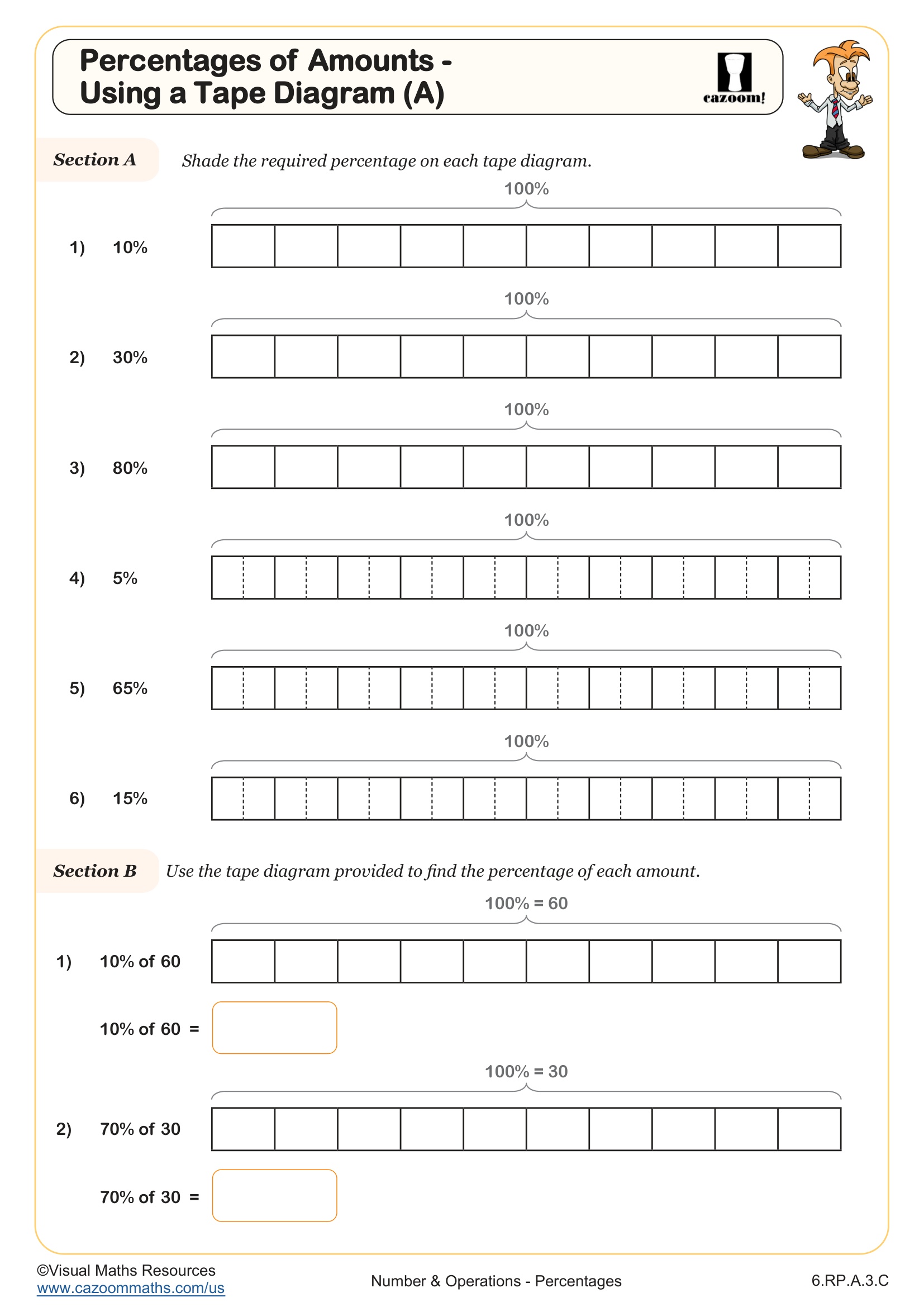
Percentages of Amounts - Using a Tape Diagram (A)
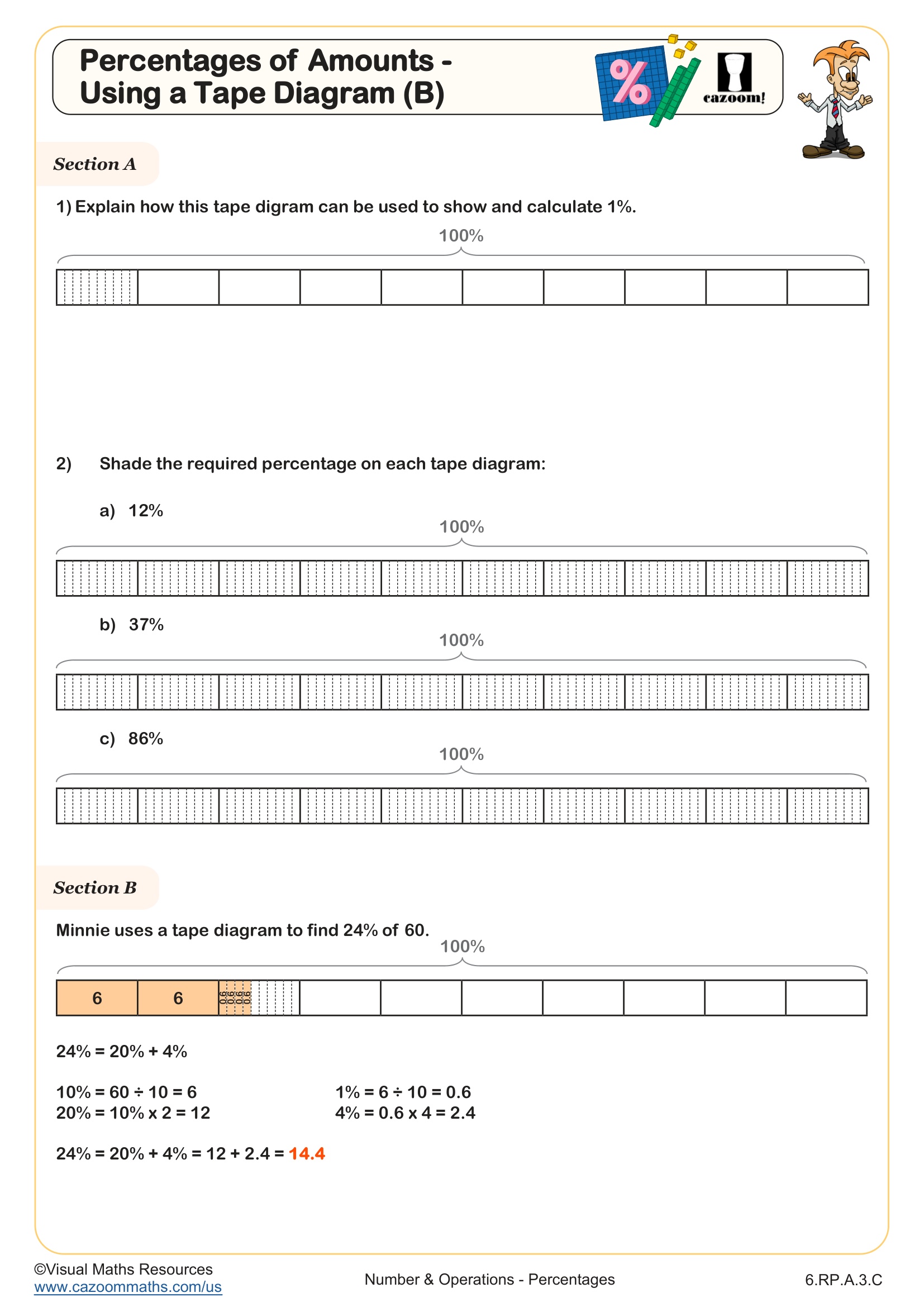
Percentages of Amounts - Using a Tape Diagram (B)
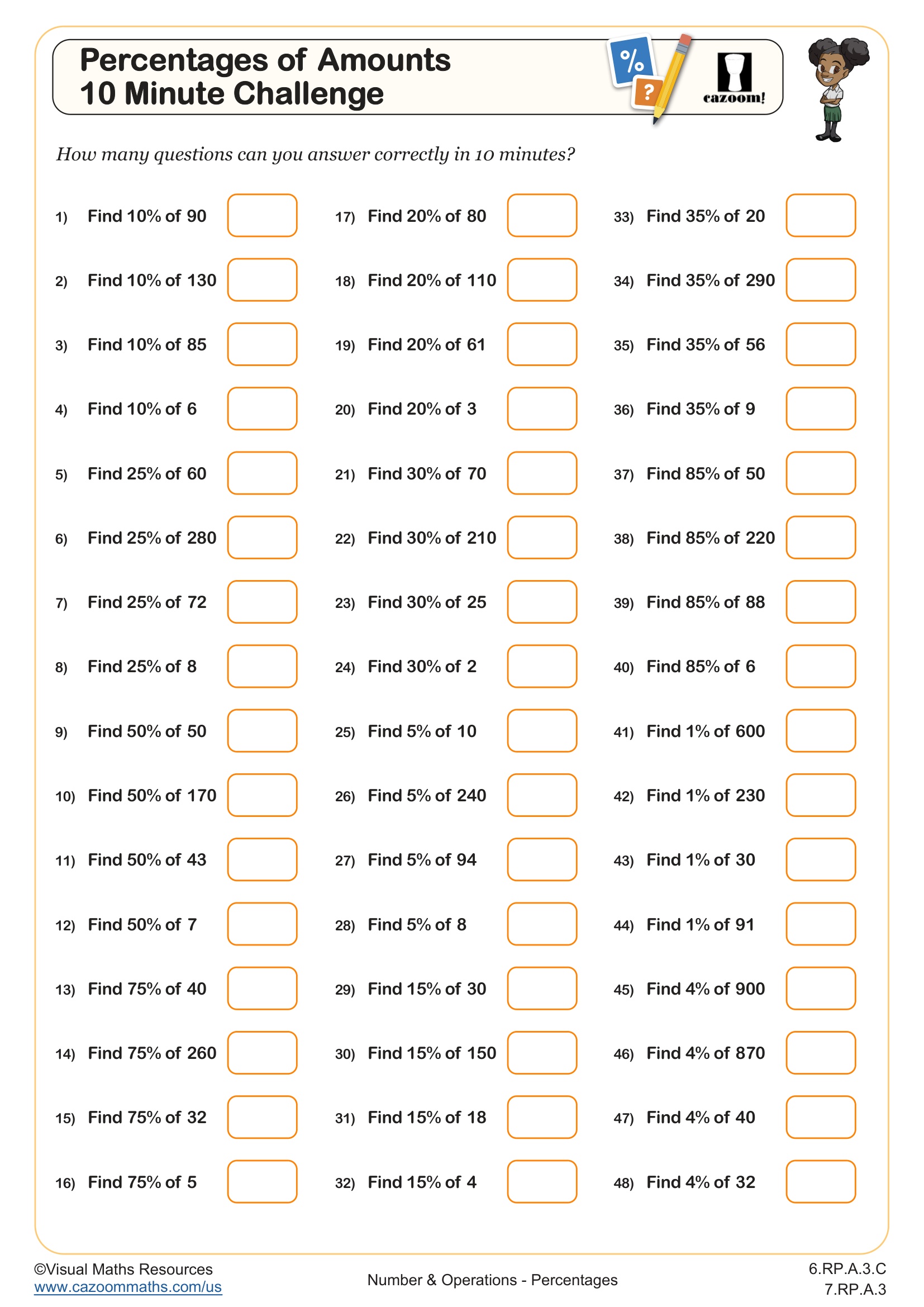
Percentages of Amounts 10 Minute Challenge
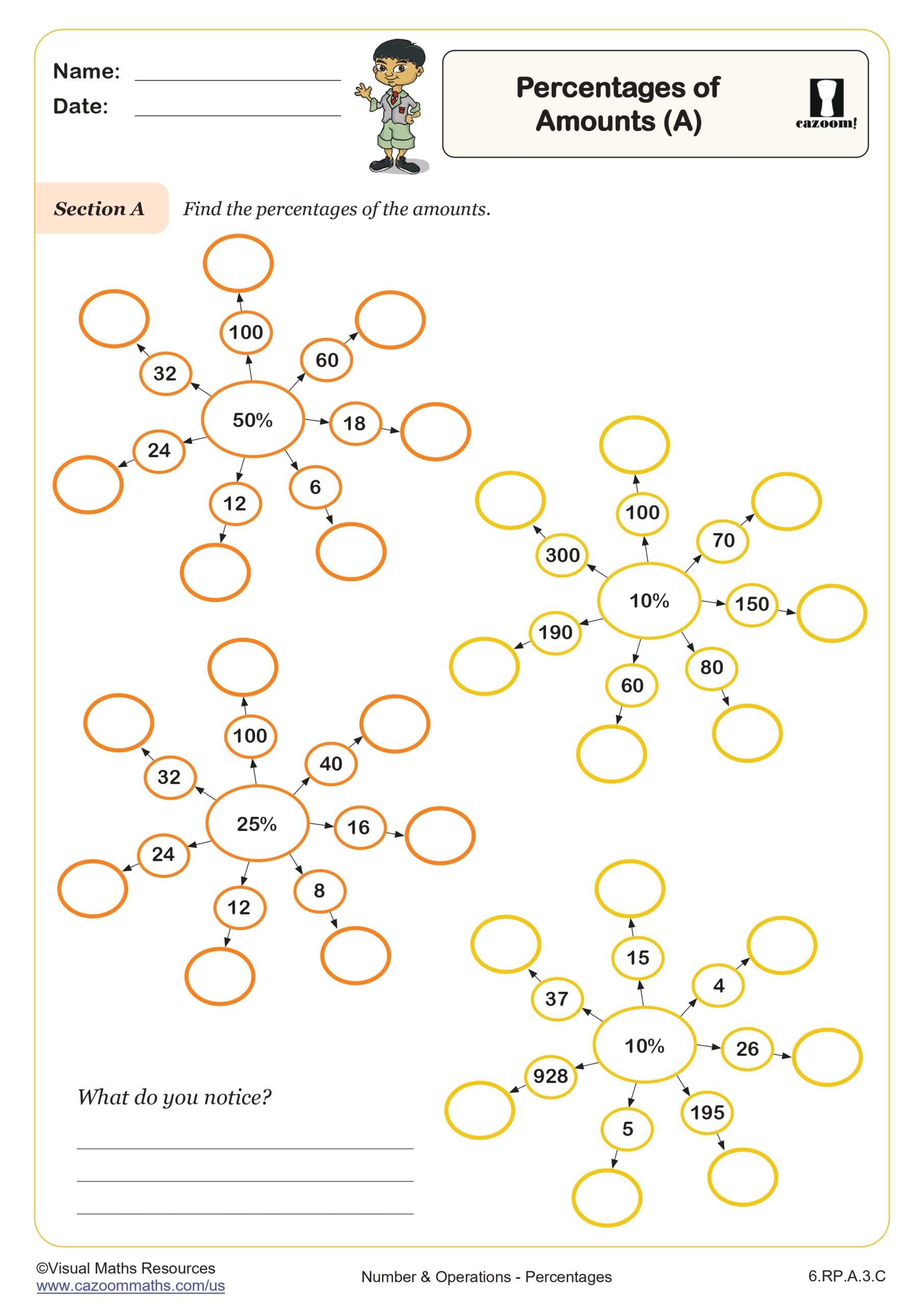
Percents of an Amount (A)
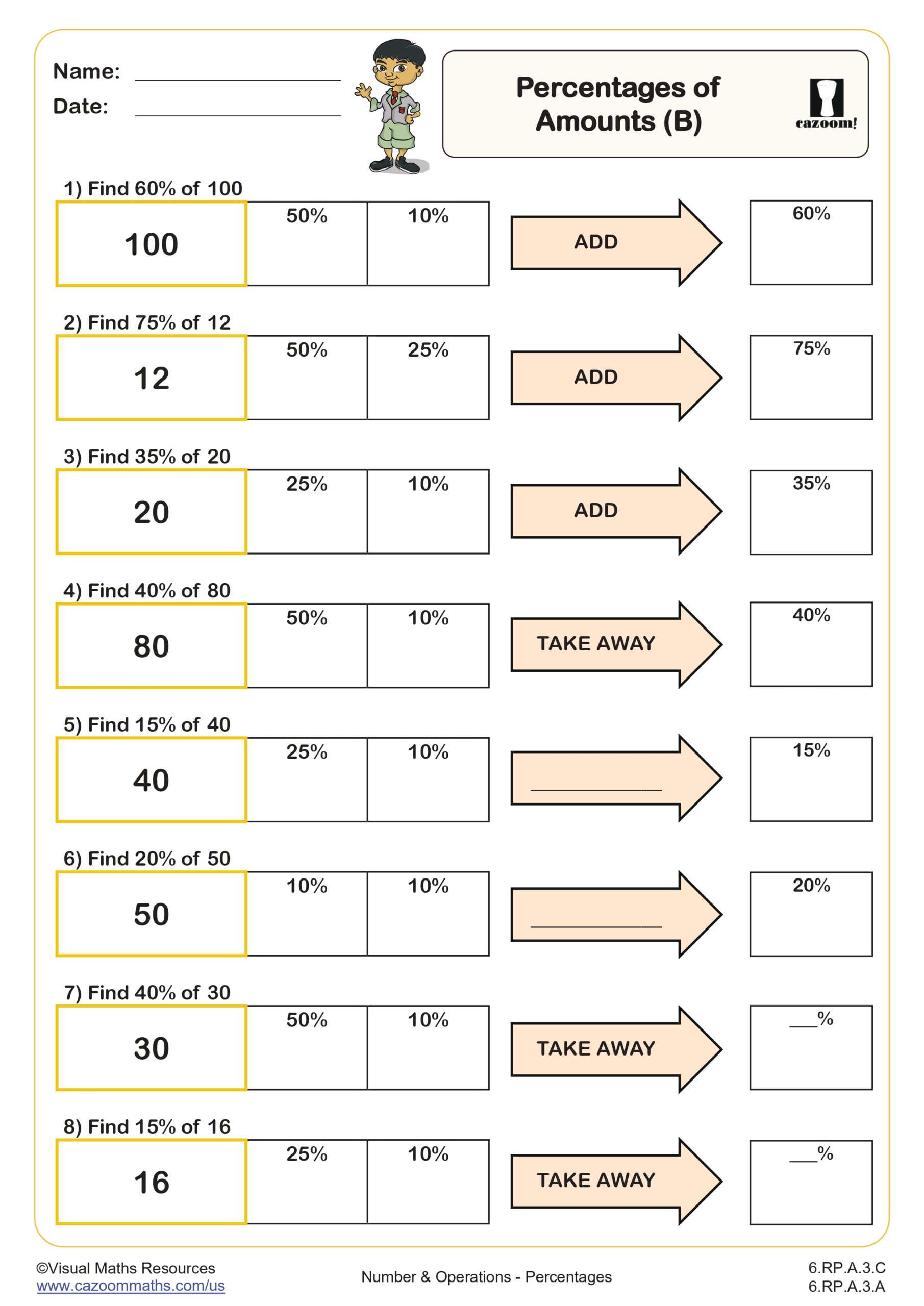
Percents of an Amount (B)
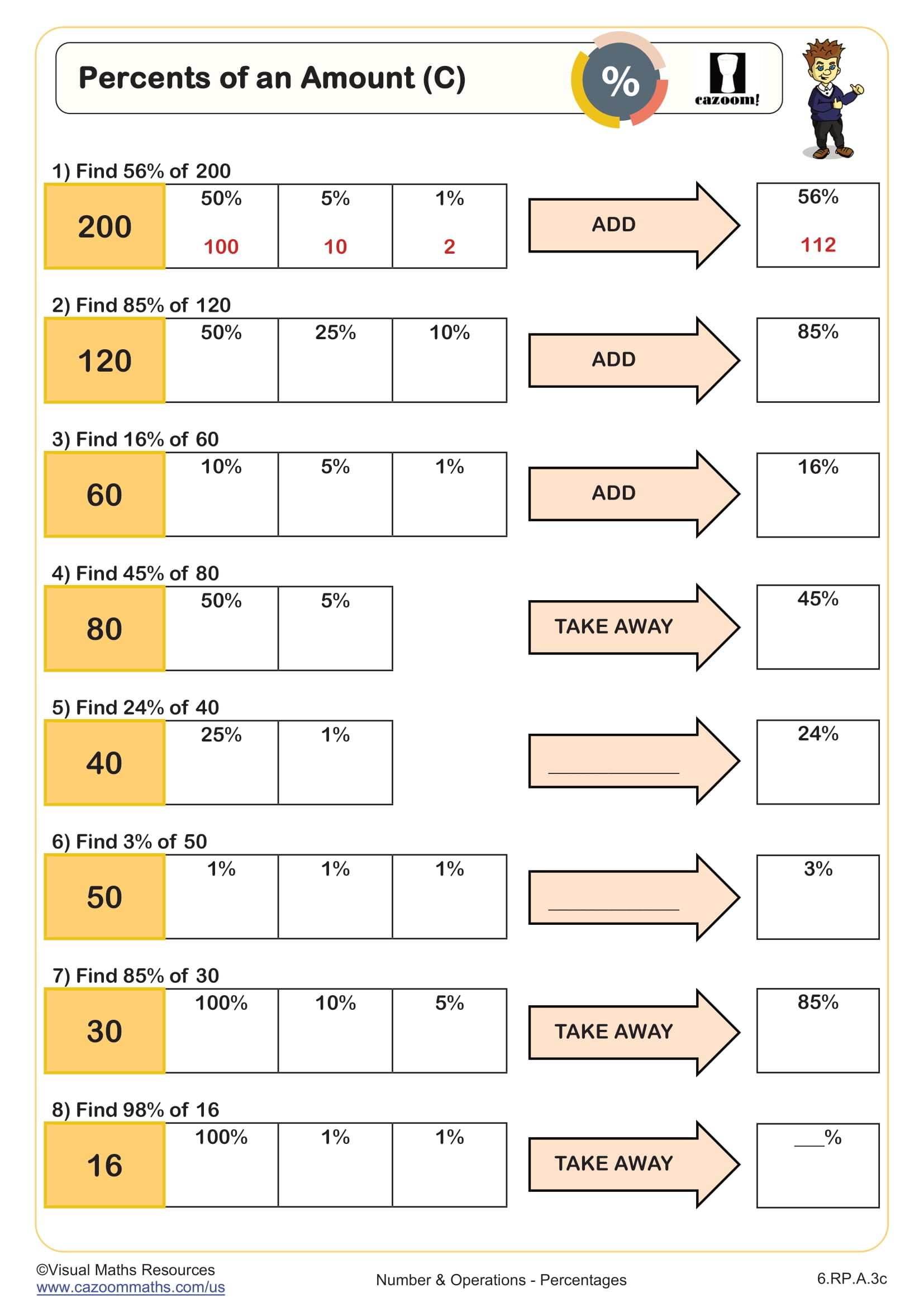
Percents of an Amount (C)
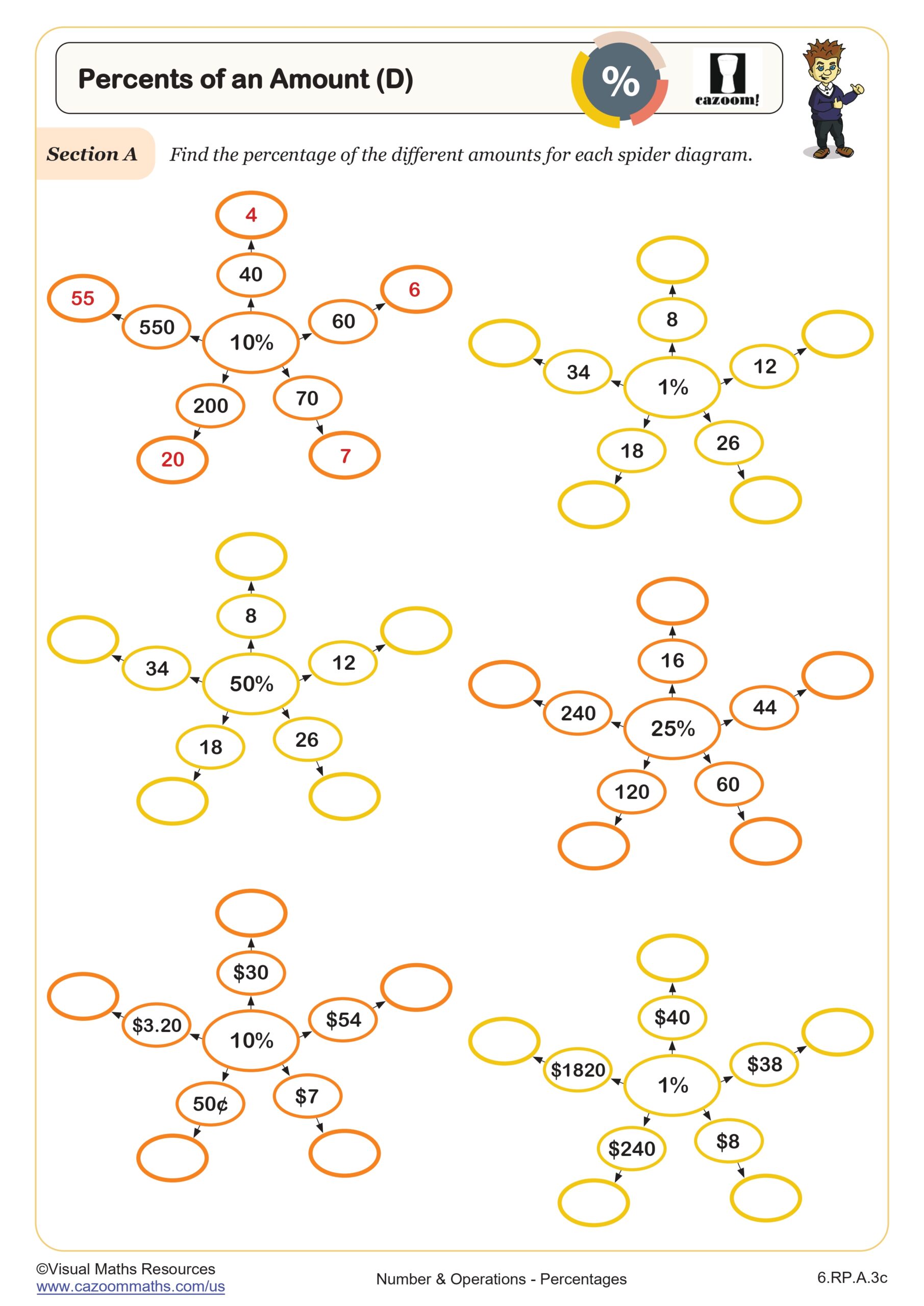
Percents of an Amount (D)
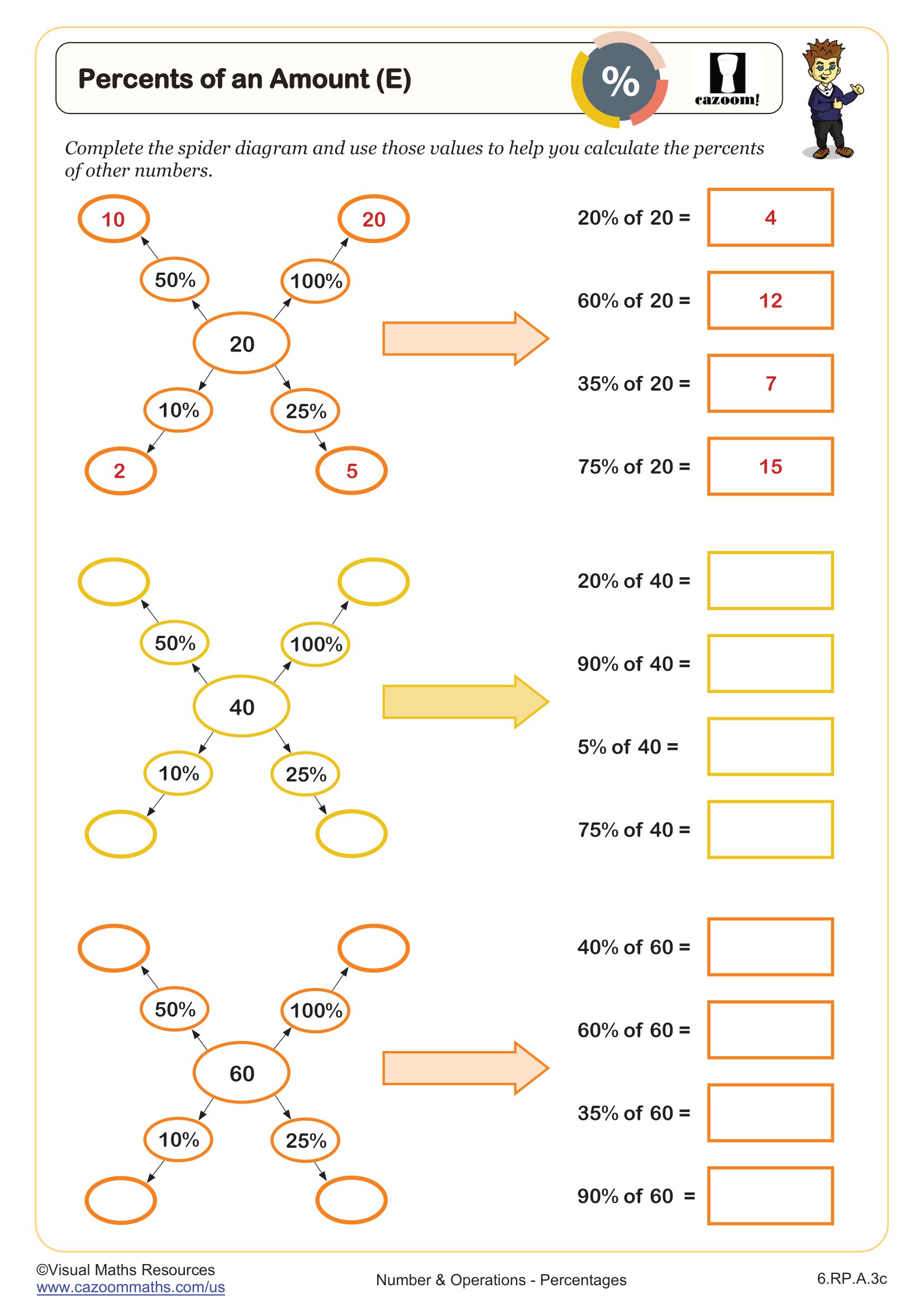
Percents of an Amount (E)
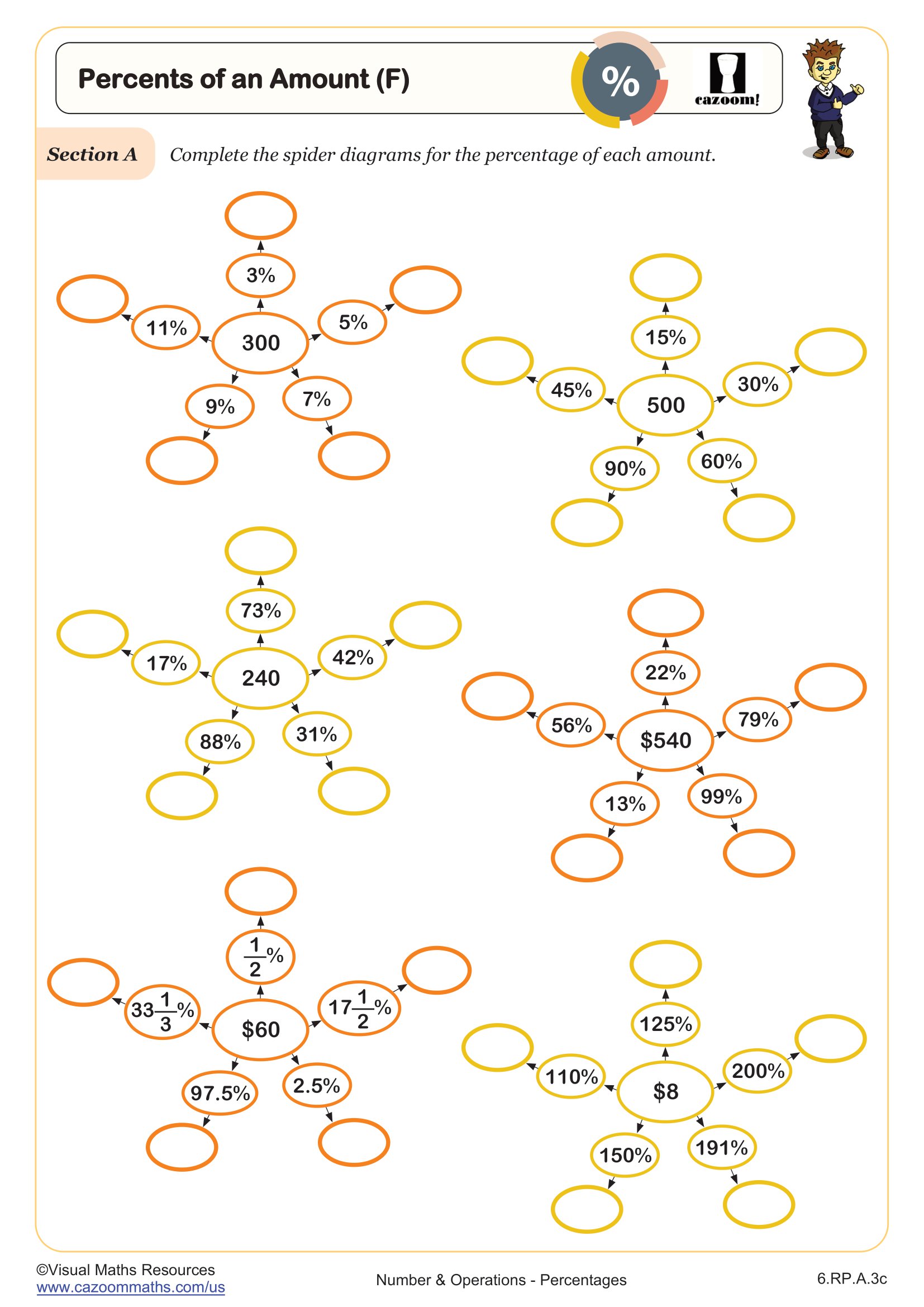
Percents of an Amount (F)
All worksheets are created by the team of experienced teachers at Cazoom Math.
What topics do 6th grade percentage worksheets typically cover?
6th grade math percentage worksheets typically cover converting between fractions, decimals, and percentages, finding percentages of whole numbers, calculating percentage increases and decreases, and solving basic percentage word problems. These topics align with Common Core standard 6.RP.3c, which requires students to find percentages of quantities and solve problems involving finding the whole given a part and the percentage.
Teachers often observe that students make errors when converting percentages to decimals, frequently forgetting to move the decimal point or writing 25% as 0.025 instead of 0.25. Practice with visual models like hundred grids helps students conceptualize percentages before moving to abstract calculations involving sales tax, tips, and discount problems.
Are these percentage worksheets appropriate for students above or below 6th grade level?
Students in 5th grade who are ready for pre-algebra concepts can benefit from simpler percentage problems, while 7th and 8th graders often use these worksheets for review before tackling more complex percentage applications. The worksheets provide foundational skills that spiral through middle school mathematics curricula.
Advanced 5th graders typically handle basic percentage-to-fraction conversions well, while struggling 7th graders often need to revisit the concept that percentages represent parts per hundred. Teachers frequently use these worksheets as diagnostic tools to identify gaps in understanding before introducing percentage applications in geometry, statistics, and algebraic problem-solving contexts.
Why do students struggle with percentage word problems compared to basic calculations?
Percentage word problems require students to identify which quantity represents the whole, the part, and the percentage, which involves more complex reasoning than straightforward calculations. Students must also determine whether they're finding the part, the whole, or the percentage itself, leading to confusion about which operation to use.
Teachers notice that students often misinterpret phrases like "20% off" or "increased by 15%," treating them as simple multiplication problems rather than understanding the underlying relationships. Real-world contexts like calculating tips at restaurants or determining sale prices help students see percentages as practical tools, making the abstract concepts more concrete and memorable for future applications.
How can teachers use these worksheets most effectively in their percentage unit?
Teachers achieve best results by starting with visual percentage models before moving to computational practice, using the worksheets as guided practice after direct instruction rather than independent discovery activities. The answer keys allow for immediate feedback, helping teachers identify common misconceptions quickly during class work time.
Many teachers find success pairing these worksheets with manipulatives like hundred charts or decimal squares, then transitioning to paper-and-pencil practice. The worksheets work well for differentiated instruction, allowing advanced students to work independently while teachers provide additional support to students who need more scaffolding with the foundational concepts of part-whole relationships.