6th Grade Ratios Worksheets
All worksheets are created by the team of experienced teachers at Cazoom Math.
What Are Ratios and Why Do Students Learn Them in 6th Grade?
Ratios represent the relationship between two or more quantities, showing how many times one value contains another or how quantities compare. In 6th grade, the Common Core State Standards (6.RP.A.1) introduce ratios as students begin formal work with proportional reasoning, a concept that extends through middle school mathematics and into high school algebra and geometry.
Students often confuse ratios with fractions initially, not recognizing that while 3:4 and 3/4 look similar, they represent different mathematical ideas. A ratio of 3:4 compares two separate quantities (like 3 boys to 4 girls), while the fraction 3/4 represents a single value or part of a whole. Teachers find that using concrete examples with colored counters or real objects helps students distinguish between these related but distinct concepts before moving to abstract notation.
What Should 6th Graders Know About Writing Ratios?
Sixth graders should understand that ratios can be written in three equivalent forms: using ratio notation (3:4), as a fraction (3/4), or with the word "to" (3 to 4). Students need to correctly identify which quantity comes first based on the context of a problem and maintain consistent order throughout their work. They should also recognize that ratios compare quantities with the same units or different units depending on the situation.
This skill builds directly on 5th grade work with multiplication, division, and fractions, where students developed number sense about proportional relationships without formal ratio language. Mastering ratio notation in 6th grade prepares students for 7th grade unit rates, proportional relationships, and scale drawings, then later for slope in 8th grade algebra and trigonometric ratios in high school geometry.
How Do Students Write Ratios from Word Problems?
Writing ratios from word problems requires students to identify the two quantities being compared and determine the correct order based on the problem's language. The phrase "the ratio of cats to dogs" means cats come first (cats:dogs), while "dogs to cats" reverses the order. Students must carefully read what the problem asks for and write quantities in that specific sequence, which becomes particularly important when solving proportion problems later.
Ratios appear constantly in STEM fields and everyday contexts. Recipes use ingredient ratios (2 cups flour to 1 cup sugar), mixing paint or concrete requires specific ratios of components, and gear ratios determine how bicycles and cars operate. In science classes, students encounter concentration ratios in solutions, and in technology, screen aspect ratios (16:9) determine display dimensions. Understanding ratio notation gives students the mathematical language to describe these proportional relationships accurately.
How Do These Worksheets Help Students Master Ratio Writing?
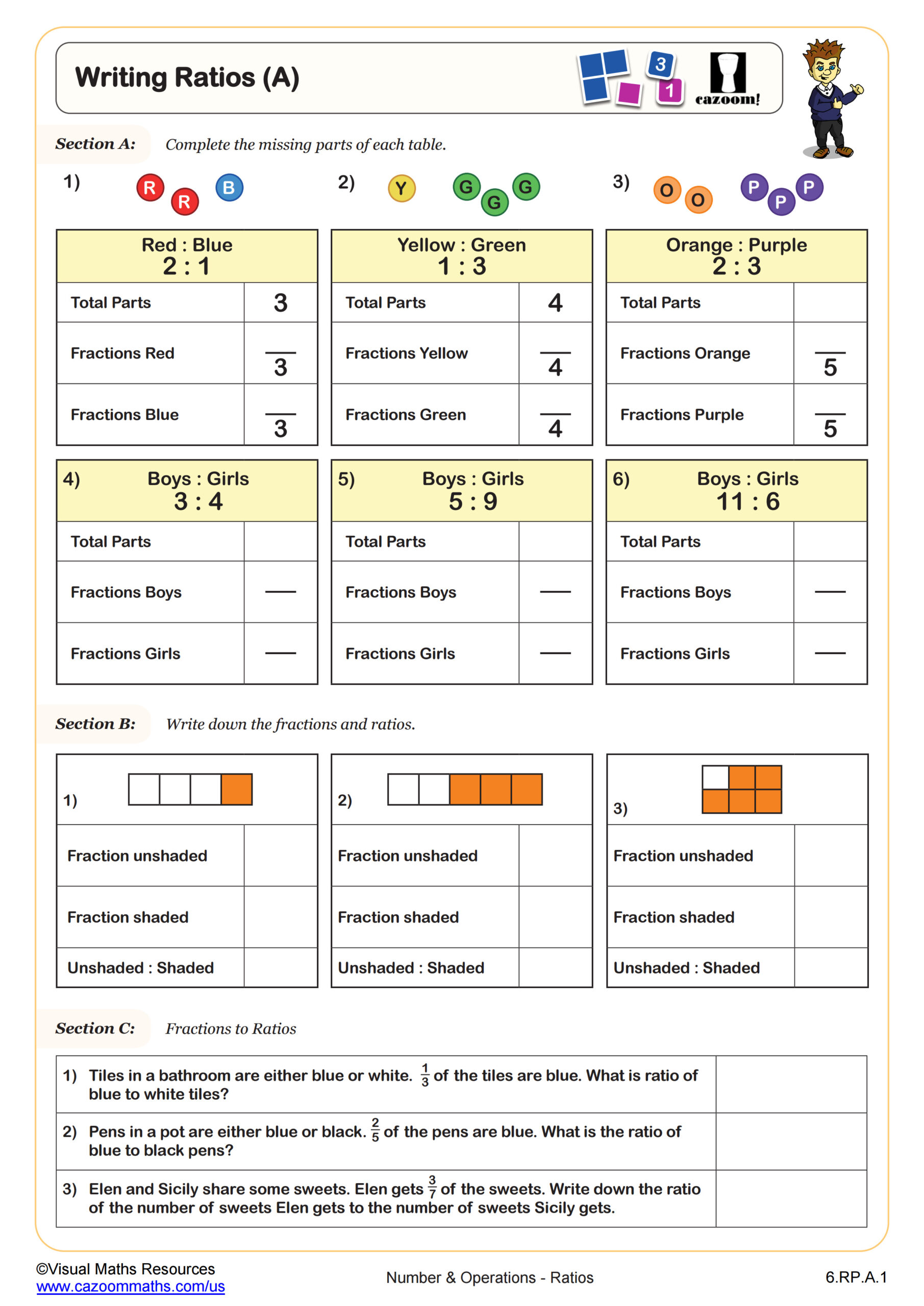
The worksheets provide structured practice moving from visual representations to abstract word problems, allowing students to develop ratio sense progressively. Problems typically begin with pictures or diagrams where students can count objects and write corresponding ratios, then advance to scenarios described in words. Answer keys allow students to self-check their work and identify whether they've placed quantities in the correct order, addressing the most common error pattern teachers observe.
Teachers use these worksheets effectively during initial instruction as guided practice, where students complete problems while receiving immediate feedback. They work well for homework after students demonstrate basic understanding in class, and for intervention with students who struggle with part-to-part versus part-to-whole relationships. Paired work encourages mathematical discussion as students explain their reasoning about which quantity should come first, deepening conceptual understanding beyond procedural fluency.