6th Grade Space Worksheets
All worksheets are created by the team of experienced teachers at Cazoom Math.
How Does Space-Themed Math Connect to 6th Grade Standards?
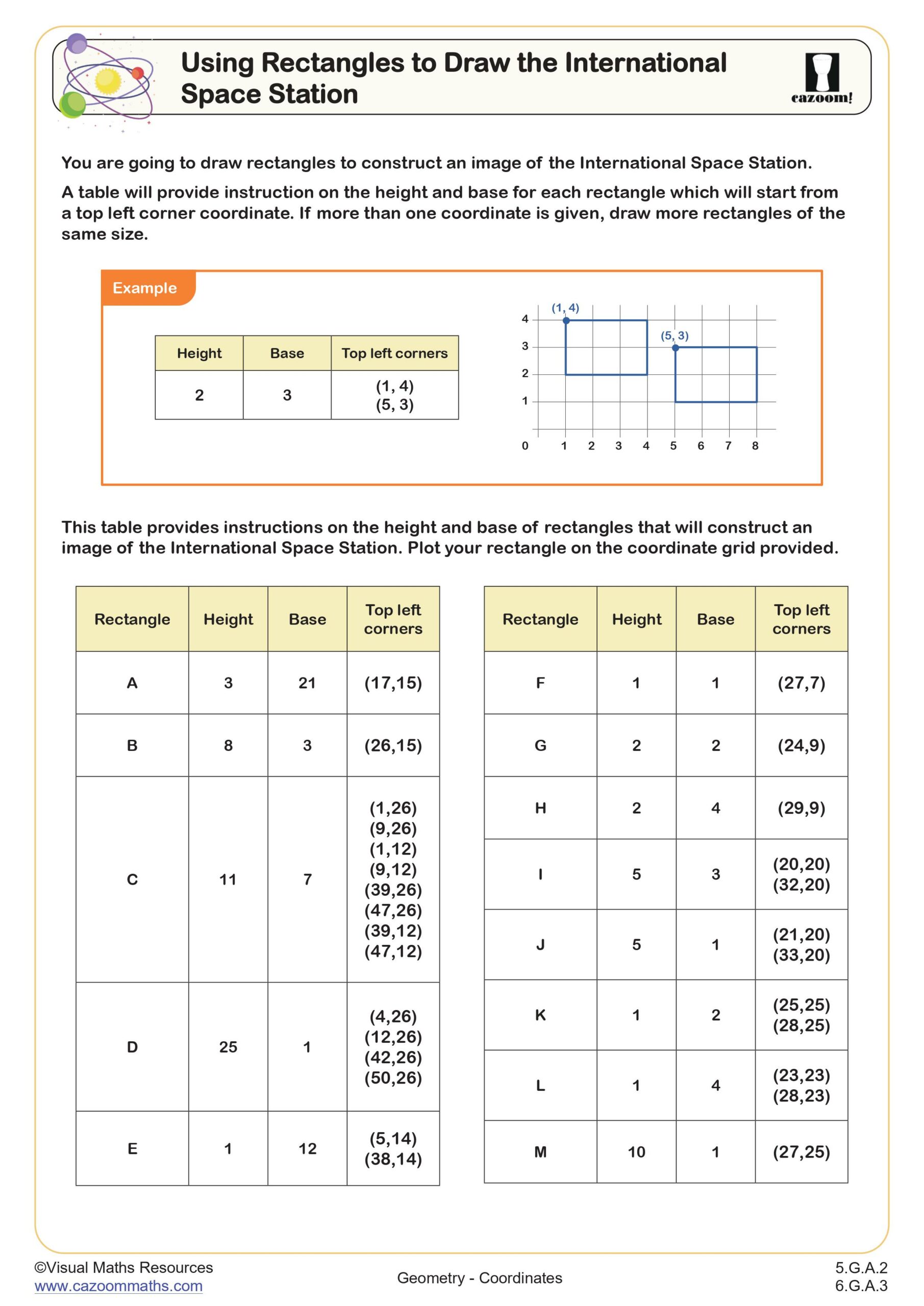
Space-themed worksheets address Common Core standards 6.G.A.3 (drawing polygons in the coordinate plane) and 6.NS.C.6 (understanding coordinates in all four quadrants). By using space stations, satellites, or spacecraft as the context, students apply coordinate graphing skills while developing spatial reasoning abilities that transfer across multiple mathematical domains.
Teachers observe that students often make sign errors when working in quadrants II, III, and IV, particularly forgetting that moving left or down requires negative values. Space contexts help reinforce this concept because students can visualize positions relative to a central point, making the abstract coordinate system more concrete and memorable.
What Should 6th Graders Know About Coordinate Geometry?
By 6th grade, students should confidently plot and identify points in all four quadrants of the coordinate plane, understanding that the first coordinate represents horizontal distance and the second represents vertical distance from the origin. They should recognize that coordinates with opposite signs fall in different quadrants and use absolute value to find distances between points sharing a common x or y coordinate.
This builds directly on 5th grade work with the first quadrant only and prepares students for 7th and 8th grade topics including slope, transformations, and eventually functions in algebra. Students who master coordinate graphing in 6th grade approach linear equations with greater confidence because they already understand the relationship between numerical coordinates and visual representations.
How Do Rectangles Help Students Understand Complex Structures?
Using rectangles to draw structures like the International Space Station breaks down complex shapes into manageable components. Students identify vertices, plot coordinates, connect points in order, and verify that opposite sides are parallel and equal in length. This decomposition strategy teaches students to approach complicated problems systematically rather than feeling overwhelmed by visual complexity.
This skill directly applies to engineering, architecture, and computer graphics where designers create intricate objects by combining basic geometric shapes. NASA engineers actually use similar coordinate-based methods when designing spacecraft components and planning orbital maneuvers, making this more than just a classroom exercise. Students who understand this foundational approach can later apply it to CAD software, video game design, and 3D modeling careers.
How Can Teachers Use These Worksheets Most Effectively?
The worksheets provide structured practice with clear visual references that help students connect abstract coordinates to concrete images. Answer keys allow students to self-check their work immediately, catching plotting errors before they become ingrained habits. Teachers can use the visual nature of the completed drawings as an informal assessment tool since incorrect coordinates produce noticeably distorted shapes.
These worksheets work well as bell ringers to activate prior knowledge before geometry lessons, as enrichment for students who finish early, or as homework that parents can support without advanced math knowledge. Many teachers also use them during intervention periods because the space theme reengages students who previously struggled with coordinate graphing when presented in purely abstract form. Paired work encourages students to verify each other's coordinates before connecting points, building collaborative problem-solving skills.