6th Grade Statistics & Probability Worksheets
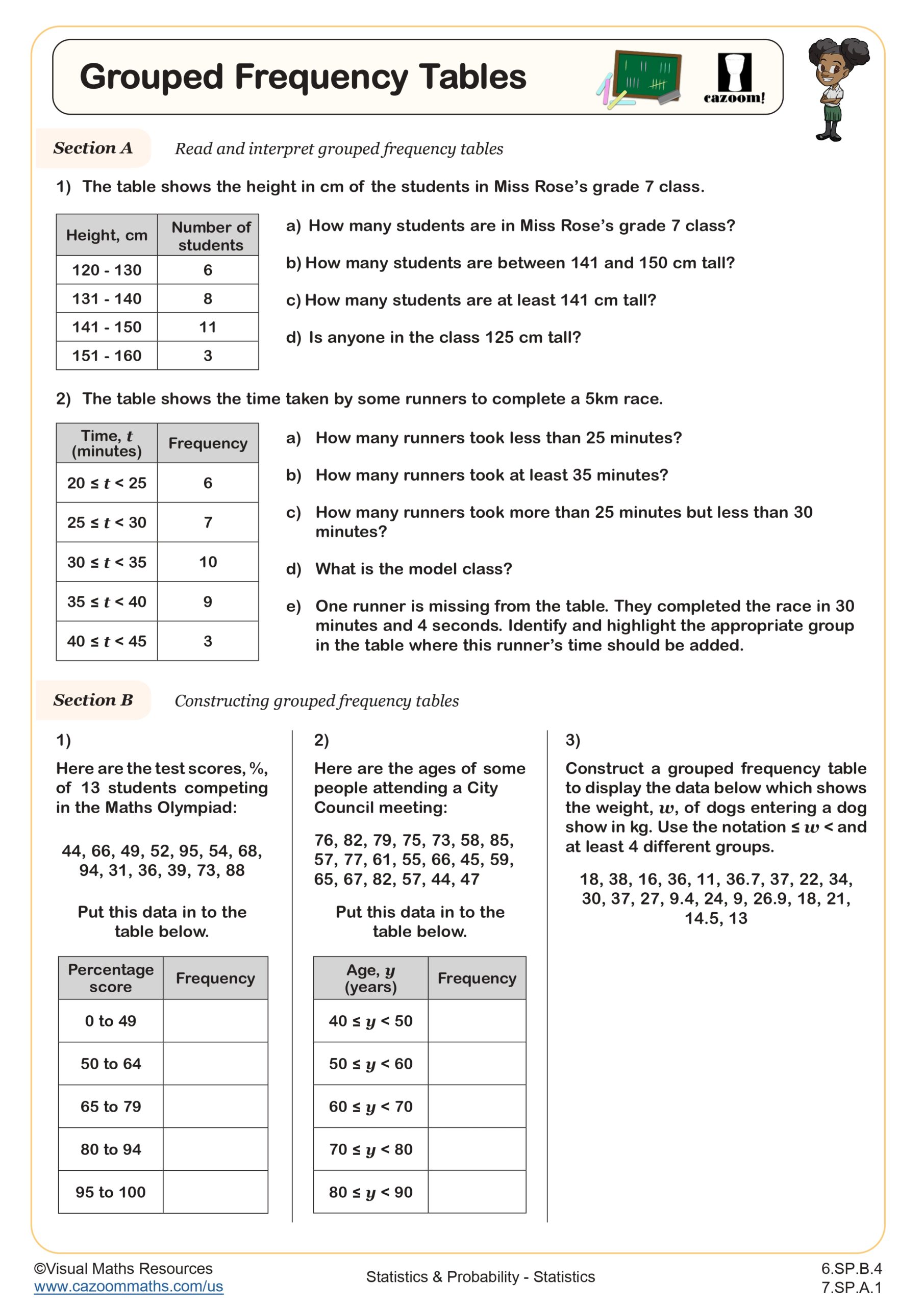
All worksheets are created by the team of experienced teachers at Cazoom Math.
What topics do 6th grade statistics worksheets typically cover?
Statistics and probability worksheets for sixth grade focus on the foundational concepts outlined in Common Core Standard 6.SP. Students practice creating and interpreting dot plots, histograms, and box plots while learning to calculate measures of center like mean, median, and mode. The probability component introduces simple events, sample spaces, and the relationship between theoretical and experimental probability.
Teachers consistently observe that students need extra practice distinguishing between different types of data displays. Many sixth graders initially create histograms when dot plots would be more appropriate, or struggle to identify which measure of center best represents their data set. Worksheets that provide guided practice with choosing appropriate representations help students develop this critical thinking skill.
How do 6th grade probability concepts build on earlier learning?
Sixth grade marks students' formal introduction to probability concepts, building on their elementary understanding of likelihood and chance. Previously, students may have used informal language like "likely" or "unlikely," but now they learn to express probability as fractions, decimals, and percentages between 0 and 1. This grade level establishes the foundation for more complex probability topics in grades 7 and 8.
The transition from informal to formal probability language often creates confusion for students. Teachers notice that many sixth graders initially want to describe probability using whole numbers greater than 1, or struggle to connect fractional representations to real-world contexts. Probability worksheets grade 6 that emphasize this connection between mathematical notation and practical situations help bridge this conceptual gap.
Why do students find measures of center challenging to understand?
Measures of center (mean, median, and mode) present unique challenges because students must understand both the computational process and when each measure provides the most useful information about a data set. Mean requires understanding of equal distribution, median demands ordering skills, and mode focuses on frequency. Students often memorize procedures without grasping the conceptual meaning behind each measure.
Classroom observations reveal that students frequently calculate all three measures for every data set without considering which one best represents the data. When working with skewed distributions, many sixth graders default to using the mean even when the median would provide better insight. 6th grade data and statistics worksheets that include real-world contexts help students develop judgment about which measure tells the most meaningful story about their data.
How can teachers use these worksheets most effectively in their classrooms?
6th grade probability worksheets with answers work best when integrated into a broader instructional sequence that includes hands-on data collection and analysis activities. Teachers find success using worksheets as follow-up practice after students have collected their own data through surveys or experiments. The answer keys allow for immediate feedback, but teachers should encourage students to explain their reasoning rather than simply checking for correct answers.
Many teachers use these worksheets for differentiated instruction, assigning different problem sets based on student readiness levels. Probability for 6th graders often requires multiple exposures to the same concepts, so having a variety of worksheet formats helps teachers provide additional practice without repetition. The most effective approach involves connecting worksheet problems to ongoing classroom projects or STEM investigations where students can see statistics and probability in action.