6th Grade Using a Calculator Worksheets
All worksheets are created by the team of experienced teachers at Cazoom Math.
What calculator skills should 6th graders focus on?
Sixth graders should move beyond basic arithmetic operations to apply calculator use in context-specific situations, particularly with money and time calculations. This includes entering multi-step problems efficiently, understanding order of operations as it applies to calculator input, and recognizing when answers need rounding or conversion to match real-world formats.
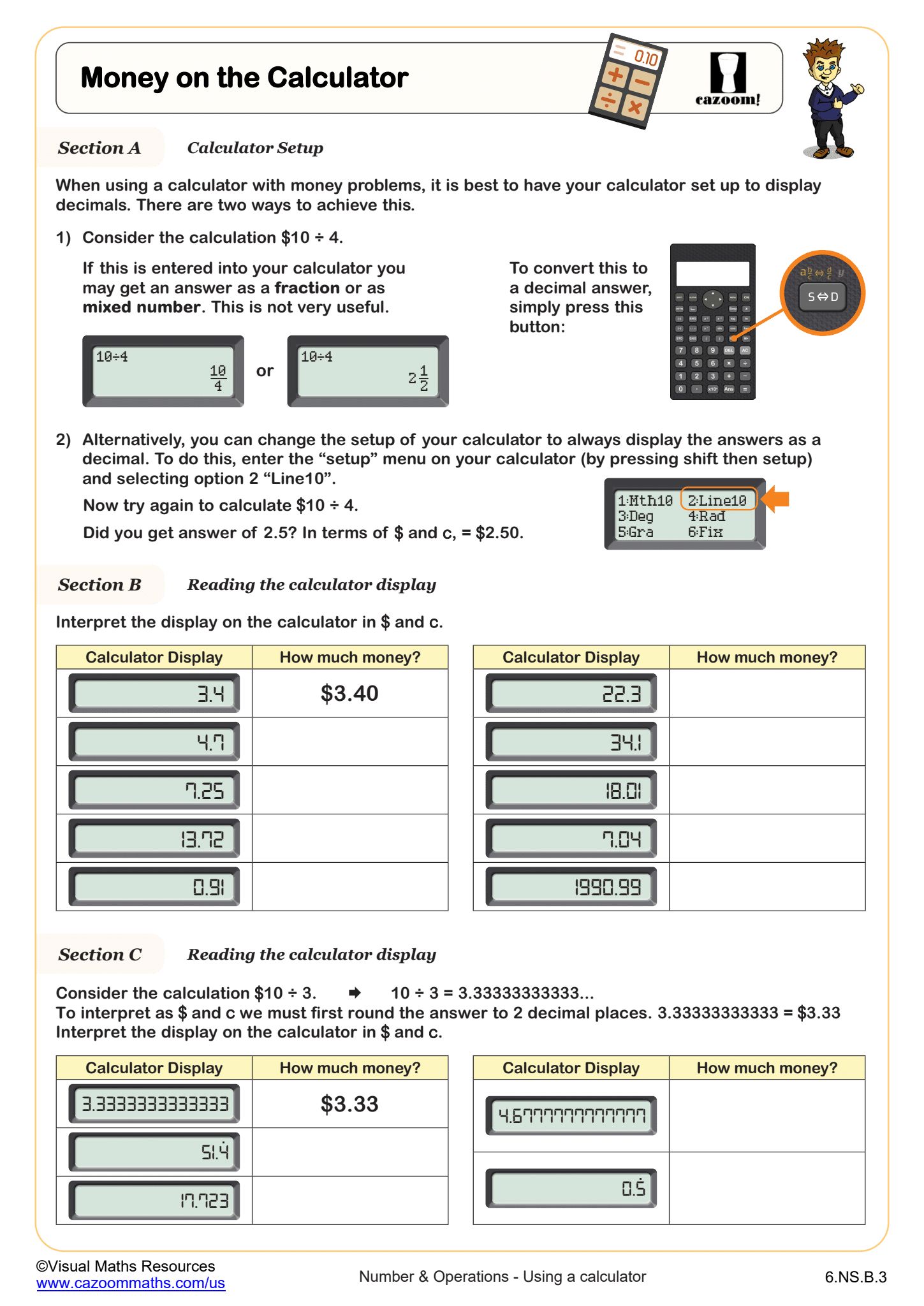
Students often make the mistake of accepting calculator outputs without considering context. For example, when calculating $45.75 ÷ 4 for splitting a restaurant bill, the calculator shows 11.4375, but students must recognize this means $11.44 when rounded appropriately for currency. Teachers notice that students who verify their calculator results against estimation perform significantly better on standardized assessments.
Why is calculator practice important for middle school students?
By 6th grade, Common Core State Standards expect students to use calculators as problem-solving tools rather than computational crutches. Students should know when calculators save time on complex calculations and when mental math or estimation provides faster, more accurate results. This grade level marks the transition from learning calculator mechanics to applying calculator skills strategically across different mathematical contexts.
This builds directly on 5th grade work with decimals and prepares students for pre-algebra topics in 7th and 8th grade where calculators help check solutions to multi-step equations. Students who master contextual calculator use in 6th grade show greater confidence tackling scientific notation, statistical calculations, and algebraic problem-solving in later middle school years.
How do students handle time calculations on a calculator?
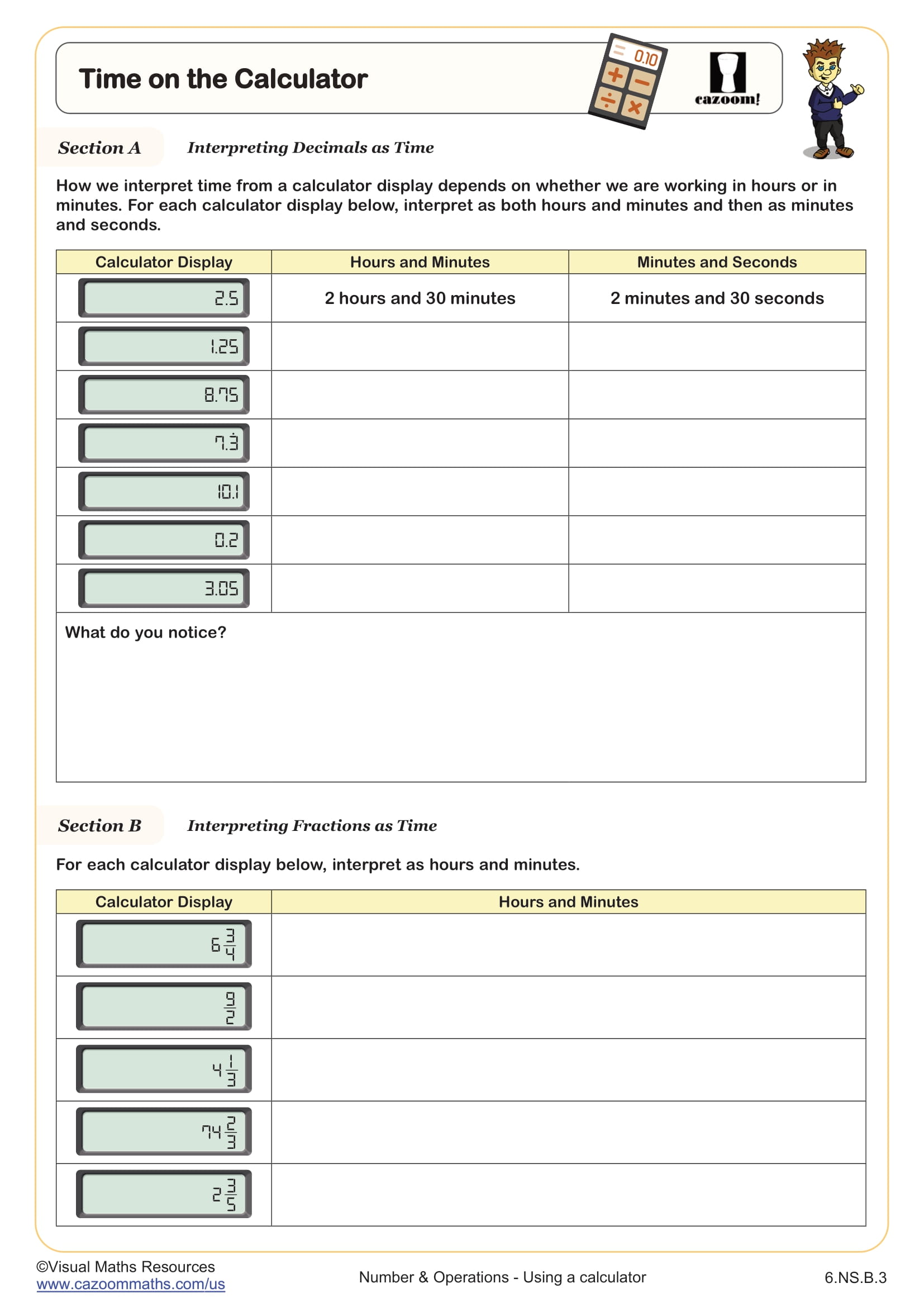
Time calculations require students to work with base-60 systems (60 minutes per hour, 60 seconds per minute) rather than the base-10 decimal system calculators use. Students must convert between hours, minutes, and seconds before and after using the calculator, understanding that 2.5 hours equals 2 hours and 30 minutes, not 2 hours and 50 minutes. This involves dividing or multiplying by 60 to convert between units, then interpreting decimal outputs correctly.
These skills connect directly to STEM applications like calculating experiment durations in science labs, determining cooking times when scaling recipes, or figuring travel times for field trips. Students working on robotics projects frequently need to calculate how long battery charges last or how much time autonomous programs require to complete tasks, making time calculation skills practically valuable beyond the math classroom.
How can teachers use these calculator worksheets effectively?
These worksheets provide structured practice where students must decide which operations to perform, enter calculations correctly, and interpret results within money and time contexts. The problems require multi-step thinking rather than simple computation, encouraging students to plan their approach before reaching for the calculator. Answer keys allow students to self-check and identify where their process breaks down, whether in calculation entry, unit conversion, or result interpretation.
Many teachers use these worksheets during small group instruction to observe how individual students approach calculator problems and address specific misconceptions. They work well as intervention materials for students who struggle with decimal applications or as independent practice for students ready to apply calculator skills without direct supervision. The real-world contexts make them effective homework assignments that parents can connect to everyday financial literacy discussions at home.