7th Grade Properties of Shapes Worksheets
All worksheets are created by the team of experienced teachers at Cazoom Math.
What geometric properties do 7th graders need to know?
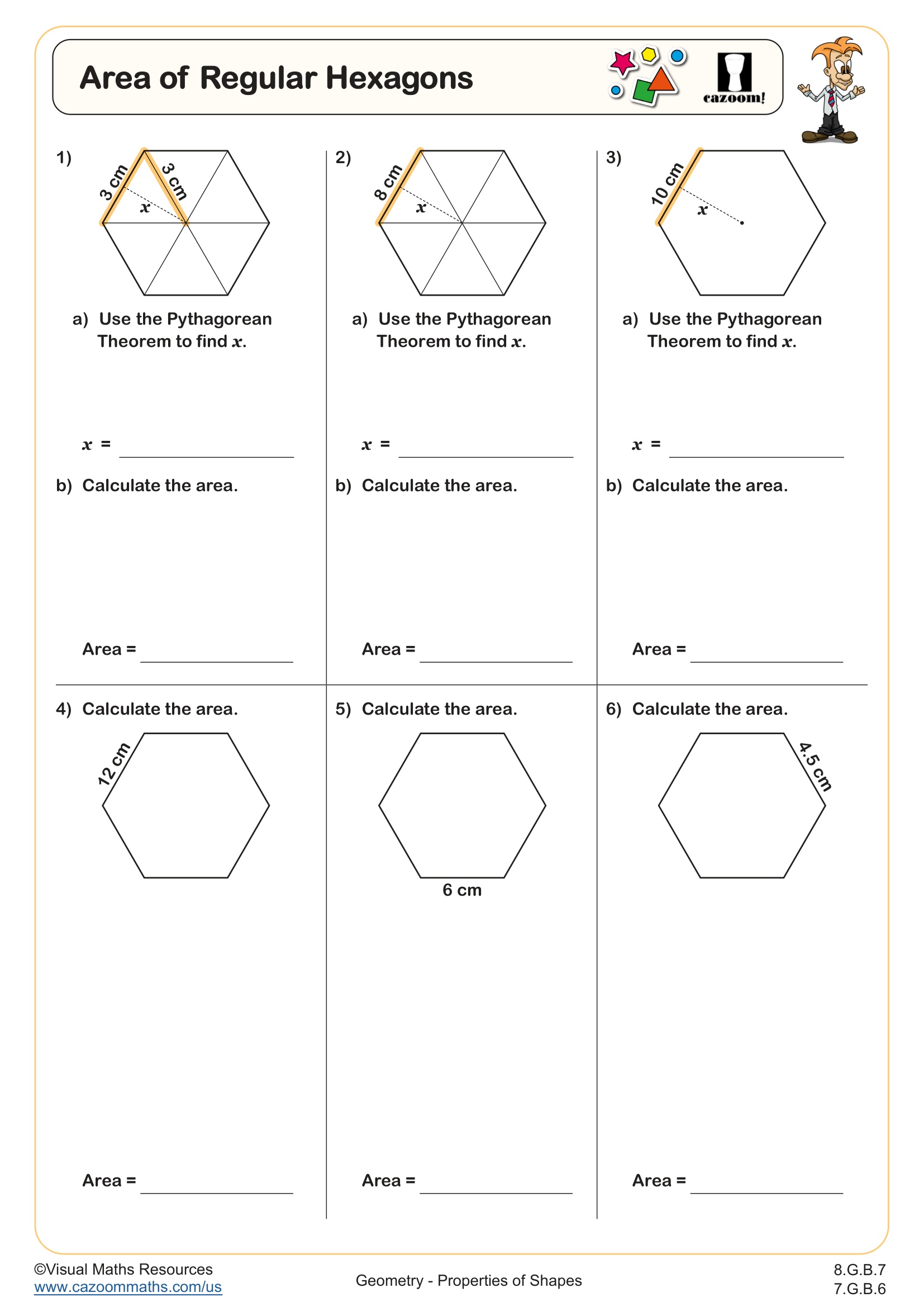
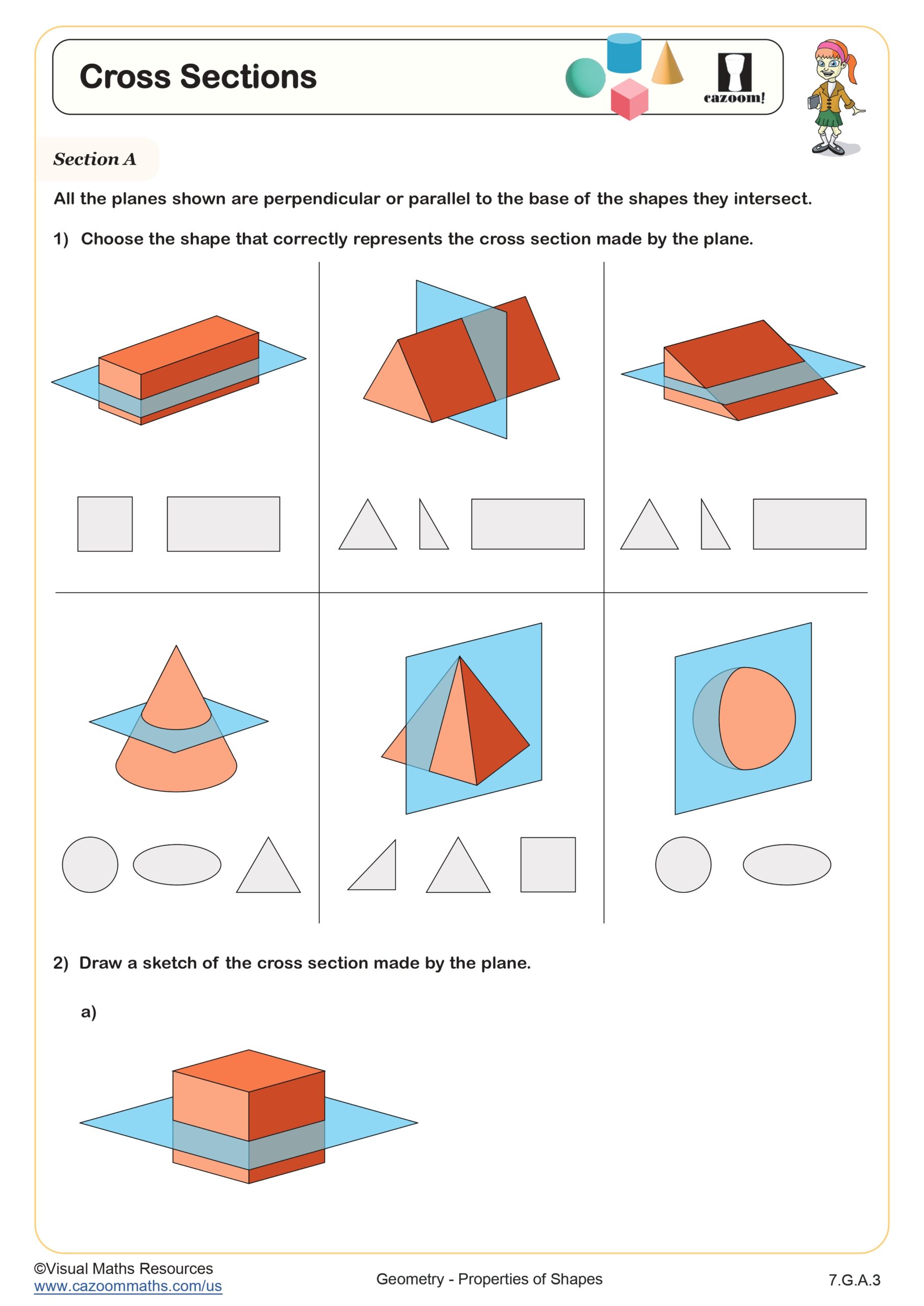
Seventh grade students focus on understanding how shapes transform, calculating areas of complex polygons like regular hexagons, and recognizing geometric properties in real-world contexts. This aligns with Common Core standards 7.G.A.1 through 7.G.A.3, which emphasize scale drawings, geometric constructions, and describing two-dimensional figures.
Students frequently lose points on assessments when they confuse area formulas for different polygons or apply incorrect units. Many teachers find that students master hexagon area calculations once they recognize the shape can be divided into six equilateral triangles, making the formula more intuitive than simply memorizing it.
What grade level learns properties of shapes?
These worksheets are specifically designed for 7th grade middle school students who are building on the basic shape recognition and measurement skills from elementary grades. At this level, students move beyond simple perimeter and area into more sophisticated concepts like transformations and properties of regular polygons.
The progression at 7th grade introduces enlargements and scale factors, which prepare students for similarity and congruence concepts in 8th grade geometry. Teachers notice that students who solidify their understanding of shape properties in 7th grade tackle coordinate geometry and trigonometry with greater confidence in high school.
How do students work with enlargements using column vectors?
Enlargements using column vectors combine transformation geometry with coordinate notation, where students describe how each vertex of a shape moves during scaling. The column vector represents the movement from the center of enlargement to each point, multiplied by the scale factor. This method gives students precise control over transformations and introduces algebraic thinking into geometric problems.
Architects and engineers regularly use vector-based enlargements when scaling blueprints or creating CAD drawings. When a structural engineer scales a building design from 1:100 to 1:50 for detailed construction plans, they're applying the same vector multiplication principles students practice in these worksheets, ensuring every measurement scales proportionally.
How can teachers use these properties of shapes worksheets effectively?
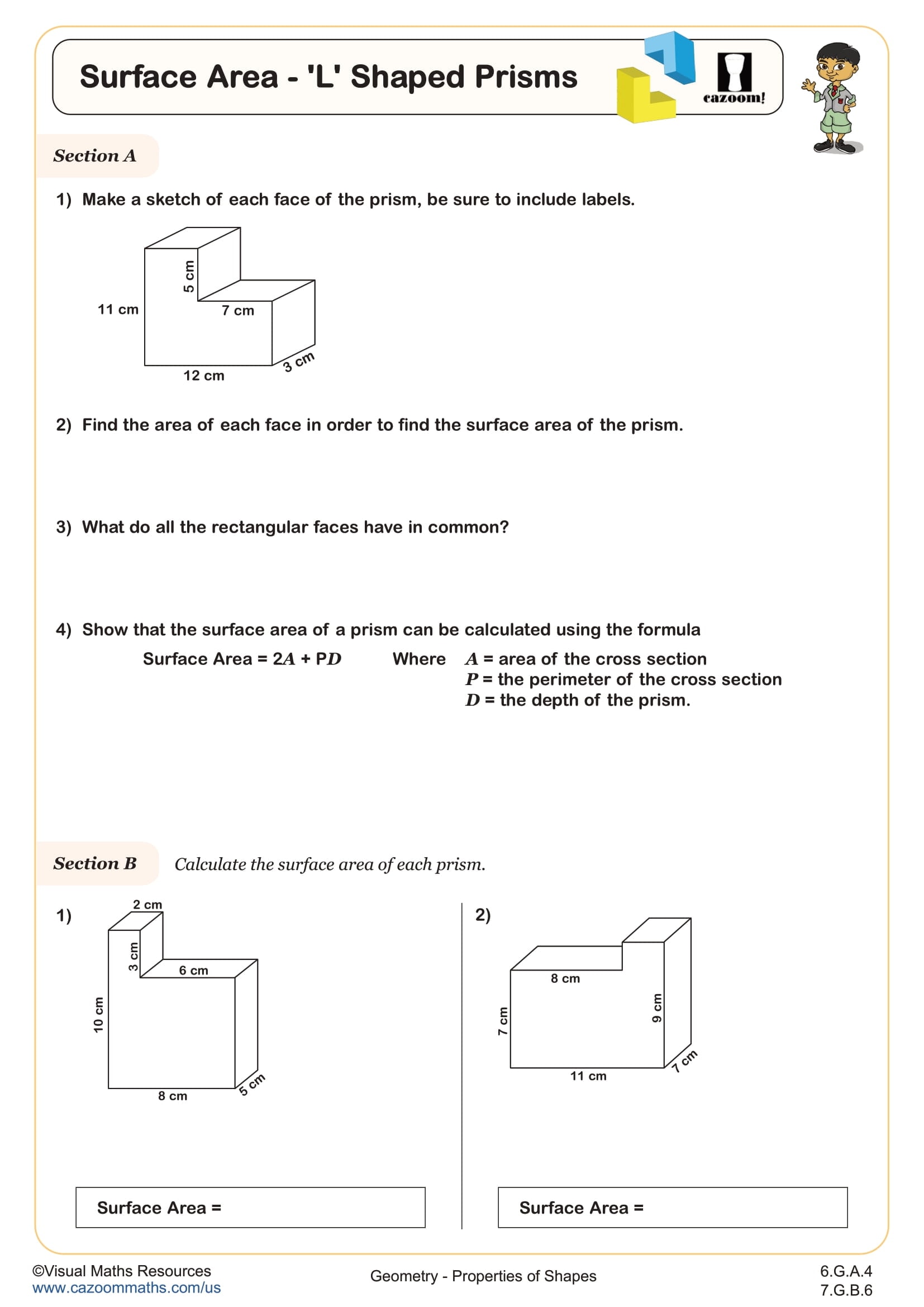
The worksheets progress from vocabulary building with the word search to computational practice with hexagon areas, then advance to conceptual understanding with enlargements and real-world connections. Each worksheet includes worked examples or visual guides that help students recognize patterns before attempting independent problems, making them suitable for both introduction and reinforcement.
Many teachers use these worksheets for differentiated instruction—stronger students work independently on enlargements with column vectors while others receive guided practice on area calculations. The answer keys make them particularly useful for homework assignments where students can self-check their work, and for intervention sessions where teachers can quickly identify which specific properties students haven't yet mastered.