8th Grade Angles Worksheets
All worksheets are created by the team of experienced teachers at Cazoom Math.
What Are Co-Interior Angles?
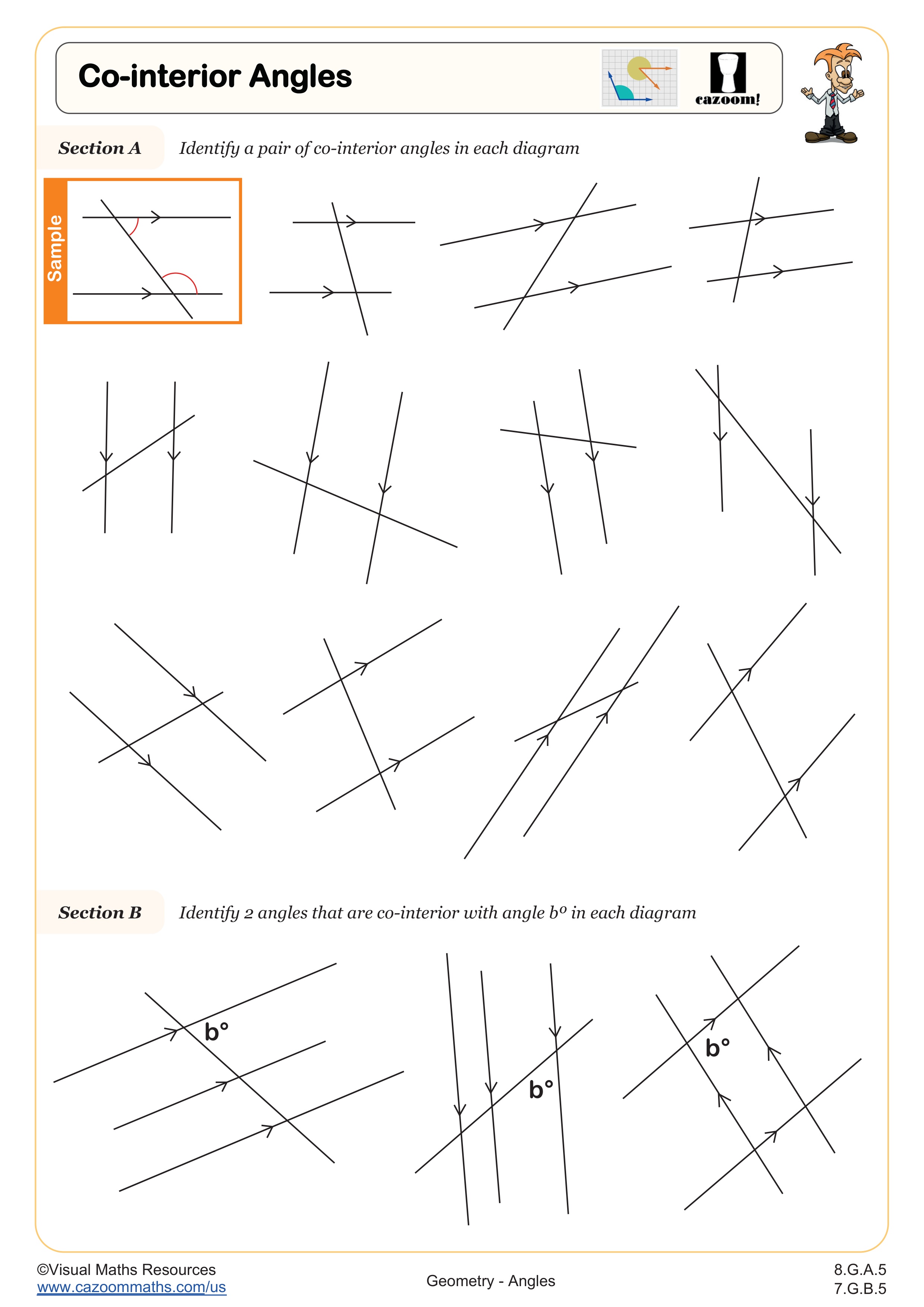
Co-interior angles, also called consecutive interior angles or same-side interior angles, are pairs of angles that lie between two parallel lines on the same side of a transversal. When two parallel lines are cut by a transversal, co-interior angles are always supplementary, meaning they add up to 180 degrees. This property distinguishes them from alternate interior angles, which are congruent, and makes them useful for proving lines are parallel or finding missing angle measures.
Students often lose points on standardized tests when they apply the wrong property to co-interior angles, treating them as congruent pairs instead of supplementary. Teachers can help students avoid this error by emphasizing the spatial relationship: co-interior angles are on the same side of the transversal and inside the parallel lines, forming a "C" or backward "C" shape. Practice problems that mix different angle relationships help students strengthen their ability to identify and apply the correct theorem.
What Should 8th Graders Know About Angles?
By 8th grade, students should confidently identify and work with all angle relationships created when parallel lines are cut by a transversal, including corresponding angles, alternate interior angles, alternate exterior angles, and co-interior angles. They should apply these angle theorems to write and solve equations for unknown angle measures, often incorporating variables and multi-step algebraic reasoning. The Common Core State Standards expect students to use informal arguments to establish geometric facts, making angle relationships a key area for developing mathematical reasoning skills.
This work builds directly on 7th grade studies of supplementary, complementary, and vertical angles while preparing students for high school geometry proofs. Many teachers find that students who struggle with angle relationships in 8th grade often need to revisit the foundational concept that a straight line measures 180 degrees. Once students solidify this understanding, they typically make faster progress with more complex angle problems involving algebraic expressions and multi-step reasoning.
How Do You Use Co-Interior Angles to Solve Problems?
To solve problems involving co-interior angles, students first identify the angle pair by locating two angles between parallel lines on the same side of the transversal. Since co-interior angles are supplementary, students set up an equation where the two angle measures sum to 180 degrees. When one or both angles contain variables, students solve algebraically, then substitute back to find each individual angle measure. This process reinforces equation-solving skills while building geometric reasoning.
Co-interior angles appear frequently in architectural design and construction, particularly when calculating roof pitch angles or designing staircases with parallel stringers. Engineers use these angle relationships when analyzing truss systems in bridges, where parallel members intersected by diagonal supports must maintain specific angle sums to distribute weight properly. Understanding co-interior angles also helps students recognize why certain angles in polygon tessellations must be supplementary for the pattern to work without gaps, connecting geometry to art and design applications.
How Can Teachers Use These Angles Worksheets Effectively?
The worksheets provide structured practice with co-interior angles, progressing from basic identification to multi-step algebraic problems. Each problem set includes diagrams with parallel lines and transversals, requiring students to identify co-interior angle pairs, write equations using the supplementary property, and solve for unknown values. The included answer keys allow students to check their work independently, helping them catch conceptual errors before they become habits. Teachers often use these materials to assess whether students can distinguish co-interior angles from other angle relationships.
These worksheets work well as intervention tools for students who struggle to differentiate between angle theorems, offering focused practice on one specific relationship. Many teachers assign them as homework after introducing co-interior angles in class, then use student errors to guide small-group instruction the following day. The worksheets also serve as effective review before unit assessments or state tests, particularly when paired with mixed practice covering all parallel line angle relationships. Some teachers find success using them during paired work, where students explain their reasoning to each other and catch misapplications of angle theorems.