8th Grade Area and Perimeter Worksheets
All worksheets are created by the team of experienced teachers at Cazoom Math.
What geometric concepts do 8th graders practice with area and perimeter?
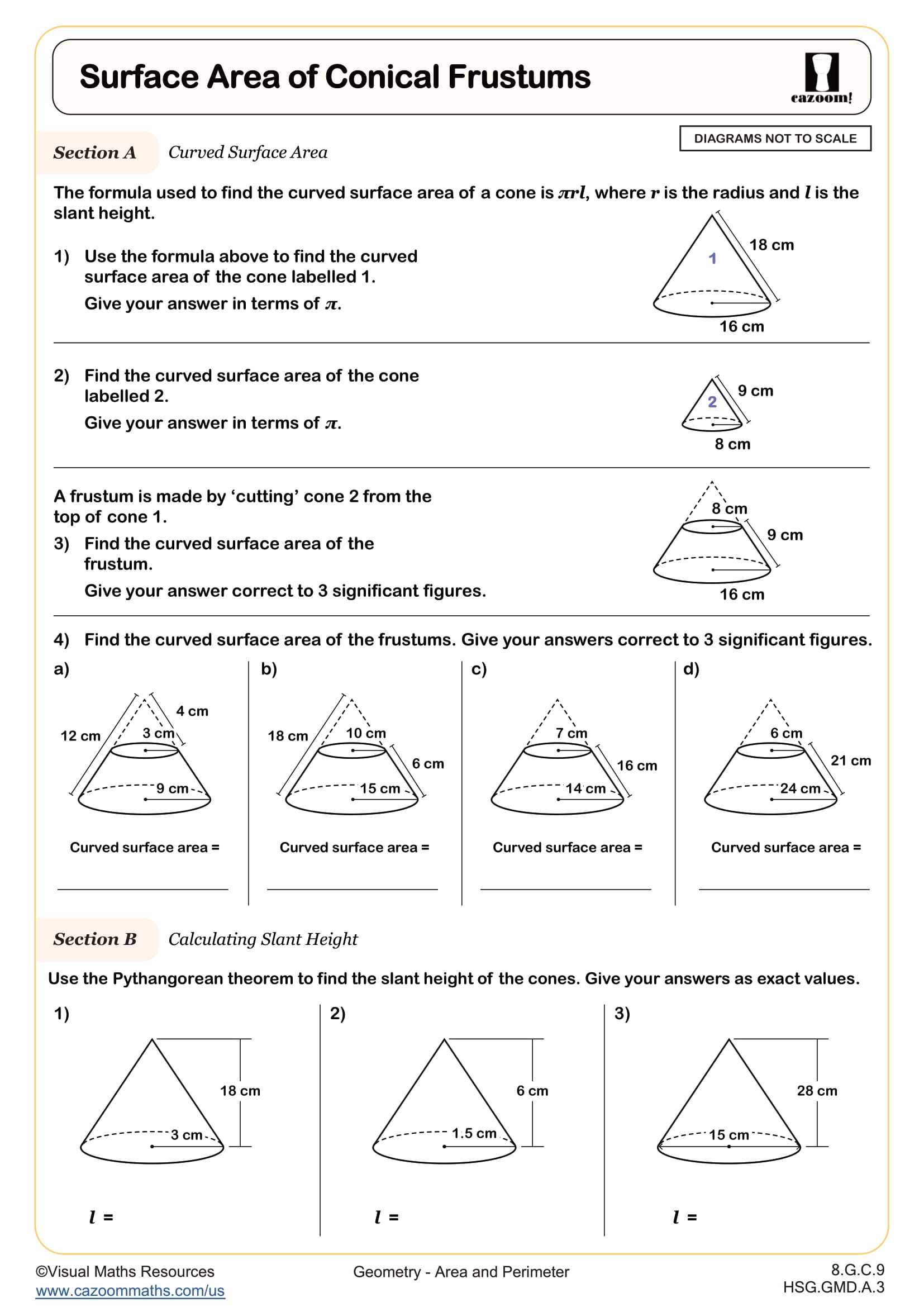
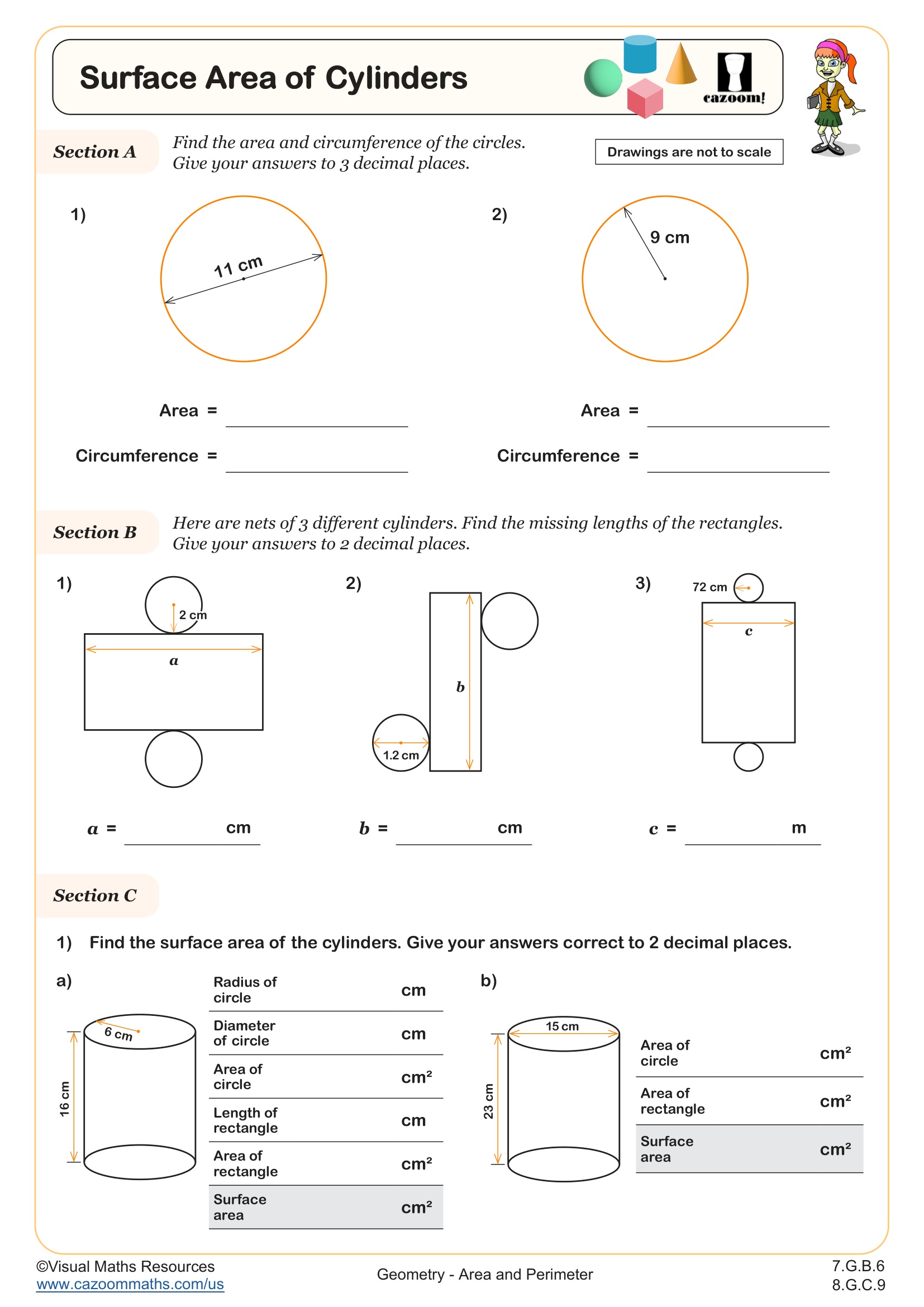
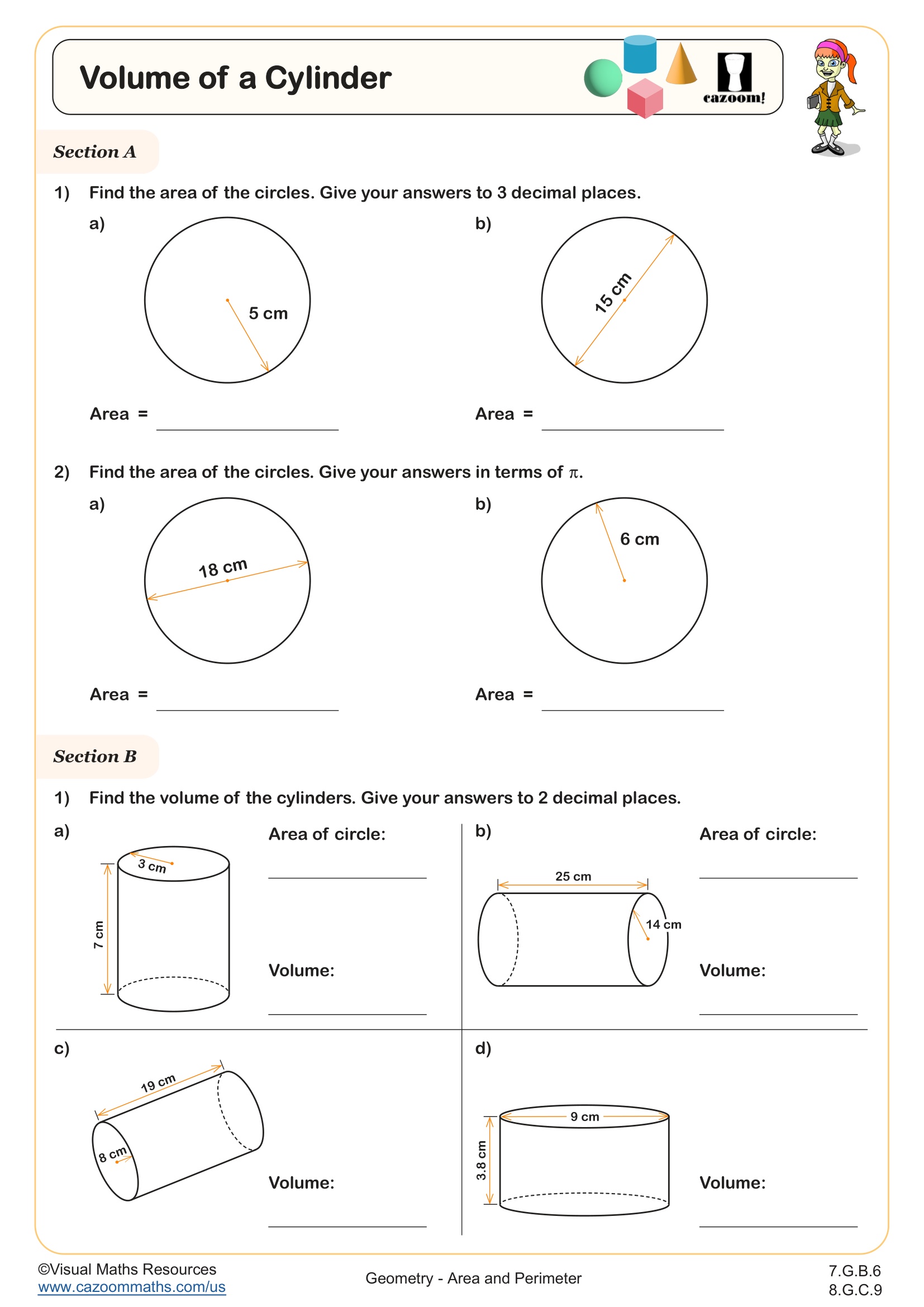
At the 8th grade level, area and perimeter work extends into composite figures, three-dimensional surface area, and problems where finding perimeter or area requires applying the Pythagorean Theorem first. Students calculate surface area of cylinders and more complex solids like conical frustums, determine volumes, and solve multi-step problems that combine measurement with algebraic thinking. This aligns with Common Core Standard 8.G.C.9, which expects students to apply volume formulas for cylinders, cones, and spheres.
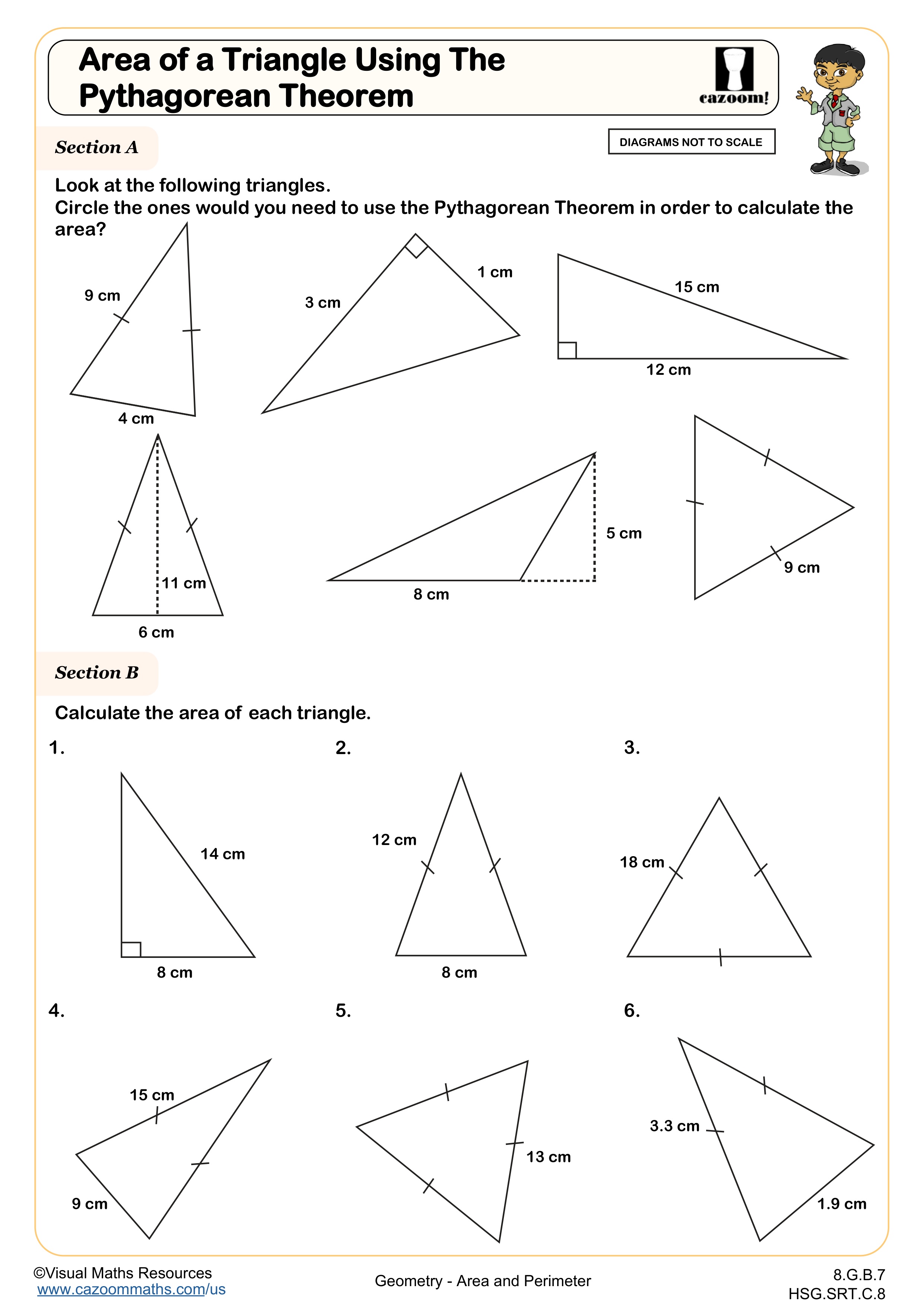
Students often struggle when a problem doesn't explicitly state which formula to use or when they must find a missing dimension before calculating area. A triangle area problem might require using the Pythagorean Theorem to determine the height first, then applying the area formula. Teachers notice that students who methodically label diagrams and write out their solution steps catch these hidden requirements, while those who rush to plug numbers into formulas miss the multi-step nature of the problem entirely.
How does 8th grade area and perimeter build on earlier learning?
By 8th grade, students should confidently recall area formulas for triangles, rectangles, parallelograms, and circles, along with perimeter calculations for polygons and circumference for circles. They've worked with the Pythagorean Theorem in 7th or early 8th grade and understand how to find missing side lengths in right triangles. The new challenge comes from combining these skills rather than learning formulas from scratch. Problems now require deciding which tools to use and in what order.
This groundwork prepares students for high school geometry, where they'll encounter proofs about area relationships, work with irregular polygons, and apply these concepts to trigonometry and coordinate geometry. Many students make the connection between surface area problems and real manufacturing questions when teachers point out that material costs, paint coverage, and packaging all depend on accurate surface area calculations. Students who master multi-step area and perimeter problems in 8th grade enter algebra and geometry courses with stronger problem-solving frameworks.
How do students use the Pythagorean Theorem with area and perimeter?
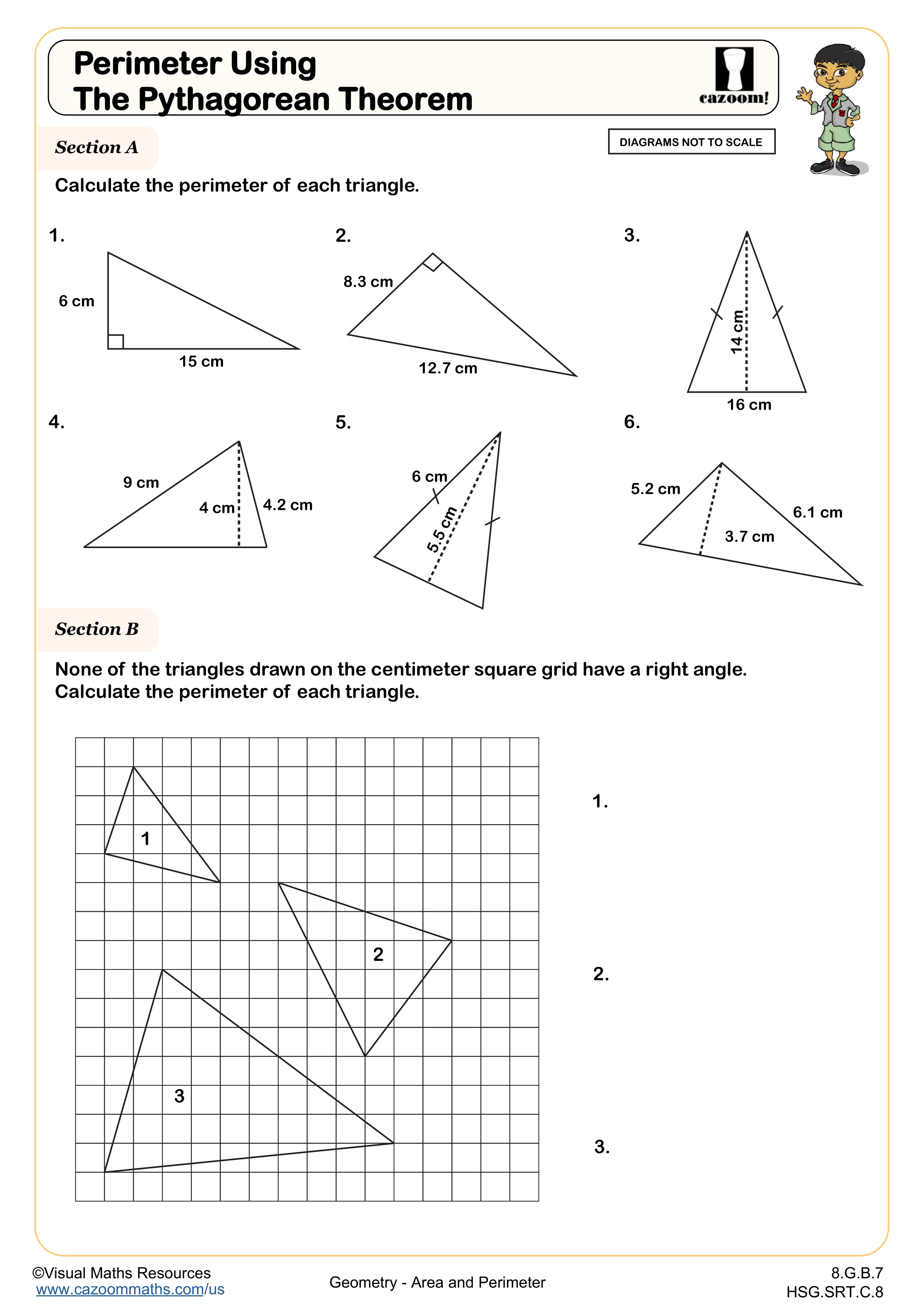
The Pythagorean Theorem becomes a necessary first step when students need to find a missing dimension before calculating area or perimeter. For example, finding the area of a triangle might require using a² + b² = c² to determine the height from given side lengths. Similarly, perimeter problems involving right triangles often provide two sides and expect students to calculate the third before adding all sides together. This integration tests whether students recognize when the theorem applies and can sequence their problem-solving steps correctly.
This skill connects directly to construction, architecture, and engineering fields where workers must calculate material needs for triangular roof sections, diagonal bracing, or sloped surfaces. Roofing contractors determine shingle quantities by calculating surface area of triangular gables after using slope measurements to find actual dimensions. Structural engineers specify steel beams for diagonal supports by first calculating exact lengths, then determining surface area for corrosion-resistant coatings. These real-world applications show students why geometric problem-solving matters beyond the classroom and how professionals layer mathematical techniques to solve practical challenges.
How can teachers use these area and perimeter worksheets effectively?
These worksheets provide targeted practice on specific geometric calculations that 8th graders need to master, from cylinder surface area to Pythagorean applications in measurement. The progression allows teachers to assign particular skills based on formative assessment results rather than cycling through generic review. Students working on volume might need the cylinder worksheet, while those struggling with composite problem-solving benefit more from the Pythagorean Theorem applications. The answer keys let students check their work independently, which helps them identify whether errors stem from formula mistakes, calculation errors, or misreading diagrams.
Many teachers use these worksheets during small-group intervention time, assigning different problems based on individual student needs shown on recent quizzes or state assessment practice. They work well as homework following initial instruction, giving students necessary repetition without requiring teacher supervision. Some teachers create worksheet stations where student pairs work through problems together, comparing solution methods and catching each other's errors before checking the answer key. This approach builds mathematical communication skills while reinforcing geometric concepts that standardized tests assess heavily.