8th Grade Division Worksheets
All worksheets are created by the team of experienced teachers at Cazoom Math.
What division skills should 8th graders focus on?
Eighth graders should master division of integers, rational numbers, and numbers in scientific notation, along with applying division in algebraic contexts like solving equations and working with rates. The Common Core State Standards expect students at this level to fluently divide with all rational numbers and understand division as multiplication by the reciprocal, a concept that becomes foundational for solving linear equations and working with proportional relationships.
Teachers notice that students often lose points on assessments when they correctly set up division problems but make sign errors with negative numbers or misplace decimal points. A breakthrough typically happens when students recognize that division problems can be rewritten as multiplication by a reciprocal, which helps them apply familiar multiplication rules and check their work more effectively.
Is division still important in 8th grade math?
Division remains crucial in 8th grade as it underpins solving linear equations, working with rational expressions, and understanding inverse operations. Students apply division when manipulating formulas, calculating unit rates, converting measurements, and analyzing proportional relationships. At this level, division moves beyond basic computation to become a tool for algebraic thinking and problem-solving across multiple mathematical domains.
This builds directly on 7th grade work with rational number operations and prepares students for high school algebra, where division of polynomials and rational expressions requires solid foundational skills. Students who enter high school without automatic division fluency often struggle with simplifying algebraic fractions and solving complex equations, making 8th grade a critical year for cementing these skills.
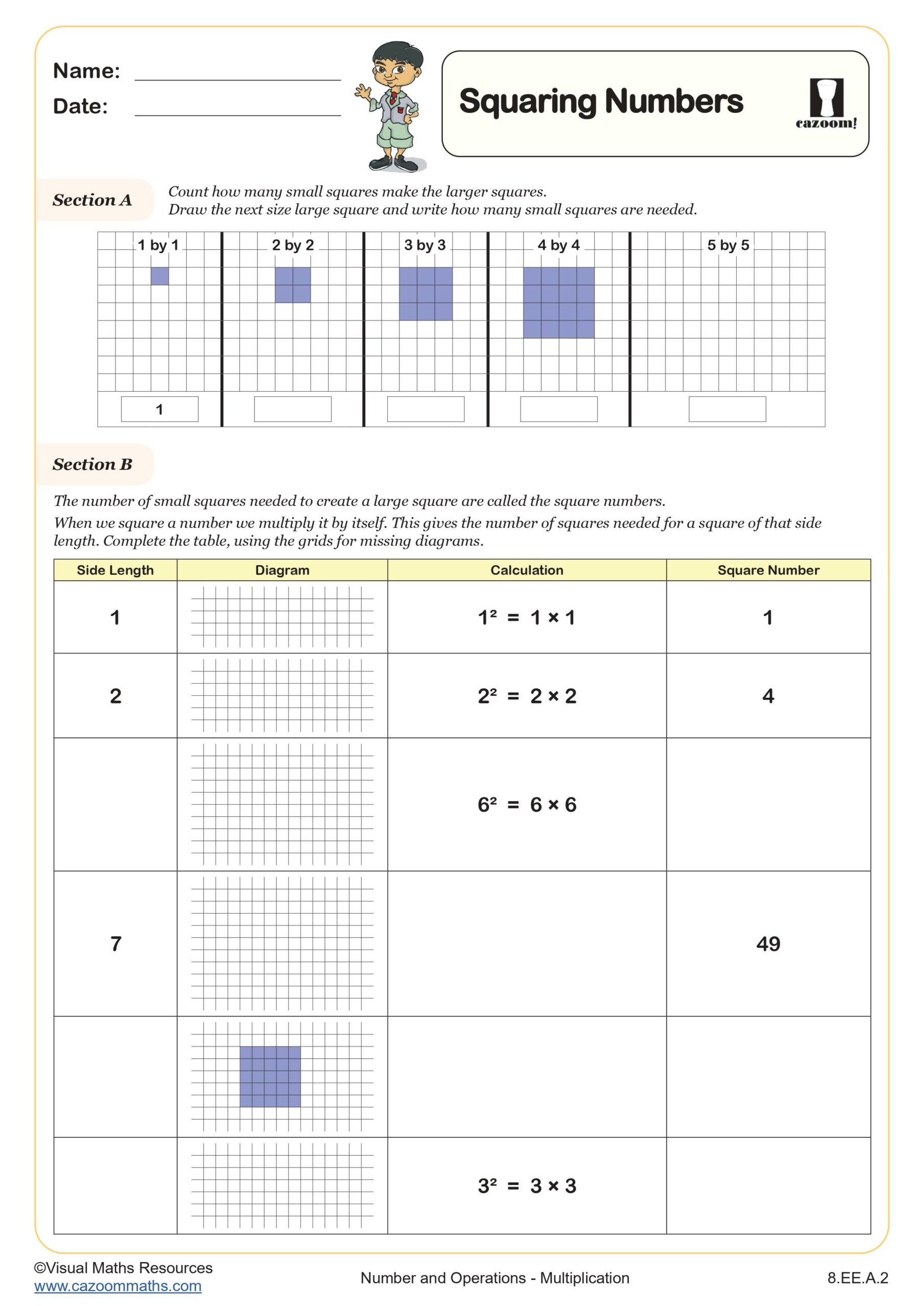
How does squaring numbers relate to division?
Squaring numbers connects to division through inverse operations and problem-solving contexts where students must work backward from a squared value. Understanding that squaring and taking square roots are inverse operations parallels how multiplication and division are inverses, helping students recognize patterns in mathematical relationships. Students also encounter division when simplifying expressions with squared terms or calculating with perfect squares in fraction form.
This concept appears in real-world STEM applications like calculating areas and working with the Pythagorean theorem. Engineers use squared values when determining load distributions, and physicists apply squaring in formulas for kinetic energy and gravitational force. When students understand how to manipulate squared terms through division, they gain tools for solving authentic problems in physics, engineering, and data analysis where squared relationships are common.
How can teachers use these division worksheets effectively?
The worksheets provide structured practice that allows teachers to target specific skill gaps while building computational fluency. With complete answer keys included, students can work independently and self-check their progress, freeing teachers to provide targeted support to individuals who need additional help. The PDF format makes it easy to project problems for whole-class instruction or print copies for individual work.
Many teachers find these worksheets useful for warm-up activities at the start of class, homework assignments that reinforce lesson content, or intervention work with students who need extra practice before assessments. They work well in paired problem-solving sessions where students can discuss strategies and catch each other's errors. Teachers also use them for spiral review, ensuring students maintain division fluency while learning new topics throughout the school year.