8th Grade Fractions, Decimals, Percents Worksheets
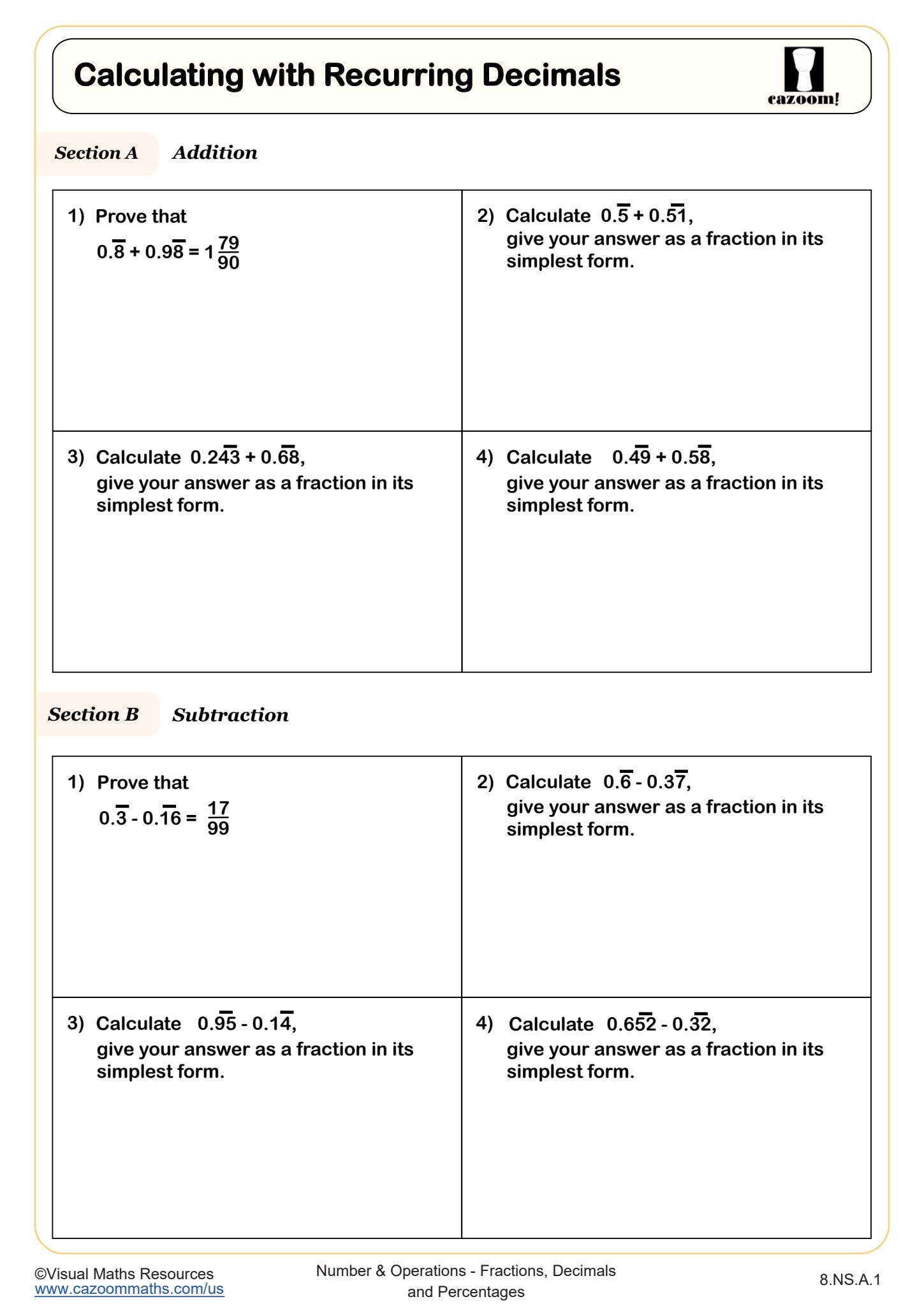
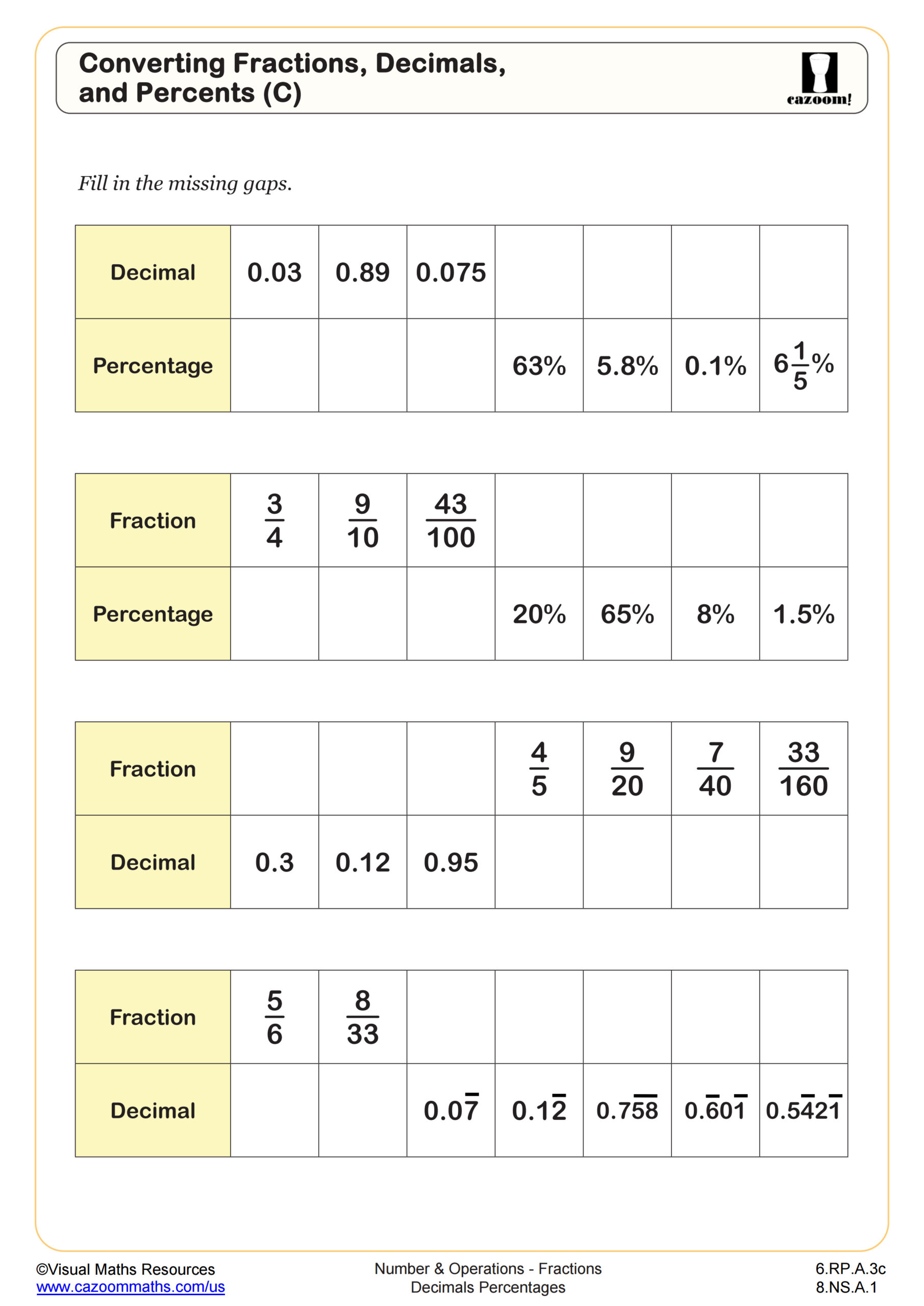
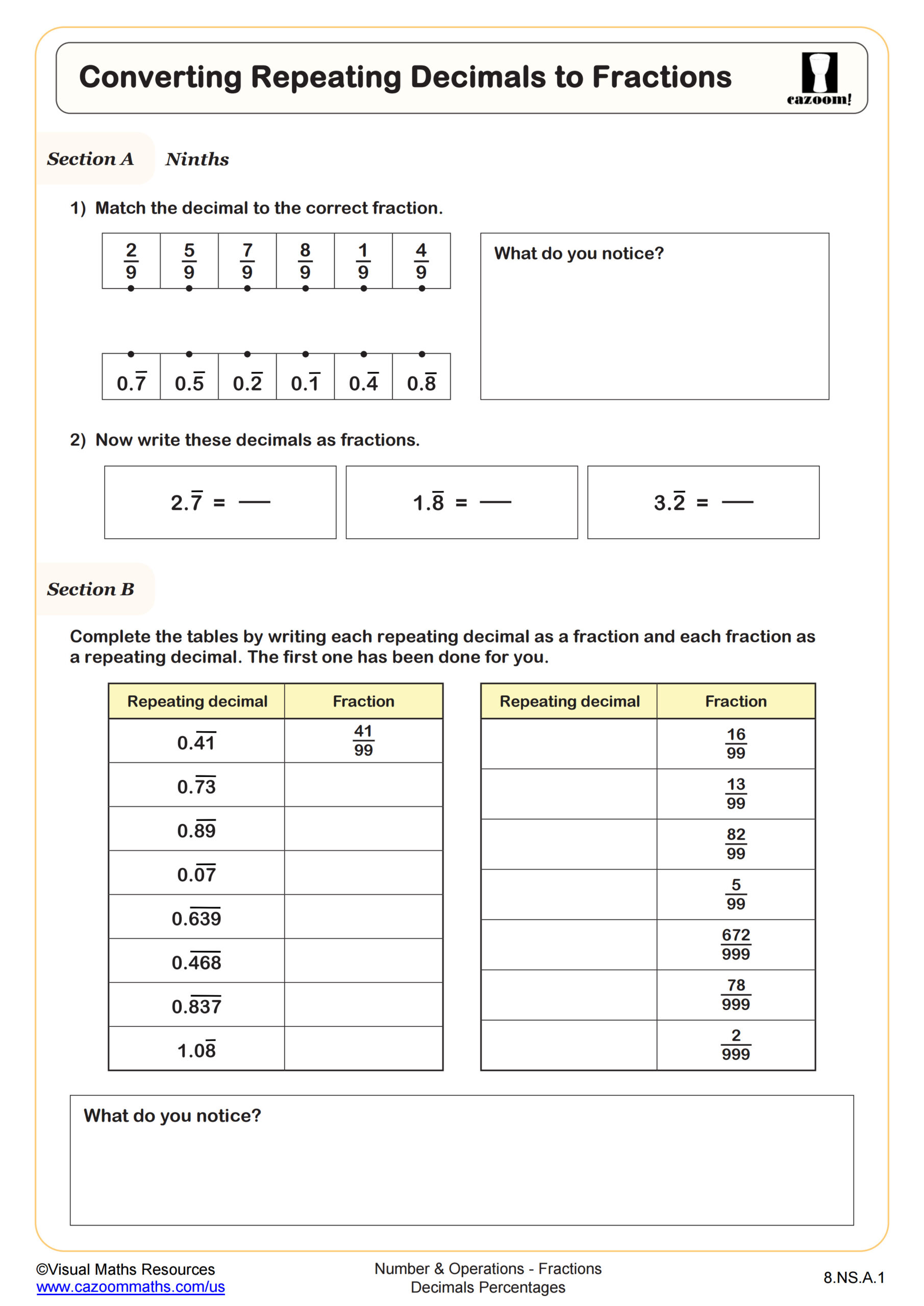
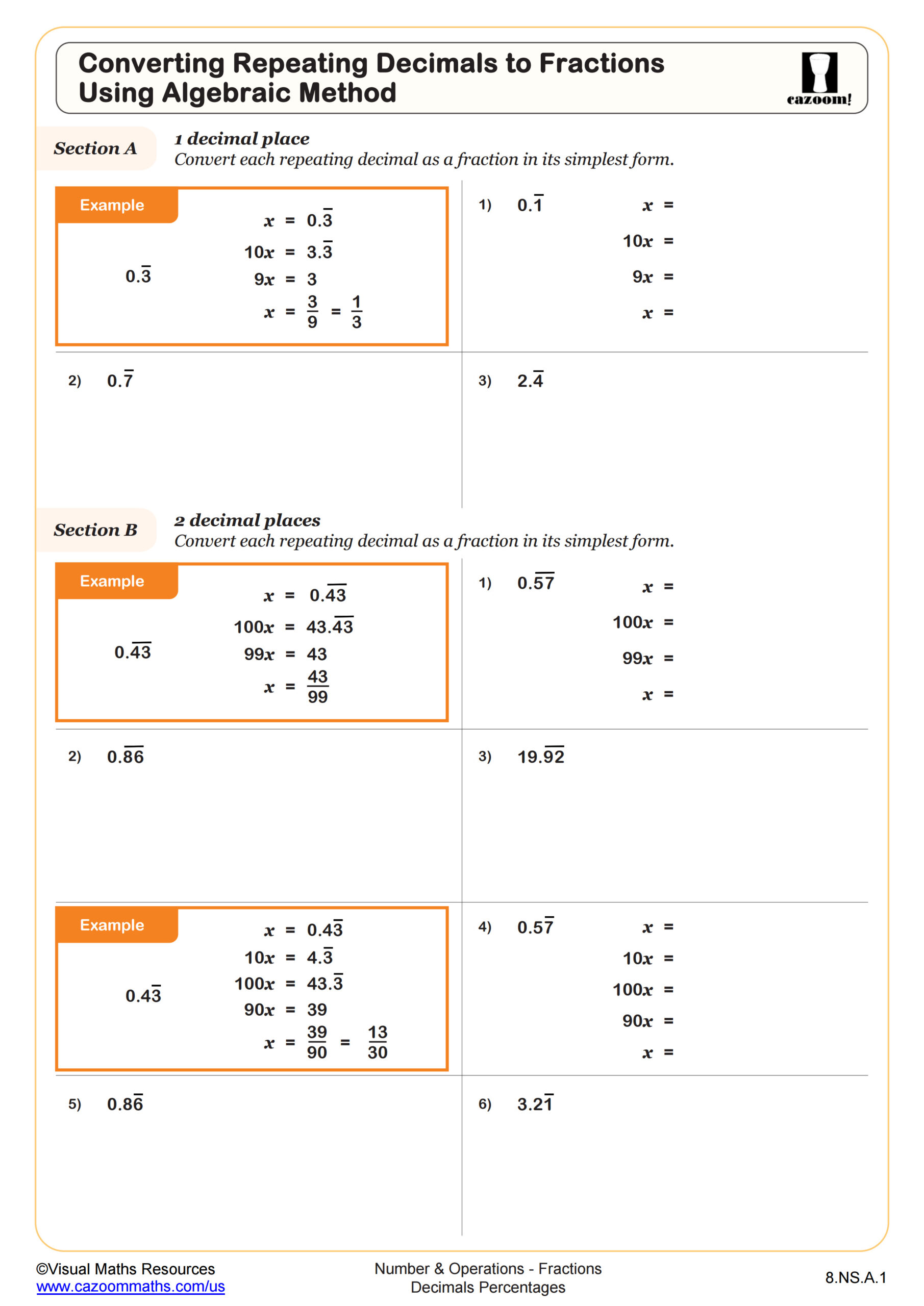
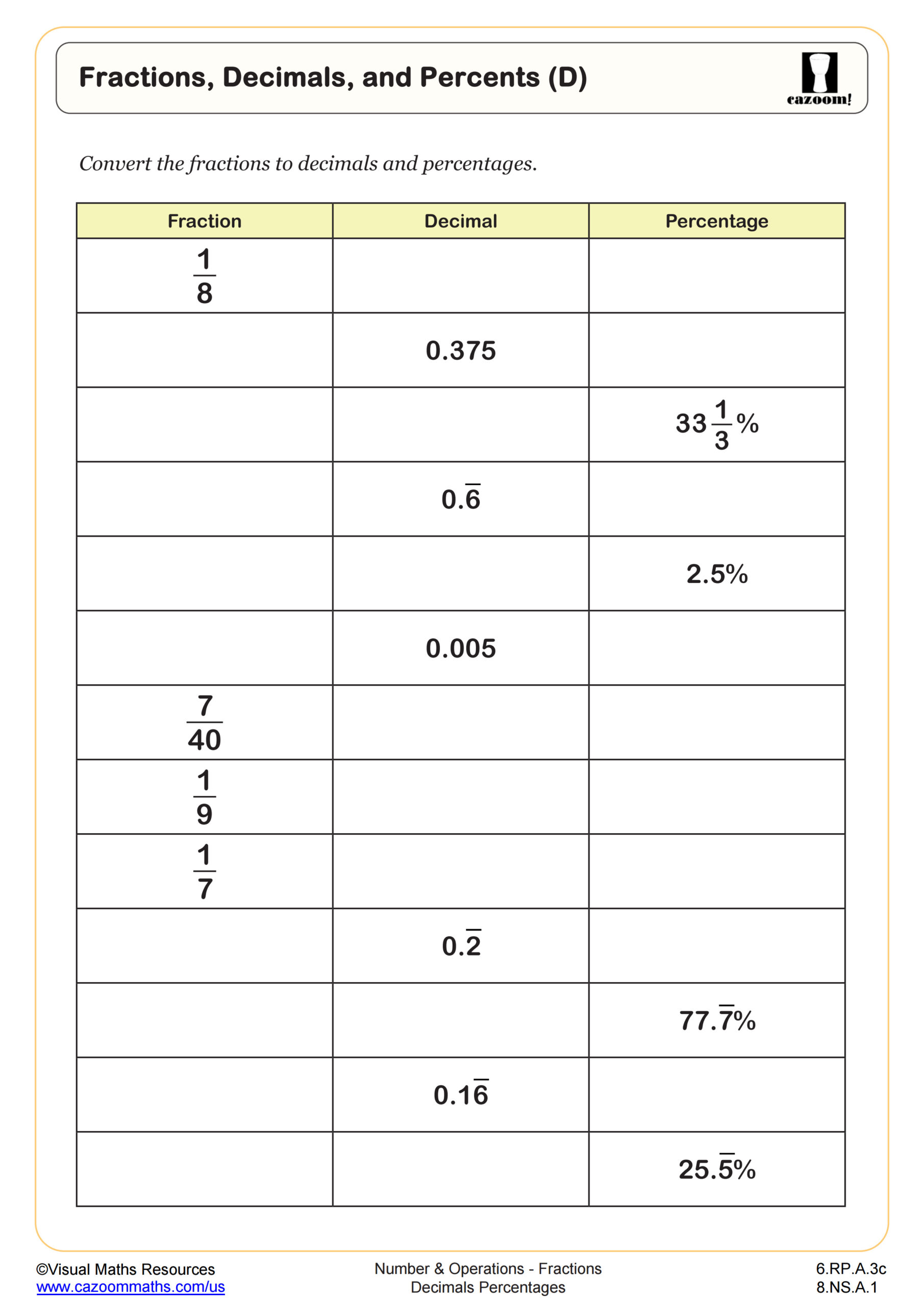
All worksheets are created by the team of experienced teachers at Cazoom Math.
What makes a good fractions to decimals worksheet 8th grade appropriate?
Quality 8th grade fractions worksheets should align with Common Core Standard 8.NS.A.1, requiring students to convert rational numbers to decimal form and understand that rational numbers have decimal expansions that terminate or repeat. The problems should progress from simple fractions with denominators that are factors of powers of 10 to more complex fractions requiring long division.
Teachers notice students often make procedural errors when dividing, particularly losing track of place value during long division or misplacing decimal points. The most effective worksheets include fraction-to-decimal conversions that result in both terminating decimals like 3/8 = 0.375 and repeating decimals like 1/3 = 0.333..., helping students recognize patterns and understand why certain fractions produce repeating decimals.
How do 8th grade fraction skills build from earlier grades?
Eighth graders arrive with foundational skills from 6th and 7th grade work with ratios, proportions, and basic decimal operations. However, 8th grade expectations require students to work with irrational numbers and understand the complete rational number system, making fraction-decimal-percent conversions more sophisticated than elementary approaches that relied primarily on memorization.
Many teachers find that students can handle basic conversions but struggle when problems involve negative numbers or require them to express answers in multiple forms. The converting repeating decimals to fractions worksheet 8th grade pdf format allows students to see the algebraic reasoning behind these conversions, preparing them for high school algebra where this symbolic manipulation becomes routine.
Why do students find converting repeating decimals to fractions challenging?
Converting repeating decimals to fractions requires algebraic thinking that many 8th graders find abstract. Students must set up equations like x = 0.636363... and then manipulate 100x - x = 63 to solve for the fractional form. This process combines decimal understanding, equation solving, and fraction simplification in ways that feel disconnected from their previous math experiences.
Classroom observations show students often make errors in the setup phase, forgetting to multiply by the appropriate power of 10 based on the repeating block length. They also struggle with simplifying the resulting fraction, particularly when the numerator involves subtraction like 63 - 0 = 63. Systematic practice with these multi-step conversions builds confidence and procedural fluency.
How can teachers use these worksheets most effectively in their instruction?
Teachers report the most success when they use these fractions decimals and percents worksheets grade 8 as guided practice during the learning phase rather than independent work immediately after introducing concepts. The answer keys allow for immediate feedback, which helps prevent students from practicing incorrect procedures that become difficult to unlearn later.
Effective implementation often involves having students work problems in pairs or small groups, discussing their reasoning before checking answers. This collaborative approach helps students catch common errors like misplacing decimal points or incorrectly identifying repeating patterns. Teachers also find value in having students verify their conversions by working backwards, such as converting their fraction answer back to a decimal to confirm accuracy.