8th Grade Function Machines Worksheets
All worksheets are created by the team of experienced teachers at Cazoom Math.
What Are Function Machines and Why Do Students Learn Them?
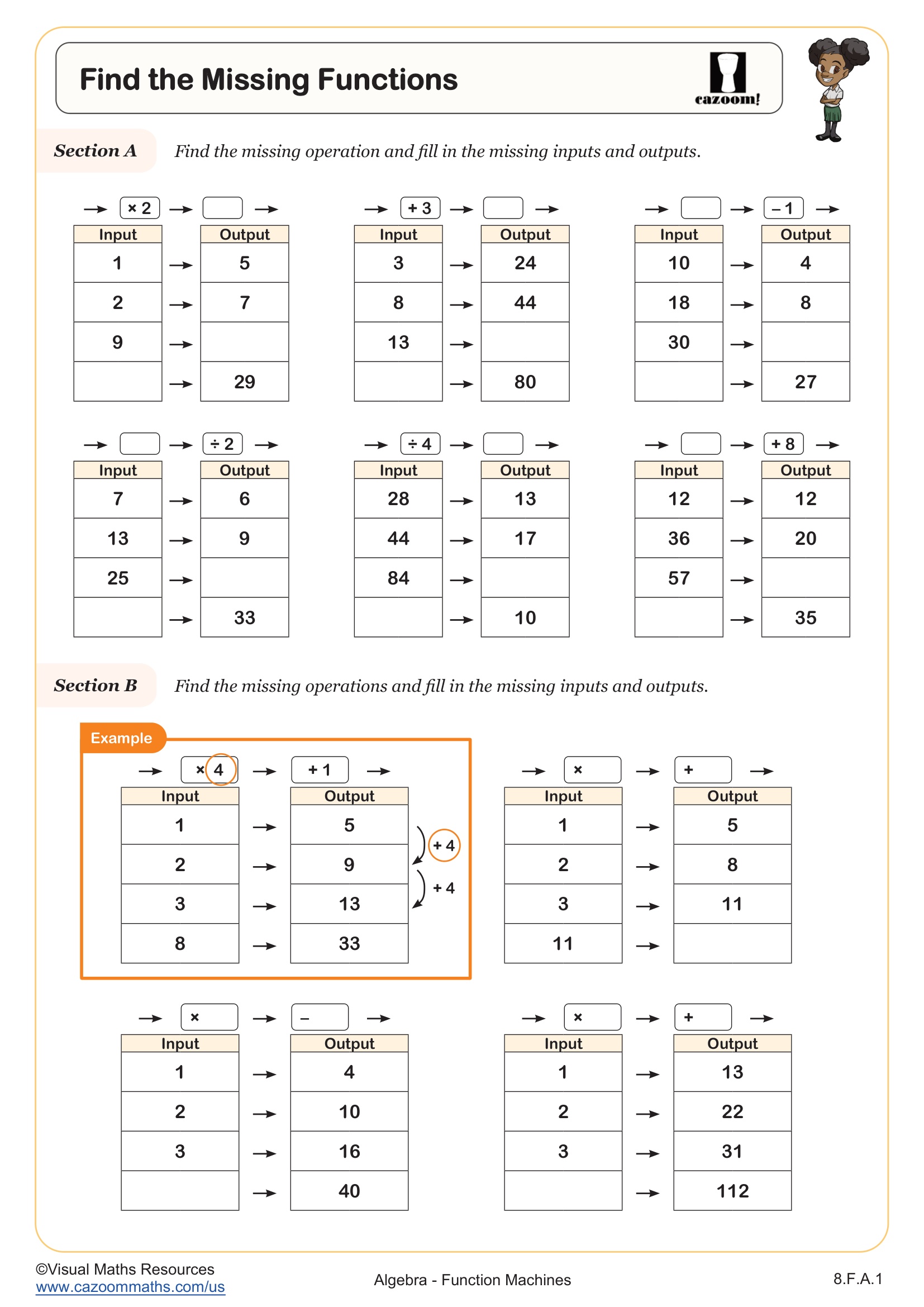
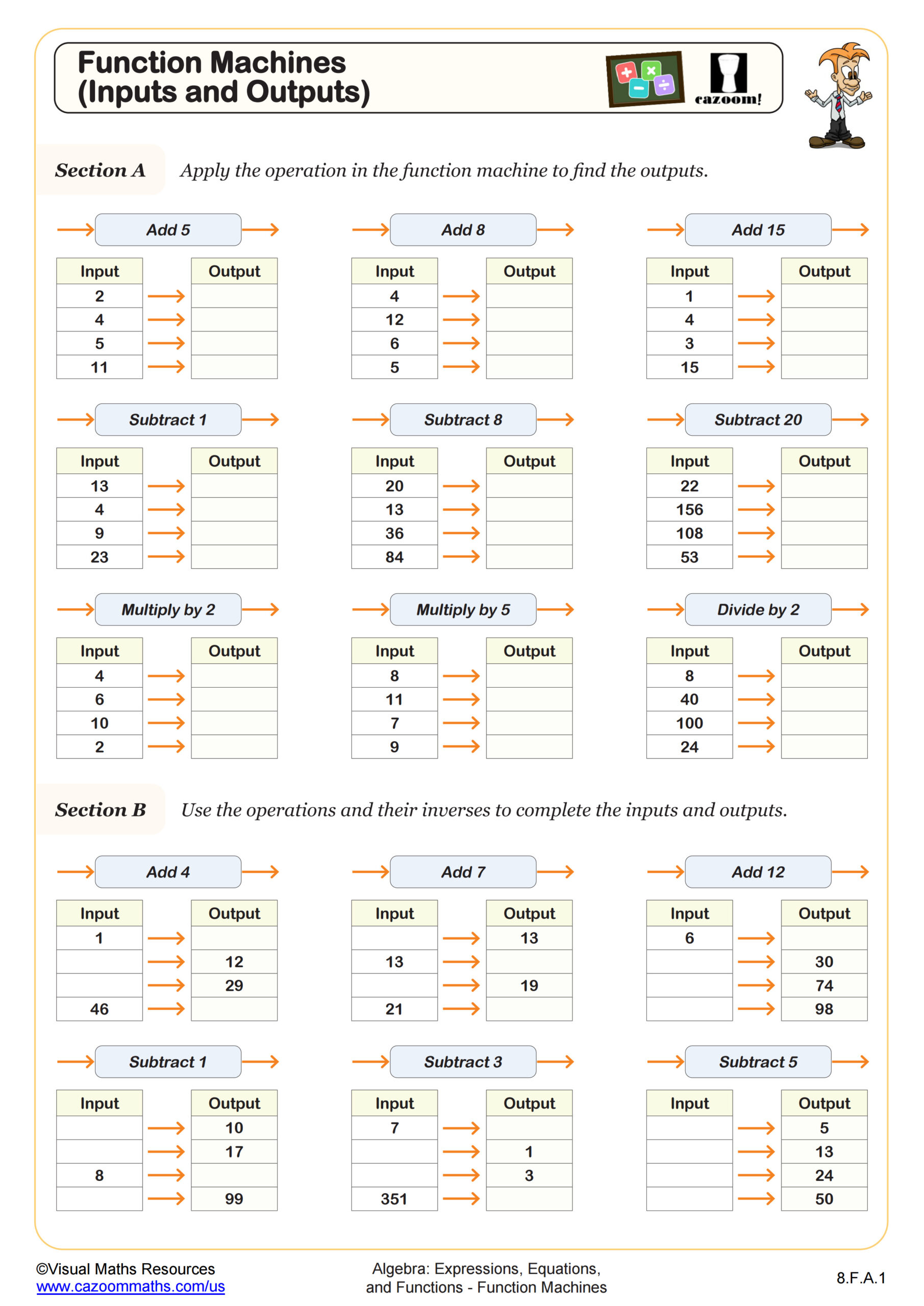
Function machines are visual representations that show how an input value is transformed by a mathematical rule to produce an output value. Students learn them in 8th grade as a bridge between arithmetic patterns and formal function notation, helping them understand that functions are consistent rules that produce exactly one output for each input. This conceptual model aligns with Common Core Standard 8.F.A.1, which requires students to understand that a function assigns each input exactly one output.
Students frequently confuse the function rule with the output itself, writing "output = 12" instead of recognizing that "multiply by 3" is the rule that transforms an input of 4 into an output of 12. The function machine diagram helps clarify this distinction by physically separating the input, the transformation process, and the output into distinct visual components that students can identify and label separately.
Which Grade Levels Use Function Machine Worksheets?
These function machine worksheets are designed specifically for 8th grade middle school students who are developing their understanding of functions and algebraic thinking. At this level, students transition from recognizing numerical patterns to representing those patterns with variables and algebraic expressions, preparing them for high school algebra courses where function notation and transformations become more abstract.
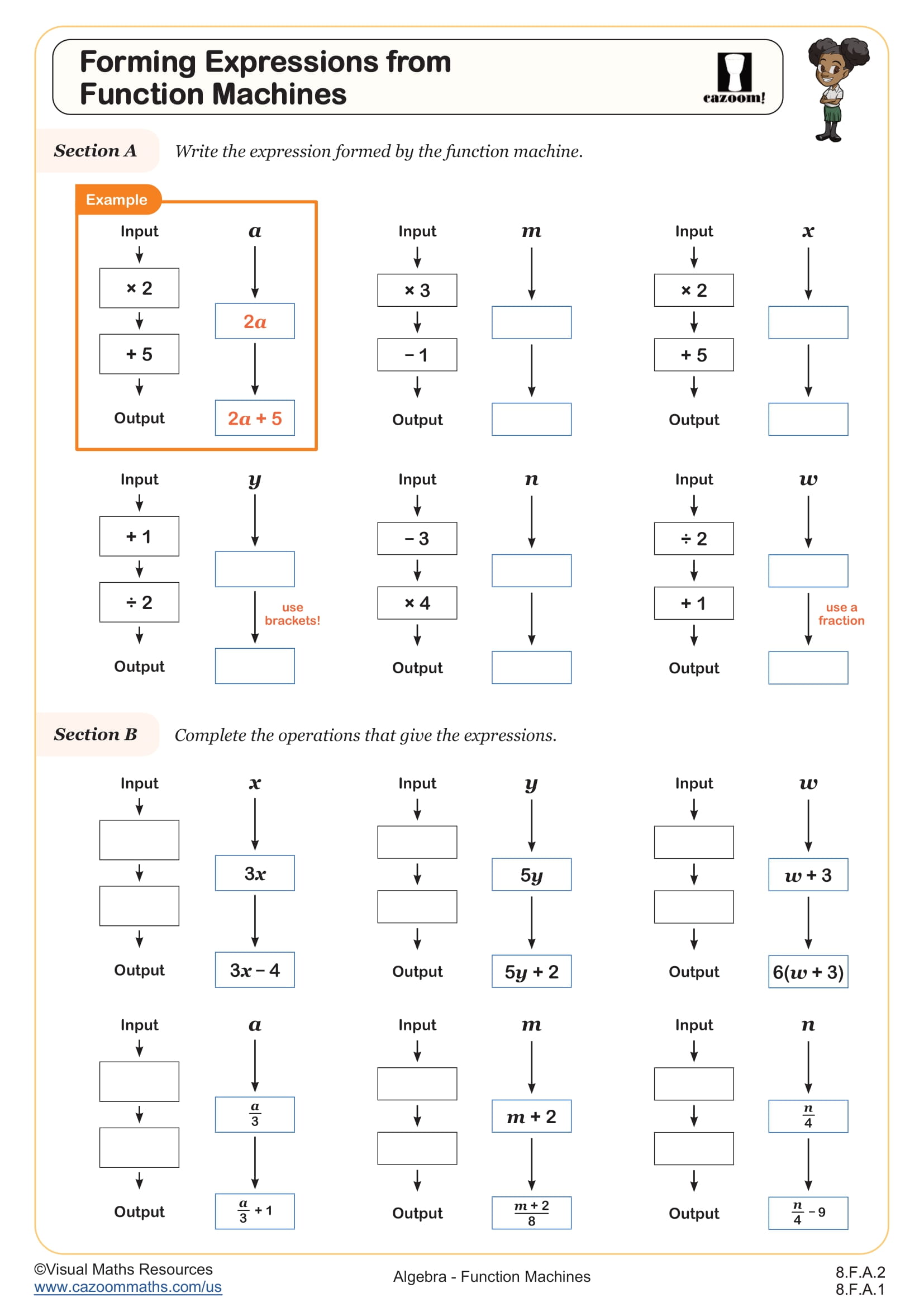
The worksheets progress in difficulty from identifying simple patterns in function machines to forming algebraic expressions that represent the function rules. Early problems might show a machine that adds 5 to any input, while more advanced problems require students to work backwards from multiple input-output pairs to determine the function rule, or to write expressions like "2x + 3" based on the operations shown in the machine diagram.
How Do Function Machines Help Students Form Algebraic Expressions?
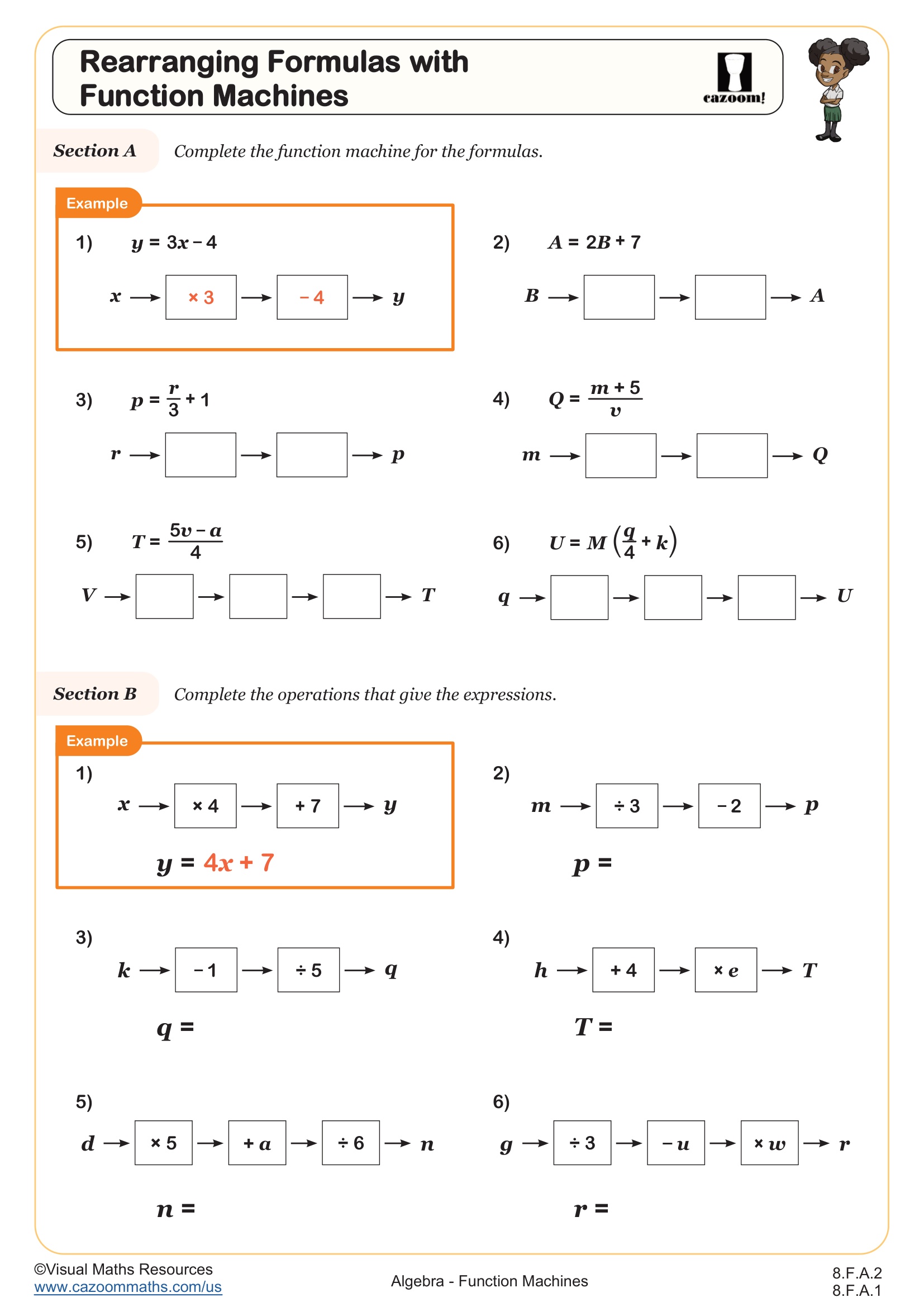
Forming expressions from function machines teaches students to translate visual representations and verbal descriptions into algebraic notation. When students see a function machine with two operations, such as "multiply by 4, then subtract 2," they learn to write this as the expression 4x - 2, understanding that x represents any possible input value. This skill directly connects to writing equations and inequalities that model real situations.
This concept appears constantly in STEM fields, particularly computer programming and data analysis. Software engineers write functions that transform input data according to specific rules, exactly like function machines. A temperature conversion app, for example, uses the function (9/5)C + 32 to transform Celsius inputs into Fahrenheit outputs, and data scientists create functions that transform raw sensor readings into meaningful measurements, making function machines a foundational concept for computational thinking.
How Can Teachers Use These Function Machine Worksheets Effectively?
The worksheets scaffold student learning by starting with concrete examples where students can identify patterns through observation before moving to abstract algebraic representation. Students work through complete function machine diagrams with multiple examples, then progress to finding missing components, and finally to creating their own algebraic expressions based on the patterns they observe. The answer keys allow students to check their work independently and identify which types of problems need more attention.
Many teachers use these worksheets for differentiated small group instruction, where struggling students benefit from the visual nature of function machines while advanced students tackle the expression-writing challenges. The worksheets work well as homework to reinforce classroom instruction, as warm-up activities to activate prior knowledge before introducing function notation, or as intervention materials for students who haven't yet made the connection between patterns and algebraic rules. Paired work is particularly effective, as students can discuss which operations they see in the function machine before writing the expression.