8th Grade Money and Time Worksheets
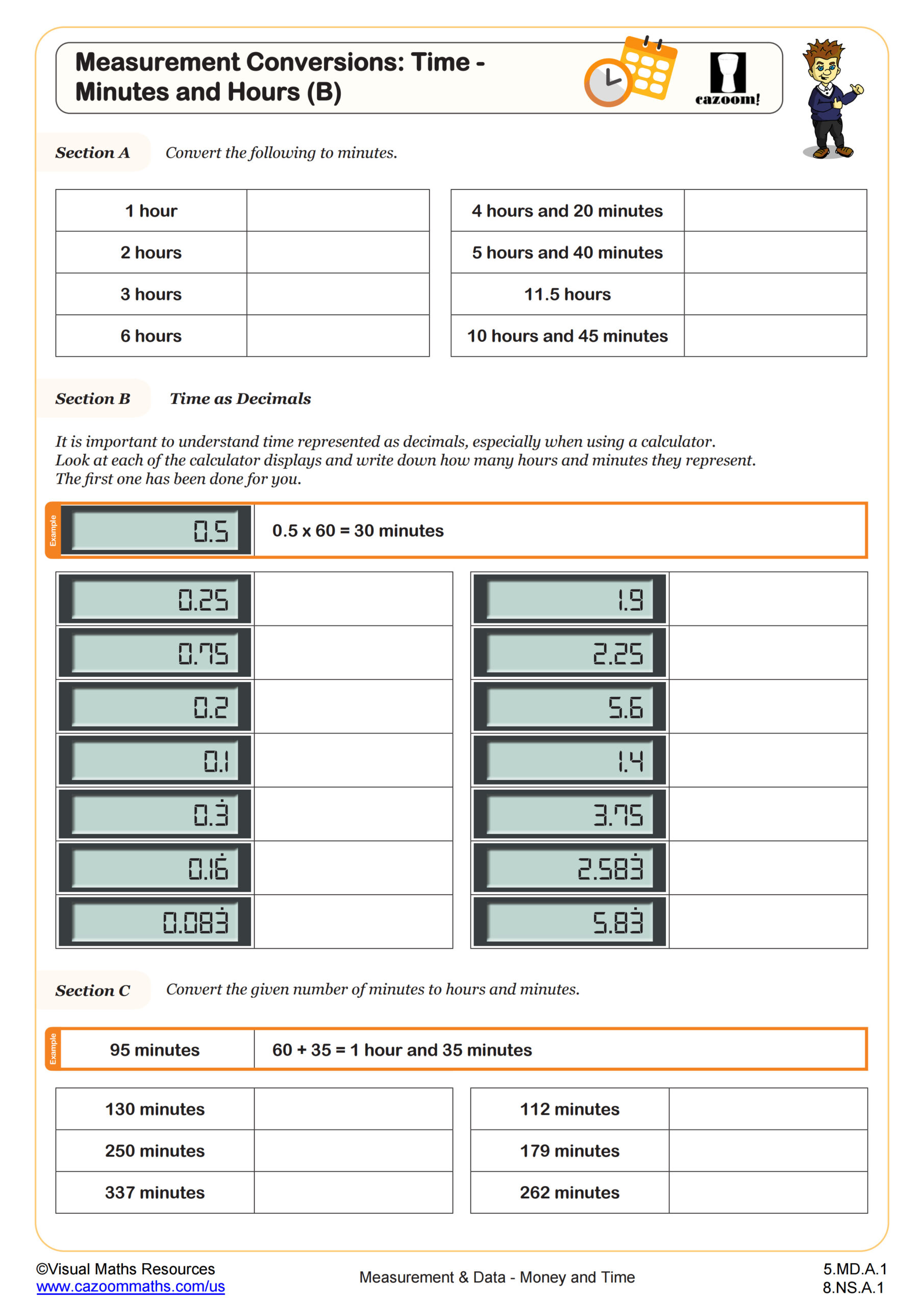
All worksheets are created by the team of experienced teachers at Cazoom Math.
Why Do 8th Graders Need to Practice Time Conversions?
Time conversions remain relevant in 8th grade mathematics because they support more complex problem-solving involving rates, proportions, and algebraic thinking. While students learned basic time conversions in elementary school, middle school math requires them to work with fractional hours, decimal representations, and multi-step problems that embed time conversions within larger contexts like distance-rate-time relationships or wage calculations.
Students lose points on standardized assessments when they misapply conversion factors or fail to recognize when a problem requires converting between units. A common error occurs when students multiply instead of divide (or vice versa) because they haven't developed a conceptual understanding of whether they're moving to a larger or smaller unit. Consistent practice with isolated conversion problems builds automaticity that transfers to more complex applications in algebra and science courses.
What Should 8th Grade Students Know About Time Measurement?
By 8th grade, students should fluently convert between minutes and hours using both whole numbers and decimals, understanding that 1 hour = 60 minutes as a conversion factor. They should recognize that 90 minutes equals 1.5 hours (not 1.9 hours, a surprisingly persistent misconception) and be able to express times like 2 hours and 45 minutes as 2.75 hours for algebraic calculations. This fluency directly supports their work with linear equations, rates of change, and proportional relationships throughout the Common Core 8th grade curriculum.
This topic builds on elementary school measurement work but prepares students for high school physics, where time conversions become essential for kinematics problems, and for Algebra I, where rate problems require comfortable manipulation of time units. Many students make the connection between time conversions and their earlier work with fraction-decimal equivalents once they recognize that converting 45 minutes involves finding 45/60 of an hour.
How Do You Convert Between Minutes and Hours?
Converting from minutes to hours requires dividing by 60 because there are 60 minutes in one hour. For example, 180 minutes ÷ 60 = 3 hours. Converting from hours to minutes requires multiplying by 60, so 2.5 hours × 60 = 150 minutes. Students often struggle when conversions involve decimals or remainders, particularly when converting times like 225 minutes (which equals 3.75 hours or 3 hours and 45 minutes) because they must decide whether to express answers as decimals or mixed units depending on the context.
Real-world applications appear constantly in STEM fields and everyday situations. Nurses calculate medication schedules across shifts measured in hours while individual doses are timed in minutes. Project managers convert task durations to create realistic timelines. Athletes and coaches analyze training data that combines hours of weekly practice with minute-by-minute performance metrics. Understanding these conversions ensures students can interpret schedules, calculate wages for partial hours worked, and make sense of data presented in different time units.
How Can Teachers Use These Time Conversion Worksheets?
The worksheets provide focused practice on the specific skill of converting between minutes and hours without the distraction of multi-step word problems, allowing students to build conversion fluency before applying it in complex contexts. The structured format helps teachers quickly identify whether students understand the directional nature of conversions (when to multiply versus divide) and whether they can work accurately with both whole numbers and decimals. Answer keys enable students to self-check during independent practice, promoting immediate feedback and error correction.
These materials work well as targeted intervention for students who show gaps in measurement skills during pre-algebra units on rates and proportions. Teachers often use them as warm-up activities before introducing distance-rate-time problems or as homework reinforcement when standardized test data reveals conversion weaknesses. They're also effective for paired work where students explain their conversion reasoning to each other, which surfaces misconceptions that silent individual practice might miss. The focused scope makes them suitable for quick formative assessment of this foundational skill.