8th Grade Properties of Shapes Worksheets
All worksheets are created by the team of experienced teachers at Cazoom Math.
What Are the Key Properties of Shapes Students Learn in 8th Grade?
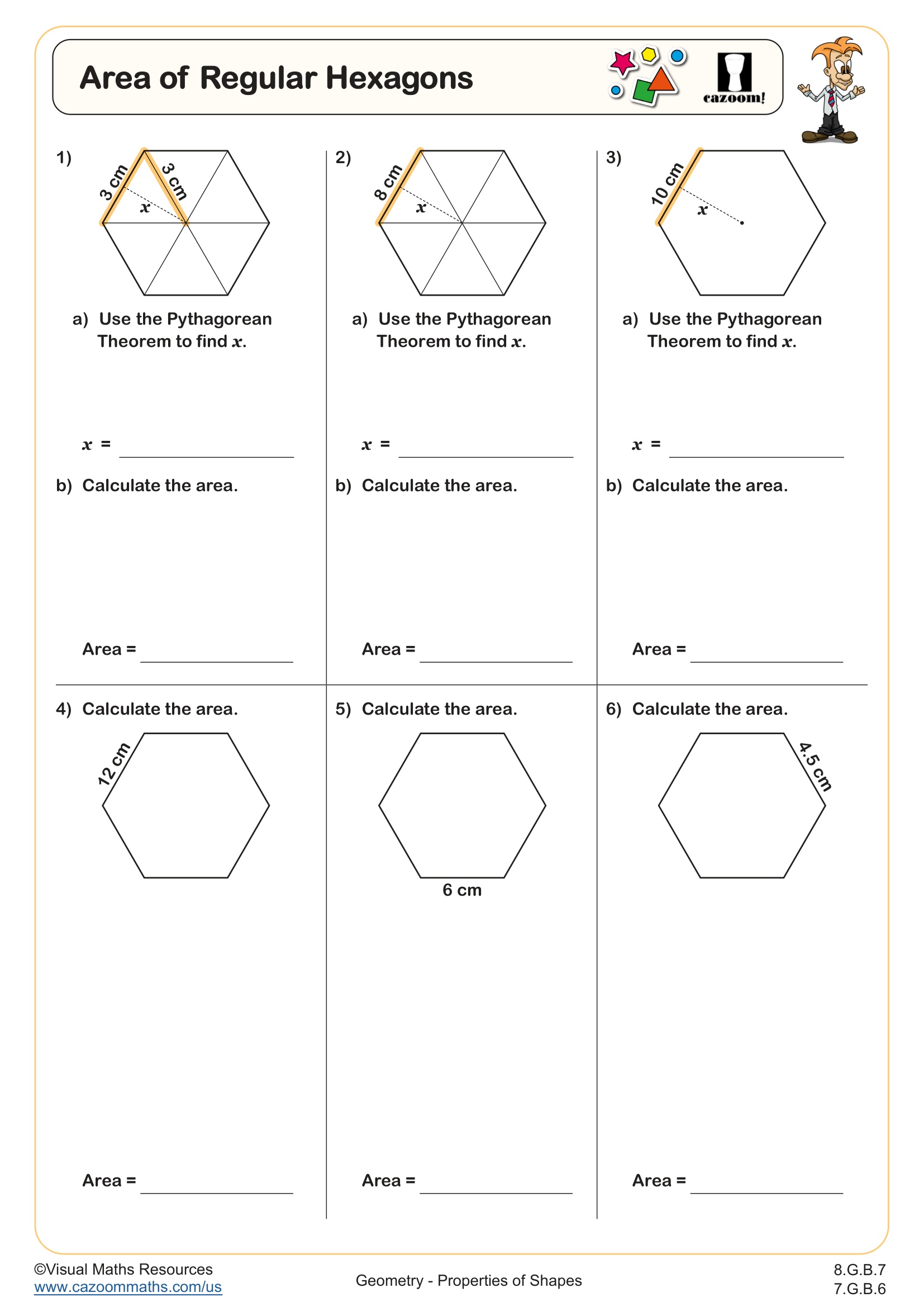
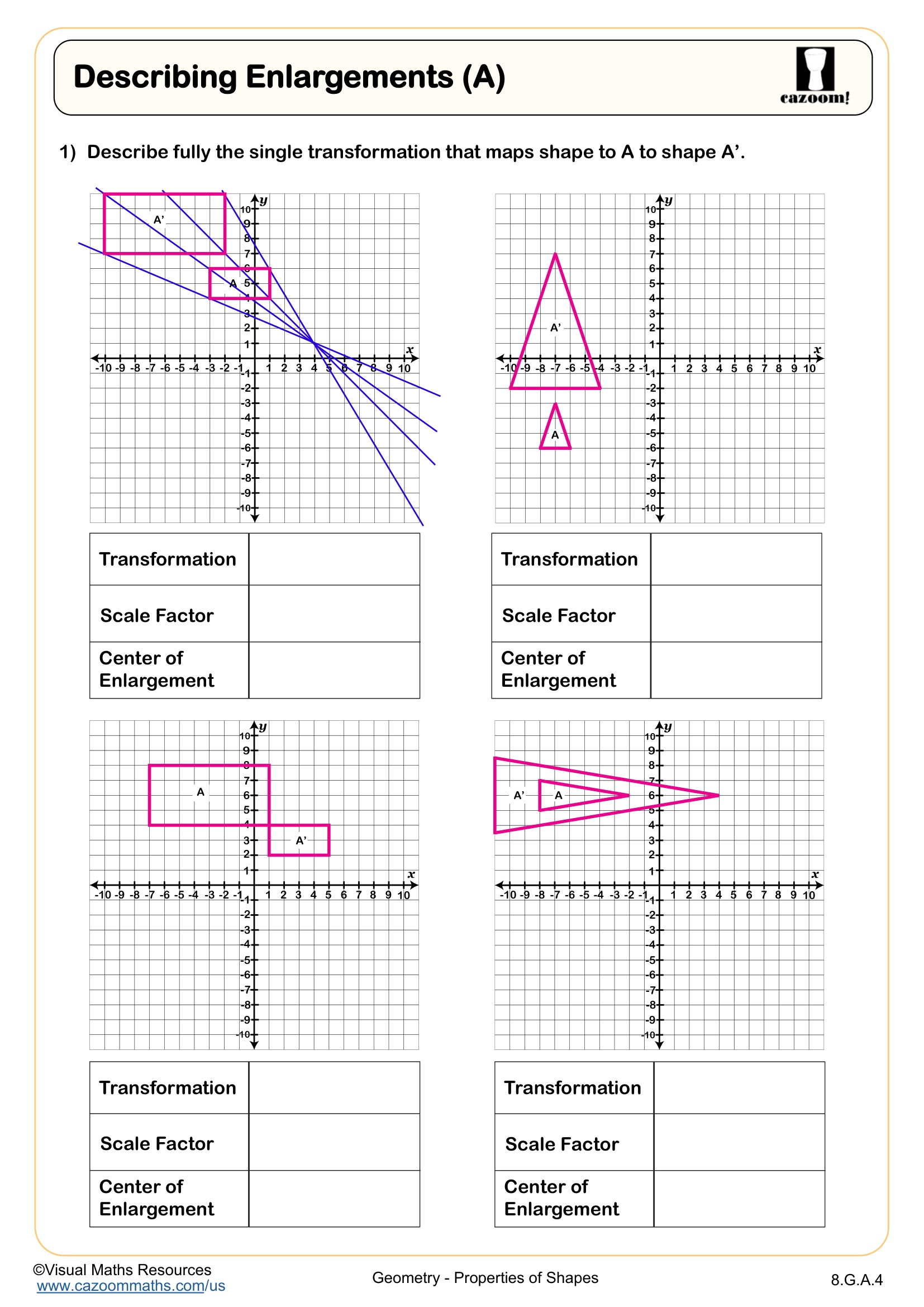
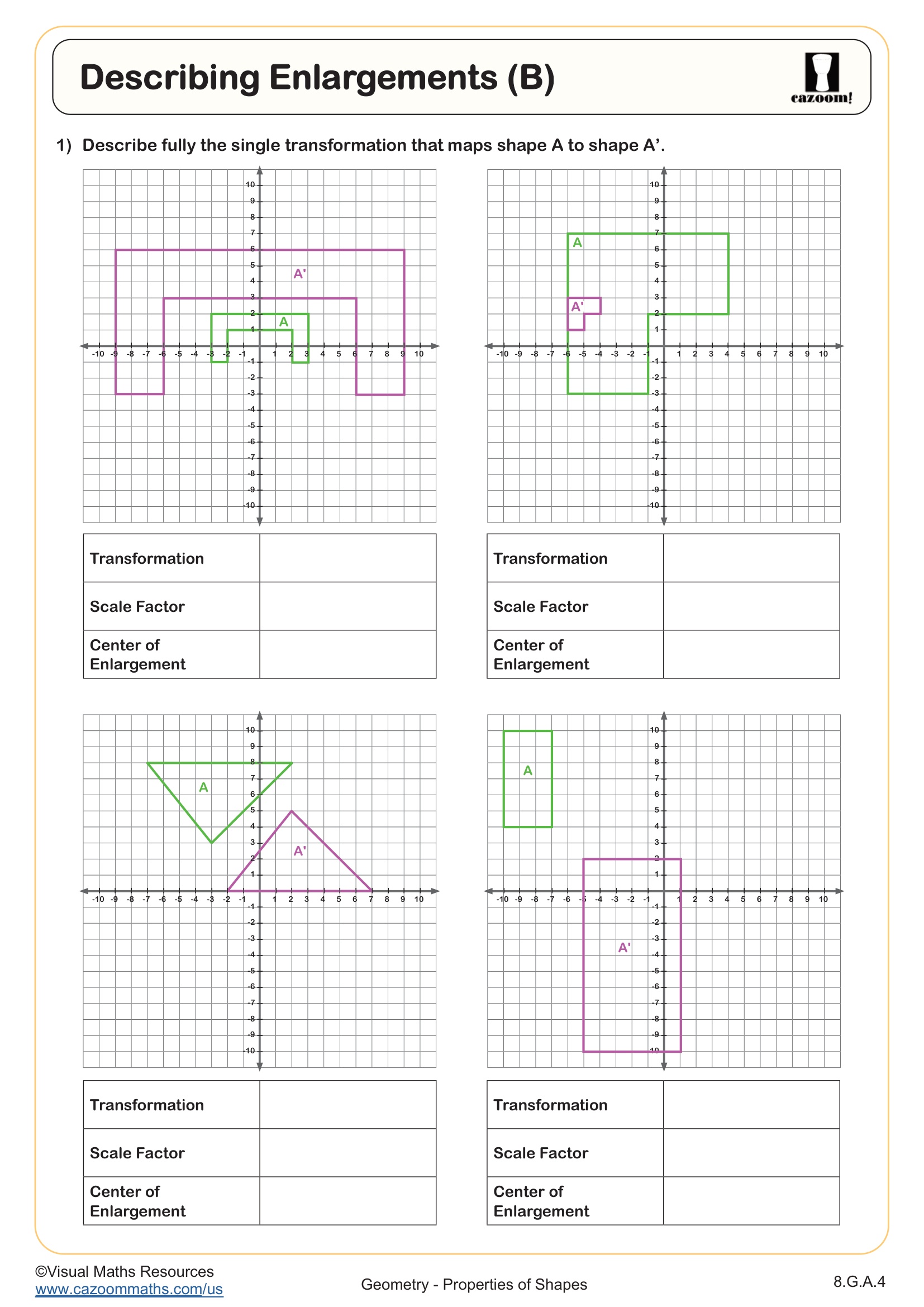
Eighth graders build on earlier shape knowledge by exploring properties that involve measurement, transformation, and mathematical relationships rather than just identification. Students analyze how regular polygons like hexagons can be decomposed into triangles to calculate area, understand how enlargements maintain shape while changing size, and recognize geometric forms embedded in real-world contexts. This work aligns with Common Core Standard 8.G.A, which emphasizes understanding and applying theorems about angles, lines, and triangles.
A common misconception surfaces when students assume all hexagons are regular or that area formulas work the same way for irregular polygons. Teachers observe that explicitly comparing regular versus irregular hexagons—pointing out that only regular hexagons have six equal sides and six equal angles—prevents students from misapplying formulas. State assessments often include items where students must justify why a particular property applies, not just identify shapes, so understanding the "why" behind properties becomes critical for success.
Which Grade Levels Cover Properties of Shapes?
This collection specifically addresses 8th grade middle school standards, where students transition from basic geometry into more sophisticated analysis of shape properties and transformations. At this level, students are expected to move beyond perimeter and area of simple quadrilaterals to work with regular polygons, understand transformations including enlargements and dilations, and use algebraic thinking to describe geometric relationships.
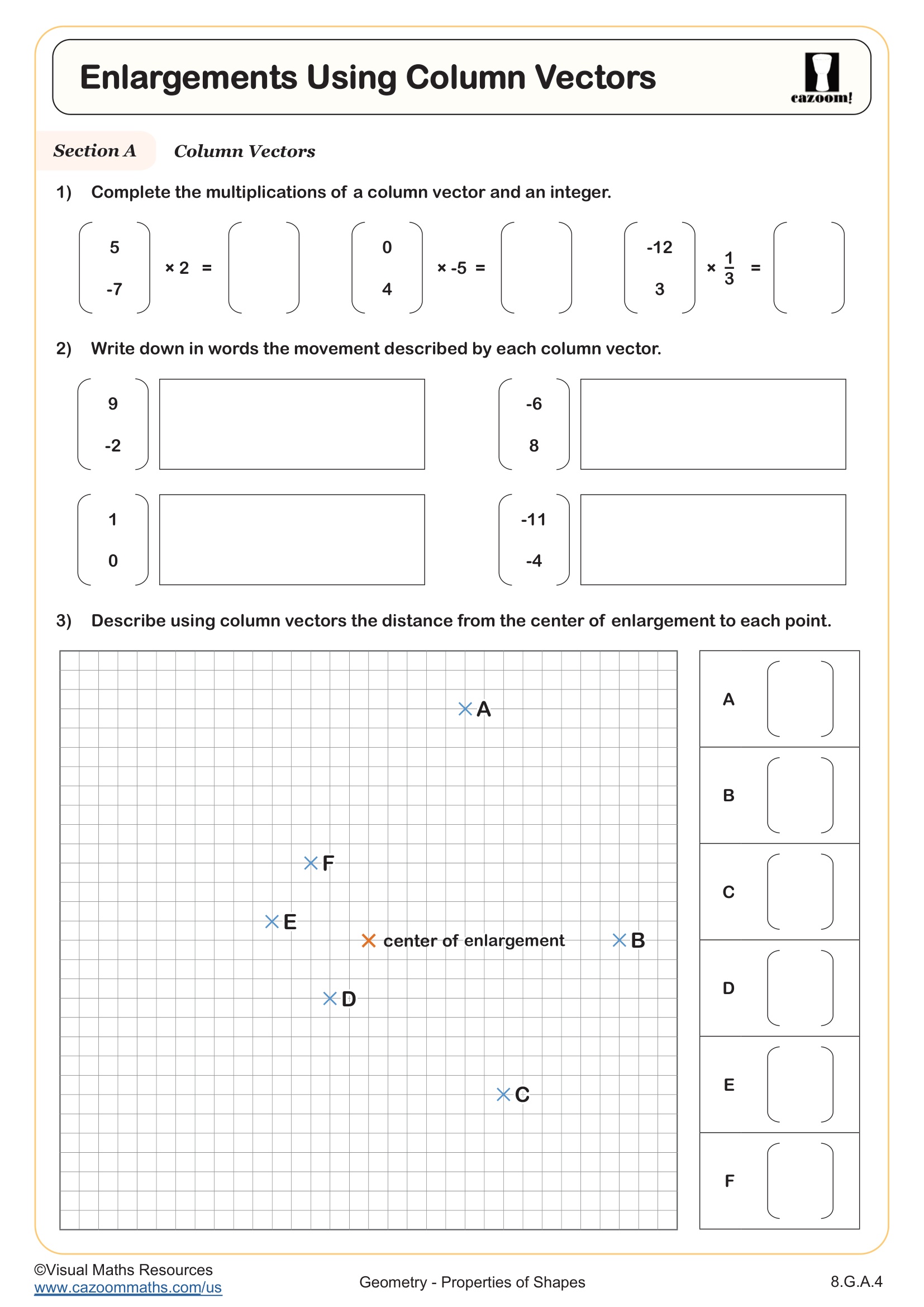
The difficulty progression within 8th grade becomes apparent as students move from recognizing shapes in context (word searches and everyday objects) to calculating specific measurements like hexagon area, then to describing and performing enlargements using both descriptive language and precise column vector notation. Teachers notice that students who master the foundational vocabulary and recognition tasks build confidence before tackling the computational and transformational challenges. This scaffolded approach mirrors how standardized tests structure items, starting with identification before moving to application and justification.
How Do Column Vectors Work for Describing Enlargements?
Column vectors provide a precise mathematical notation for describing transformations, including enlargements and translations on the coordinate plane. When performing an enlargement using column vectors, students identify the center of enlargement, apply the scale factor to each coordinate, and express the transformation as a vector showing how far each point moves. This method connects geometric transformations to algebraic representations, reinforcing the coordinate plane skills students need for high school algebra and geometry.
This skill has direct applications in computer graphics and digital design, where programmers use transformation matrices (an extension of column vectors) to resize, rotate, and position images on screen. Video game developers, architects using CAD software, and animators all rely on vector-based transformations to manipulate shapes precisely. When students recognize that the column vector notation they're learning describes the same mathematical operations used to scale characters in their favorite games or zoom into digital maps, the abstract concept gains concrete relevance and purpose.
How Can Teachers Use These Worksheets Most Effectively?
The worksheets provide structured practice that moves from conceptual understanding to procedural fluency, with word searches building vocabulary recognition, calculation sheets developing computational skills, and transformation exercises applying both concepts together. Answer keys allow students to self-check during independent practice or help teachers quickly identify patterns in student errors during formative assessment. The variety of subtopics means teachers can select specific sheets that target where individual students need reinforcement rather than assigning the entire collection uniformly.
Many teachers find these worksheets effective for differentiated instruction during geometry units—students who grasp transformations quickly can work on column vector enlargements while others solidify understanding with descriptive enlargement practice. The sheets work well as warm-up activities to activate prior knowledge, homework assignments that reinforce classroom lessons, or review materials before quizzes and state assessments. Pairing students with different skill levels during worksheet completion often helps both learners, as the explaining student deepens understanding while the listening student gains peer-level clarification.