8th Grade Pythagorean Theorem Worksheets
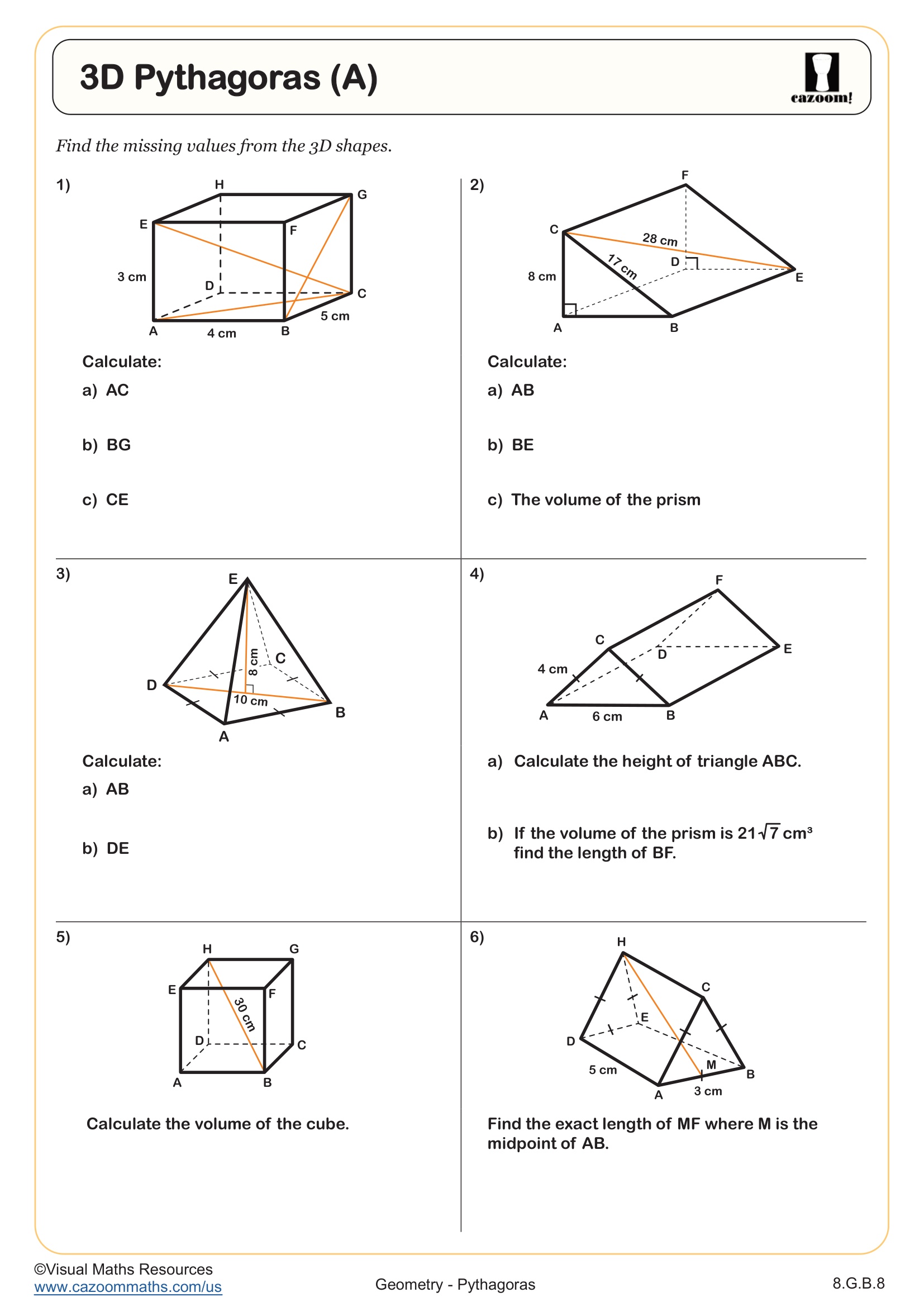
3D Pythagoras (A)
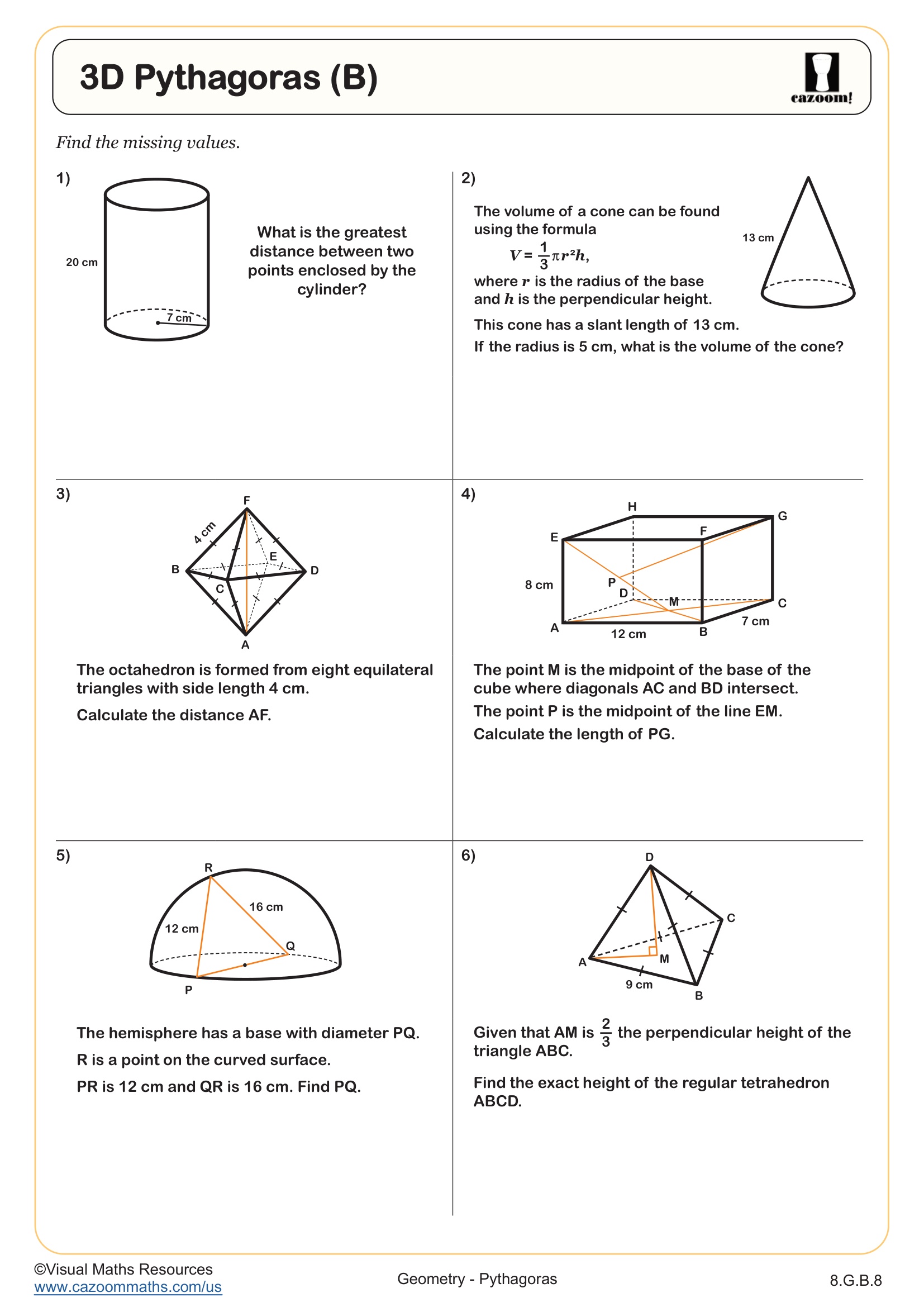
3D Pythagoras (B)
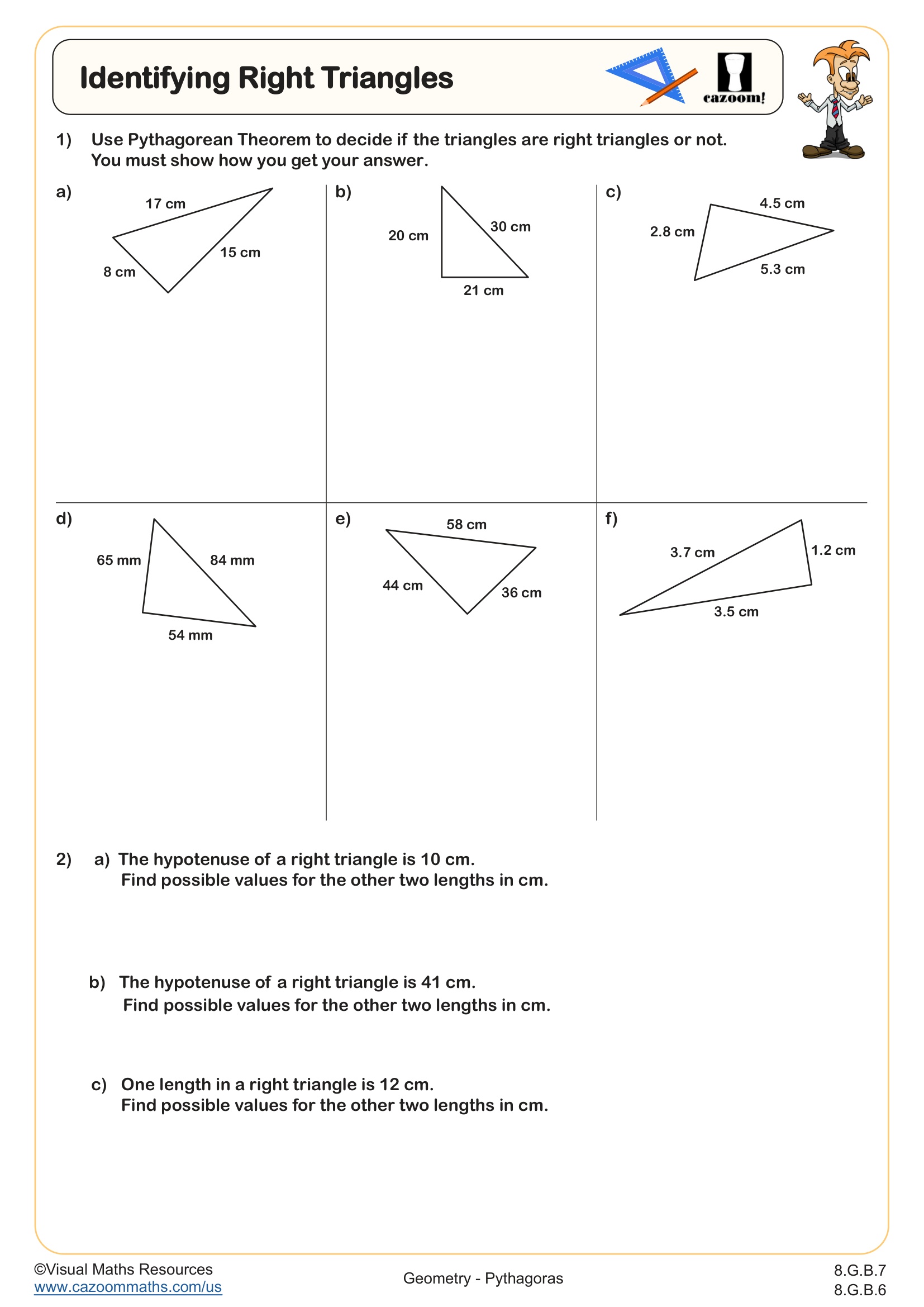
Identifying Right Triangles
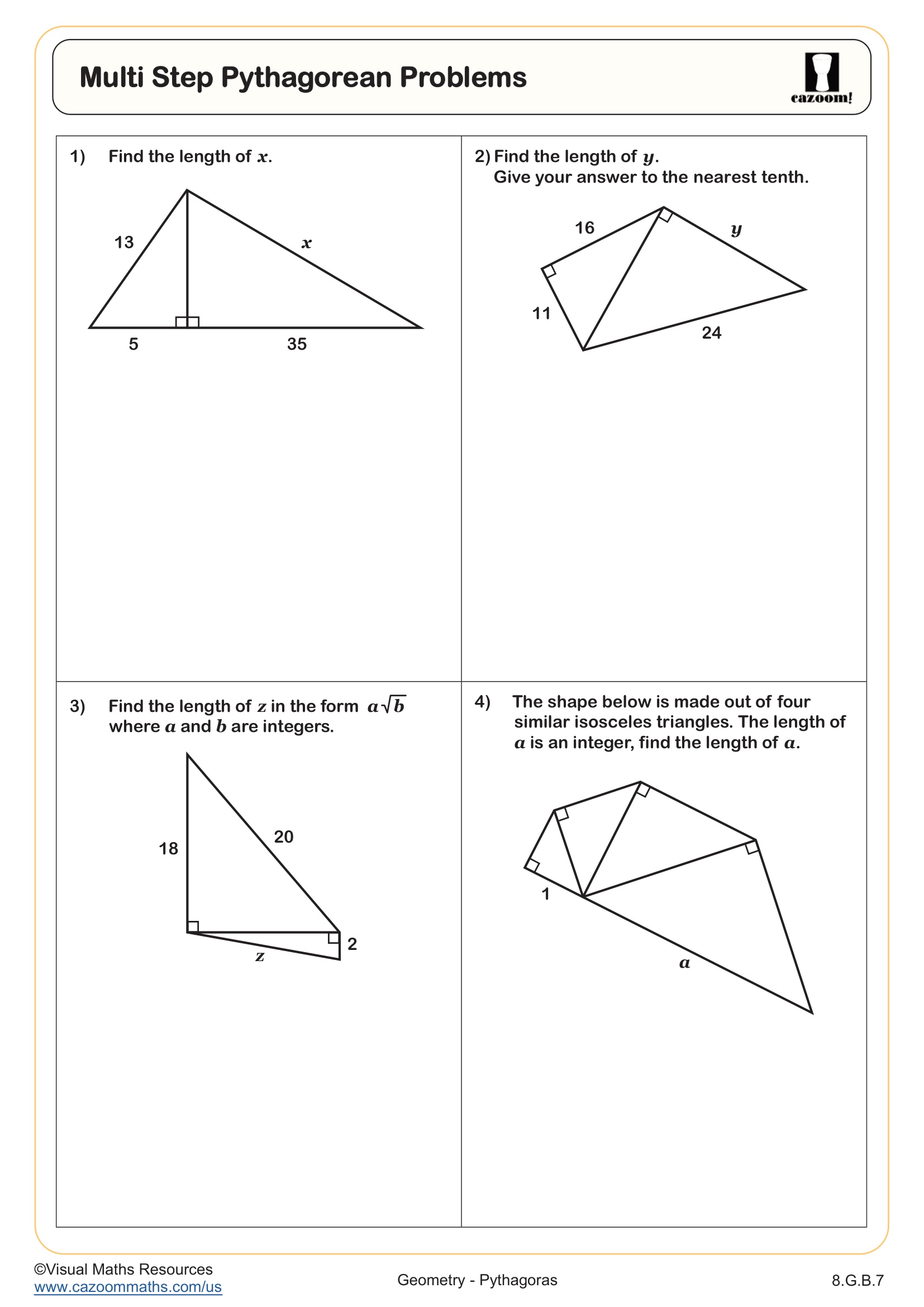
Multi Step Pythagorean Problems
Pythagorean Theorem and coordinates
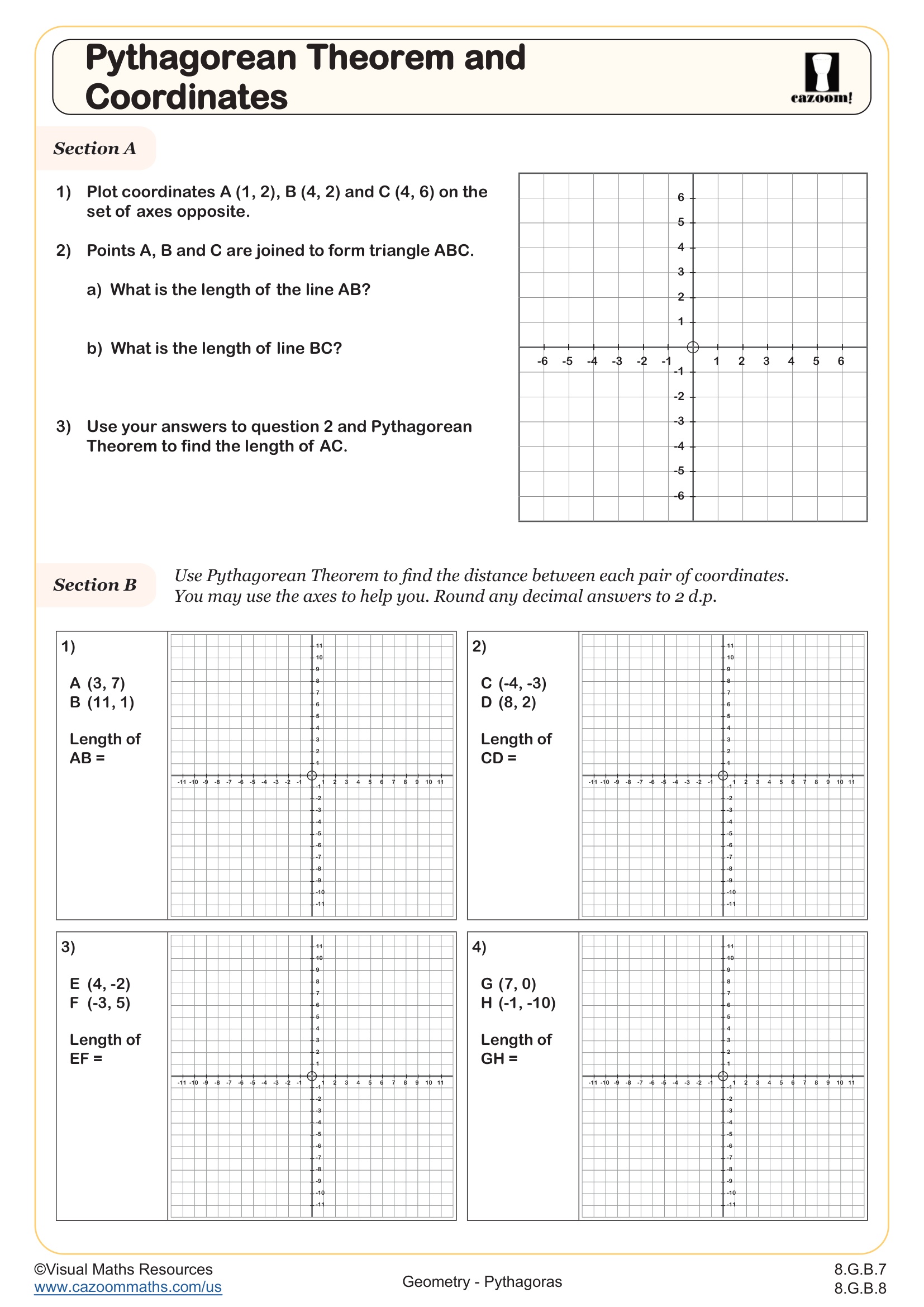
Pythagorean Theorem Word Problems
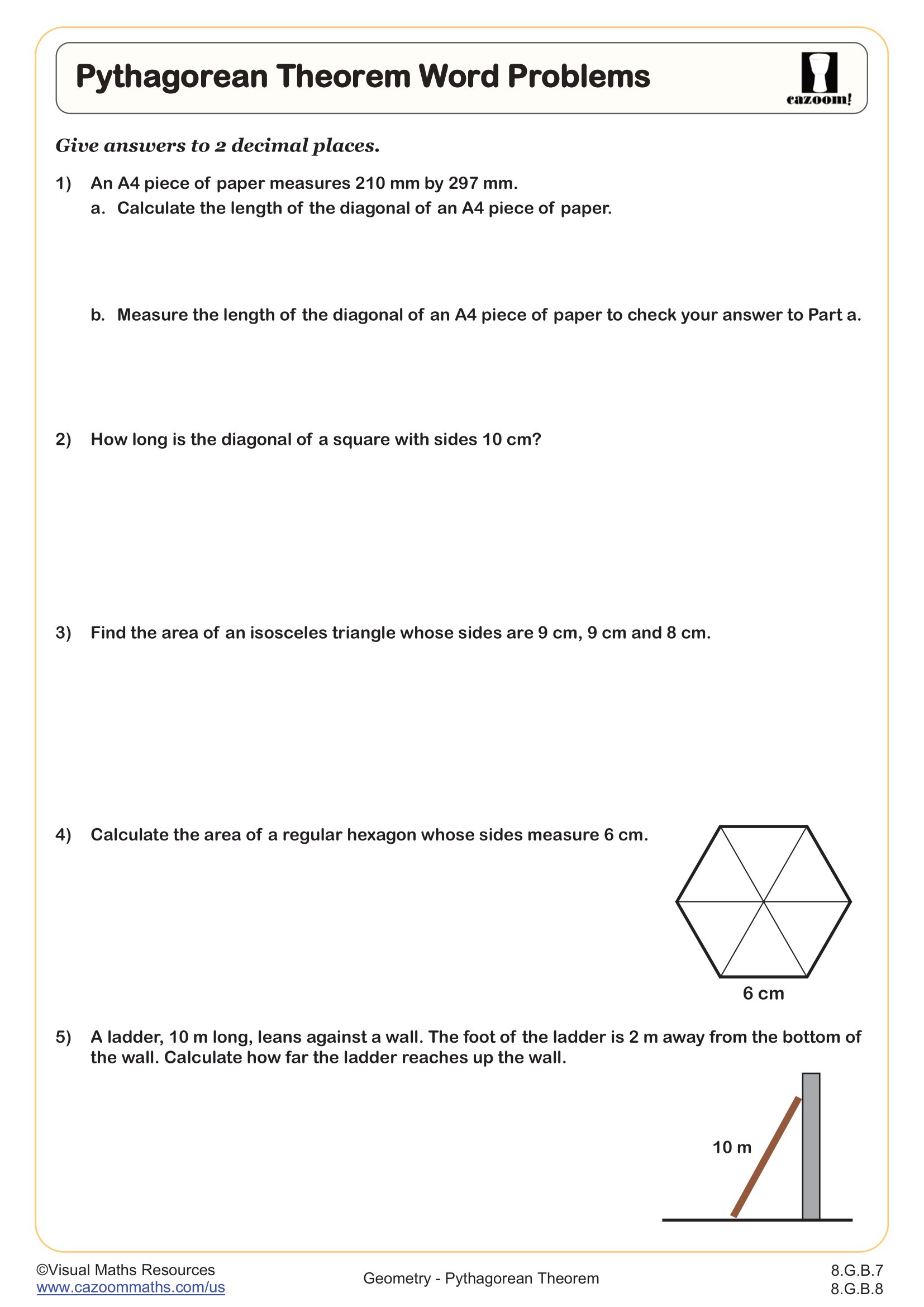
Pythagorean Theorem Word Problems (with clues)
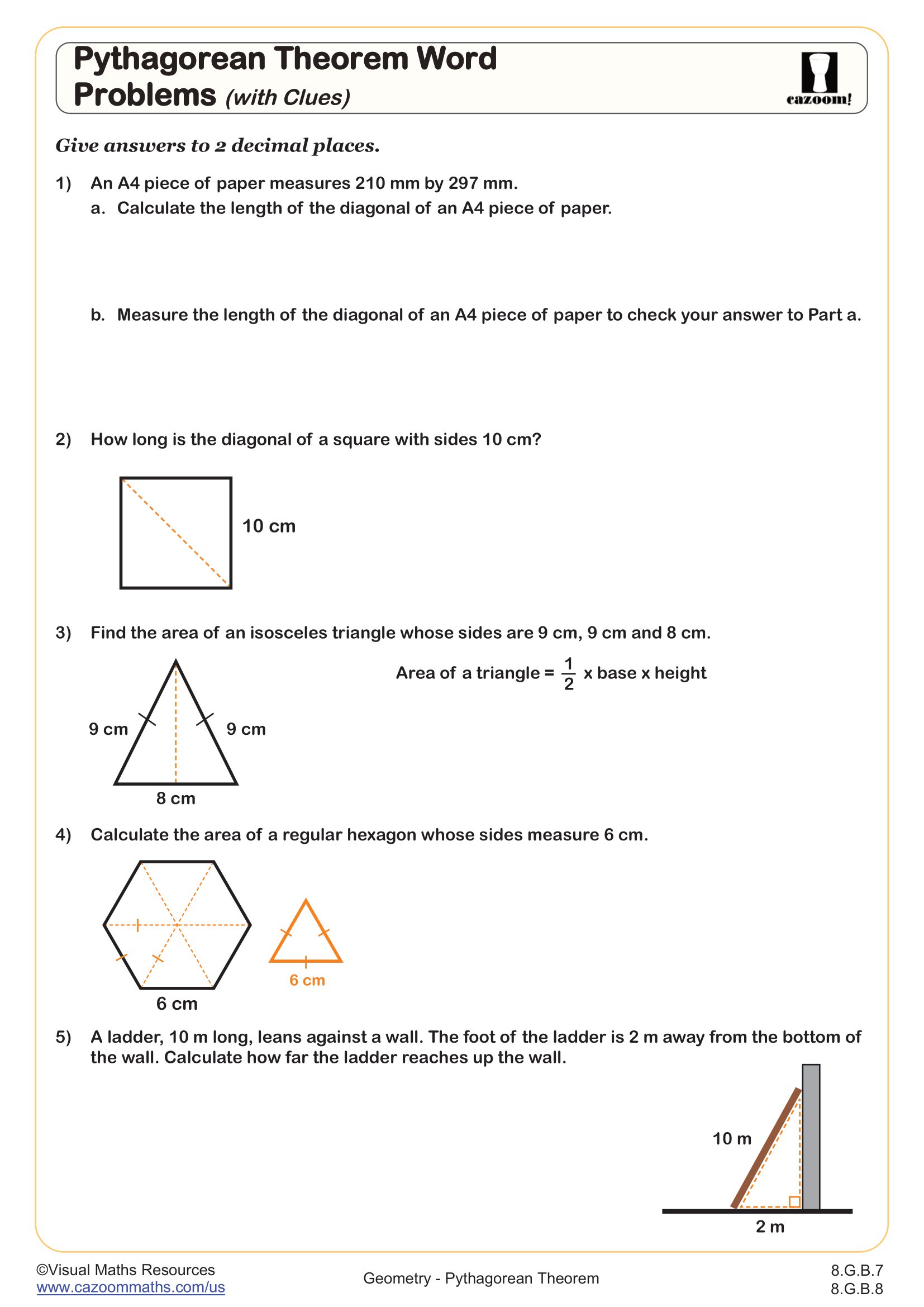
Pythagorean Theorem: Calculating Missing Side Lengths
Pythagorean Theorem: Calculating the Hypotenuse
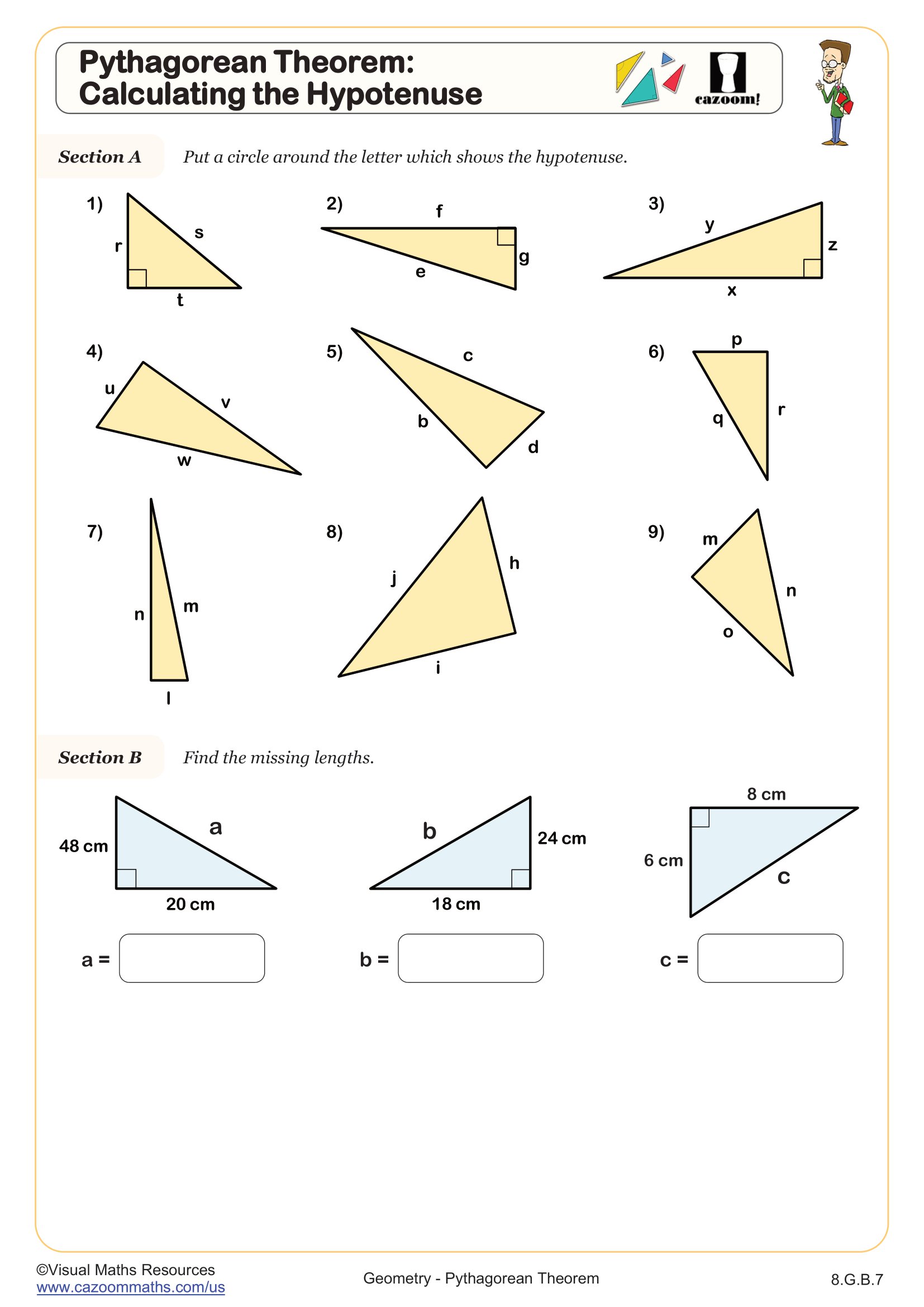
All worksheets are created by the team of experienced teachers at Cazoom Math.
What makes a quality pythagorean theorem worksheet grade 8 pdf?
Quality 8th grade pythagorean theorem worksheet materials align with Common Core standard 8.G.B.7, which requires students to apply the Pythagorean theorem to find distances in coordinate systems and solve real-world problems. The worksheets should progress from basic missing side calculations to multi-step word problems involving practical applications.
Teachers find that students perform better when worksheets include triangles in various orientations rather than always showing the hypotenuse at the bottom. Many students automatically assume the longest given measurement is the hypotenuse, leading to calculation errors when working with legs of a right triangle. Effective pythagoras theorem worksheet for grade 8 materials specifically address this by mixing problem types and requiring students to identify the hypotenuse before calculating.
Is 8th grade the right time to introduce the Pythagorean theorem?
Eighth grade represents the standard introduction point for the Pythagorean theorem in most US curricula, as students have developed sufficient algebraic skills to handle square roots and can work with irrational numbers. At this level, students can connect geometric concepts with algebraic manipulation, making the theorem more meaningful than rote memorization.
Some advanced 7th graders may encounter basic Pythagorean applications, but 8th grade allows for deeper exploration including coordinate plane applications and complex word problems. Teachers report that students who learn the theorem in 8th grade retain the concept better for high school geometry, where it becomes foundational for trigonometry and more advanced geometric proofs involving right triangles and distance formulas.
How should students approach word problems involving the Pythagorean theorem?
Students benefit from a systematic approach to Pythagorean theorem word problems: identify the right triangle within the scenario, determine which sides are legs versus hypotenuse, set up the equation, and solve for the unknown. Many problems involve indirect measurement situations like finding the height of a ladder against a wall or calculating diagonal distances.
Teachers observe that students often rush to plug numbers into the formula without visualizing the triangle first. Drawing a diagram becomes crucial, especially in problems involving coordinate planes or three-dimensional contexts like finding the diagonal of a rectangular prism. Students who sketch the problem scenario before calculating show significantly higher accuracy rates on assessments and can better identify when their numerical answers make sense in context.
How can teachers maximize student success with Pythagorean theorem practice?
Effective implementation involves starting with concrete manipulatives or grid paper activities before moving to abstract calculations. Students benefit from seeing the relationship visually through square models or by measuring actual right triangles before working with the algebraic formula. This foundation helps students understand why the theorem works, not just how to apply it.
Teachers find success in mixing computational practice with real-world applications from the start rather than treating them as separate units. Problems involving smartphone screen sizes, construction measurements, and GPS distances help students see the theorem's relevance in STEM fields. Regular practice with both exact answers using radicals and decimal approximations prepares students for the varied answer formats they'll encounter in high school mathematics courses.