8th Grade Sequences Worksheets
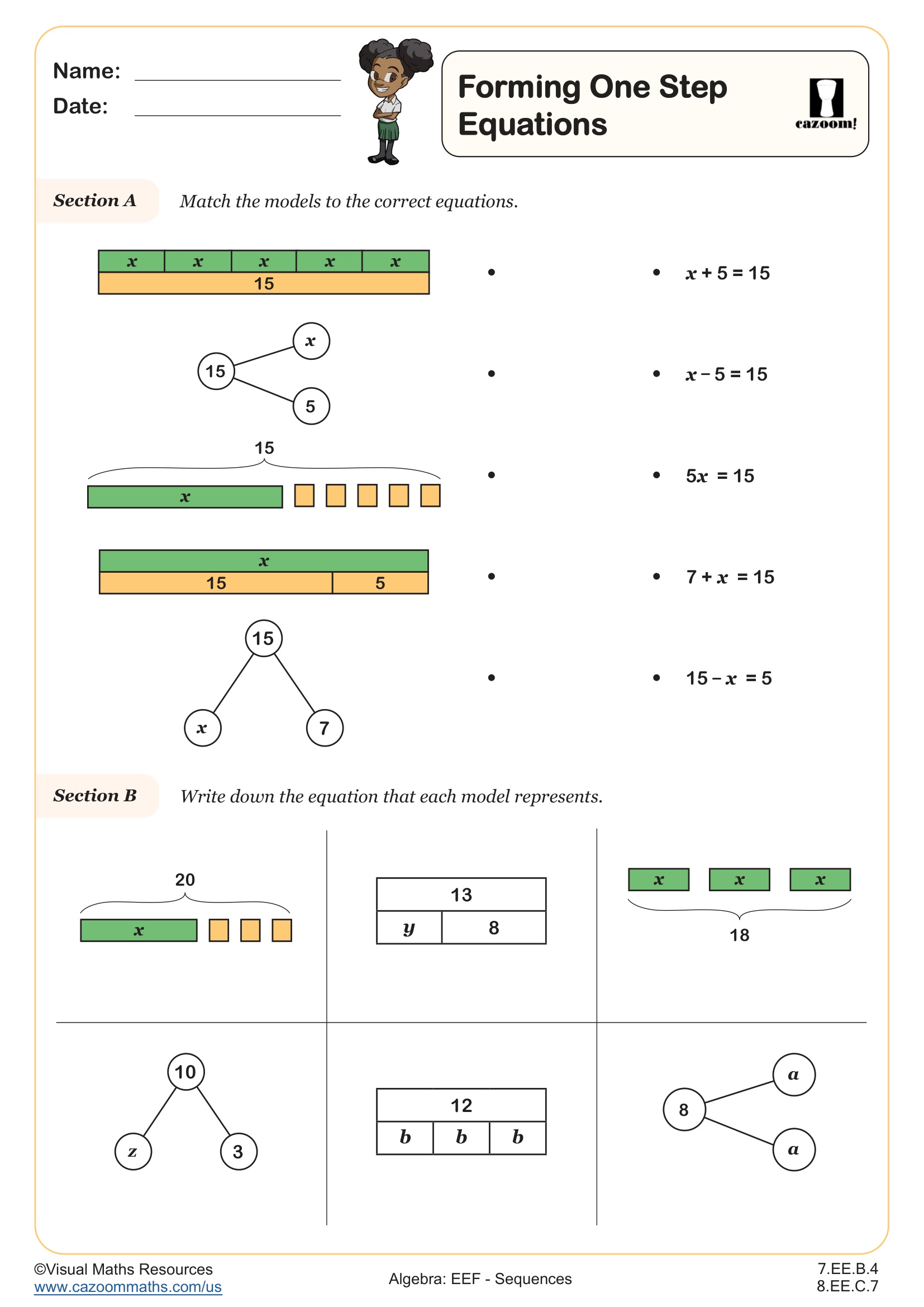
All worksheets are created by the team of experienced teachers at Cazoom Math.
What Are Sequences in 8th Grade Math?
In 8th grade mathematics, sequences are ordered lists of numbers that follow a specific pattern or rule. Students work primarily with arithmetic sequences (where each term increases or decreases by a constant difference) and begin exploring geometric sequences (where each term is multiplied by a constant ratio). The focus shifts from simply identifying patterns to expressing them algebraically using variables and equations.
Forming equations from sequences requires students to recognize the relationship between term position and term value. A common error involves confusing the term number with the term value itself—for example, in the sequence 5, 8, 11, 14, students might incorrectly say the third term equals 3 rather than 11. Teachers find that labeling columns clearly (position vs. value) helps students distinguish between these concepts and successfully write equations like y = 3n + 2.
What Should 8th Graders Know About Sequences?
By 8th grade, students should confidently identify arithmetic sequences, determine common differences, find missing terms, and write equations to represent sequence patterns. According to Common Core State Standards (8.F.A.1 and 8.F.B.4), students must understand that sequences are functions and express them using explicit formulas. They should recognize that the term number serves as the input and the term value as the output, connecting sequence notation to function notation.
This work builds directly on 7th grade proportional relationships and prepares students for Algebra I linear functions. Students who master forming equations from sequences find that writing slope-intercept form equations becomes more intuitive—they already understand how the coefficient relates to the rate of change. State assessments frequently test whether students can match sequences to their algebraic representations or use equations to predict values beyond the given terms.
How Do You Form Equations from Sequences?
Forming equations from sequences involves identifying the pattern's starting value and rate of change, then expressing it algebraically. For arithmetic sequences, students determine the common difference (the amount added or subtracted each time) and the relationship between term position (n) and term value. The equation typically takes the form y = mx + b, where m represents the common difference and b adjusts for the starting position. Many students experience a breakthrough when they realize this mirrors the slope-intercept form they've already learned.
This skill appears frequently in STEM contexts, particularly in computer programming and data science. Programmers use sequence equations to generate values in loops, while scientists use them to model linear growth patterns in populations or chemical reactions. Understanding how to form and manipulate these equations helps students recognize that mathematical patterns describe predictable real-world phenomena, from subscription pricing models (monthly fee plus startup cost) to distance-time relationships in physics.
How Can Teachers Use These Sequence Worksheets Effectively?
The worksheets provide structured practice in translating visual and numerical patterns into algebraic equations, with scaffolding that helps students develop systematic approaches to problem-solving. Complete answer keys allow teachers to quickly identify whether errors stem from pattern recognition issues or algebraic manipulation mistakes. Students benefit from checking their equations by substituting term positions back into their formulas to verify they produce the correct sequence values.
These materials work well as warm-up activities to maintain algebraic fluency or as targeted intervention for students preparing for state assessments. Teachers frequently use them during small-group instruction to address specific misconceptions about variables and coefficients. They're also effective as homework assignments when students need additional repetition beyond classwork, or as partner activities where one student generates the equation while another verifies it against the sequence. The format supports differentiated instruction since teachers can select problems matching individual student readiness levels.