8th Grade Similarity and Congruence Worksheets
All worksheets are created by the team of experienced teachers at Cazoom Math.
What's the difference between similarity and congruence in 8th grade geometry?
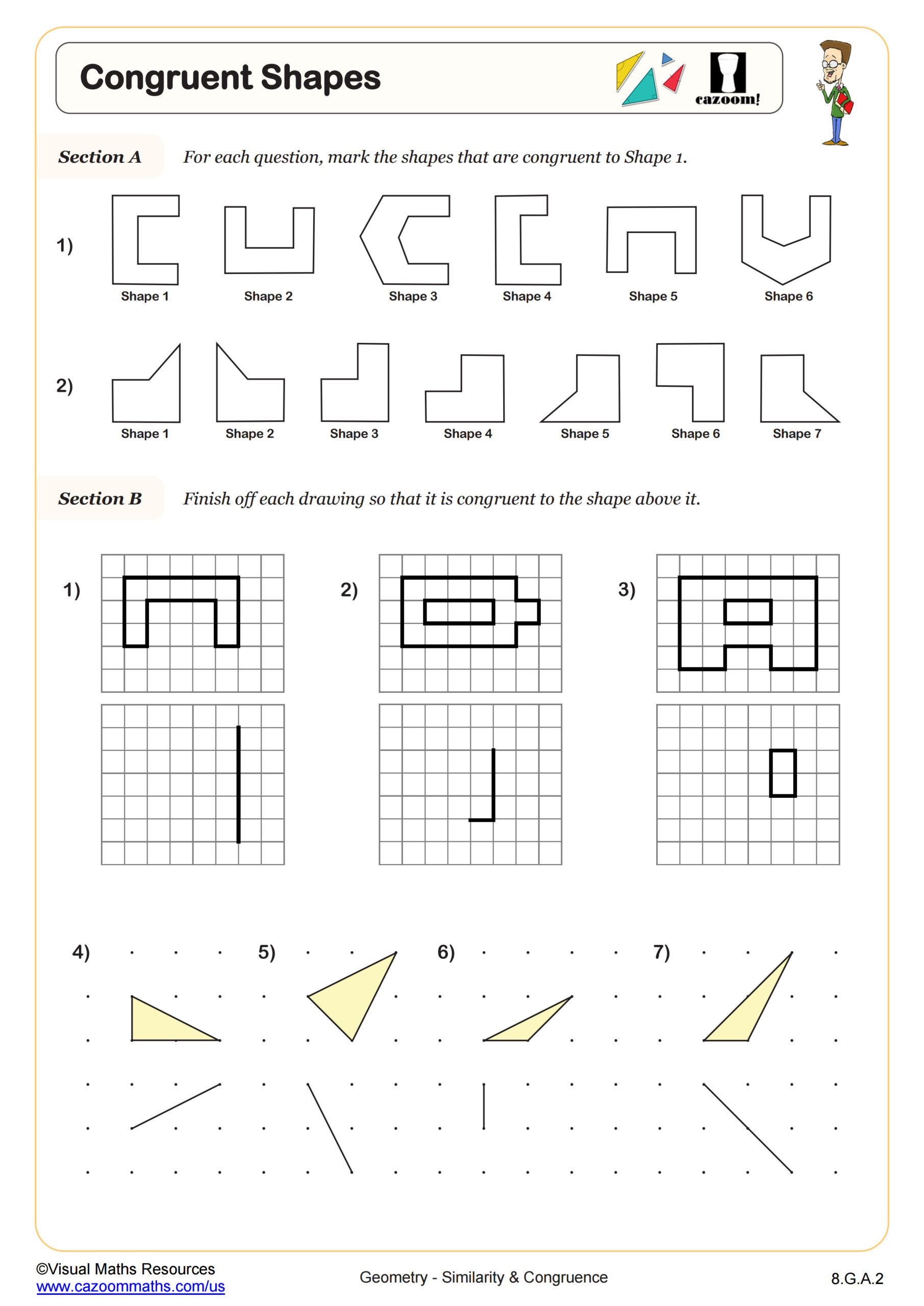
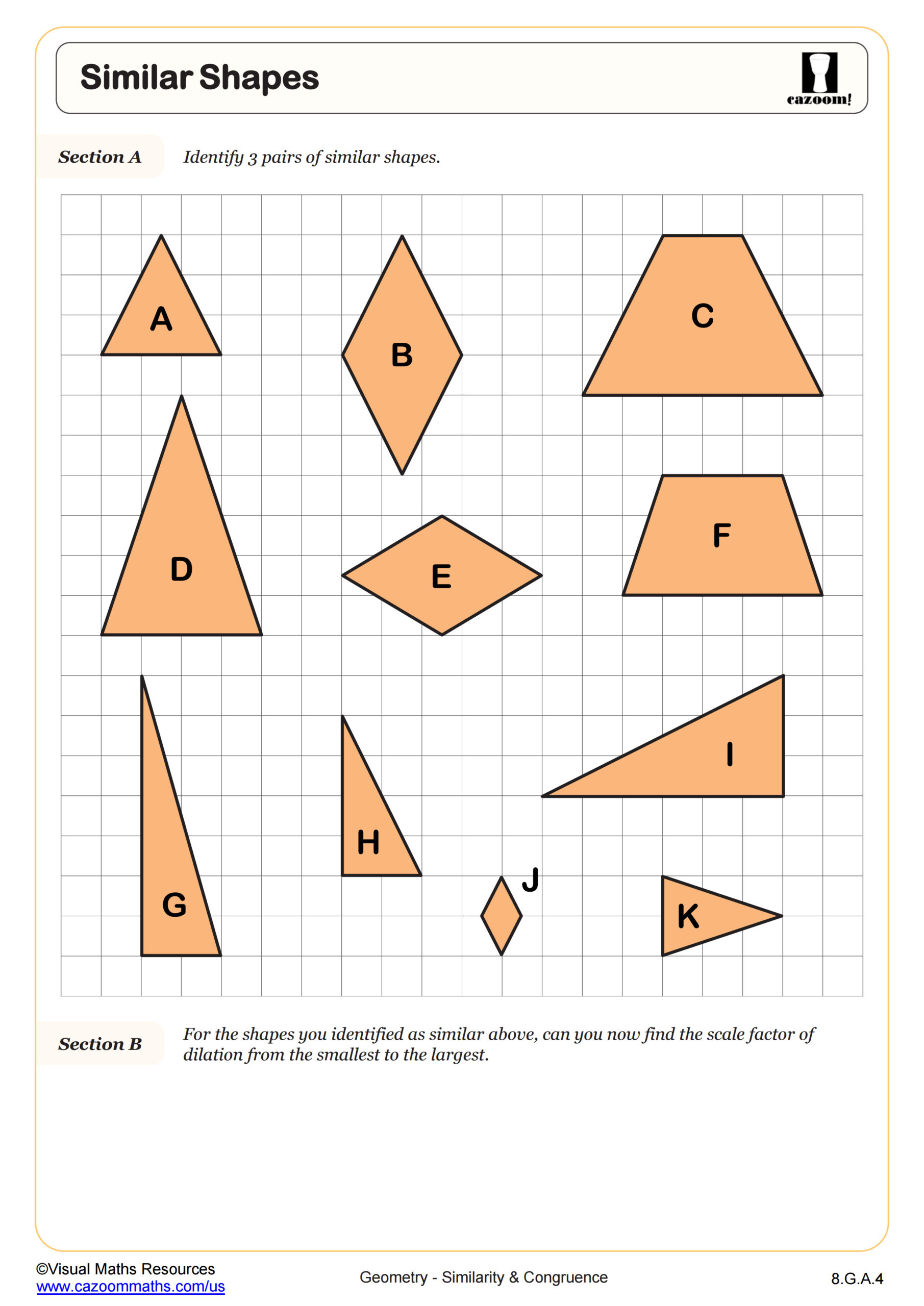
Congruent figures are identical in both shape and size, meaning all corresponding sides and angles match exactly. Similar figures share the same shape but differ in size, with corresponding angles equal and corresponding sides proportional by a consistent scale factor. This distinction aligns with Common Core Standard 8.G.A.4, which requires students to understand similarity through transformations including dilations.
Students often lose points on assessments by stating figures are congruent when they're only similar, especially when shapes appear nearly identical on the page. A reliable check is to measure corresponding sides: if ratios aren't all 1:1, the figures are similar but not congruent. Many teachers find that having students physically measure and calculate ratios helps cement this distinction more effectively than abstract definitions alone.
Which grade levels study similarity and congruence?
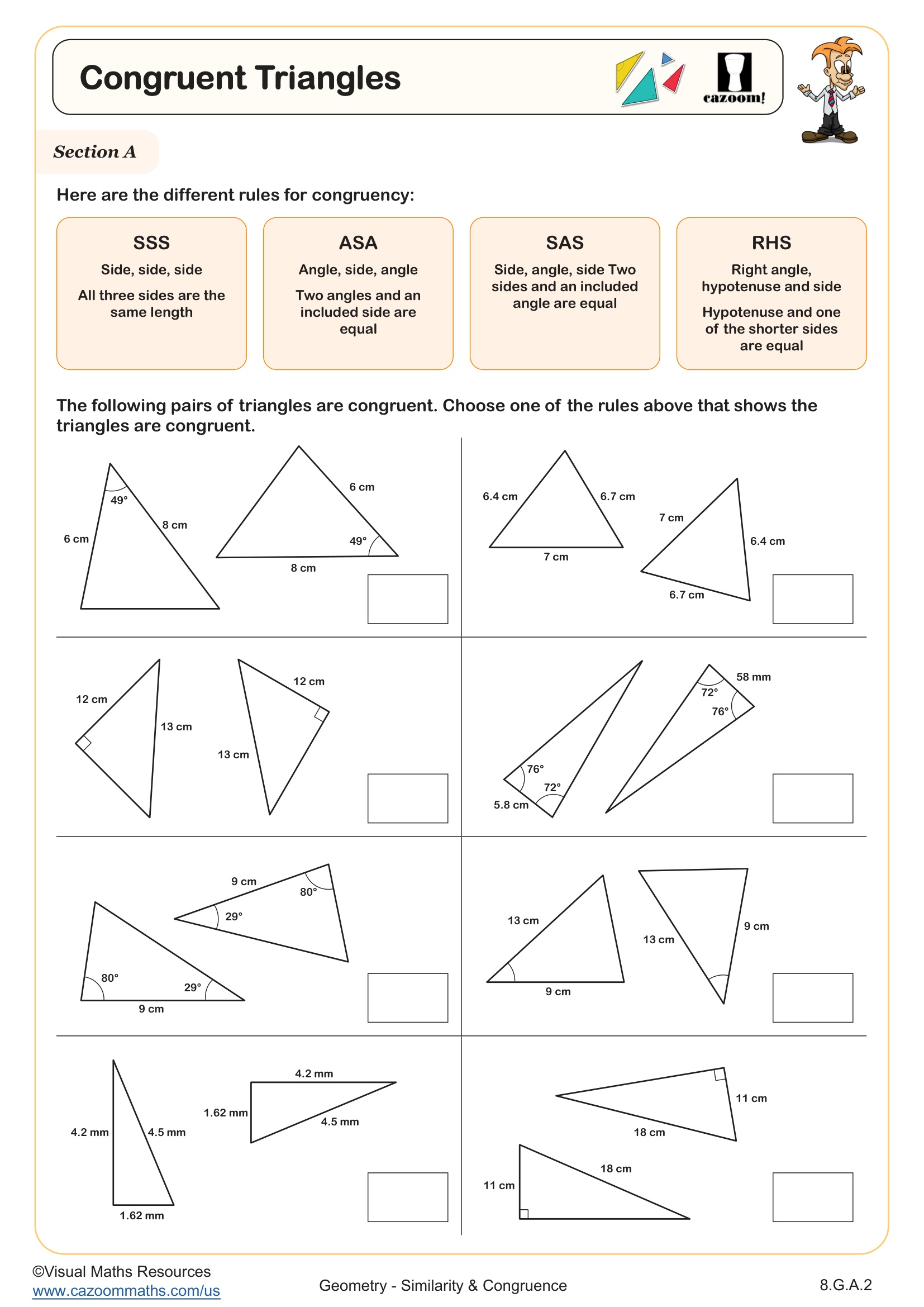
These worksheets target 8th grade middle school mathematics, where similarity and congruence become formal topics requiring precise definitions and proof. Students apply congruence criteria for triangles (SSS, SAS, ASA, AAS) and develop understanding of similarity through scale factors and proportional relationships, concepts introduced informally in earlier grades but now treated rigorously.
The progression intensifies as students move through 8th grade material, starting with identifying congruent shapes visually and advancing to proving triangle congruence algebraically. The most challenging worksheets explore how similarity affects area and volume, requiring students to square or cube the linear scale factor. Teachers notice that students who master basic proportional reasoning in 7th grade tackle these advanced similarity concepts with significantly more confidence.
How do similar triangles apply to real-world problem solving?
Similar triangles allow indirect measurement of distances and heights that can't be measured directly. Students set up proportions using corresponding sides, then solve for unknown measurements. This technique appears throughout the worksheets as students work with scale drawings, shadow problems, and proportional reasoning scenarios that mirror standardized test questions.
Architects and engineers rely on similar triangles daily when creating scale models and blueprints. A building's blueprint might use a 1:100 scale, meaning every measurement on paper represents 100 times that distance in reality. Surveyors use similar triangles to measure distances across rivers or canyons by creating smaller, accessible triangles with the same angle measures. Students often recognize this connection when they realize their phone's map app uses the same principle to represent actual city blocks on a small screen.
How can teachers use these similarity and congruence worksheets effectively?
The worksheets build from foundational identification skills to complex applications, allowing teachers to assign problems matched to current instruction. Problems progress from visual recognition of congruent and similar shapes through formal triangle congruence proofs and ratio calculations. The answer keys show complete solution steps, making them valuable for students checking their work independently or for teachers modeling problem-solving approaches on the board.
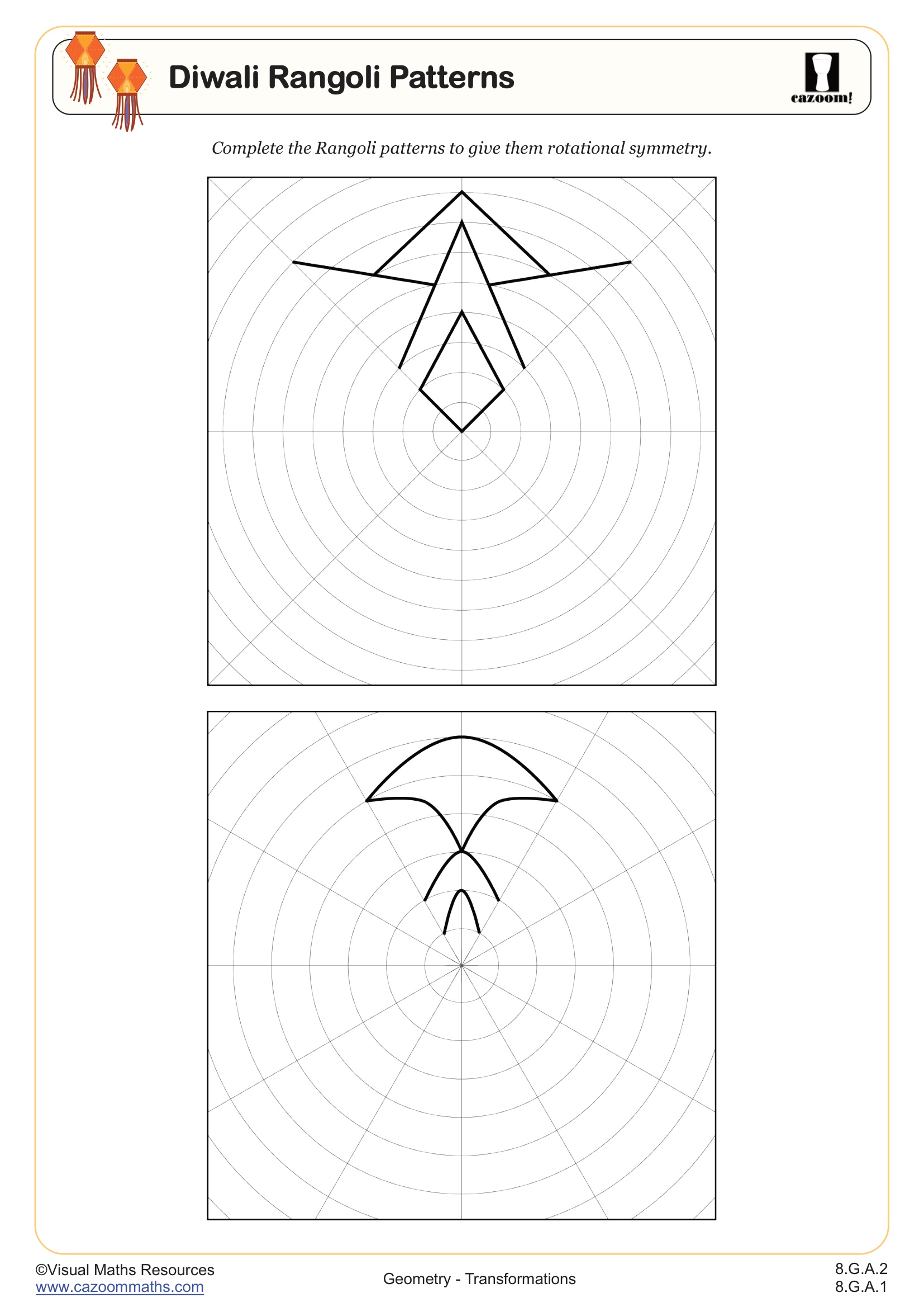
Many teachers use these worksheets for differentiated math centers, assigning congruent shapes problems to students still building confidence while directing advanced learners to area and volume scale factor challenges. The Diwali Rangoli Patterns worksheet offers cultural connections that engage students through authentic geometric art forms. Small group work with similar triangles encourages mathematical discussion as students debate whether triangles meet AA, SAS, or SSS similarity criteria before calculating unknown side lengths.