8th Grade Solving Equations Worksheets
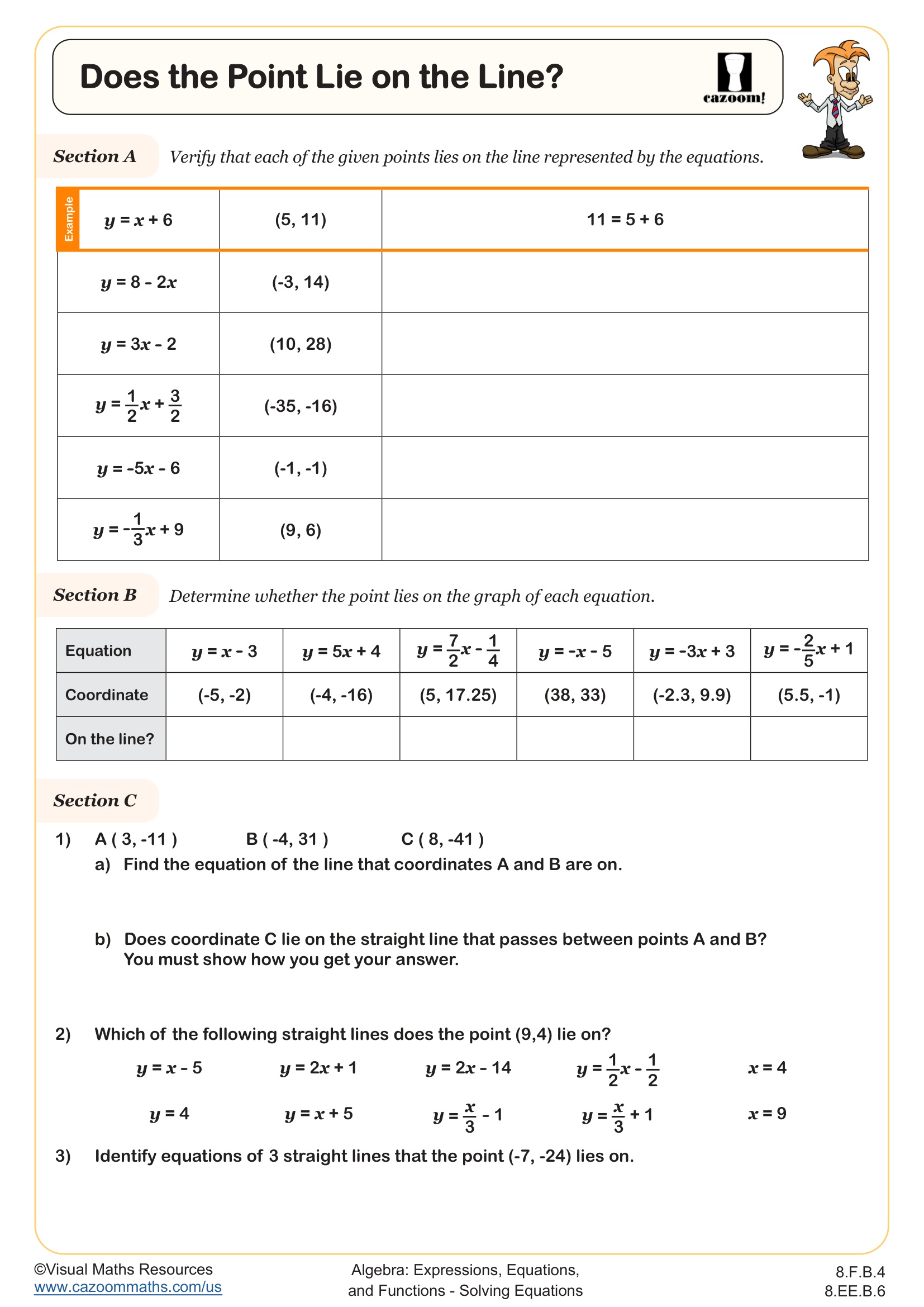
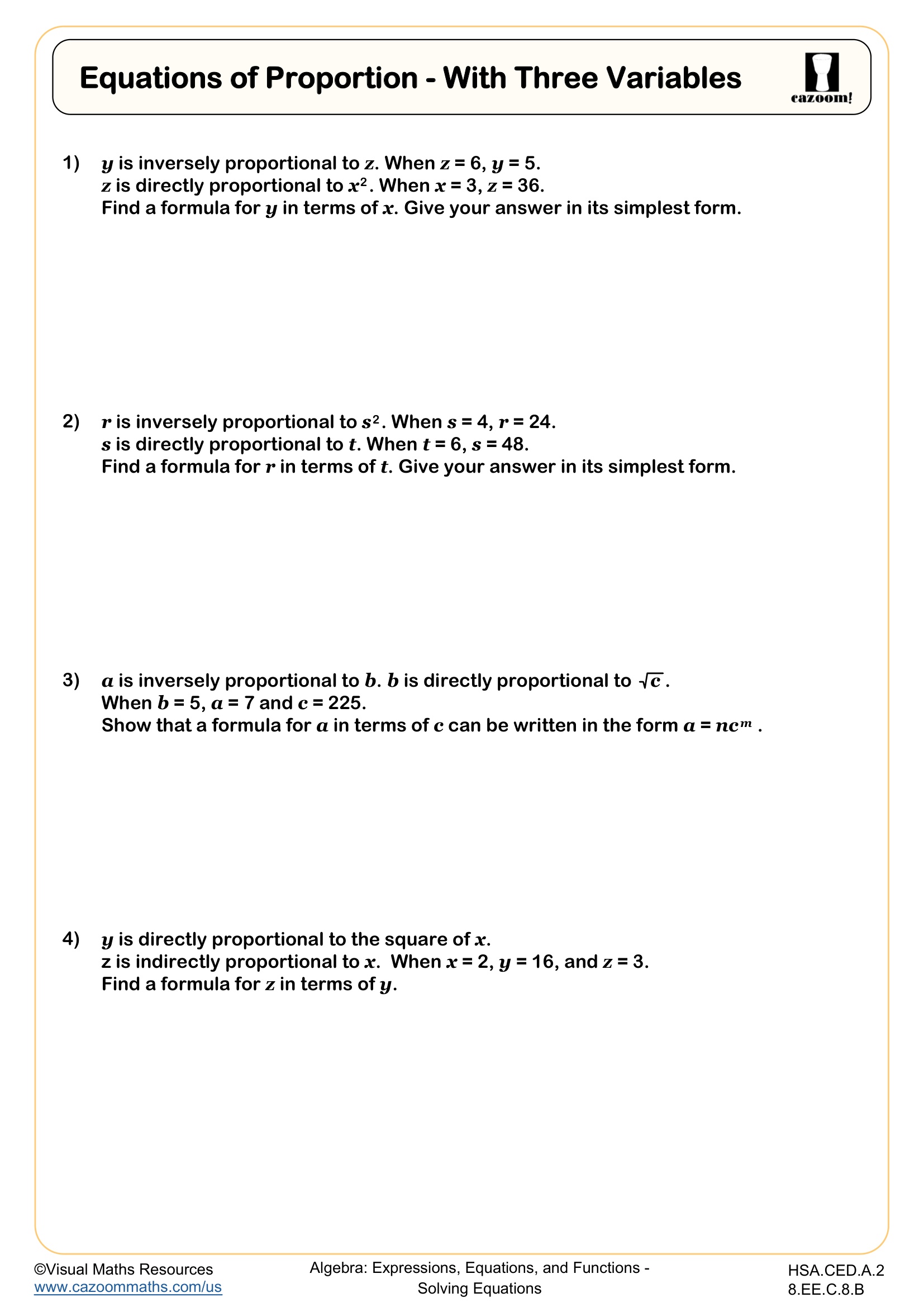
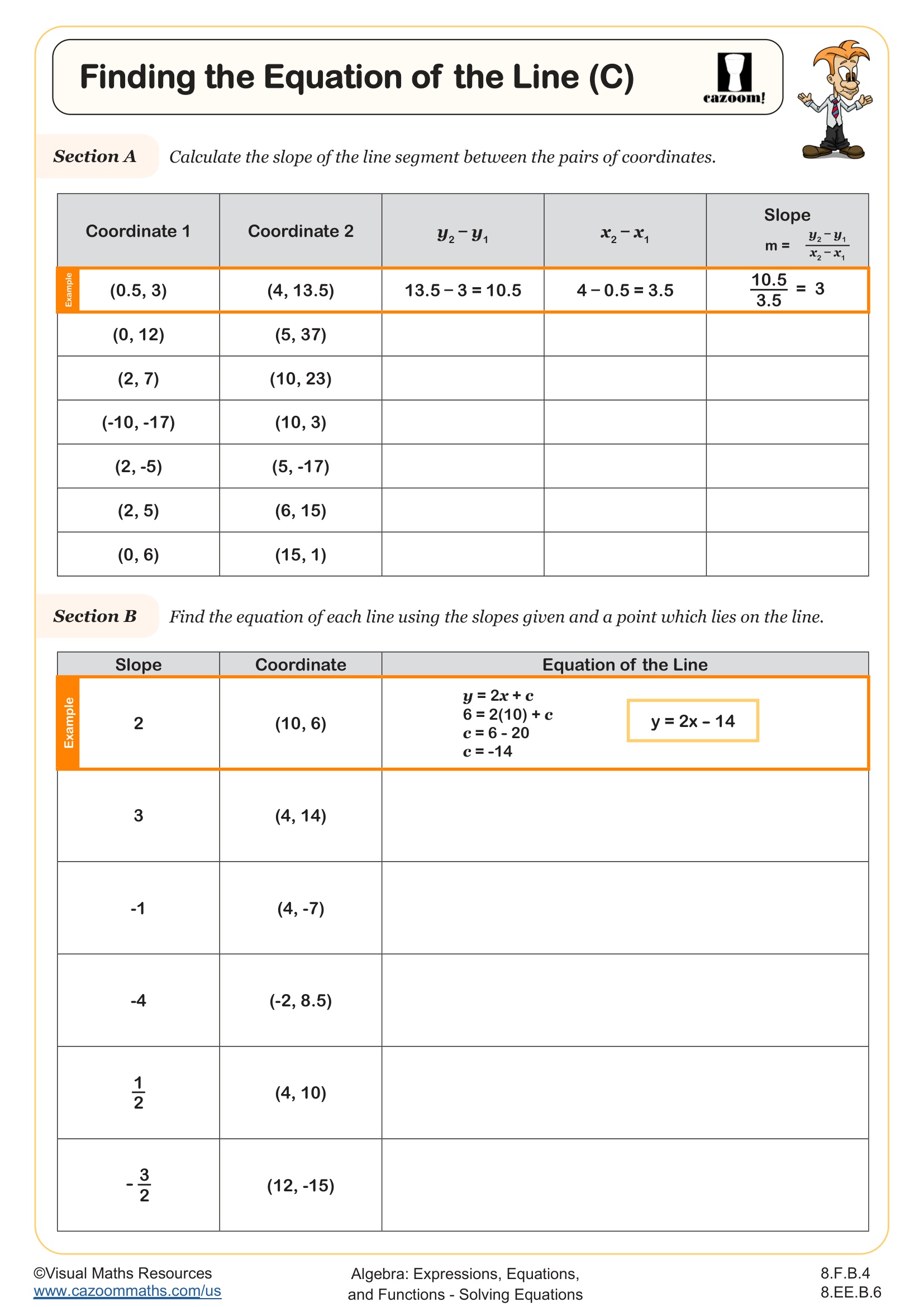
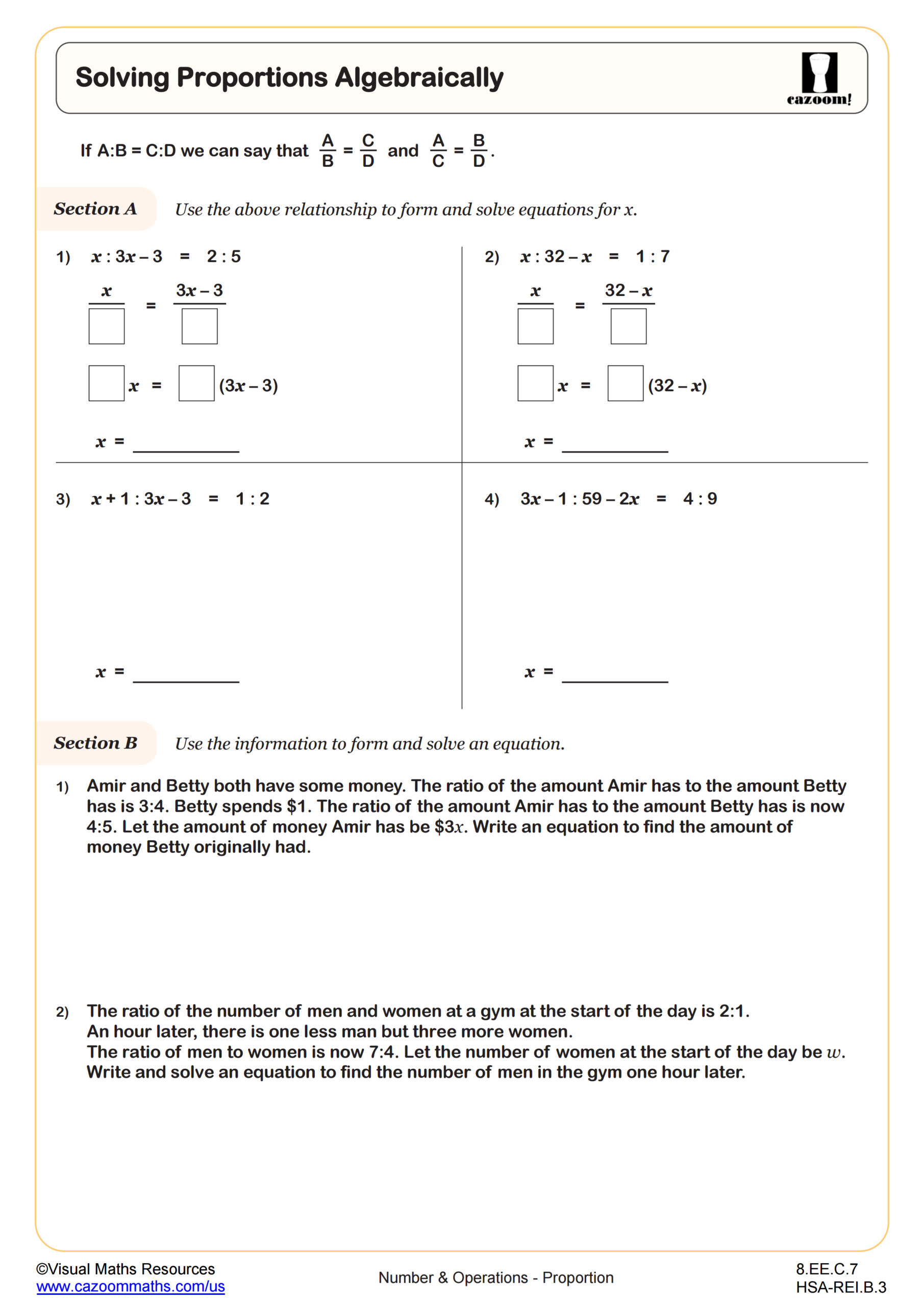

All worksheets are created by the team of experienced teachers at Cazoom Math.
What types of equations do 8th graders need to solve?
Eighth graders work with linear equations that require multiple steps, including distributing, combining like terms, and isolating variables on both sides of the equal sign. The Common Core State Standards for 8th grade also introduce systems of linear equations and require students to understand the structure of quadratic equations, though solving quadratics using the formula is often considered an extension skill at this level.
Students frequently make errors when equations contain variables on both sides, forgetting to perform the same operation to both sides simultaneously. Teachers notice that students lose points on assessments when they fail to check their solutions by substituting back into the original equation, a habit that catches computational mistakes before submitting final answers.
Which grade levels use solving equations worksheets?
This collection focuses specifically on 8th grade middle school content, addressing the algebraic reasoning and equation-solving skills expected at this level. Students at this stage transition from solving basic one-step and two-step equations in earlier grades to tackling more complex multi-step equations and beginning to work with quadratic relationships.
The progression in 8th grade moves from straightforward linear equations toward understanding function notation, working with systems of equations, and exploring quadratic patterns. By the end of middle school, students should confidently manipulate equations with variables on both sides and recognize when solutions require specific solution methods, preparing them for Algebra I and Geometry coursework in high school.
How does the quadratic formula help students solve equations?
The quadratic formula provides a reliable method for finding solutions to equations in the form ax² + bx + c = 0, especially when factoring proves difficult or impossible. Students learn to identify the coefficients a, b, and c, substitute them into the formula x = (-b ± √(b² - 4ac))/(2a), and simplify to find two solutions. Understanding the discriminant (b² - 4ac) helps students predict whether an equation has two real solutions, one solution, or no real solutions.
Physicists and engineers use quadratic equations to model projectile motion, such as calculating when a launched rocket reaches maximum height or when it returns to ground level. Students working with these worksheets connect the abstract formula to real trajectories, recognizing that the two solutions often represent two meaningful times: when an object passes a certain height on the way up and again on the way down.
How can teachers use these solving equations worksheets effectively?
The worksheets provide scaffolded practice that moves from guided examples to independent problem-solving, allowing students to reference worked solutions while building confidence with new equation types. Function machine templates help students visualize inverse operations, while algebra tiles offer concrete representations for combining like terms and understanding distributive properties before moving to abstract symbolic manipulation.
Teachers use these worksheets for differentiated instruction during independent work time, assigning specific subtopics based on formative assessment results. The answer keys make them practical for homework assignments, early finisher activities, or math centers where students can self-check their work. Many teachers pull individual problems for warm-up exercises or use selected worksheets as intervention materials for students who need targeted review before unit assessments or state testing.