8th Grade Space Worksheets
All worksheets are created by the team of experienced teachers at Cazoom Math.
What Math Concepts Do Space-Themed Transformation Worksheets Cover?
Space-themed transformation worksheets focus on geometric transformations on the coordinate plane, including reflections across the x-axis, y-axis, or lines like y=x, as well as rotations and translations. These align with 8th grade Common Core standard 8.G.A.3, which requires students to describe the effect of transformations on two-dimensional figures using coordinates. The space context provides authentic scenarios where spacecraft, satellites, or rocket components move through coordinate systems.
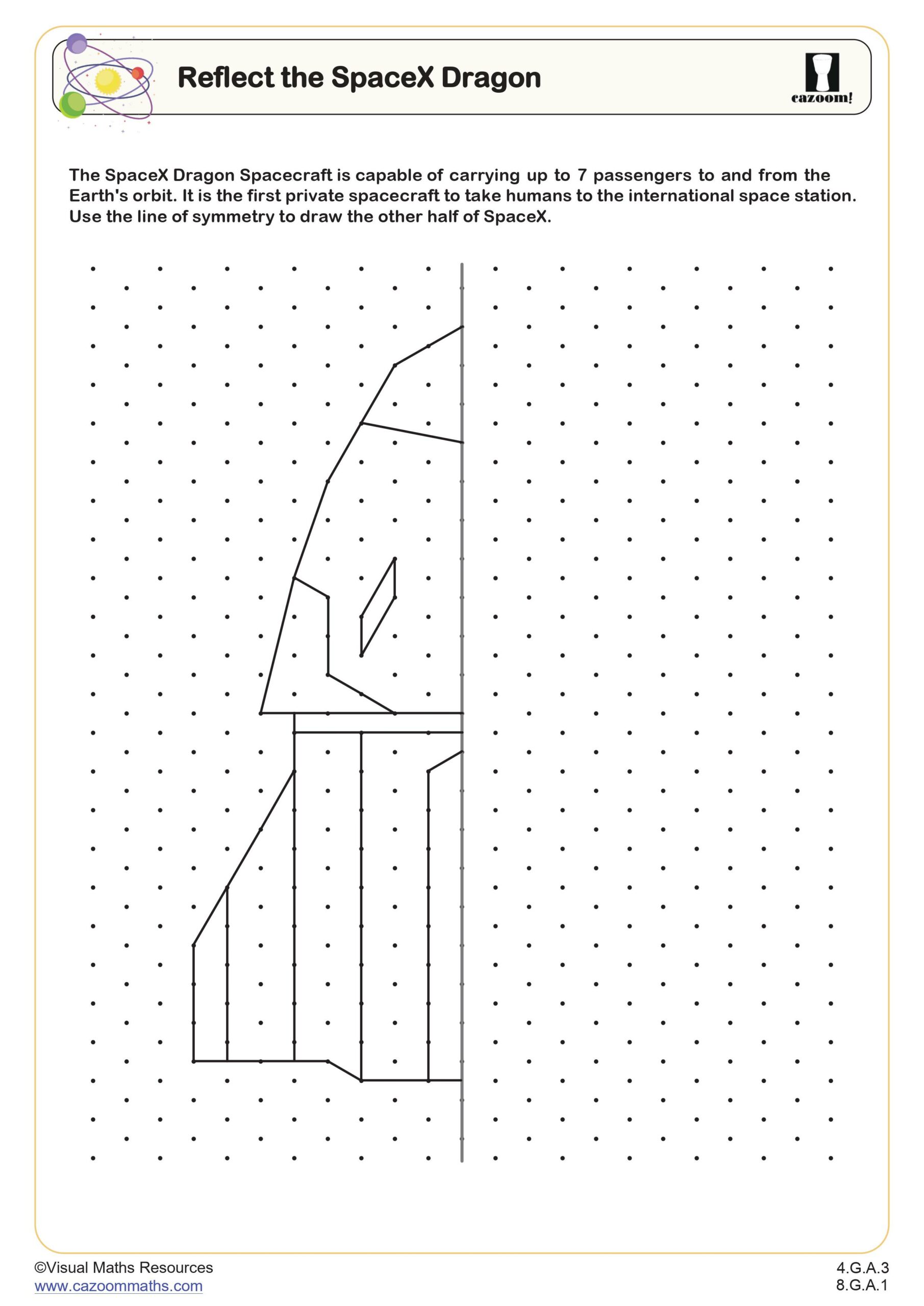
Students often lose points on assessments when they correctly perform the transformation but write the coordinates in the wrong order or forget to include negative signs. Teachers notice that students who sketch the transformation first before writing coordinates make fewer sign errors, particularly with reflections where the distance from the axis of reflection must remain constant. The SpaceX Dragon context helps students visualize why a reflection across the x-axis changes the y-coordinate while keeping the x-coordinate the same.
What Should 8th Graders Know About Transformations in Space?
By 8th grade, students should accurately perform and describe transformations using coordinate notation, understanding that reflections create mirror images, rotations turn figures around a point, and translations slide figures without changing orientation. They need to work fluently with both positive and negative coordinates across all four quadrants and recognize that transformations preserve size and shape (congruence). Students should also begin connecting transformations to function notation, laying groundwork for high school geometry.
This topic builds directly on 7th grade work with scale drawings and proportional reasoning, while the coordinate plane skills extend back to 6th grade. The transformation concepts students master in 8th grade become foundational for high school geometry proofs about congruent figures and later work with matrices in algebra. Students who struggle typically need to revisit plotting points in all four quadrants and understanding absolute value as distance, both critical prerequisites for transformation accuracy.
How Do Reflections Work in Coordinate Geometry?
A reflection creates a mirror image of a figure across a line of reflection, with each point on the original figure the same distance from that line as its reflected image. When reflecting across the x-axis, the x-coordinate stays the same while the y-coordinate changes sign (x, y) becomes (x, -y). When reflecting across the y-axis, the y-coordinate stays the same while the x-coordinate changes sign (x, y) becomes (-x, y). Reflections across the line y=x swap the coordinates entirely (x, y) becomes (y, x).
Reflection transformations appear throughout STEM fields, from designing satellite solar panels that must mirror across a central axis for balance, to programming computer graphics where screen elements flip positions. Aerospace engineers use coordinate reflections when planning symmetric spacecraft designs, ensuring that reflected components maintain proper weight distribution. Students begin recognizing these applications when they see how the SpaceX Dragon's symmetrical design relies on precise reflections to maintain stable flight characteristics.
How Can Teachers Use These Space Transformation Worksheets Effectively?
These worksheets provide structured practice with coordinate transformations while maintaining student engagement through aerospace contexts. The answer keys allow students to self-check their work during independent practice, helping them catch sign errors or coordinate reversals immediately. Teachers can use the coordinate grids to have students verify their answers visually by plotting both original and transformed figures, reinforcing the connection between algebraic rules and geometric results.
Many teachers assign these worksheets as warm-up activities before standardized test review, since transformation questions regularly appear on state assessments. They work well for paired practice where one student performs the transformation while the partner checks using the answer key, then students switch roles. Teachers also use them for differentiated homework, allowing students who need extra time with coordinate plotting to work through problems at their own pace while having the answer key available for immediate feedback rather than waiting until the next class.