8th Grade Units and Dimensions Worksheets
All worksheets are created by the team of experienced teachers at Cazoom Math.
What Are Units and Dimensions in 8th Grade Math?
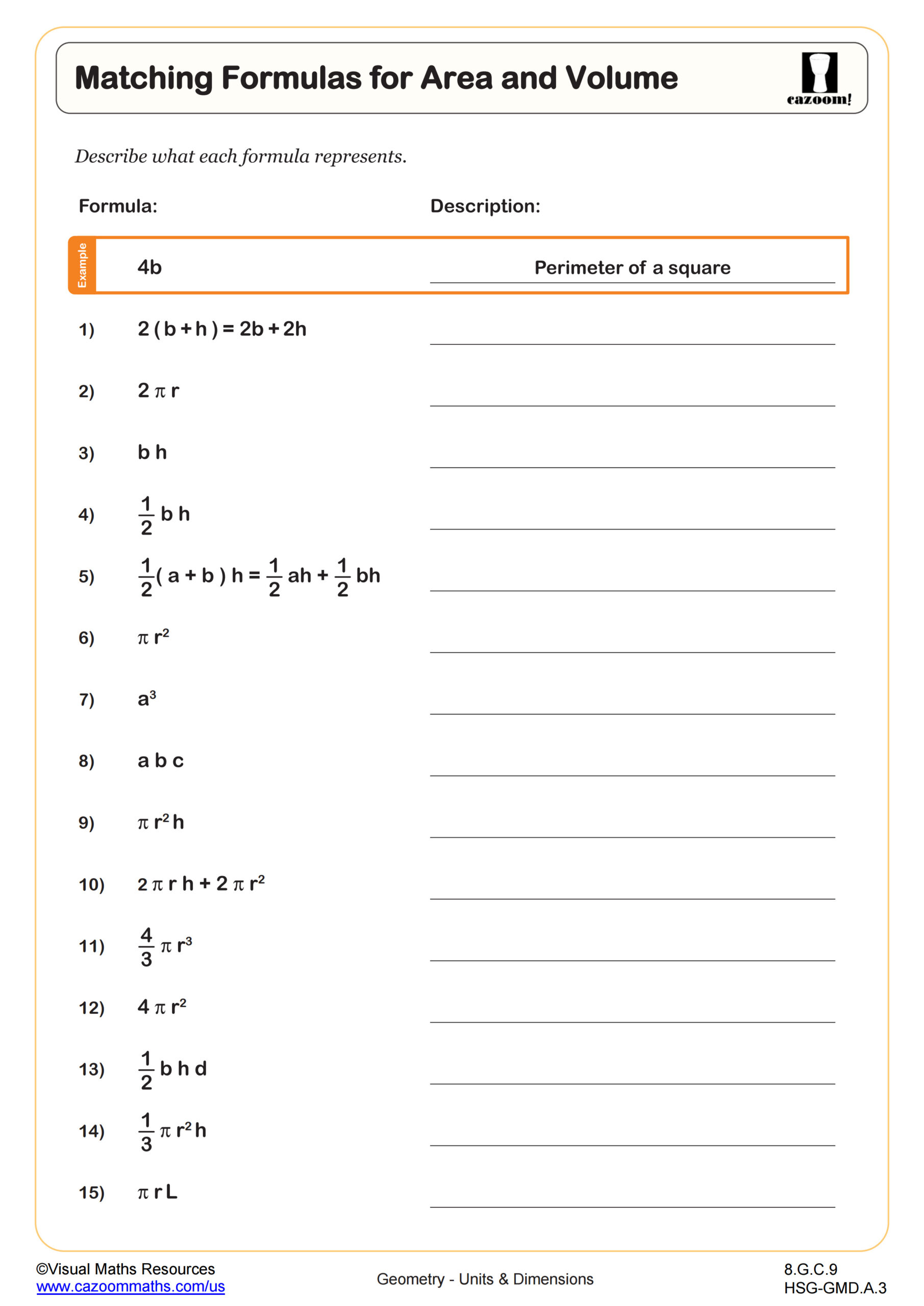
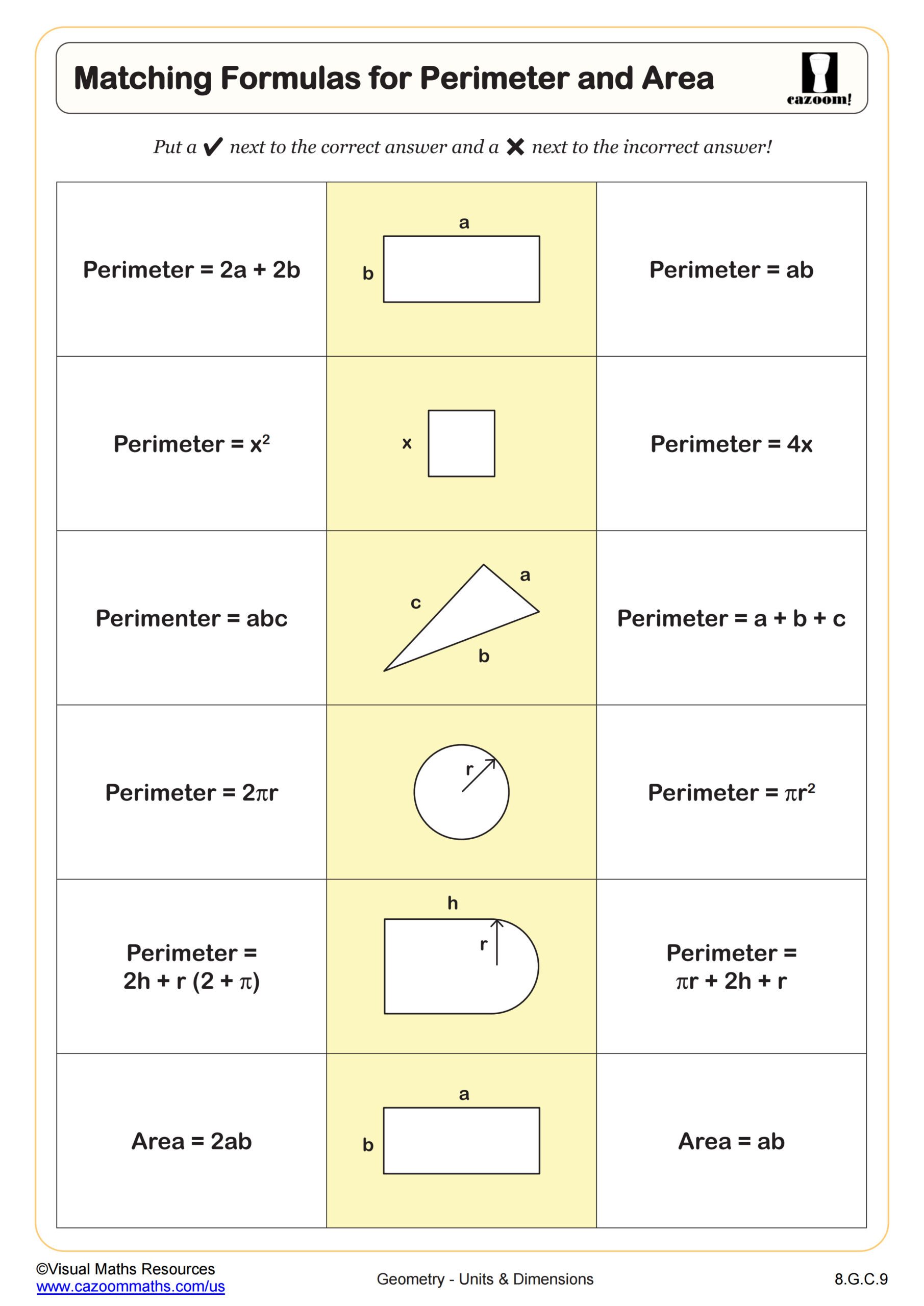
Units and dimensions refer to the measurements associated with mathematical formulas and the spatial properties they describe. In 8th grade, students learn that perimeter formulas measure one-dimensional distance (linear units like inches or centimeters), area formulas measure two-dimensional space (square units like square feet or square meters), and volume formulas measure three-dimensional space (cubic units like cubic inches or cubic centimeters). This connects directly to Common Core Standard 8.G.C.9, which addresses volume formulas for cylinders, cones, and spheres.
Students often struggle with the abstract nature of squared and cubed units, writing "5 inches squared" when they mean "5 square inches." Teachers see this confusion clear up when students physically construct models: folding paper to show how linear measurements form the edges of squares, or stacking unit cubes to demonstrate volume. The matching format helps students focus on pattern recognition before tackling numerical calculations, building confidence in formula selection.
What Should 8th Graders Know About Units and Dimensions?
By 8th grade, students should recognize that different geometric formulas produce different types of measurements based on the dimension being measured. They should distinguish between formulas for perimeter (which add side lengths), area (which multiply two dimensions), and volume (which multiply three dimensions). Students need to understand that the units in their answers reflect these operations: adding meters gives meters, multiplying meters by meters gives square meters, and multiplying three meter measurements gives cubic meters.
This concept builds on 6th and 7th grade work with area and surface area of two-dimensional shapes. In high school geometry and algebra courses, dimensional analysis becomes essential for verifying formula accuracy and checking work. Physics and chemistry classes depend heavily on this skill, as students convert between units and ensure dimensional consistency in equations. State assessments regularly include questions where students must identify appropriate units for calculated quantities or explain why certain formulas apply to specific measurement tasks.
How Does Dimensional Analysis Connect to Real-World Problem Solving?
Dimensional analysis involves checking that the units in a calculation match the quantity being measured, which prevents errors in mathematical and scientific work. When students match formulas to their corresponding measurements, they're practicing this skill at a foundational level. For example, recognizing that a perimeter formula must produce linear units helps students catch mistakes when they accidentally calculate area instead of perimeter in word problems.
Engineers, architects, and construction professionals use dimensional analysis daily to ensure measurements make sense before implementing designs. A landscape architect calculating how much mulch to order must use a volume formula (three dimensions) rather than an area formula (two dimensions), or the order will be drastically incorrect. Similarly, when NASA lost the Mars Climate Orbiter in 1999 due to a unit conversion error between metric and imperial measurements, it demonstrated how critical dimensional consistency is in STEM fields. Students who master this concept in middle school develop habits that prevent costly calculation errors in future careers.
How Can Teachers Use These Worksheets Effectively?
These worksheets use a matching format that allows students to focus on pattern recognition and conceptual understanding before performing calculations. Students analyze formulas to determine what dimension they measure based on the operations involved, strengthening their ability to select appropriate formulas in mixed problem sets. The answer keys let students check their reasoning independently or enable teachers to quickly identify which students need additional support with dimensional concepts.
Many teachers use these worksheets as a diagnostic tool at the beginning of geometry units to assess whether students understand the fundamental differences between linear, area, and volume measurements. They work well as warm-up activities before introducing complex shape formulas, or as review materials when students confuse formulas during problem-solving. Small group instruction benefits from having students explain their matching choices to partners, which reveals misconceptions about why certain formulas produce specific unit types. The worksheets also serve as effective homework assignments that prepare students for the dimensional reasoning required in high school mathematics and science courses.