Algebra I Area and Perimeter Worksheets
All worksheets are created by the team of experienced teachers at Cazoom Math.
What Do Students Learn in Algebra I Area and Perimeter Worksheets?
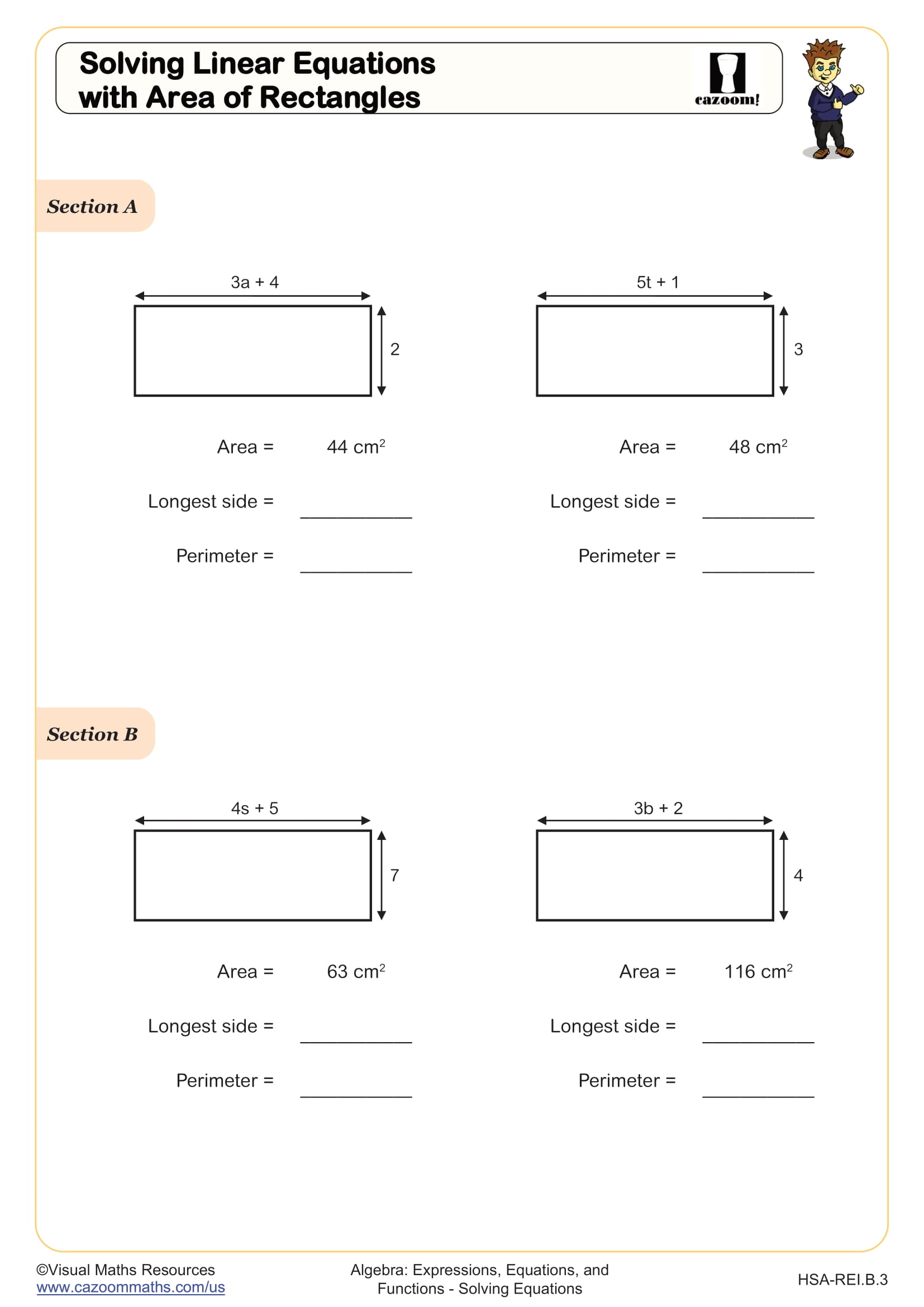
Students work with familiar geometric formulas for rectangles, transforming them into algebraic equations that require solving for unknown dimensions. The focus is on translating between geometric representations and algebraic expressions, then applying linear equation-solving techniques to find missing lengths, widths, or other measurements when given area or perimeter values. This integration reinforces both algebraic manipulation skills and geometric reasoning within the Algebra I curriculum.
A common error occurs when students correctly write the area formula A = lw but then struggle to rearrange it when solving for a variable that appears in an expression like (x + 3)(2x - 1) = 45. Teachers notice students often expand the binomials correctly but lose confidence when the resulting quadratic appears more complex than expected, highlighting the importance of checking whether problems stay linear or require factoring skills typically introduced later in Algebra I.
How Do Area and Perimeter Problems Appear on Standardized Tests?
The SAT and ACT frequently present area and perimeter questions disguised within word problems or diagram-based scenarios where students must extract information, set up equations, and solve for unknown quantities. State assessments aligned with Common Core standards test whether students can model geometric situations algebraically and interpret their solutions within the original context. These questions often combine multiple skills, requiring students to recognize which formula applies, translate the scenario into an equation, and verify that their answer makes sense geometrically.
Students lose points when they solve the equation correctly but fail to answer the actual question asked, such as finding the width when the problem requests the perimeter. Another frequent mistake involves sign errors when expressions like (x - 4) represent dimensions, where students forget that negative lengths are impossible and don't check whether their algebraic solution is geometrically valid. Standardized tests specifically target this ability to connect algebraic results back to real-world constraints.
How Do Students Work with Expressions as Dimensions?
When algebraic expressions represent lengths or widths, students must treat them as single quantities during calculations, applying the distributive property correctly when computing area or combining like terms when finding perimeter. For example, if a rectangle has length (3x + 5) and width (x - 2), students calculate perimeter as 2(3x + 5) + 2(x - 2) and simplify to 8x + 6. This reinforces order of operations and like term combination while giving abstract algebraic manipulation a concrete geometric meaning that helps students visualize what their calculations represent.
Architects and engineers regularly use these skills when designing spaces with variable dimensions or calculating material needs for projects where measurements depend on adjustable parameters. Construction planning often requires determining how changing one dimension affects area or perimeter, exactly the type of algebraic thinking these problems develop. College-bound students encounter these applications again in calculus when optimization problems ask them to maximize area given perimeter constraints or similar scenarios.
How Can Teachers Use These Worksheets in Algebra I Classes?
The worksheets provide structured practice that connects geometric formulas students learned in middle school with the algebraic equation-solving techniques they're developing in Algebra I. Problems are designed to reinforce the modeling process, where students translate verbal descriptions or diagrams into equations, solve systematically, and interpret results. Answer keys allow teachers to quickly identify whether errors stem from formula misapplication, algebraic manipulation mistakes, or misunderstanding the problem setup, making targeted intervention more efficient.
Teachers use these worksheets effectively during the transition between introducing linear equations and moving into systems of equations, as they provide authentic multi-step practice without introducing new solving techniques. They work well as warm-up problems to activate both geometric and algebraic thinking, or as assessment preparation since this content appears regularly on state tests. Paired work helps students verbalize their reasoning when setting up equations, which often reveals misconceptions about variable representation that individual practice might miss.