Algebra I Function Machines Worksheets
All worksheets are created by the team of experienced teachers at Cazoom Math.
What Are Function Machines and Why Do Students Use Them?
Function machines are visual representations that show how a function transforms an input value through one or more operations to produce an output. Students use them to bridge the gap between arithmetic thinking and algebraic reasoning, seeing functions as processes rather than just equations. The machine format helps students understand that functions follow consistent rules, applying the same operations to every input they receive.
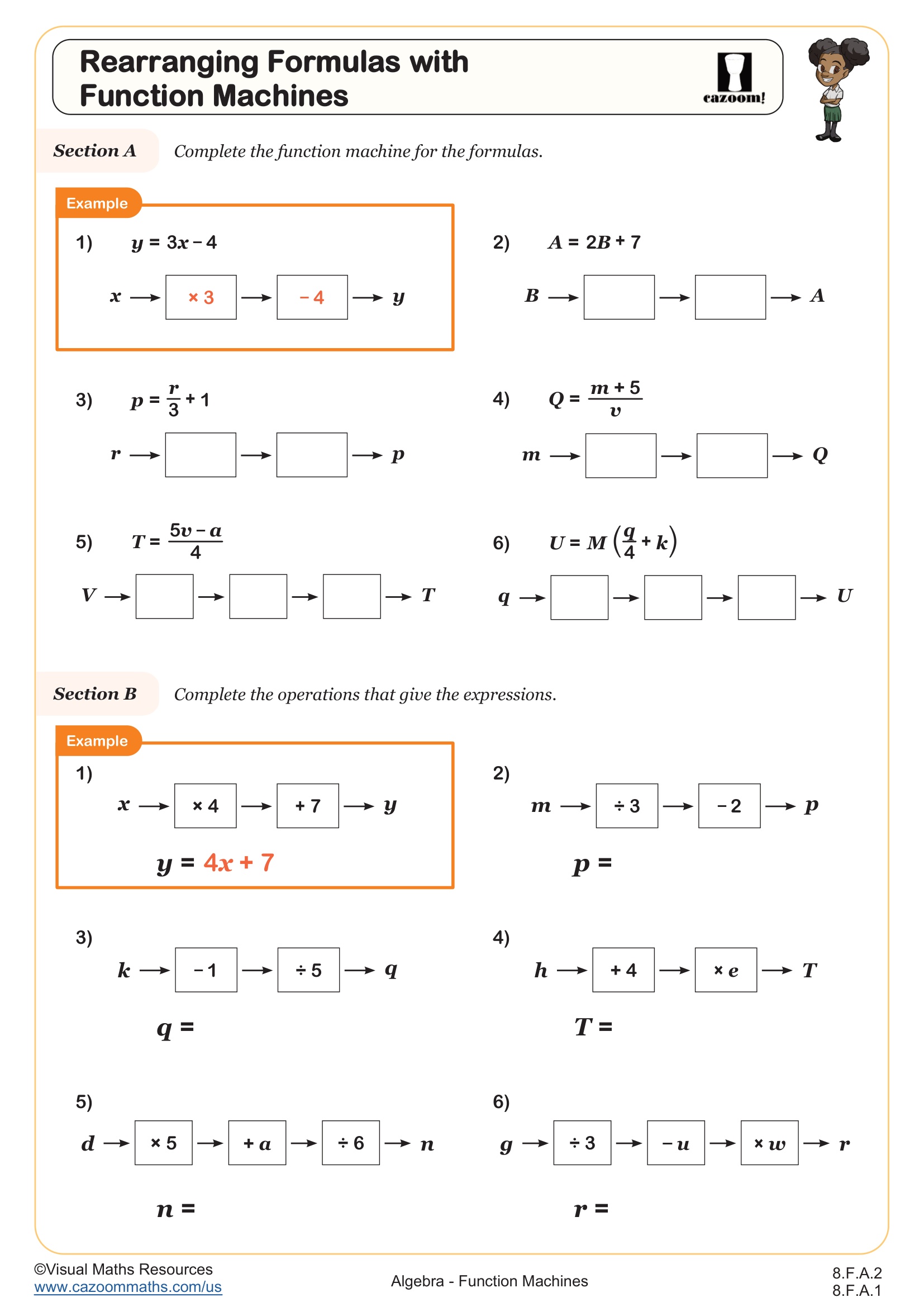
A common misconception occurs when students work backward from outputs to inputs. Many students initially try to repeat the same operations instead of applying inverse operations, particularly when the function machine includes subtraction or division. Teachers see this error pattern disappear once students recognize that reversing a function machine means undoing each operation in reverse order, like rewinding a video of the process.
What Grade Level Are Function Machines Worksheets For?
These function machines worksheets are designed for Algebra I students, typically in high school (grades 9-10). At this level, students transition from concrete numerical patterns to abstract algebraic thinking, and function machines serve as a scaffolding tool that makes this transition more accessible. The worksheets align with Common Core standards for understanding functions as rules that assign exactly one output to each input.
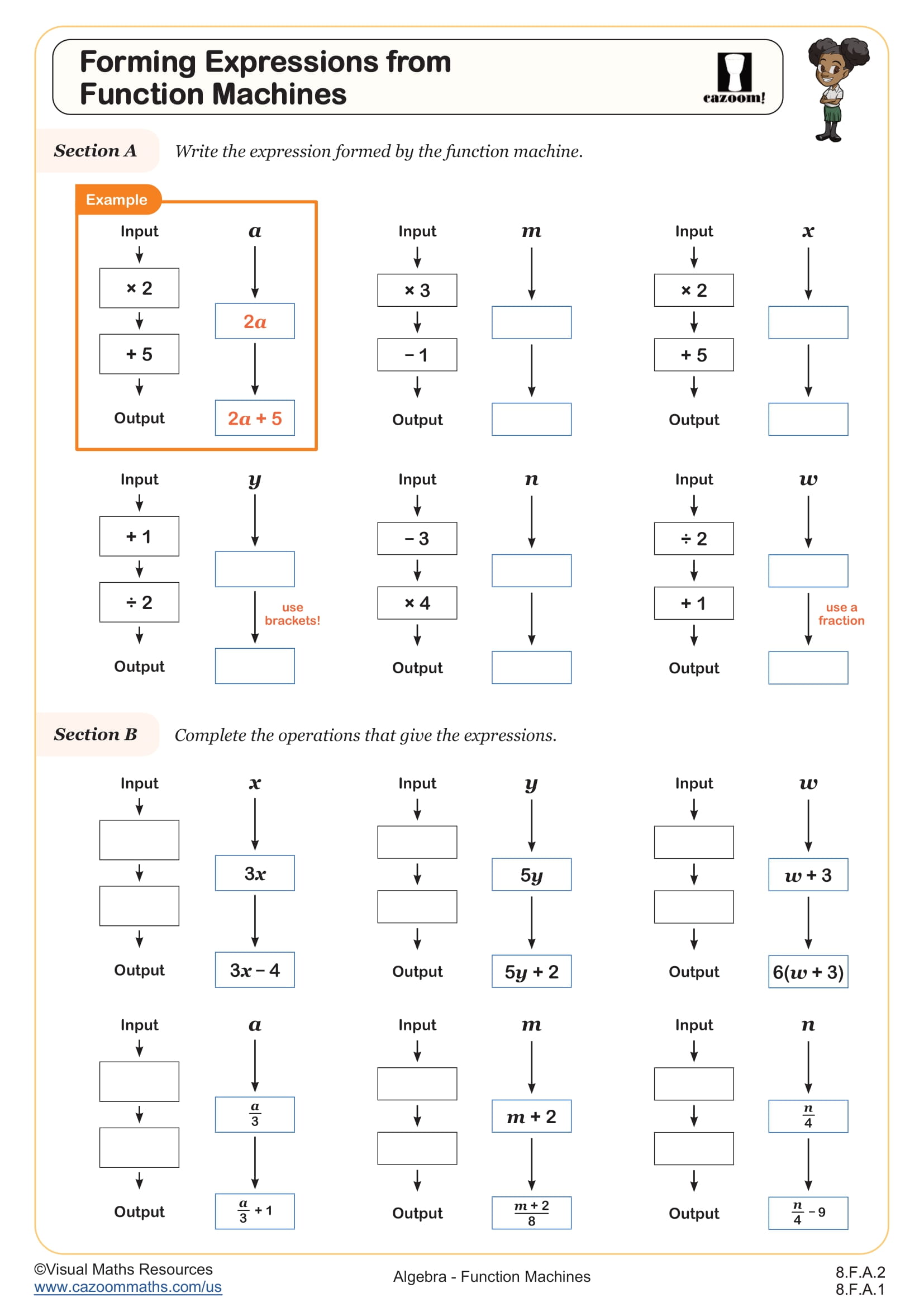
The difficulty progression moves from identifying simple one-step operations to working with multi-step function machines that require students to form complex algebraic expressions. Early worksheets focus on numerical inputs and outputs, helping students recognize operational patterns. Later worksheets introduce algebraic inputs, preparing students for function notation like f(x) and composite functions that they'll encounter throughout their high school math courses.
How Do Students Find Missing Functions in Function Machines?
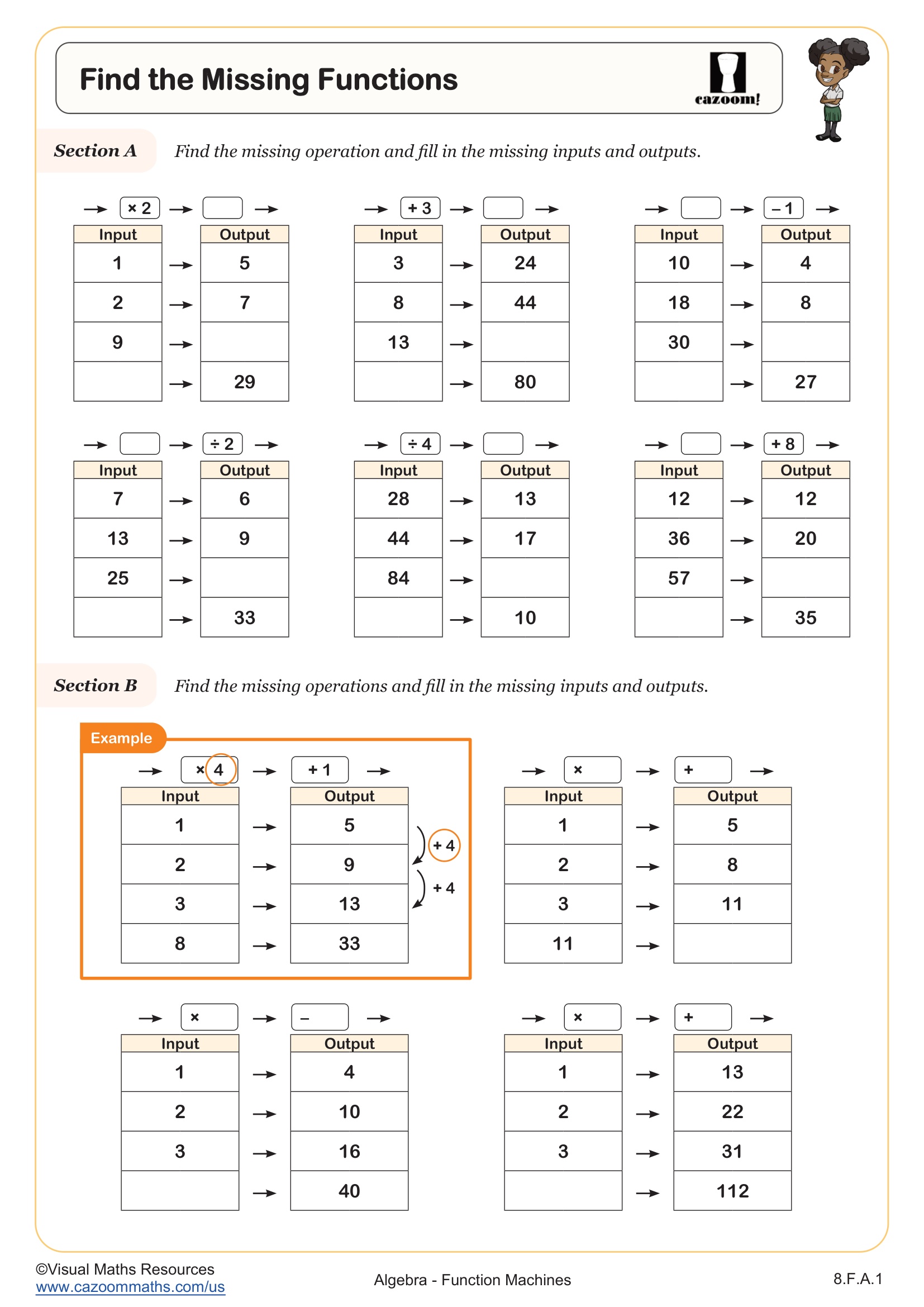
Finding missing functions requires students to analyze given input-output pairs and determine which operation or sequence of operations produces the observed transformation. Students examine the relationship between inputs and outputs, testing hypotheses about multiplication, division, addition, or subtraction until they identify the rule. For multi-step function machines, students must recognize that operations occur in sequence, with each step's output becoming the next step's input.
This skill connects directly to data analysis and computer programming, where students must identify patterns in datasets or write algorithms that process information. Software engineers regularly design functions that transform user inputs into desired outputs, whether calculating sales tax in e-commerce applications, converting temperature units in weather apps, or processing image filters in photo editing software. Understanding function machines helps students recognize that much of technology relies on systematic transformations of data through predictable rules.
How Do These Worksheets Help Students Master Function Machines?
The worksheets build understanding through carefully sequenced problem types that move from concrete examples to abstract representations. Students begin with function machines that show all components, then progress to problems where they must identify missing pieces, whether inputs, outputs, or the functions themselves. Answer keys allow students to check their reasoning immediately, helping them identify which types of operations or multi-step sequences cause confusion before those misunderstandings become ingrained.
Teachers use these worksheets for differentiated instruction, assigning simpler function machines to students who need additional practice with basic operations while challenging advanced students with complex multi-step machines. The format works well for paired activities where one student creates a function machine and their partner determines the rule. Many teachers incorporate these worksheets during intervention blocks when students struggle with function notation, finding that the visual machine format clarifies concepts that seem abstract in equation form.