Algebra I Probability Worksheets
All worksheets are created by the team of experienced teachers at Cazoom Math.
What probability concepts do Algebra I students learn?
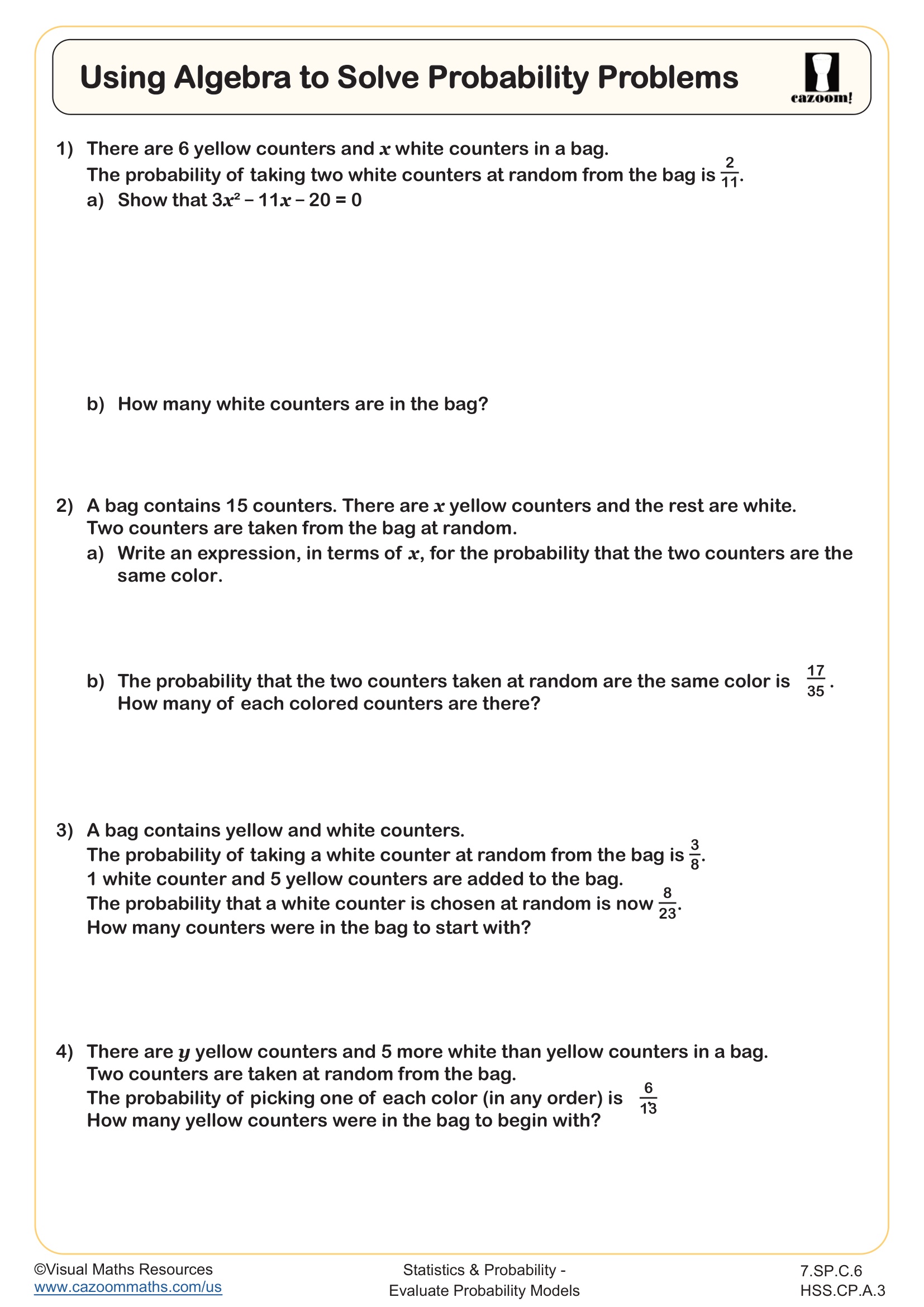
Algebra I students explore probability through an algebraic lens, learning to set up and solve equations that represent probability situations. This includes using variables to represent unknown probabilities, applying the counting rule to determine total outcomes, working with complementary events, and solving for probabilities when given specific conditions or constraints. The focus differs from middle school probability by requiring equation-solving skills and algebraic thinking rather than just arithmetic calculations.
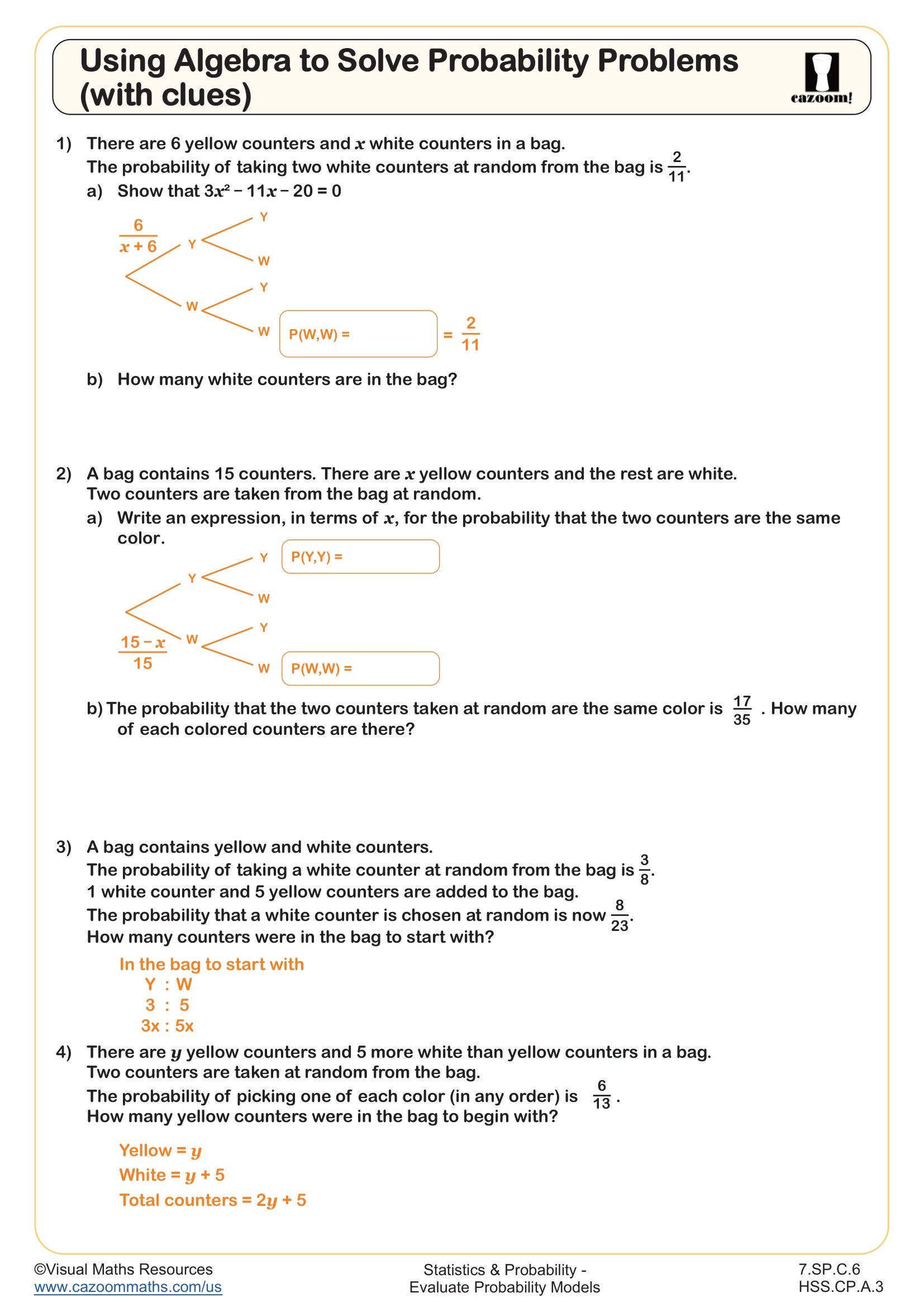
Students often struggle initially with translating word problems into algebraic probability expressions, particularly when determining whether to add or multiply probabilities. Teachers notice that providing visual representations alongside algebraic notation helps students recognize patterns, such as understanding that "and" typically signals multiplication while "or" indicates addition in probability contexts. This algebraic approach prepares students for statistics concepts they'll encounter in higher-level courses.
How does probability appear on the SAT and state assessments?
Standardized tests present probability within multi-step problem-solving contexts that require algebraic reasoning, not just memorized formulas. The SAT Math section includes questions where students must calculate probabilities from two-way tables, determine conditional probabilities, or solve equations involving probability constraints. State assessments similarly test whether students can translate complex scenarios into mathematical representations and apply algebraic methods to find solutions. These questions often embed probability within real-world contexts like survey results or game scenarios.
Students lose points when they misinterpret compound probability situations or fail to recognize when probabilities should be expressed as equations. A frequent error occurs when students add probabilities that should be multiplied, particularly in sequential events. Teachers notice that students who practice setting up algebraic equations for probability problems rather than relying solely on formulas perform better on assessment questions that require analysis and justification of their reasoning.
What is the counting rule and how do students use it with algebra?
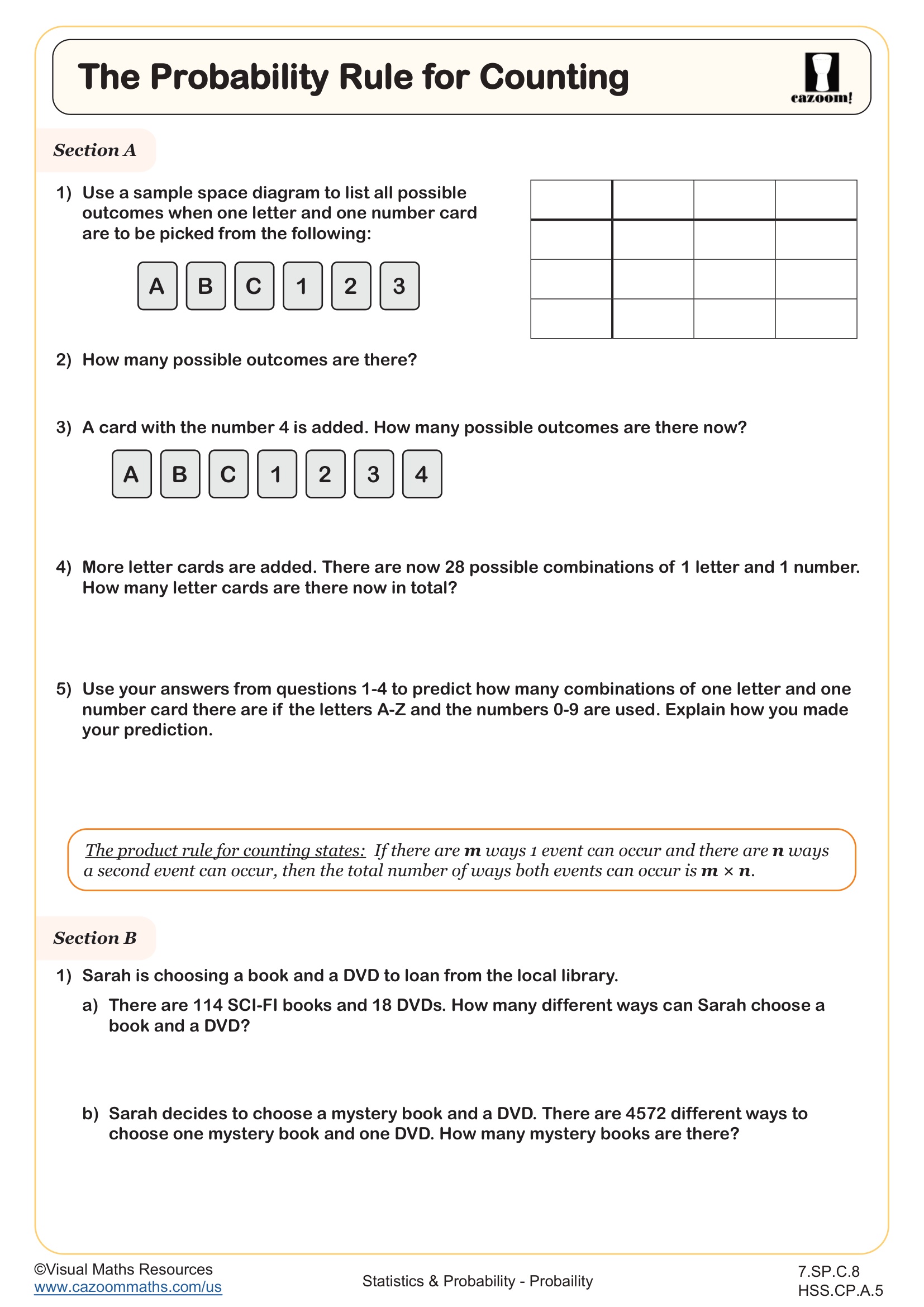
The counting rule, also known as the fundamental counting principle, states that if one event can occur in m ways and another independent event can occur in n ways, then both events together can occur in m × n ways. In Algebra I, students extend this principle by using variables to represent unknown quantities and setting up equations to solve for missing information. For example, if a combination lock has an unknown number of digits and students know the total possible combinations, they can write and solve an equation using the counting rule to determine how many positions the lock contains.
This algebraic approach to counting appears frequently in computer science and cryptography, where understanding how choices multiply to create secure passwords or encryption keys matters considerably. Technology professionals regularly calculate the size of sample spaces when designing security systems or analyzing data structures. College-bound students pursuing STEM fields encounter these concepts again in discrete mathematics and probability courses, where the counting rule forms the foundation for more advanced combinatorics and statistical analysis.
How can teachers use these Algebra I probability worksheets effectively?
These worksheets provide structured practice that bridges probability concepts with algebraic methods, offering problems that require students to set up equations, manipulate variables, and interpret solutions within probability contexts. The progression from basic algebraic probability to problems with additional clues helps students develop problem-solving strategies while reinforcing equation-solving skills. Teachers find that the answer keys showing complete solution steps serve as valuable teaching tools, particularly when students work independently or need to identify where their reasoning diverged from the correct approach.
Many teachers use these worksheets during units that review both algebra and probability before state assessments, as they reinforce multiple skills simultaneously. The problems work well for differentiated instruction, with some students completing them independently while others benefit from working through examples with teacher guidance. Some teachers assign these for homework after introducing algebraic probability methods in class, while others use them as warm-up activities to maintain skills throughout the semester. The variety of problem types helps prepare students for the diverse ways probability appears on standardized tests.