Algebra I Solving Equations Worksheets
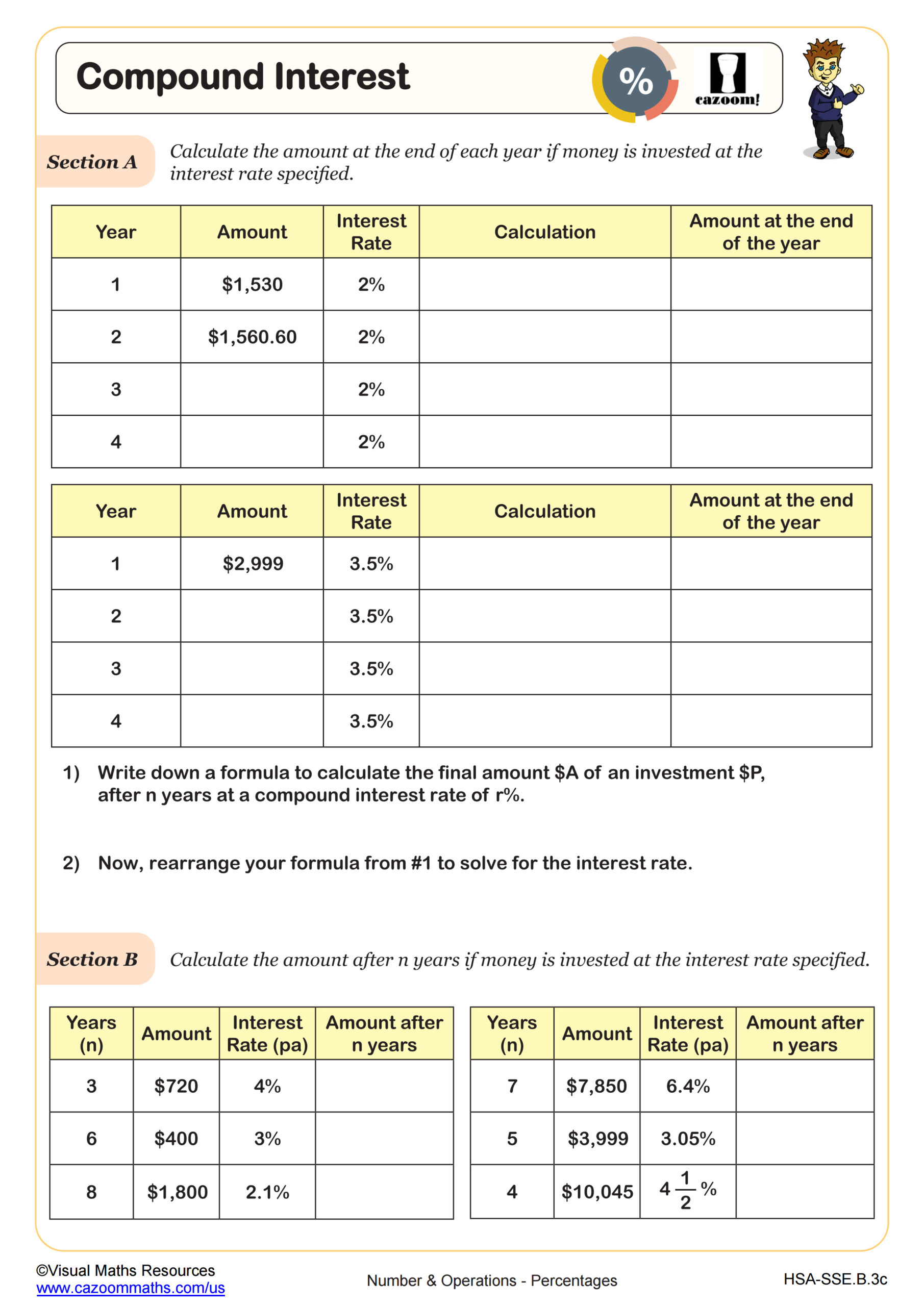
Compound Interest
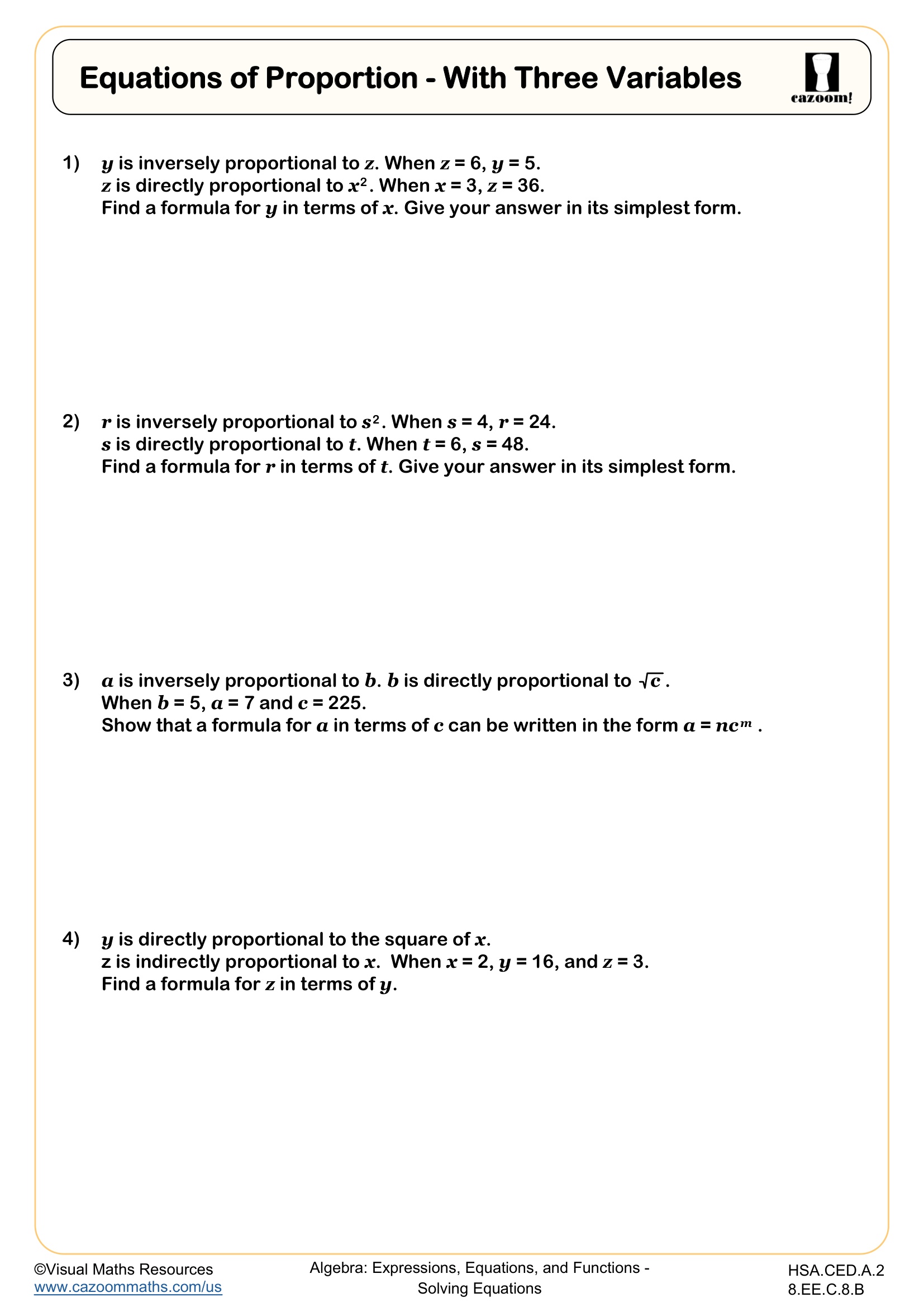
Equations of Proportion - with Three Variables
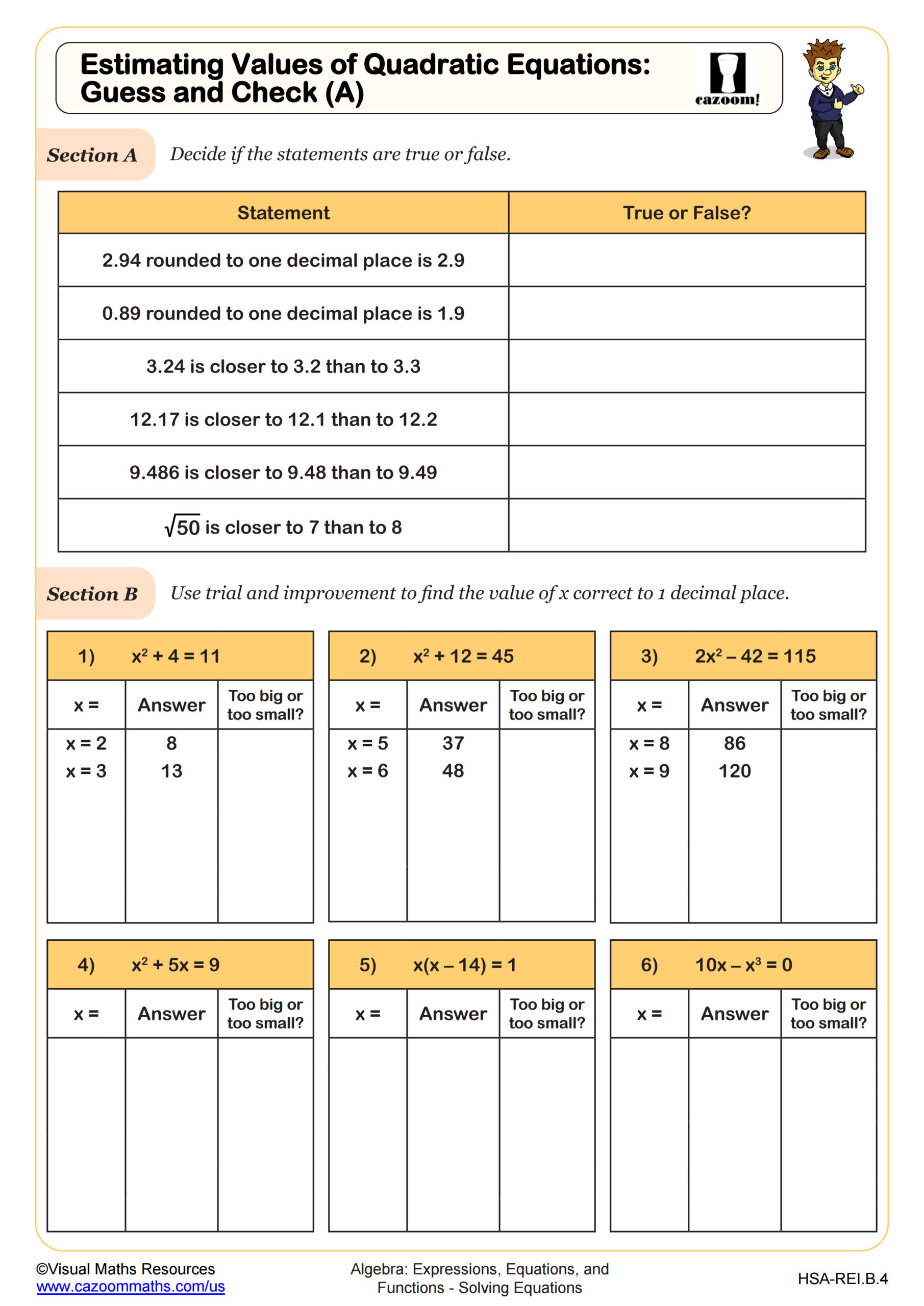
Estimating Values of Quadratic Equations: Guess and Check (A)
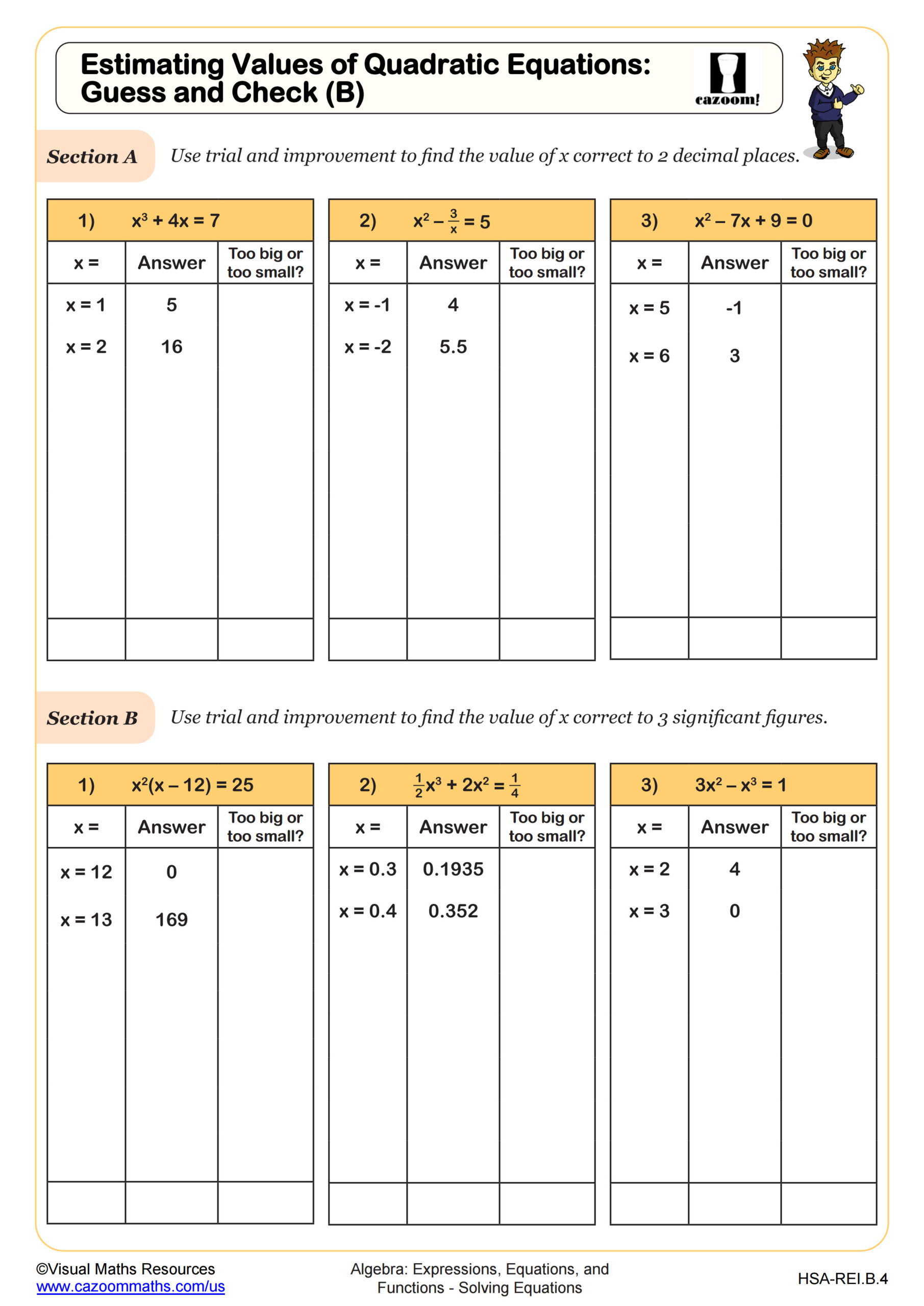
Estimating Values of Quadratic Equations: Guess and Check (B)
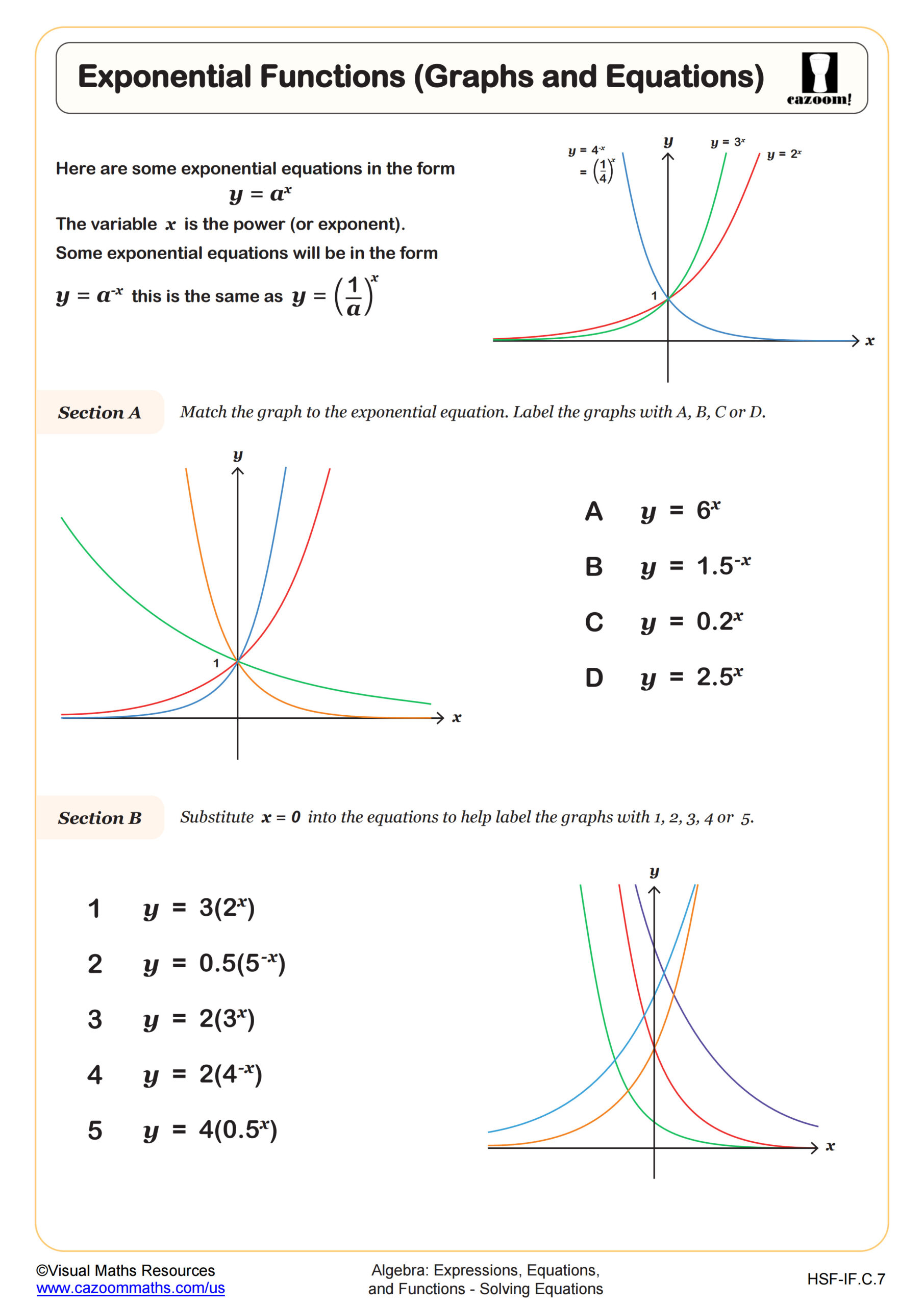
Exponential Functions (Graphs and Equations)
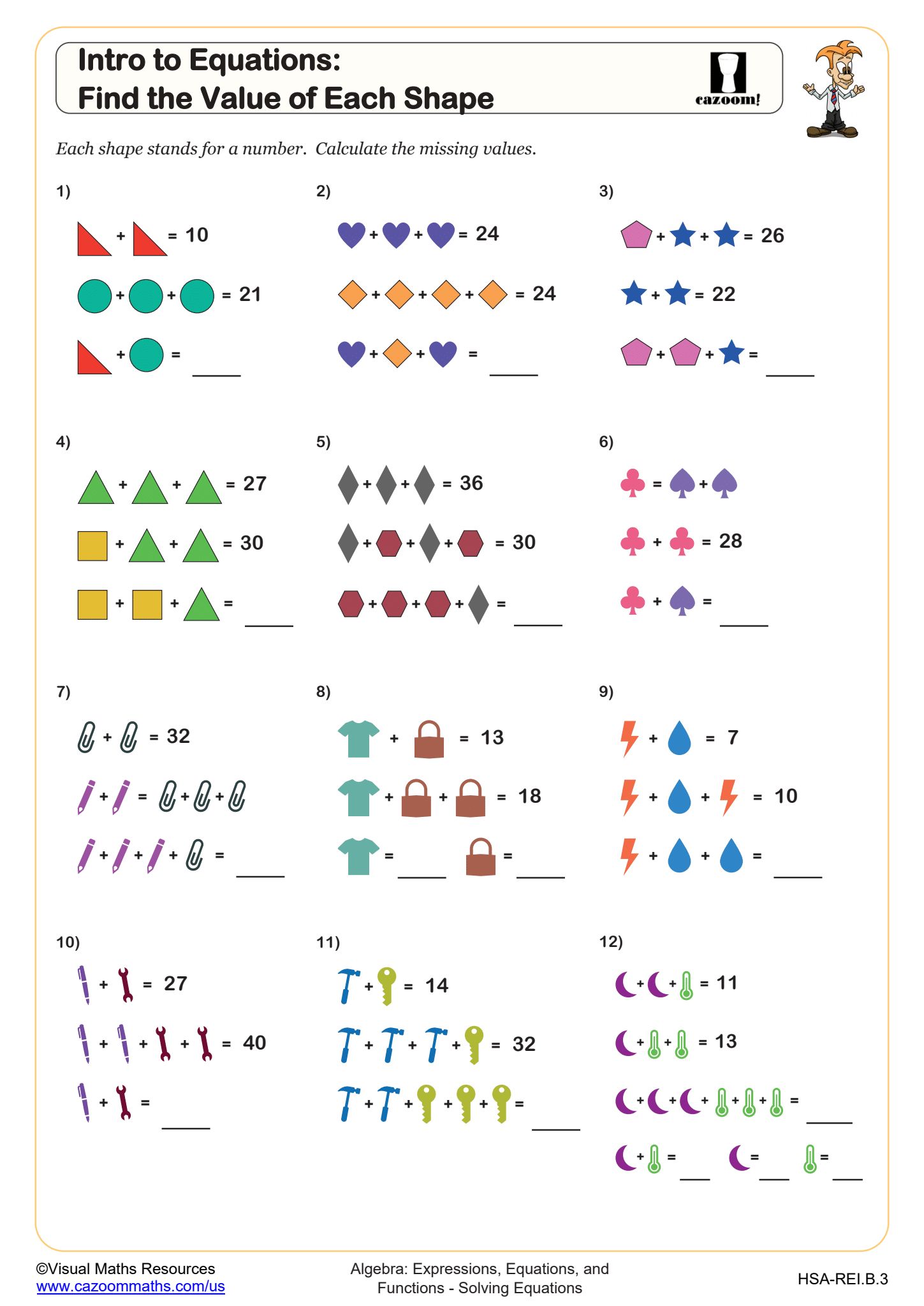
Intro to Equations: Find the Value of Each Shape
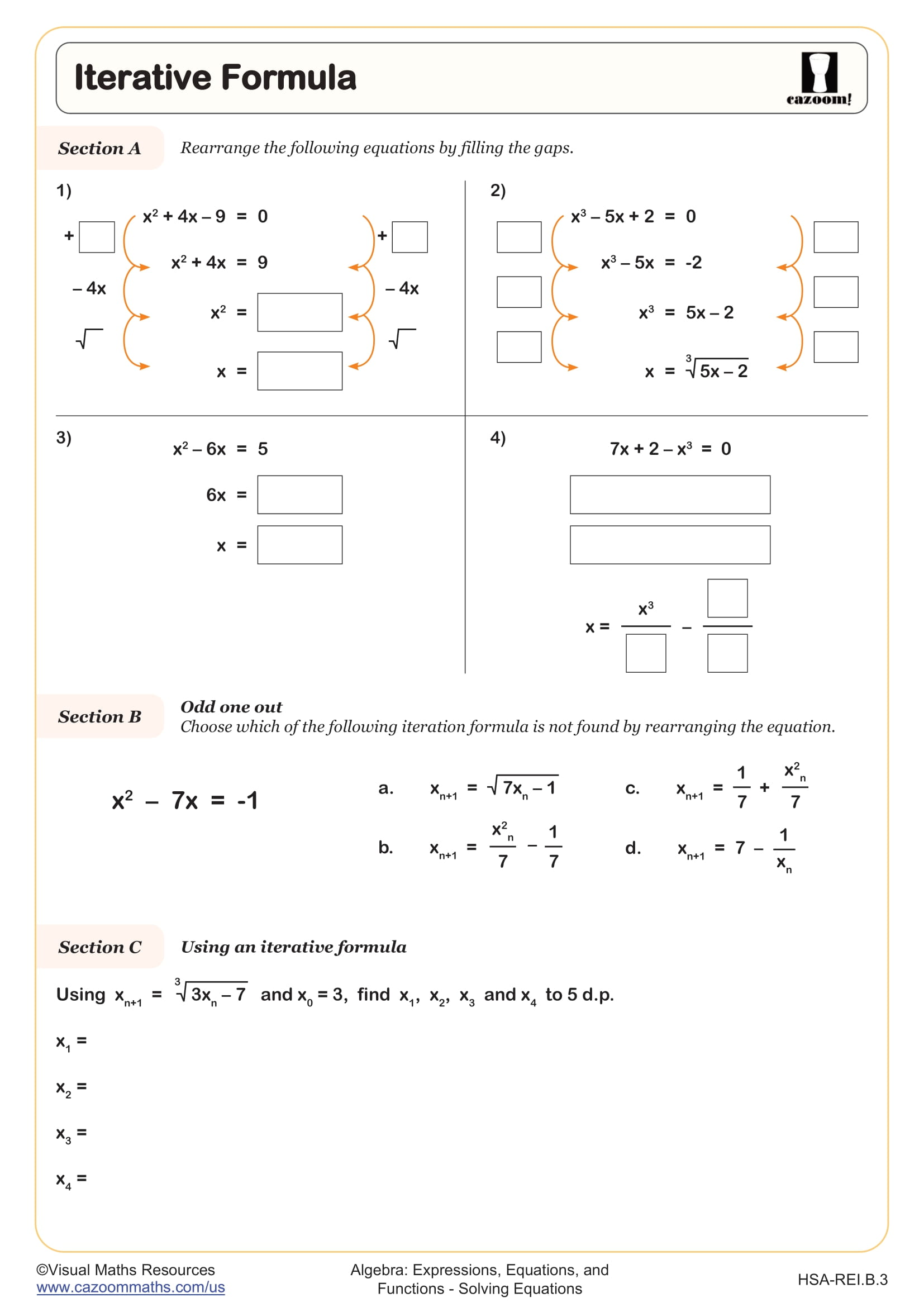
Iterative Formula
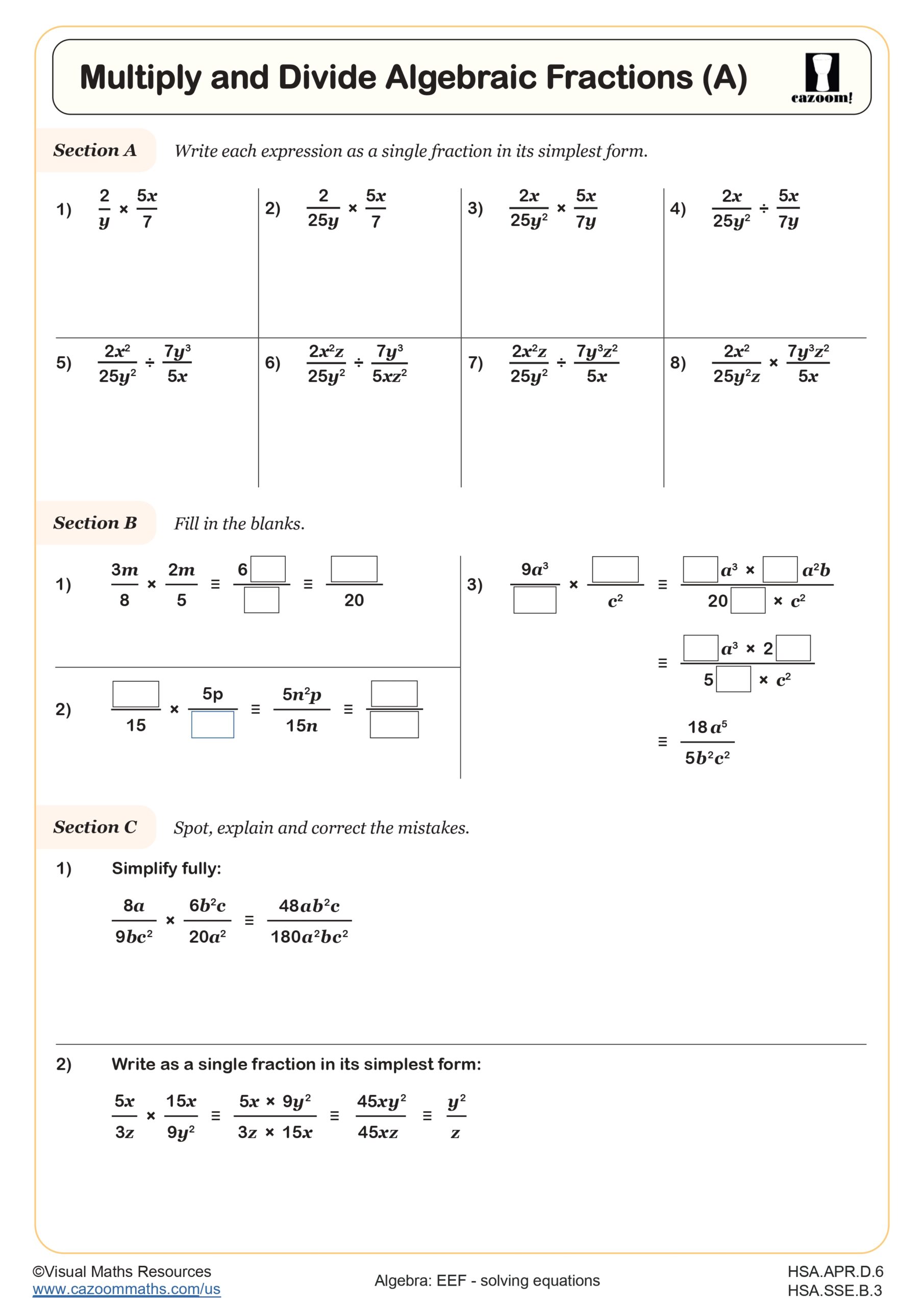
Multiply and Divide Algebraic Fractions (A)
Multiplying 3 Binomials (A)
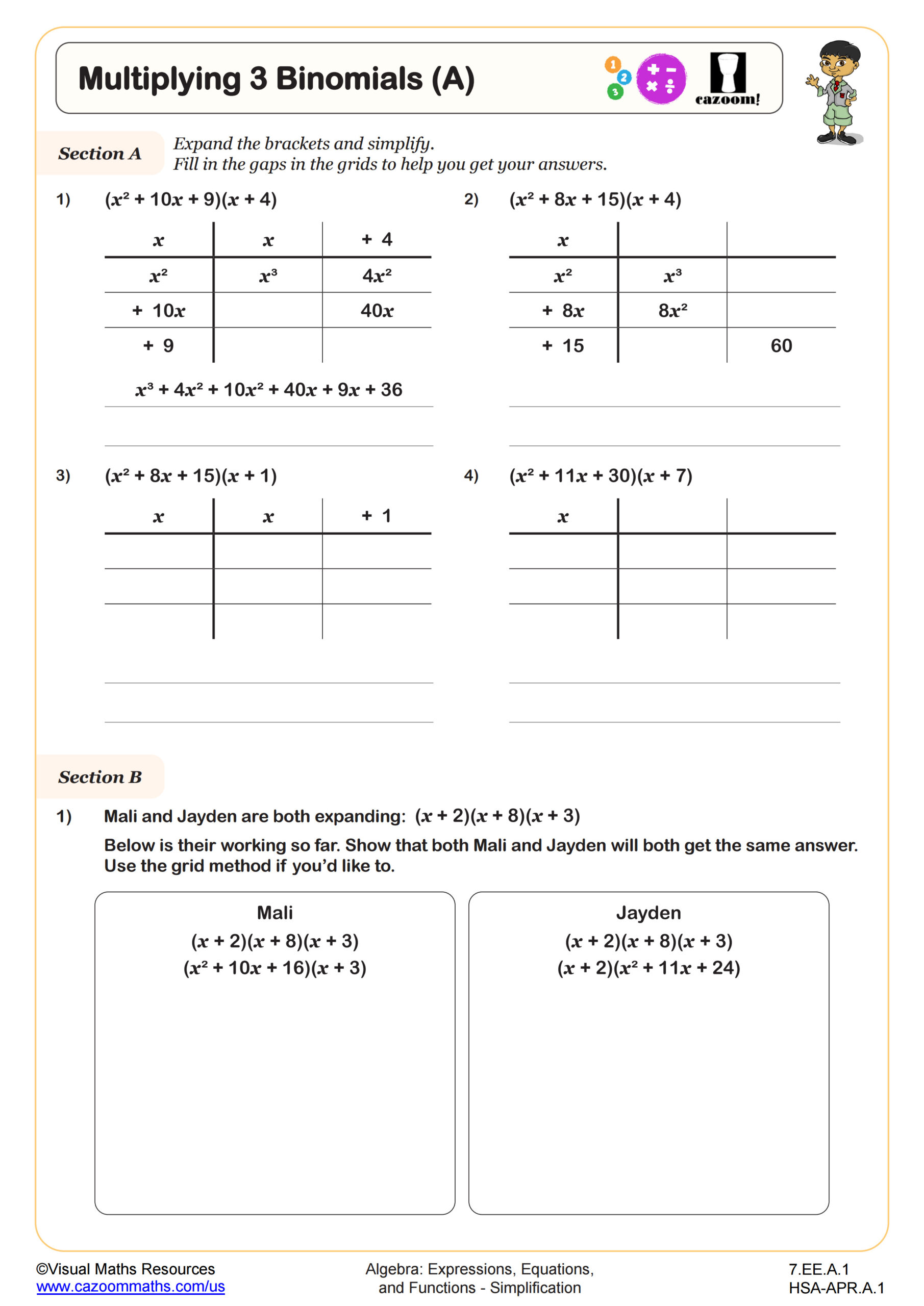
Multiplying 3 Binomials (B)
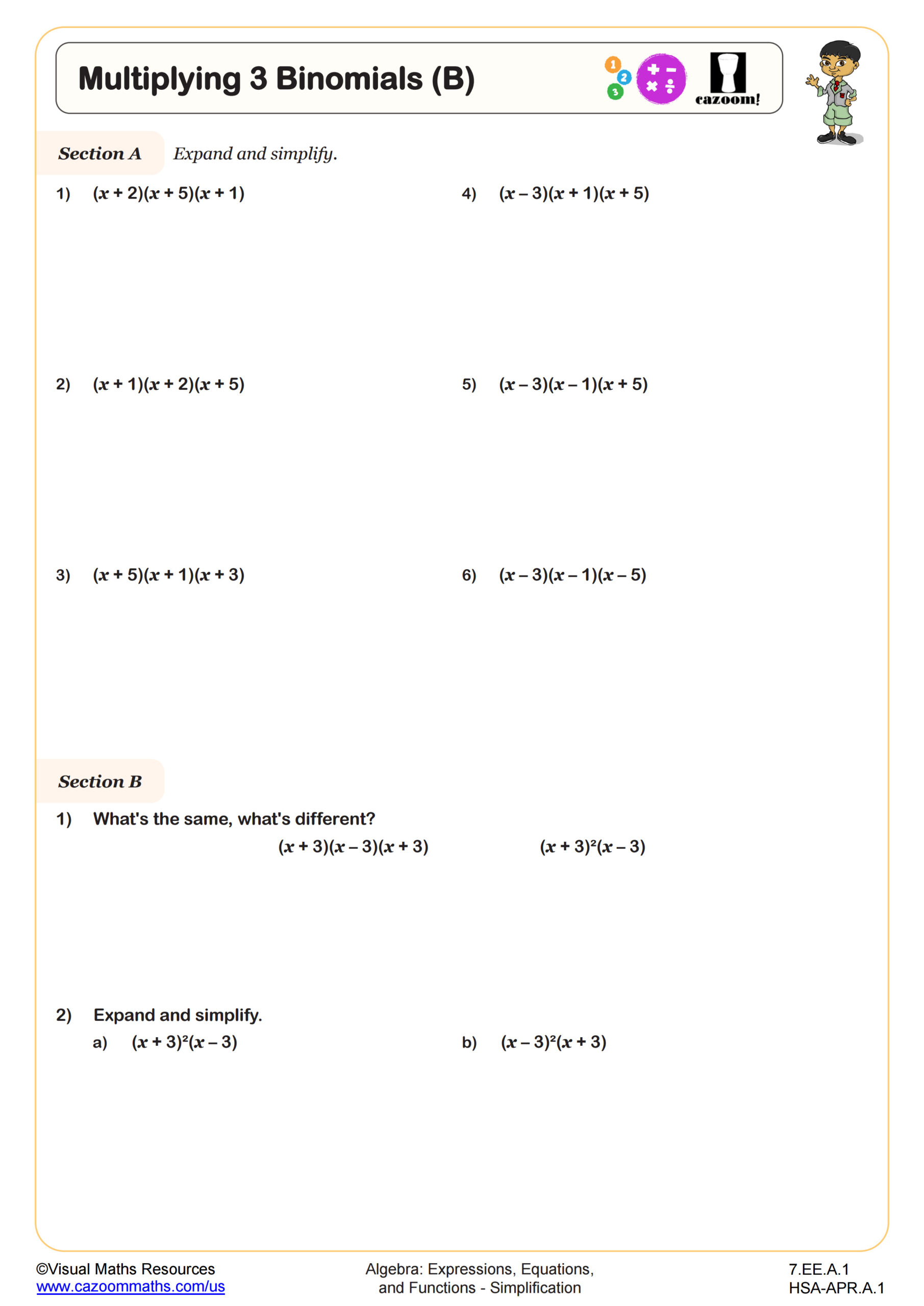
Multiplying Binomials
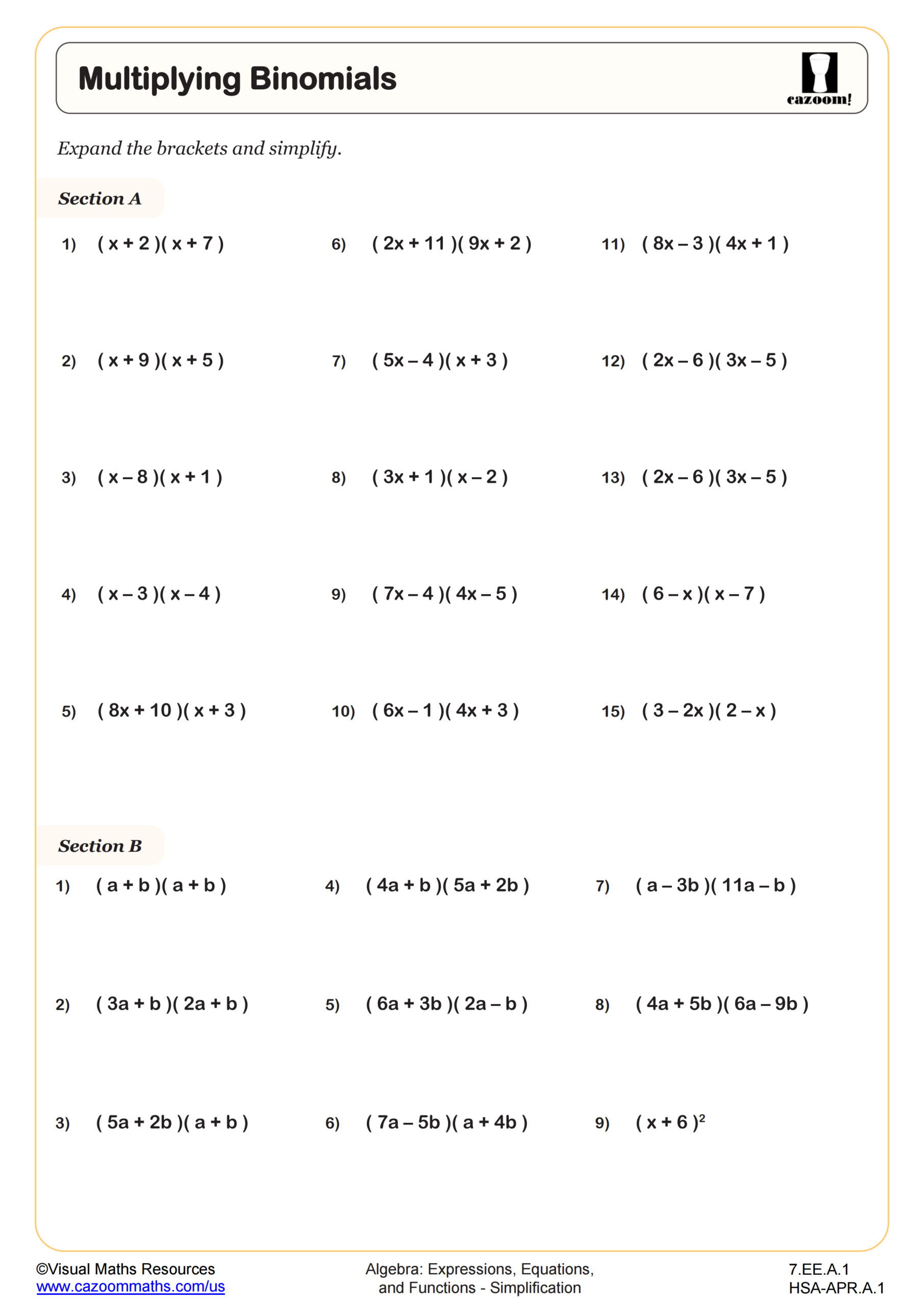
Multiplying Binomials using the Grid Method
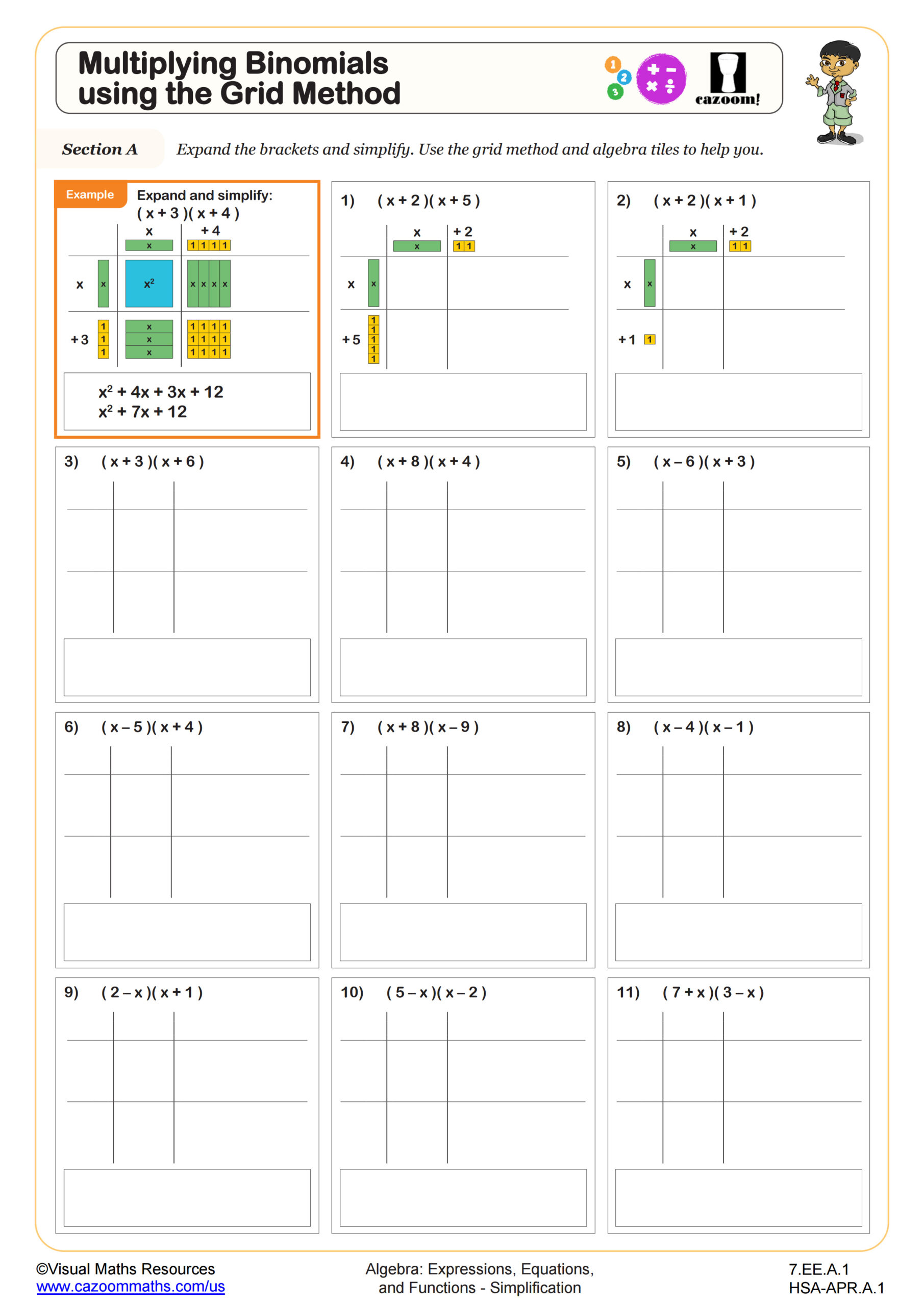
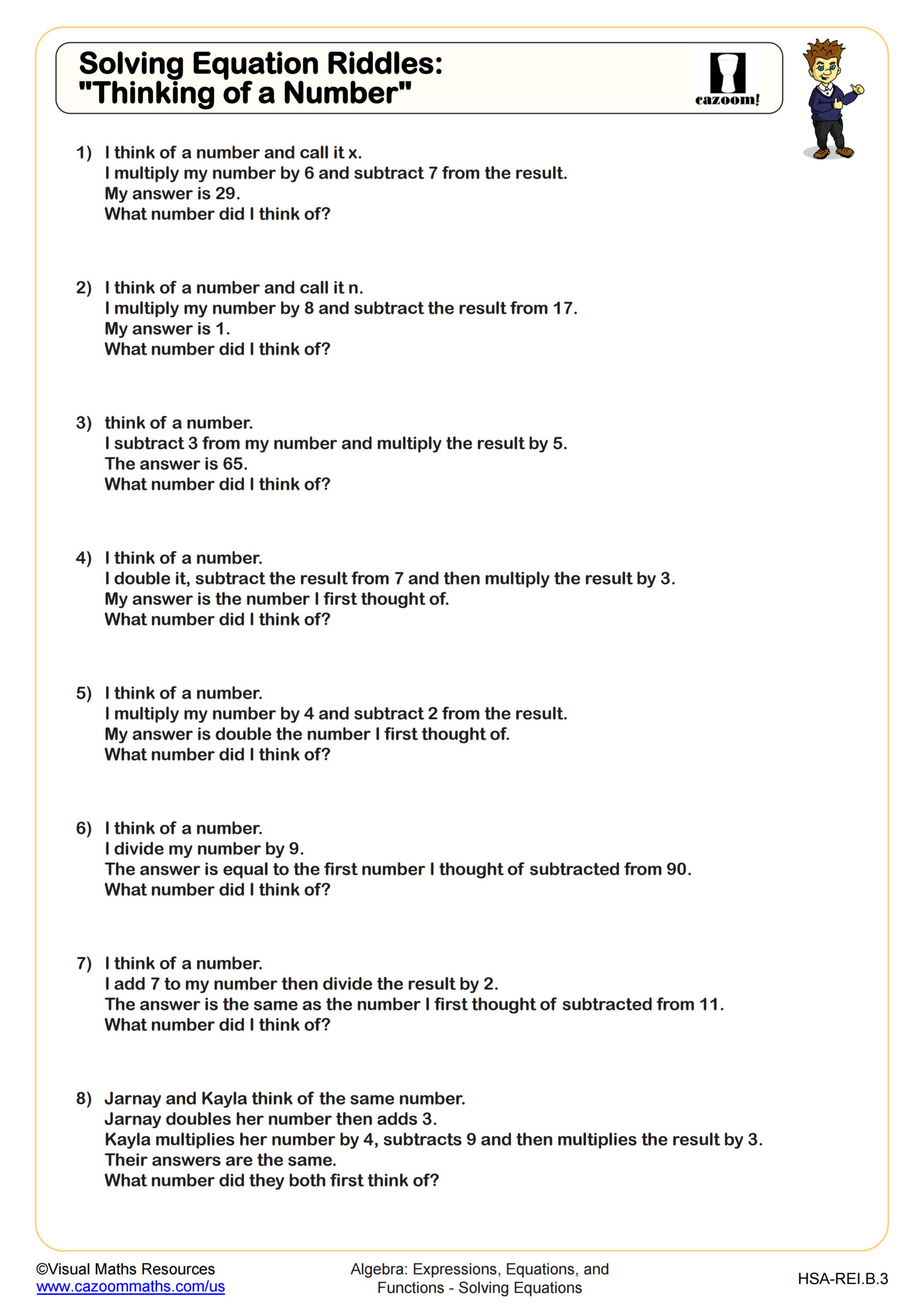
Solving Equation Riddles: "Thinking of a Number"
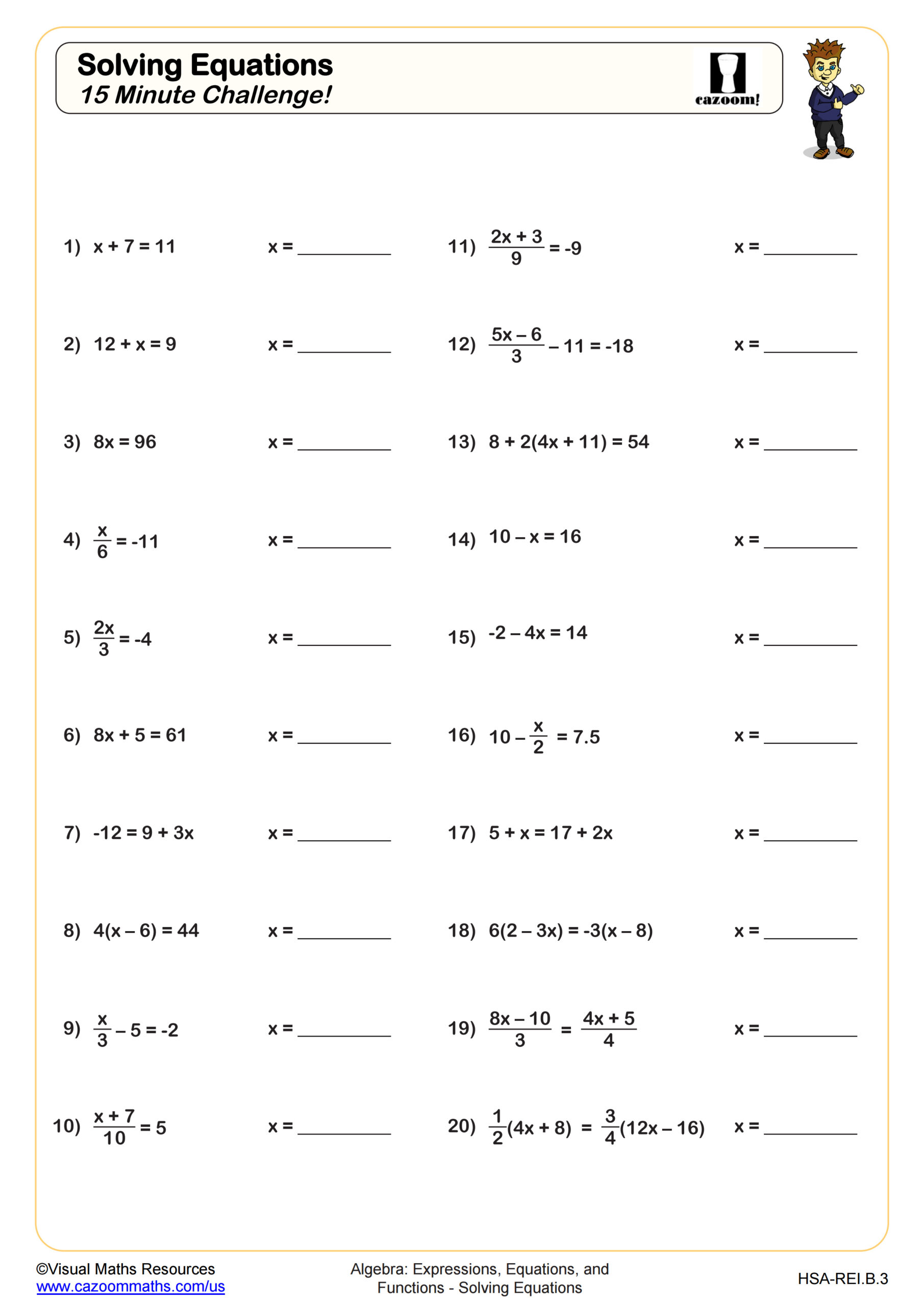
Solving Equations 15 Minute Challenge
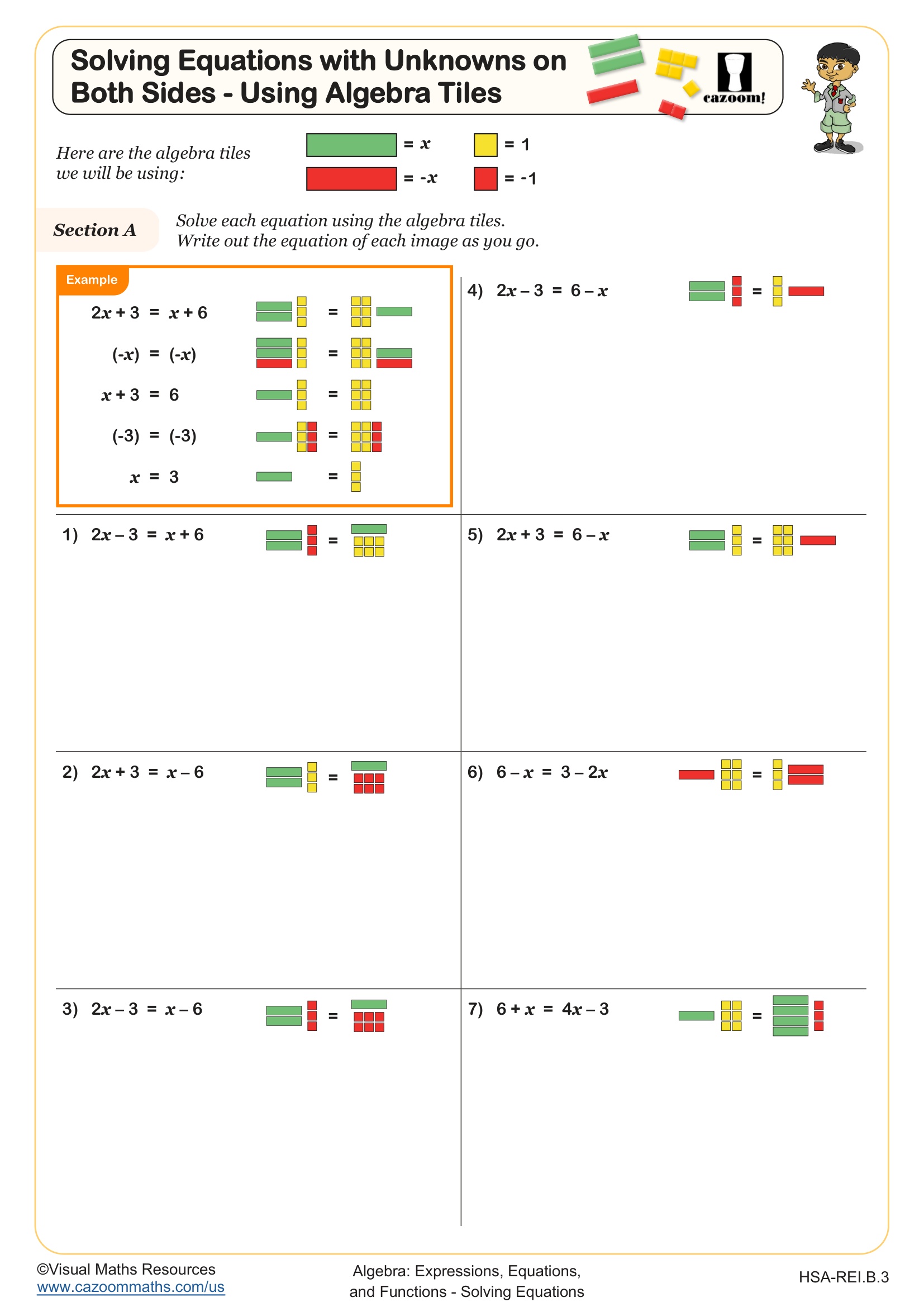
Solving Equations with Unknowns on Both Sides - Using Algebra Tiles
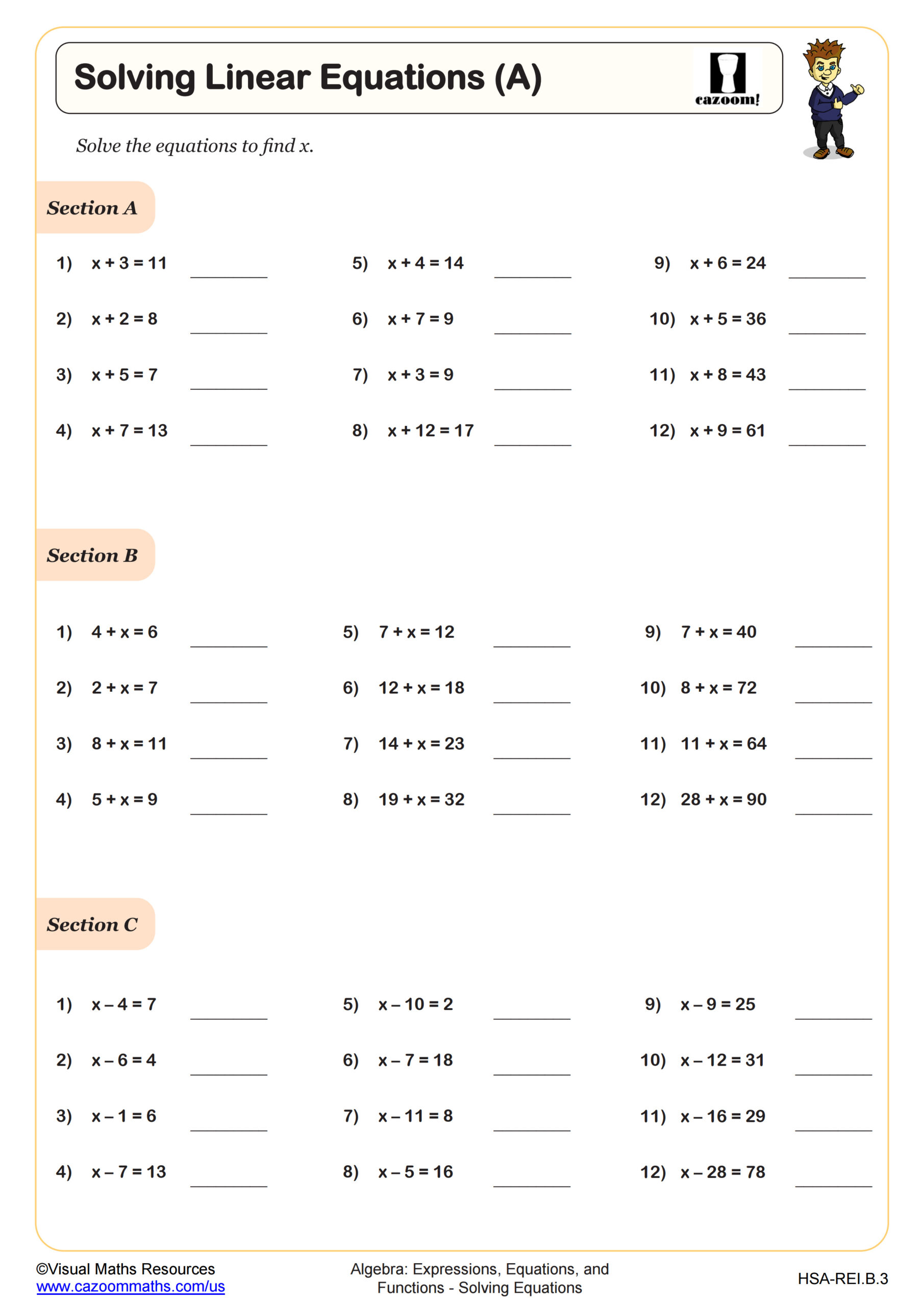
Solving Linear Equations (A)
Solving Linear Equations (B)
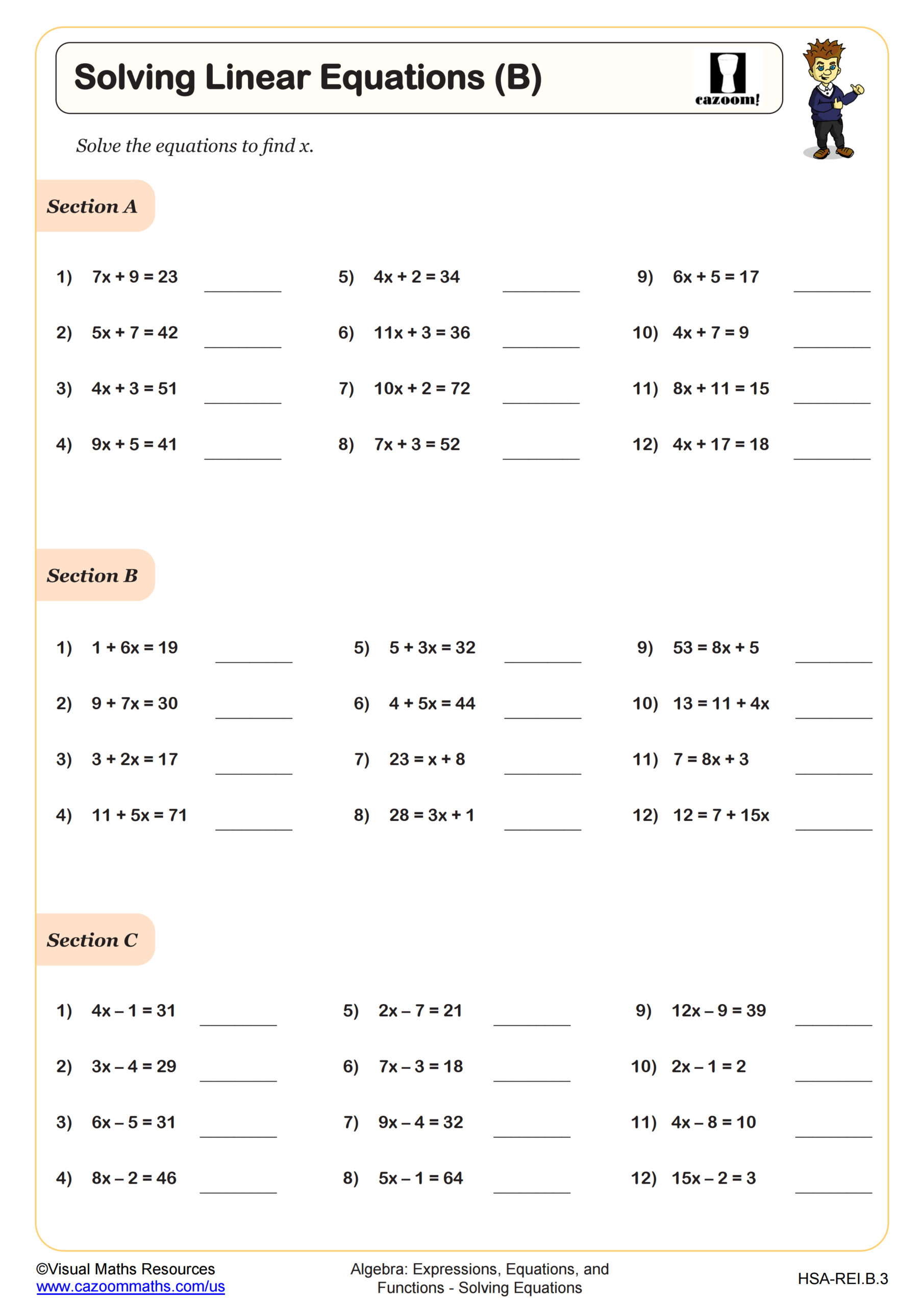
Solving Linear Equations (C)
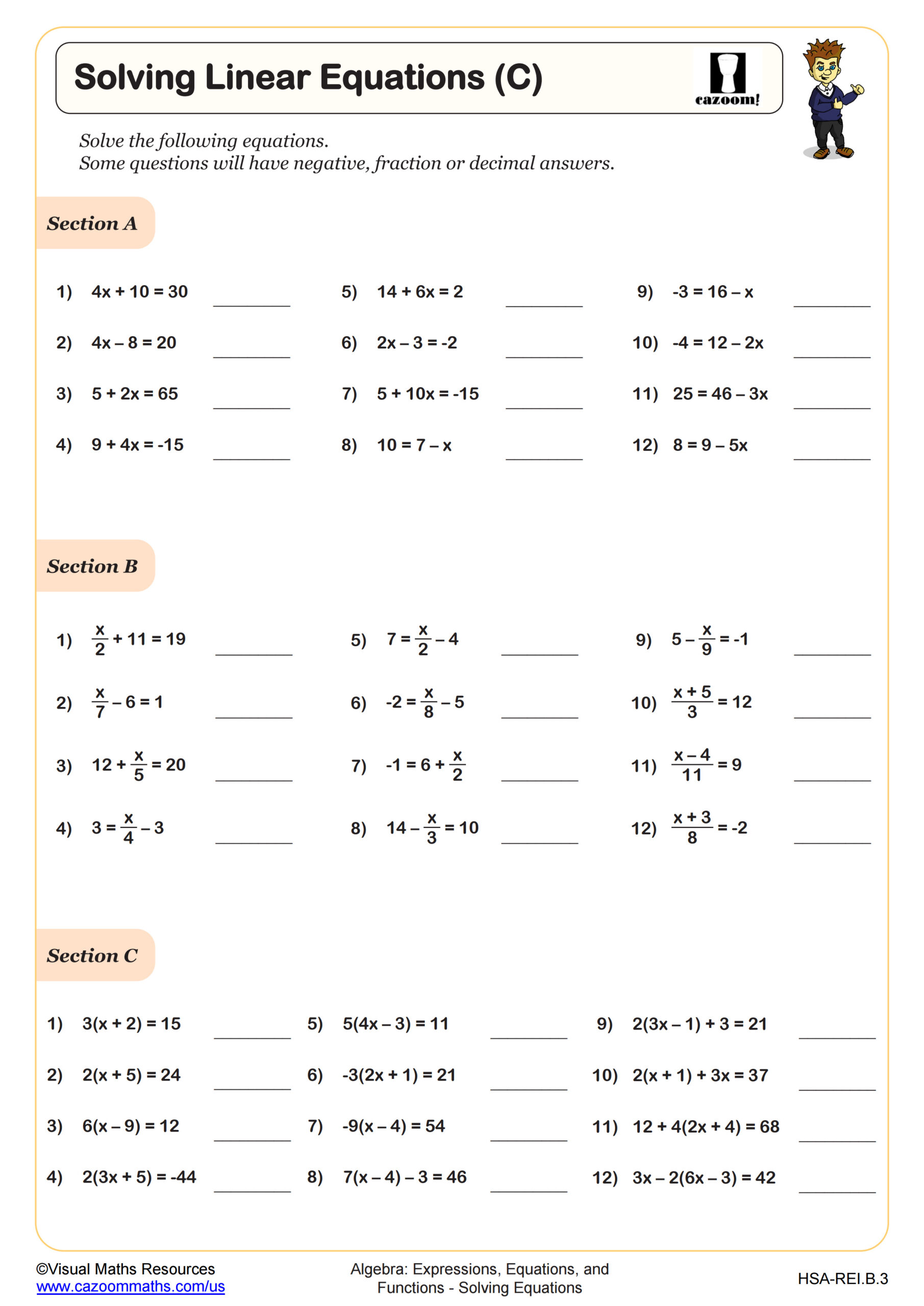
Solving Linear Equations (D)
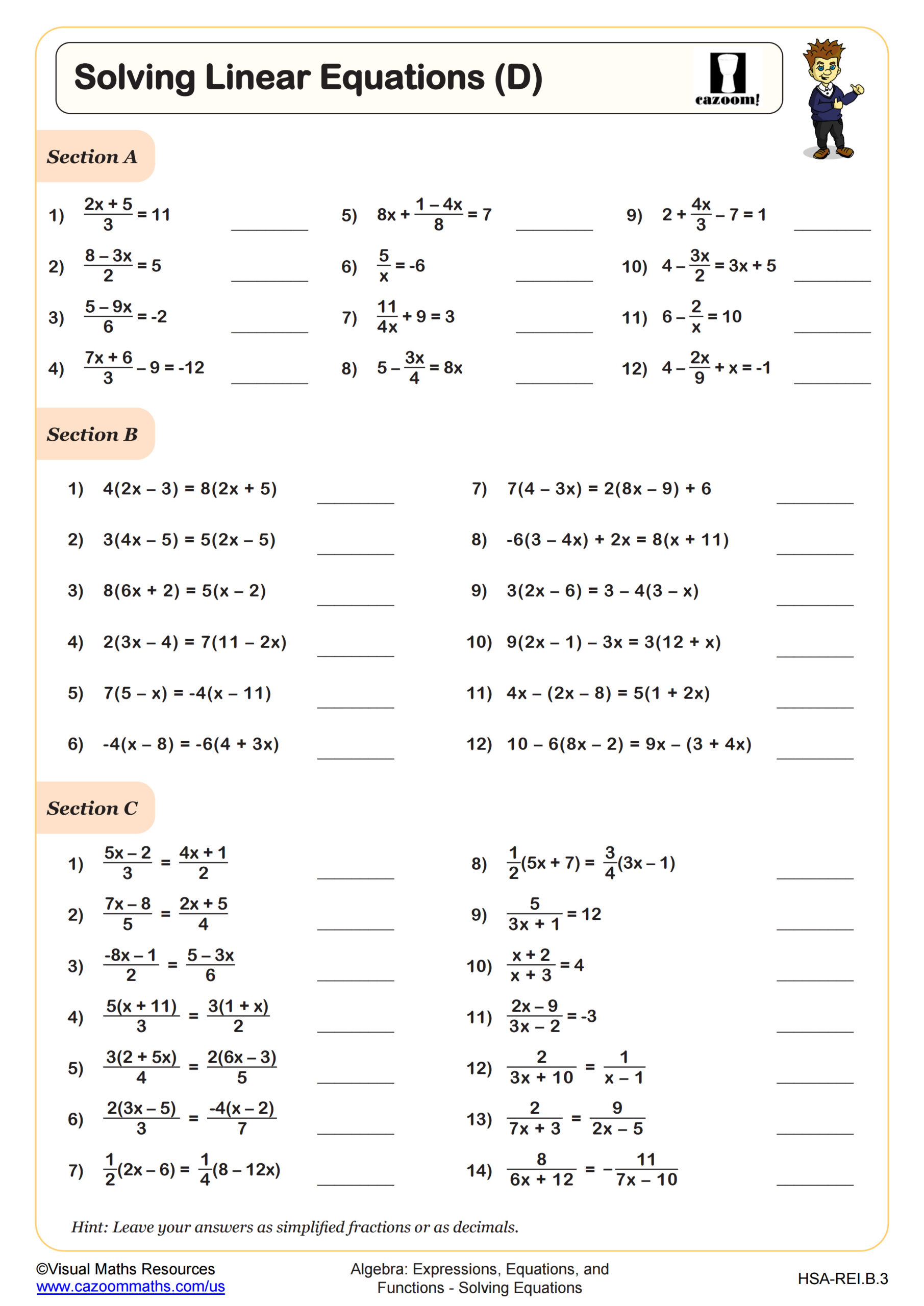
Solving Linear Equations (Without Negatives)
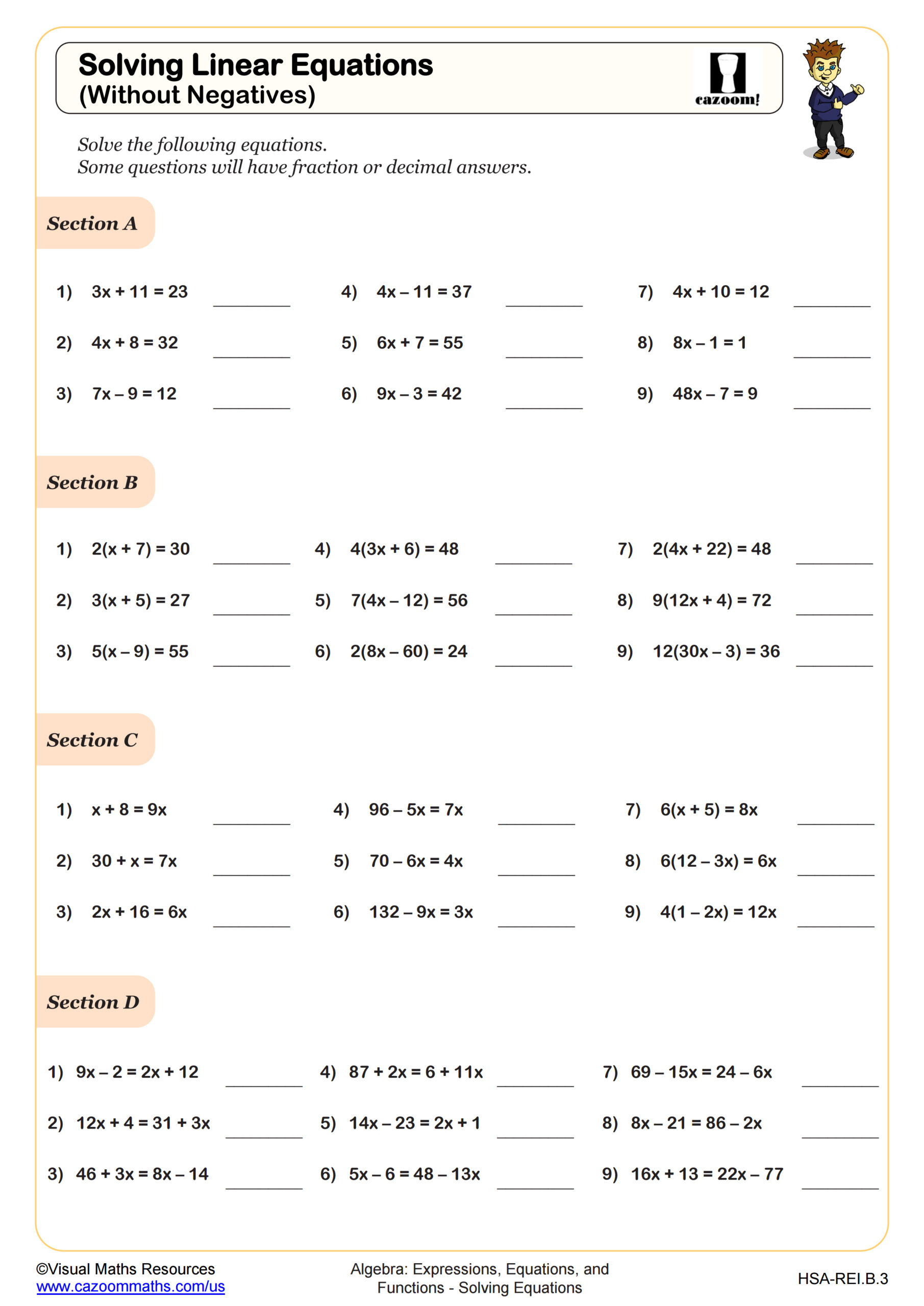
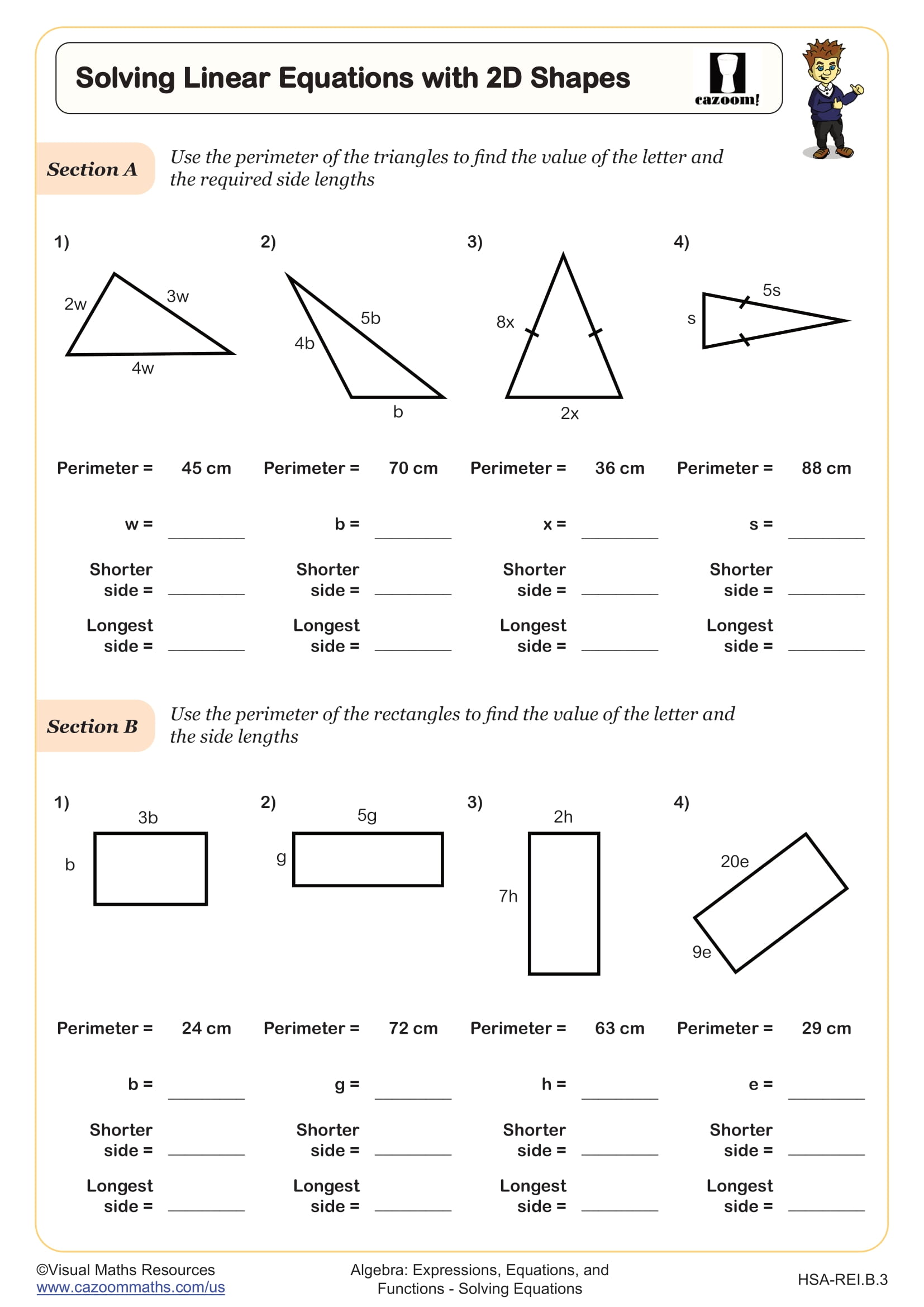
Solving Linear Equations with 2D Shapes
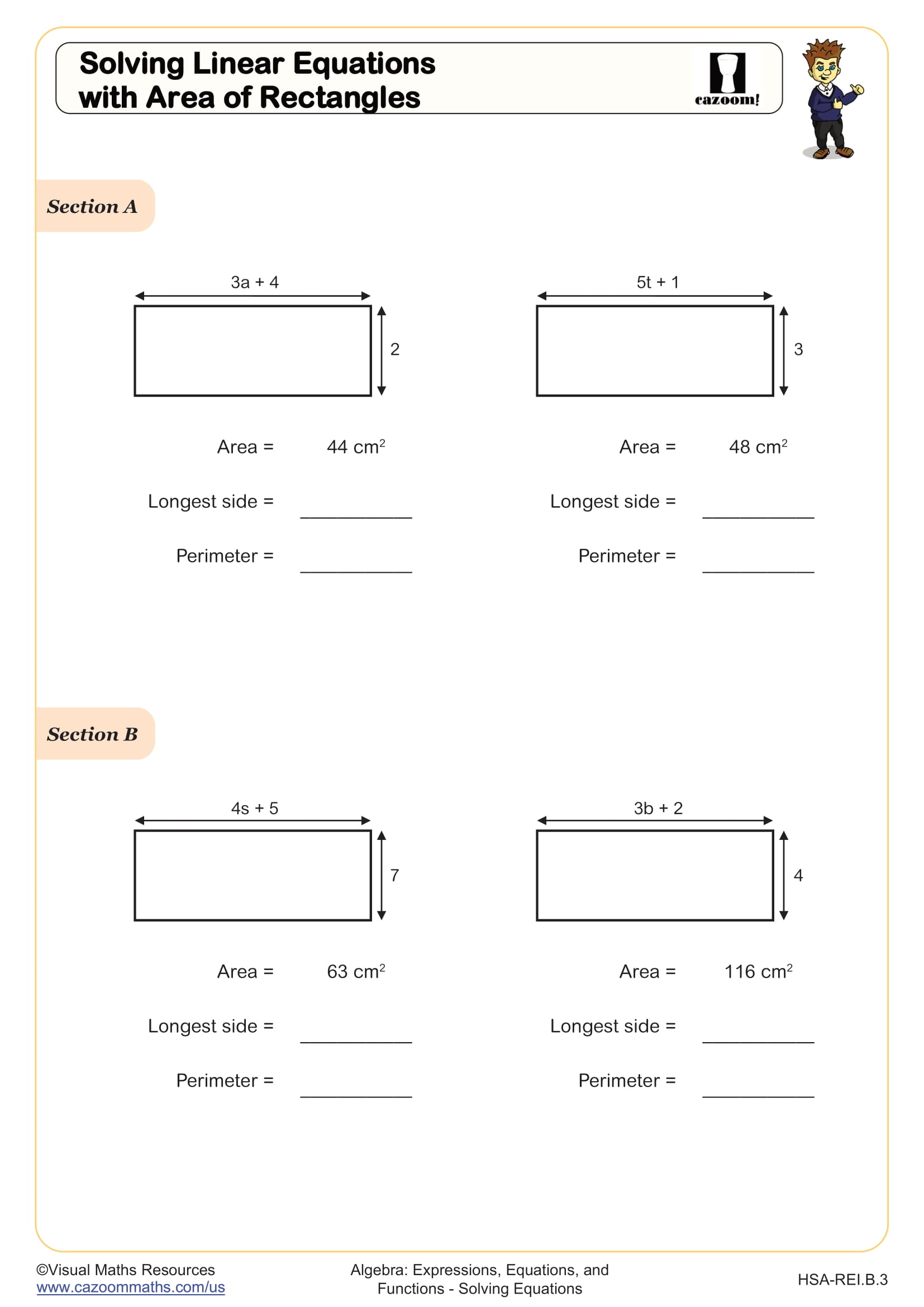
Solving Linear Equations with Area of Rectangles
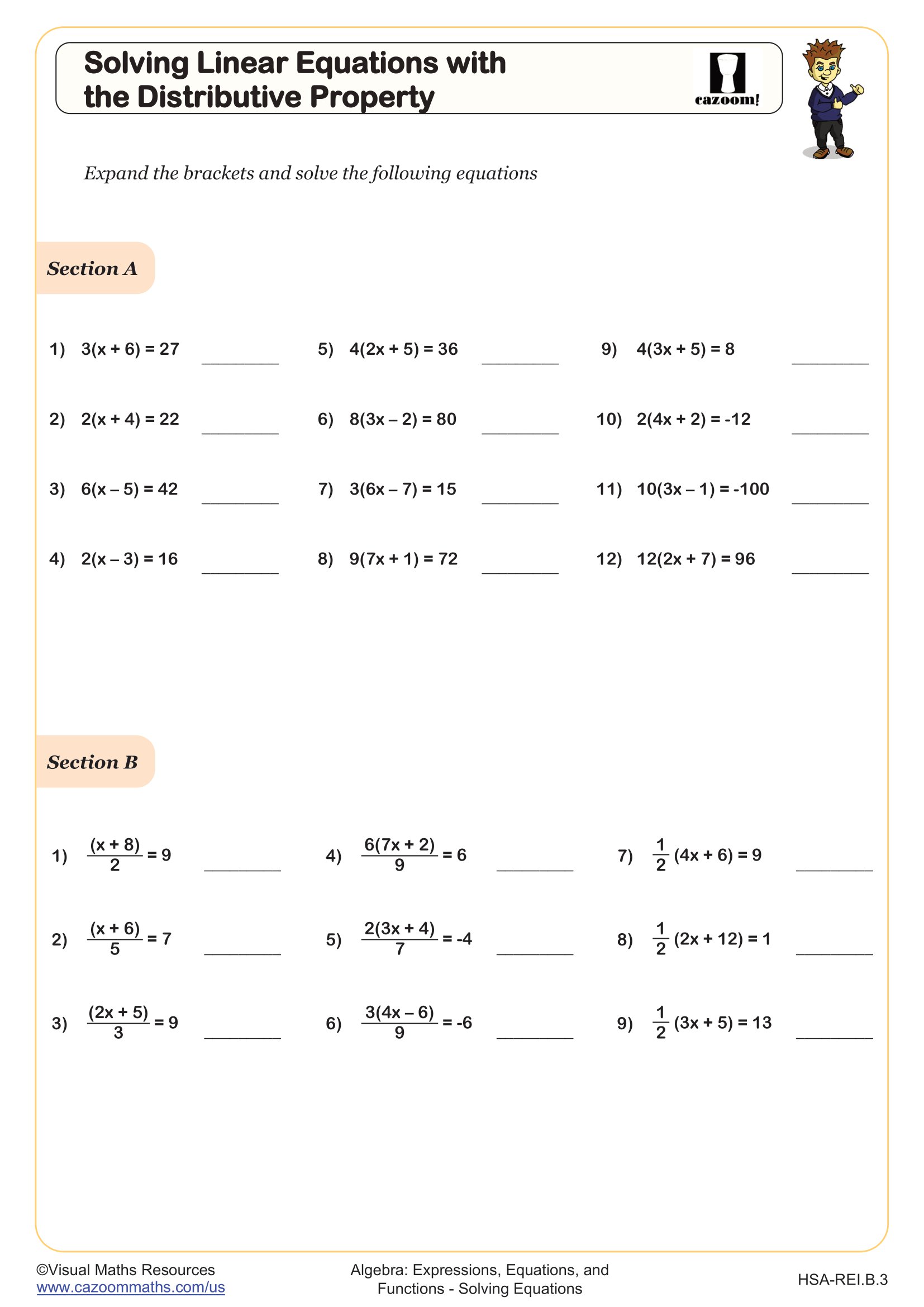
Solving Linear Equations with the Distributive Property
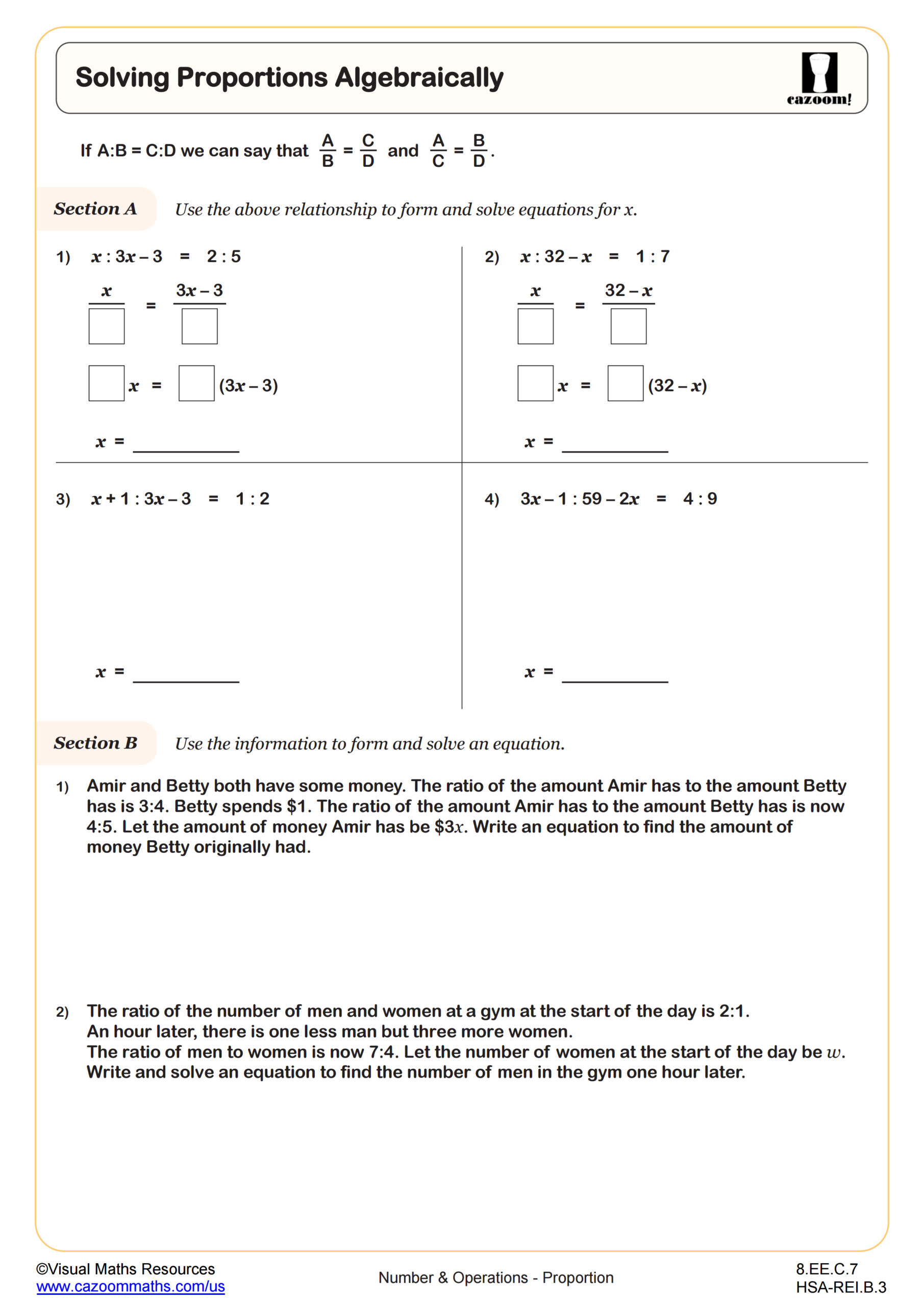
Solving Proportions Algebraically
Solving Quadratic Equations (A)
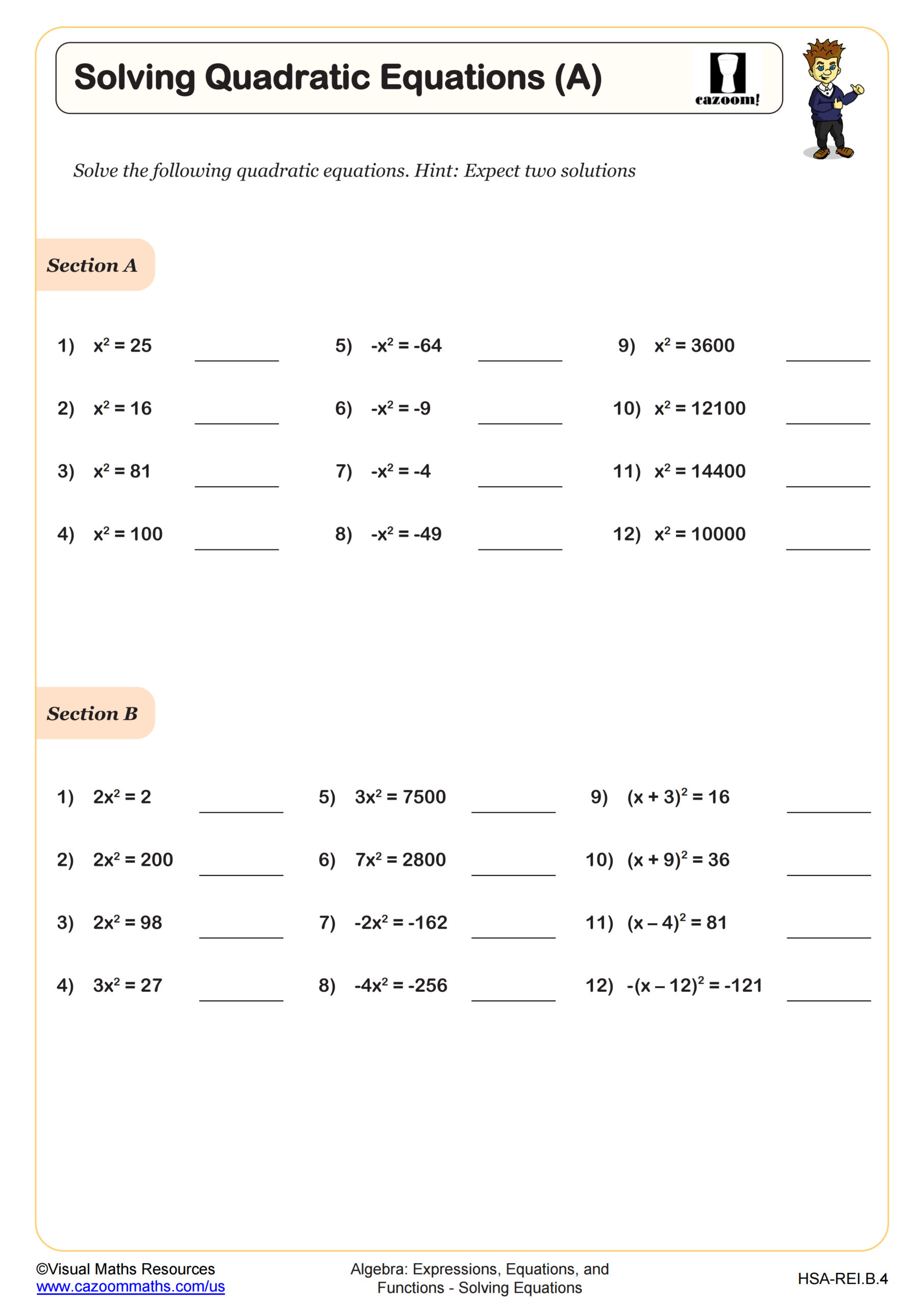
Solving Quadratic Equations (B) - By Factoring
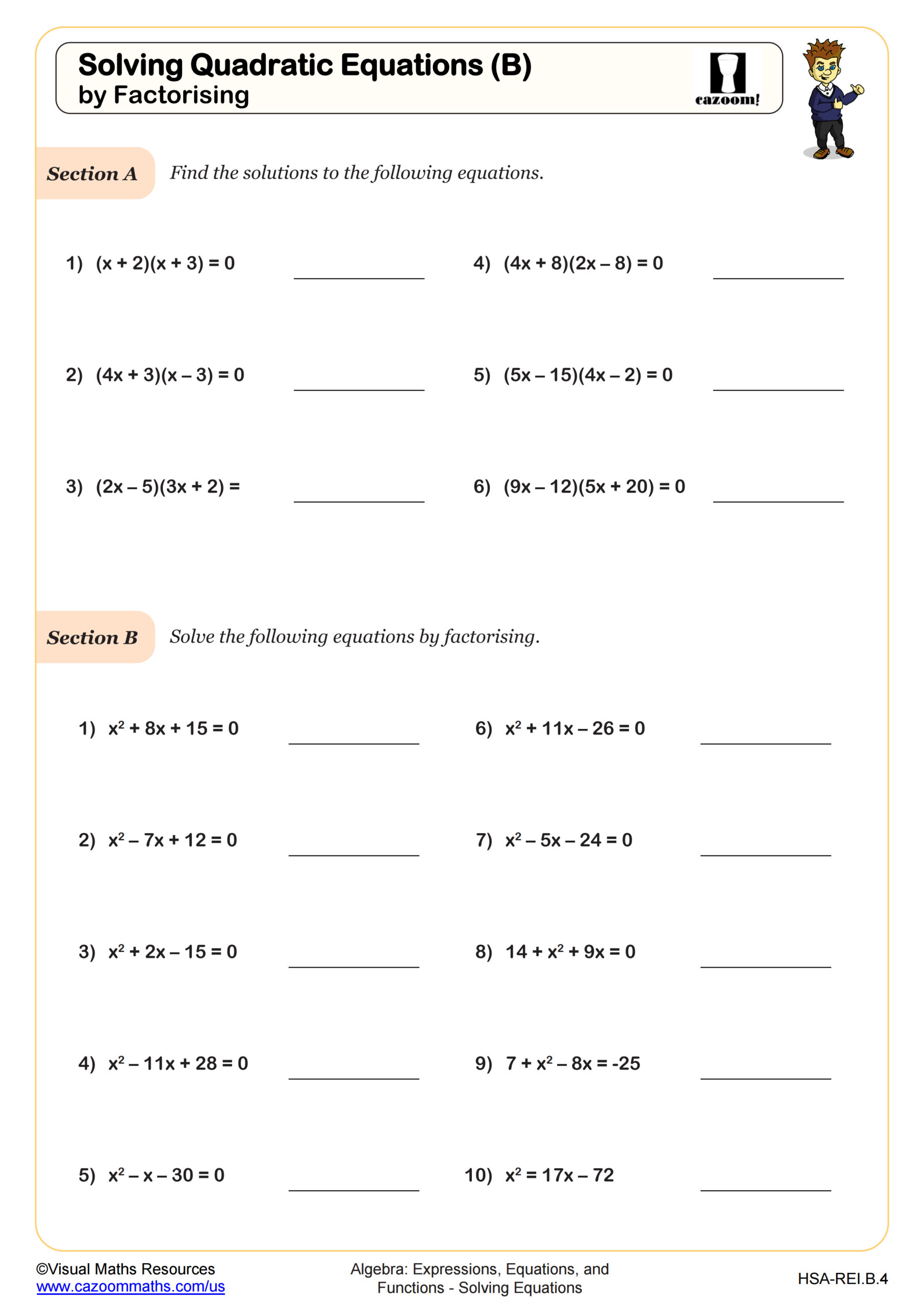
Solving Quadratic Equations (C) - By Quadratic Formula
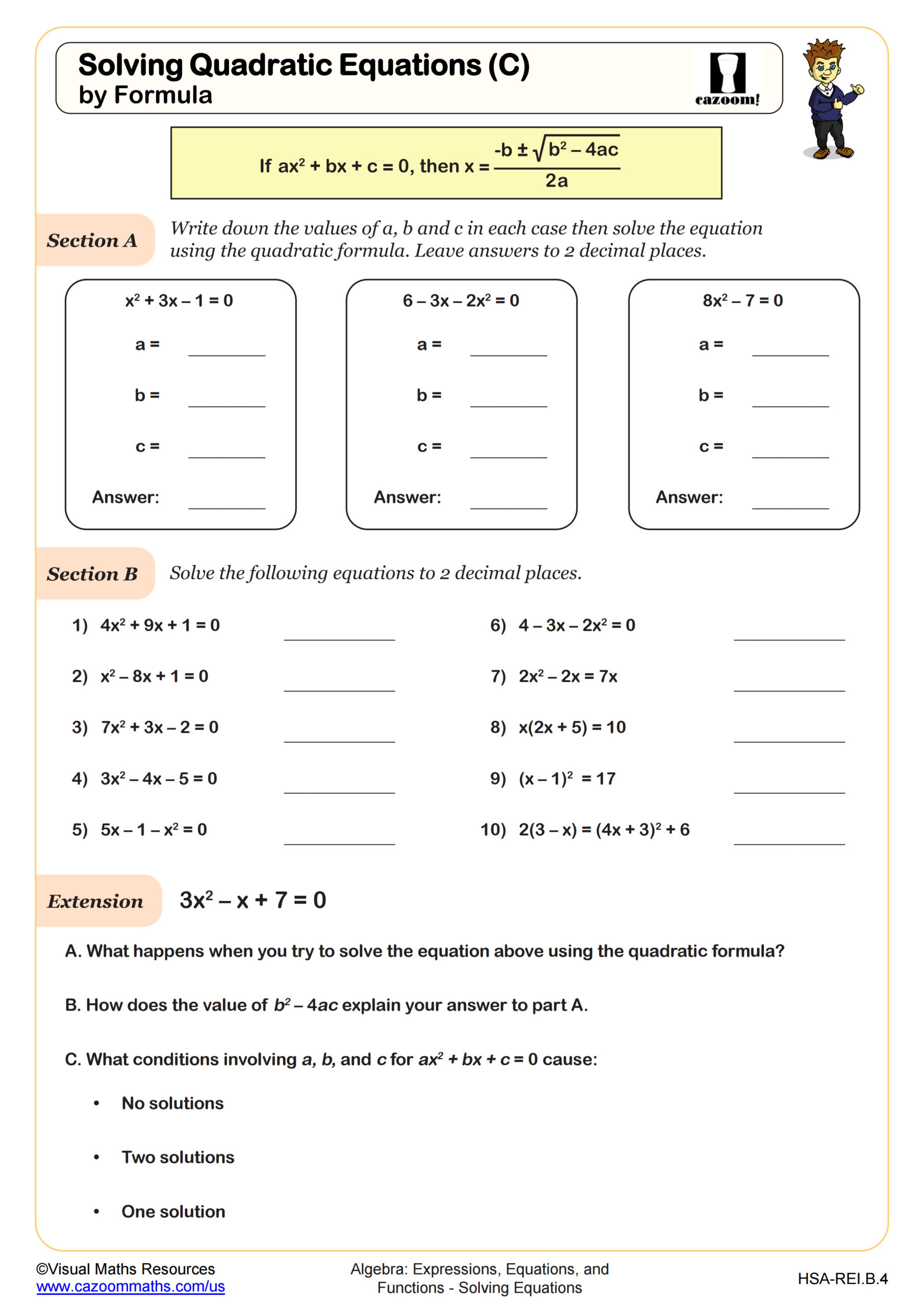
Solving Quadratic Equations (D) - By Completing the Square
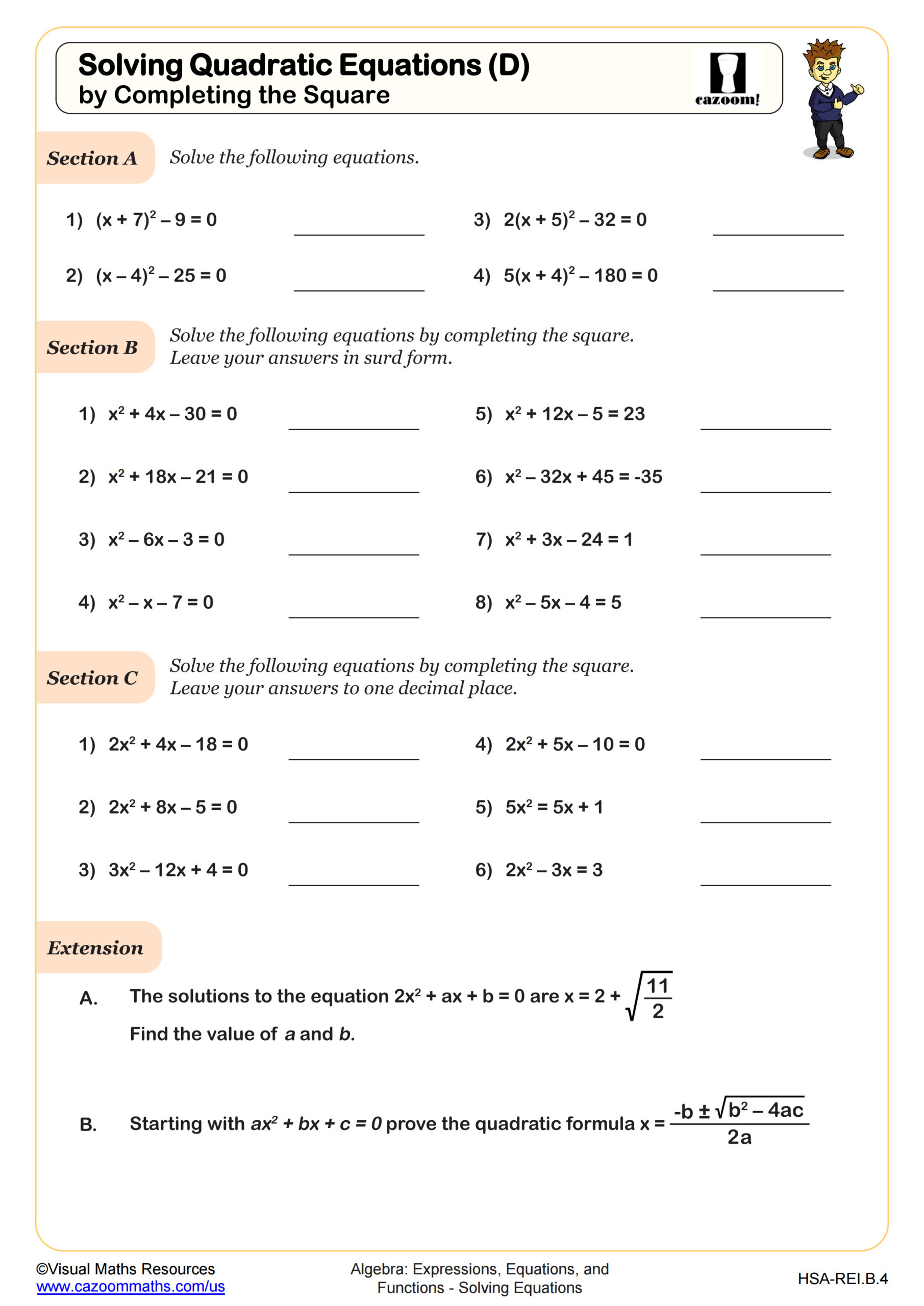
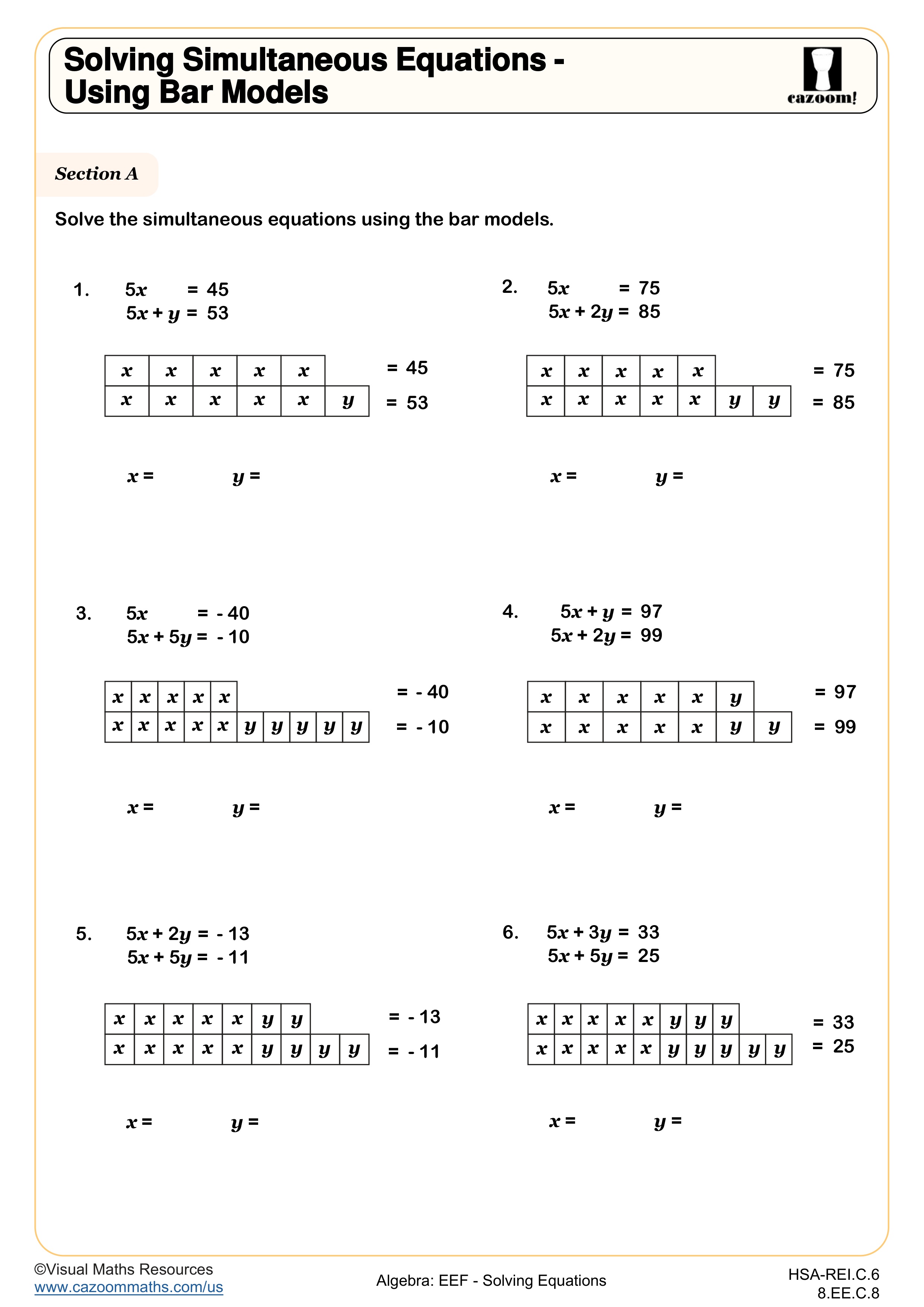
Solving Simultaneous Equations - Using Bar Models
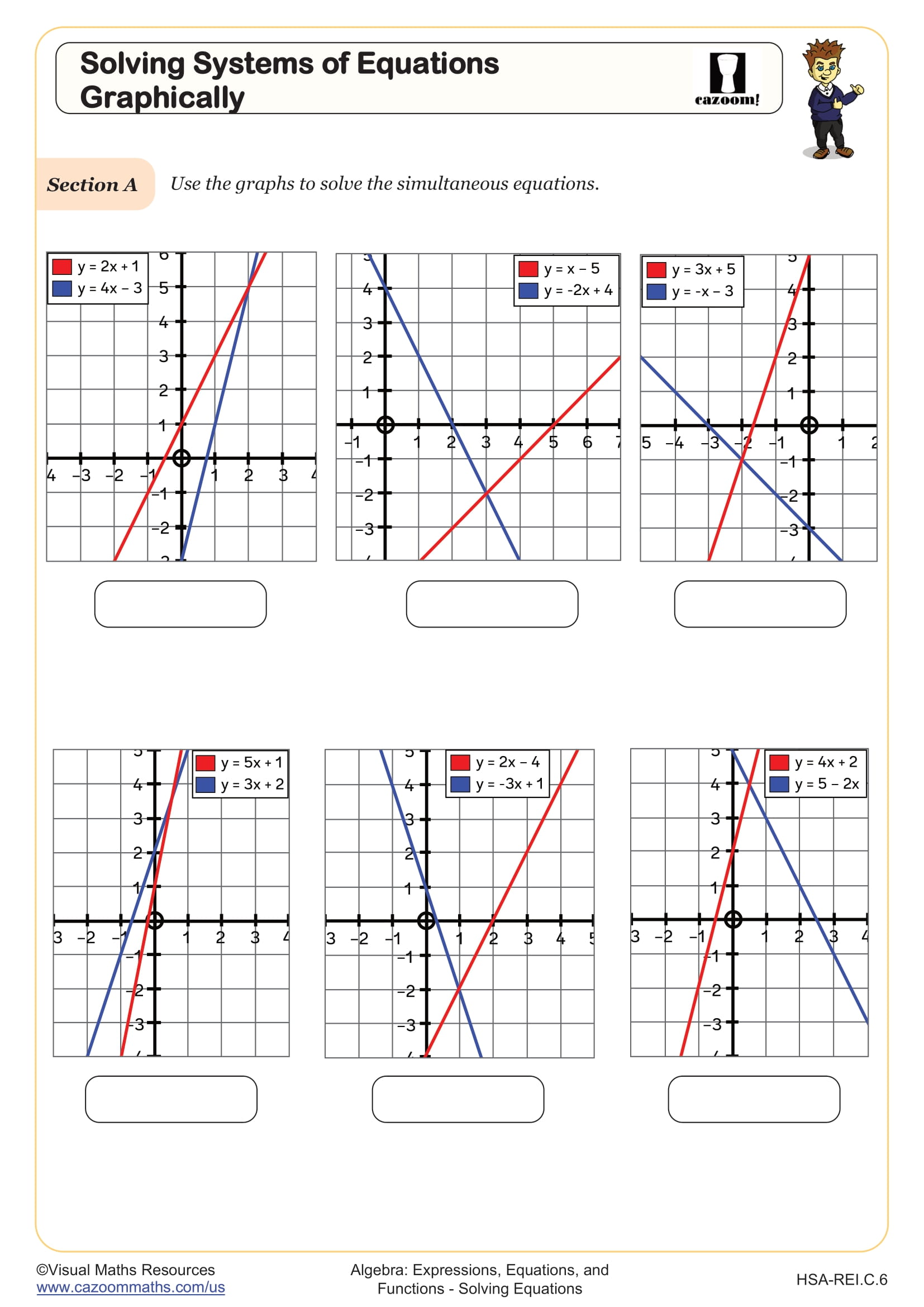
Solving Systems of Equations Graphically
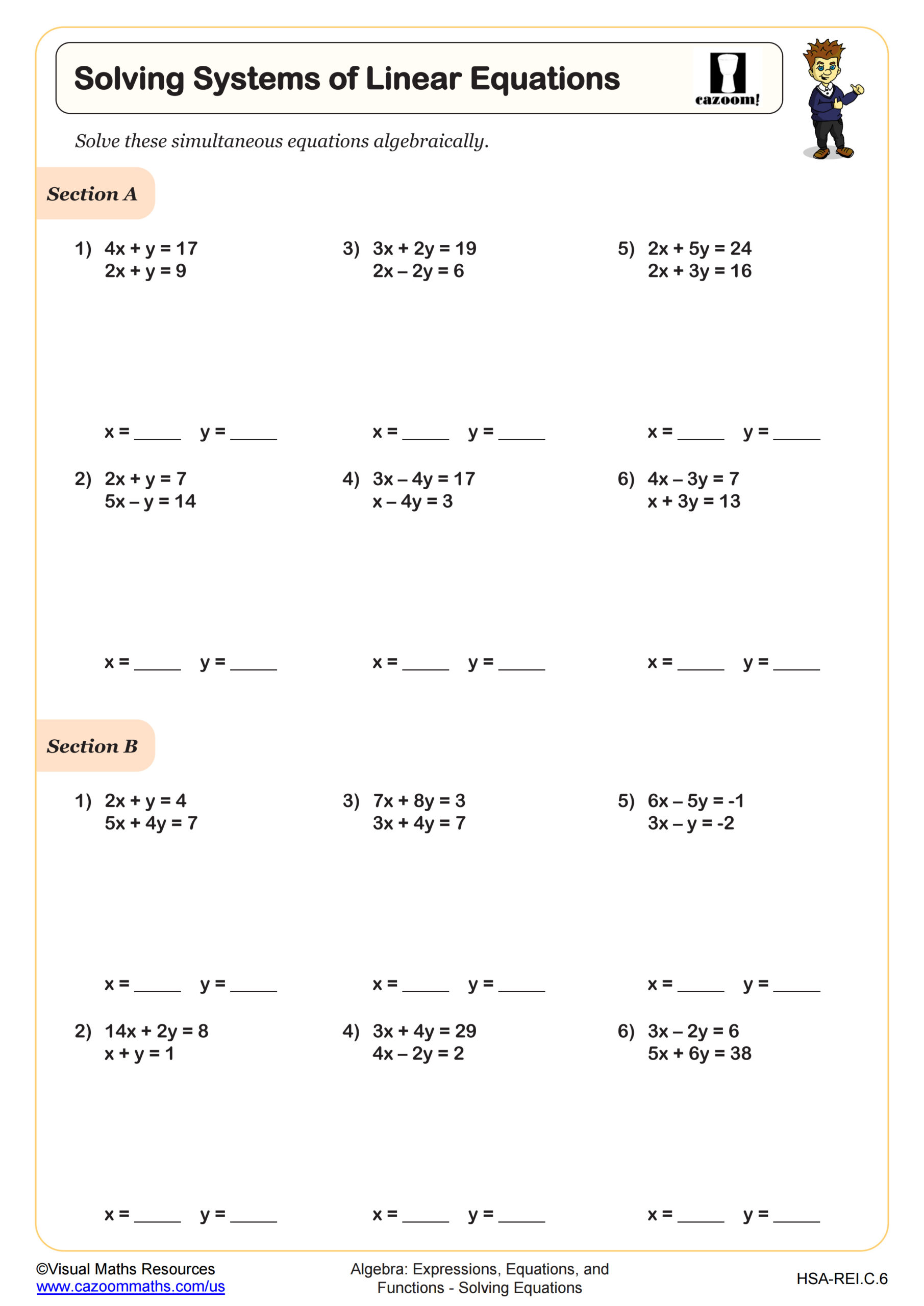
Solving Systems of Linear Equations
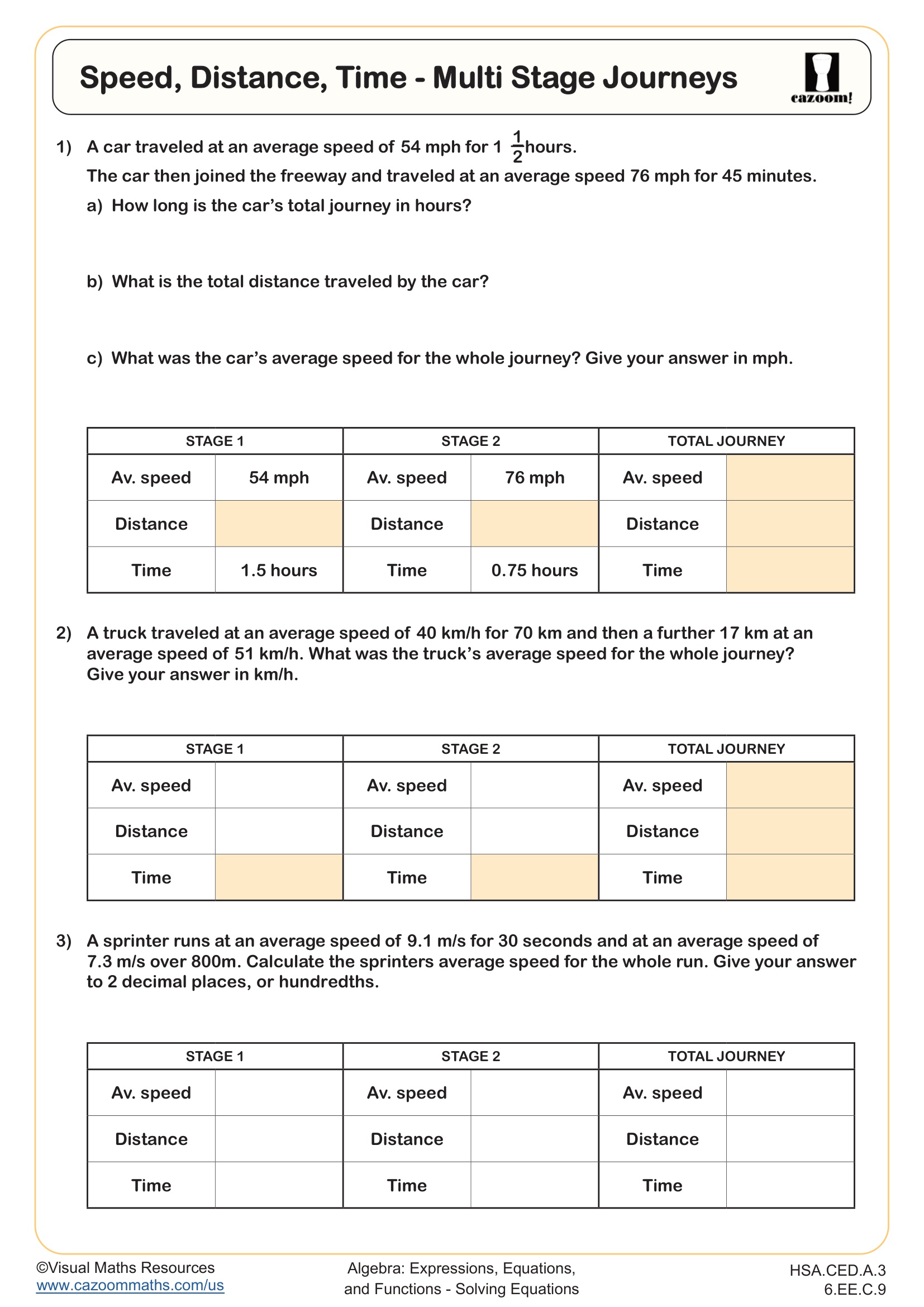
Speed, Distance, Time - Multi Stage Journeys
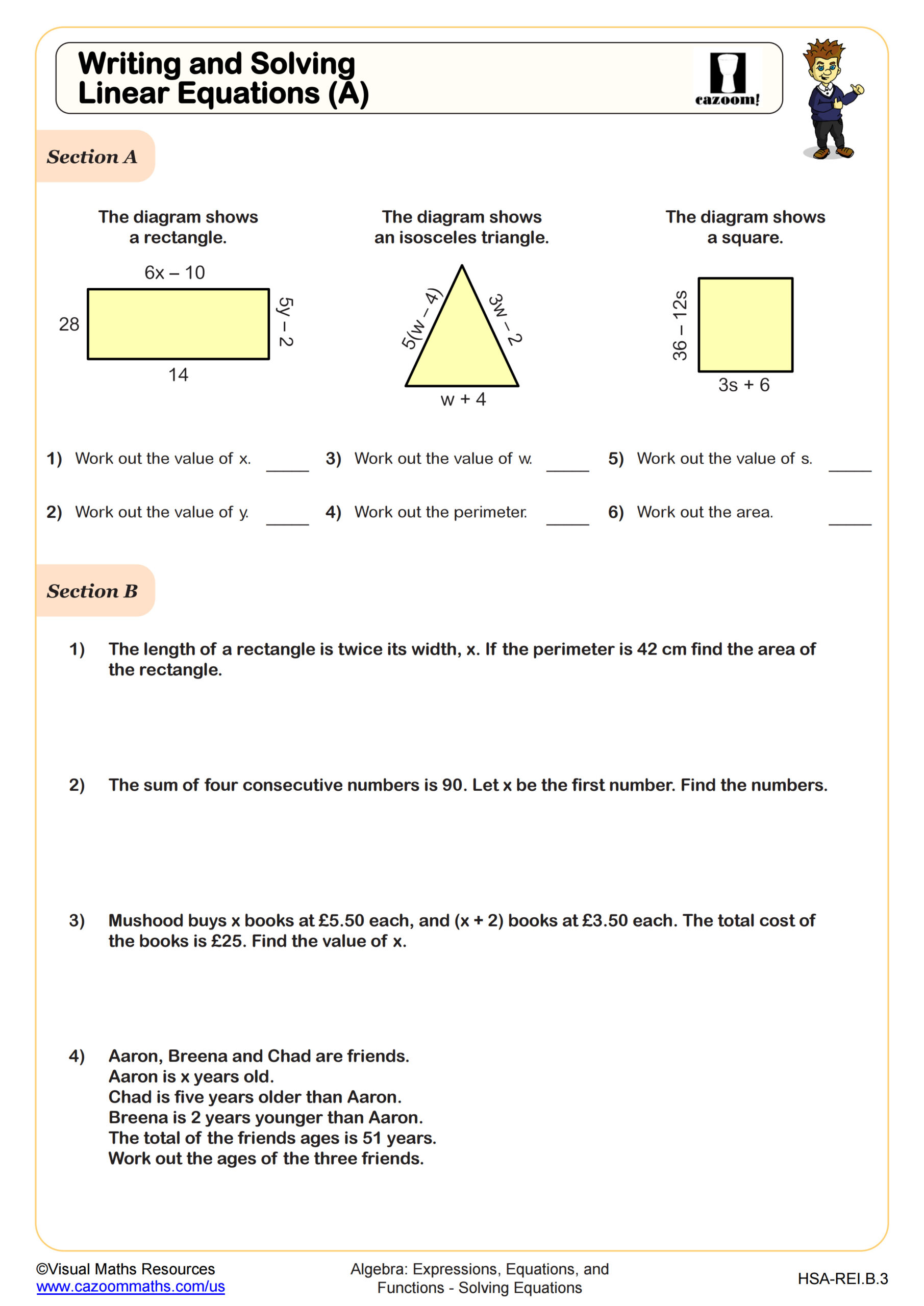
Writing and Solving Linear Equations (A)
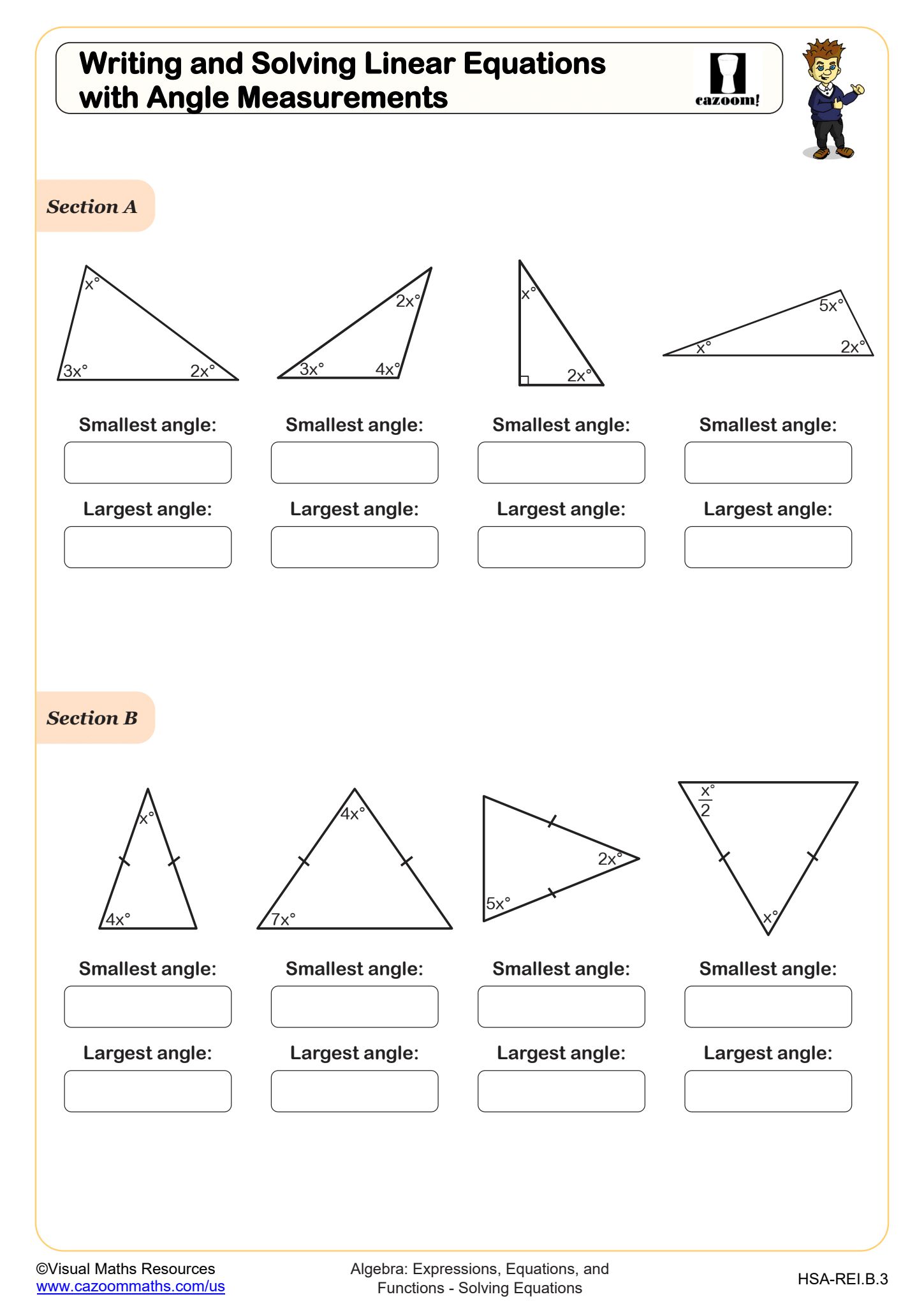
Writing and Solving Linear Equations with Angle Measurements
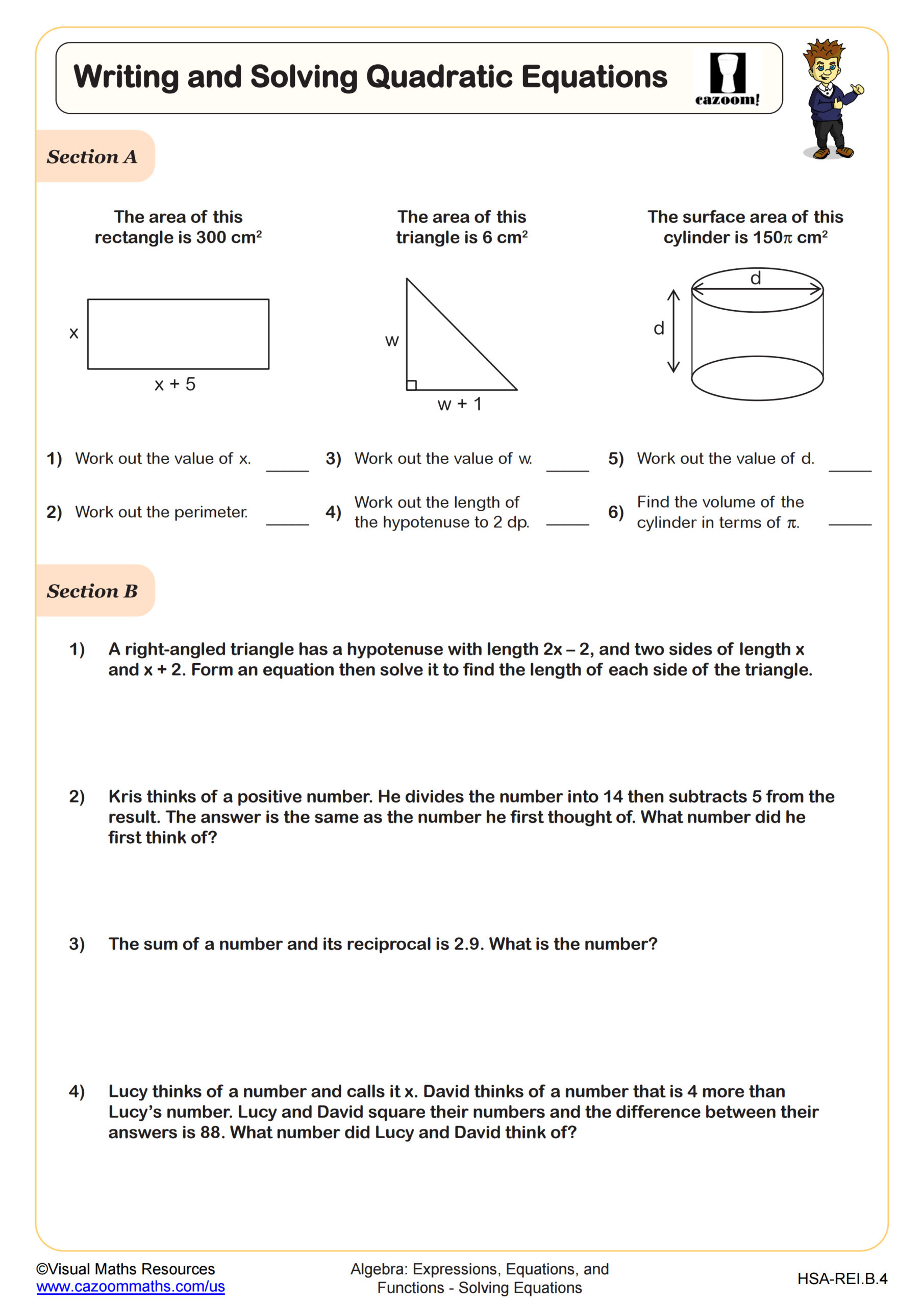
Writing and Solving Quadratic Equations
All worksheets are created by the team of experienced teachers at Cazoom Math.
What equation-solving skills do Algebra I students learn?
Algebra I students progress from solving basic one-step equations to mastering multi-step linear equations that require combining like terms, applying the distributive property, and working with variables on both sides of the equal sign. The curriculum extends to solving quadratic equations through factoring, completing the square, and using the quadratic formula, with Common Core State Standards requiring fluency in determining which method best suits each problem type.
Teachers often observe that students confidently tackle complex equations once they recognize that each operation simply reverses the order of operations used to build the expression. A common error occurs when students forget to distribute a negative sign across parentheses, leading to sign mistakes that cascade through the remaining steps. Worksheets that isolate this skill before combining it with other operations help students build accuracy before tackling more complex problems.
How do solving equations appear on the SAT and ACT?
Standardized tests like the SAT and ACT embed equation-solving within multi-step word problems, requiring students to first translate verbal descriptions into algebraic expressions before solving. The tests assess whether students can manipulate equations efficiently without a calculator on certain sections, expecting fluency with techniques like factoring quadratics or isolating variables in literal equations. Questions often involve systems of equations or require students to recognize when an equation has no solution or infinitely many solutions.
Students lose points when they fail to check whether their solutions make sense in the original context or when they drop negative signs during algebraic manipulation. Many students also struggle with questions that ask how many solutions an equation has rather than asking them to find the solution itself. State assessments similarly test whether students can justify their solution steps and identify errors in flawed solution methods presented by the test.
Why does the distributive property matter when solving equations?
The distributive property allows students to remove parentheses by multiplying each term inside by the factor outside, transforming expressions like 3(x + 4) into 3x + 12. This skill becomes necessary when solving equations that contain grouped terms, as students cannot combine or isolate variables until they've distributed and simplified. Mastering distribution with both positive and negative factors prevents the sign errors that account for a significant portion of lost points on tests and quizzes.
Engineers and scientists regularly use the distributive property when working with formulas that model physical relationships. For example, calculating the total cost when multiple items have the same tax rate requires distributing the tax percentage across all purchases. Computer programmers apply distributive principles when optimizing code, factoring out common operations to improve efficiency. College-bound students encounter this property again in physics when manipulating force and motion equations.
How can teachers use these solving equations worksheets effectively?
These worksheets provide scaffolded practice that progresses from simpler equation types to more complex multi-step problems, allowing teachers to differentiate instruction based on student readiness. The variety of problem contexts, including geometric applications like rectangle areas and abstract algebraic expressions, helps students recognize that equation-solving techniques transfer across different mathematical situations. Having answer keys for every worksheet enables students to check their work during independent practice, promoting self-assessment skills that support long-term mathematical independence.
Many teachers assign these worksheets as warm-up activities to maintain equation-solving fluency throughout the school year, even after the initial instructional unit ends. The materials work well for test preparation when teachers need to quickly identify which students need intervention on specific equation types. Paired work with worksheets allows students to compare solution methods and catch each other's errors, building the collaborative problem-solving skills that college math courses expect.