Algebra I Statistics Worksheets
All worksheets are created by the team of experienced teachers at Cazoom Math.
What Statistics Concepts Do Algebra I Students Study?
Algebra I statistics typically covers descriptive statistics including measures of central tendency (mean, median, mode), measures of spread (range, interquartile range), and data visualization through various graph types. Students learn to organize data sets, identify patterns, and use diagrams like Venn diagrams to solve problems involving set relationships and categorical data. The Common Core State Standards position these skills as foundational for data literacy that students will need across all STEM disciplines.
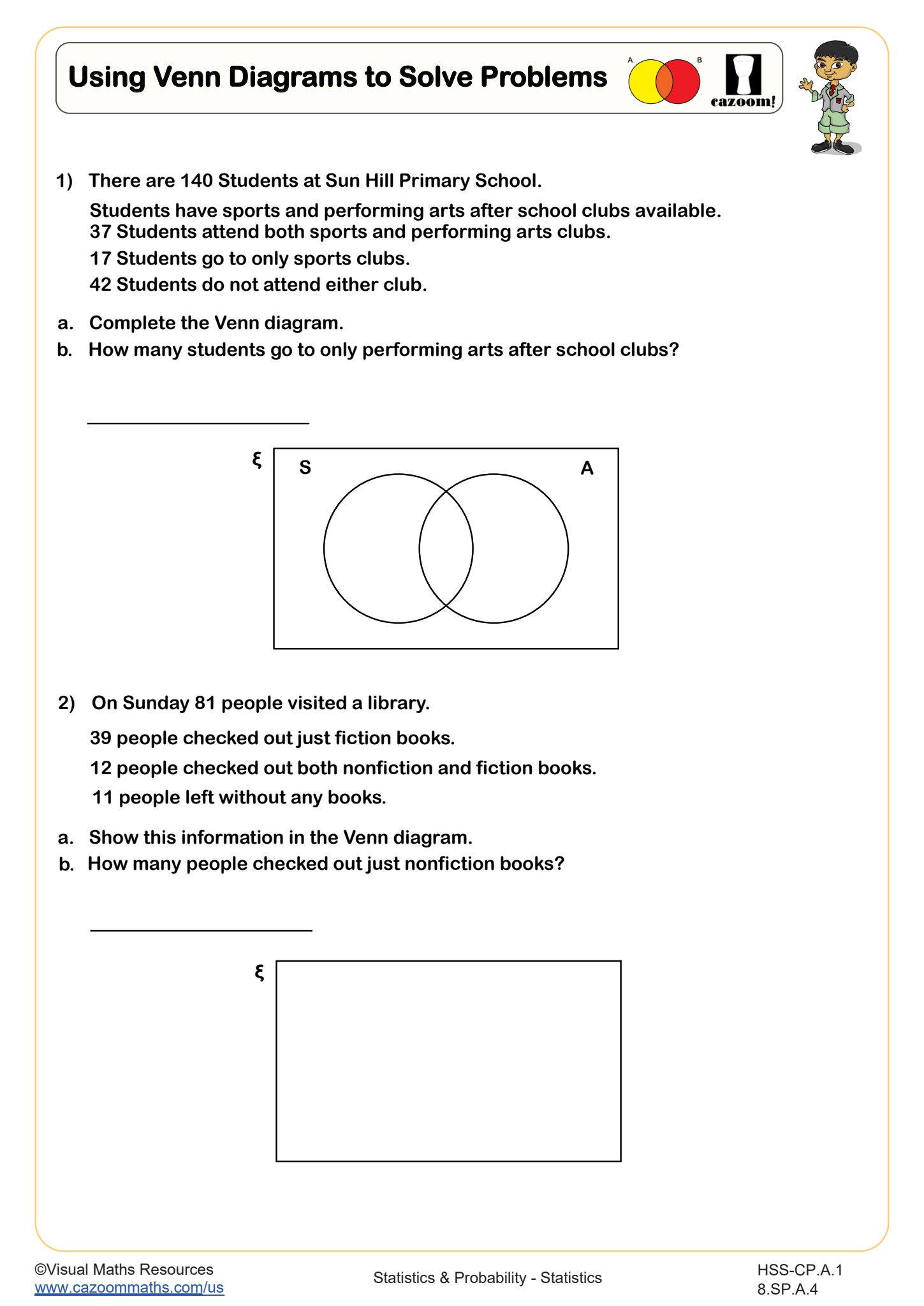
Venn diagrams specifically address problems where students must categorize information into overlapping groups, such as survey results or probability scenarios. Teachers frequently observe that students initially place data in the wrong regions because they forget that overlapping sections represent items belonging to both categories simultaneously. Providing structured practice with clearly defined sets helps students develop systematic approaches to these visual reasoning tasks.
How Does Statistics Appear on the SAT and State Assessments?
Standardized tests like the SAT include statistics questions that require students to interpret data displays, calculate measures of central tendency from given data sets, and draw conclusions from statistical information presented in context. The SAT Math section particularly emphasizes reading and analyzing graphs, tables, and charts within Problem Solving and Data Analysis questions. State assessments similarly expect students to demonstrate understanding of how data representation choices affect interpretation and conclusions.
Students lose points when they confuse mean with median or fail to recognize outliers that significantly affect averages. On Venn diagram problems, a common error involves adding all numbers shown rather than recognizing that overlapping regions are already counted in the individual set totals. Test-taking practice with varied data scenarios helps students develop the flexibility to approach unfamiliar contexts confidently.
What Problem-Solving Strategies Work Best with Venn Diagrams?
Venn diagrams provide a visual method for organizing categorical data and solving problems involving overlapping sets. Students learn to work systematically by first identifying the intersection (items belonging to both categories), then determining what remains in each individual category, and finally calculating totals or finding complements. This structured approach transforms word problems into spatial puzzles that many students find more accessible than purely algebraic methods.
Real-world applications appear everywhere from market research to medical diagnostics. Companies use Venn diagrams to analyze customer preferences across product categories, while healthcare professionals use them to identify patients meeting multiple diagnostic criteria. College-bound students encounter these concepts again in statistics courses, discrete mathematics, and data science programs where set theory and categorical analysis become increasingly sophisticated.
How Can Teachers Use These Statistics Worksheets in Algebra I Classes?
The worksheets provide structured practice moving from straightforward data organization to multi-step problem solving with Venn diagrams. Answer keys allow students to self-check during independent work or enable quick assessment during station rotations. The progressive difficulty helps teachers identify exactly where conceptual understanding breaks down, whether students struggle with basic set notation or with translating word problems into diagram form.
Many teachers find these materials effective for differentiated instruction, assigning specific problems to students based on their current skill level. The worksheets work well as warm-up activities to maintain previously learned skills, as targeted intervention for students who struggled with initial instruction, or as test preparation when reviewing data analysis before unit assessments. Paired work encourages mathematical discourse as students explain their reasoning about why data belongs in specific diagram regions.