Algebra II Algebraic Proof Worksheets
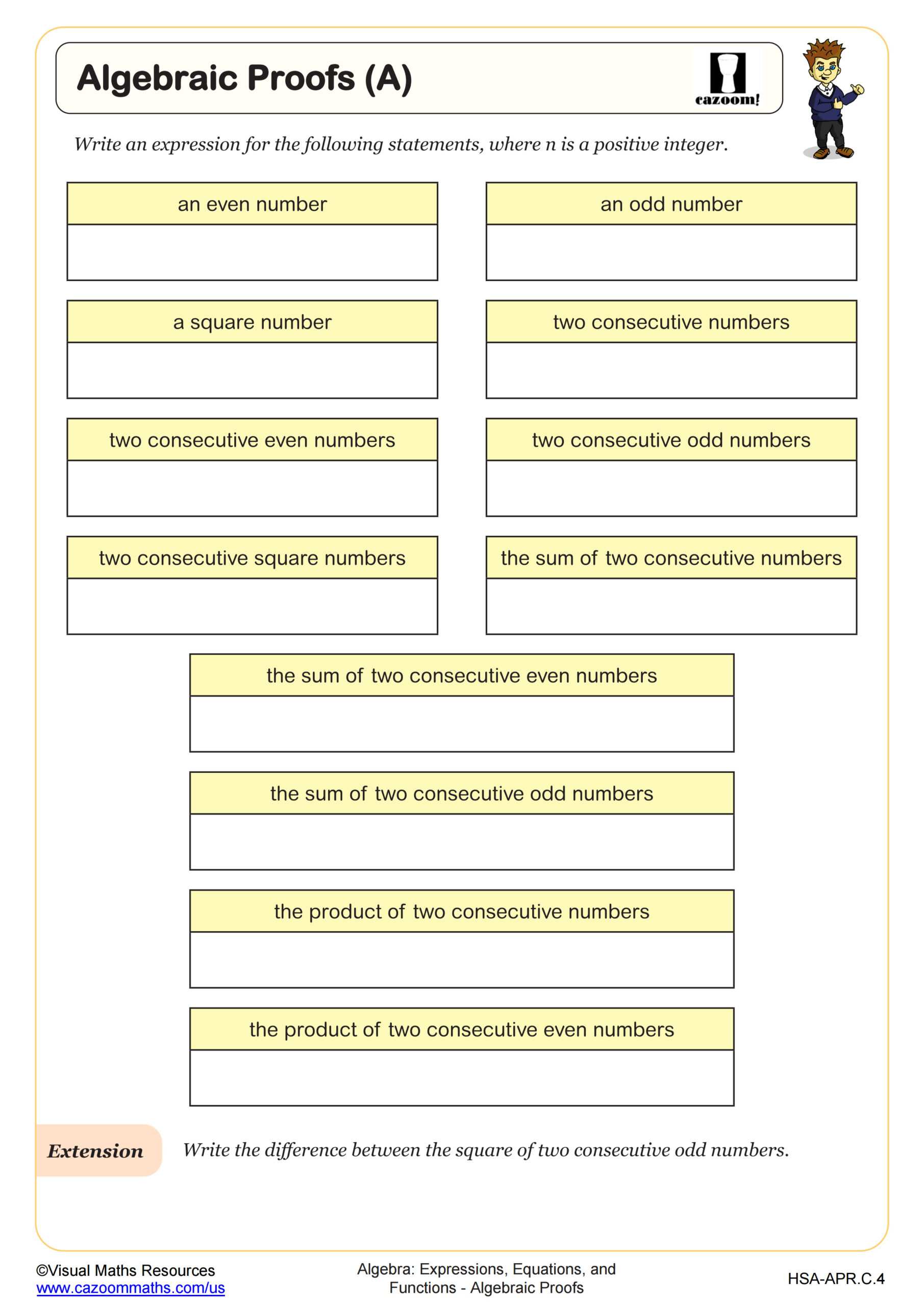
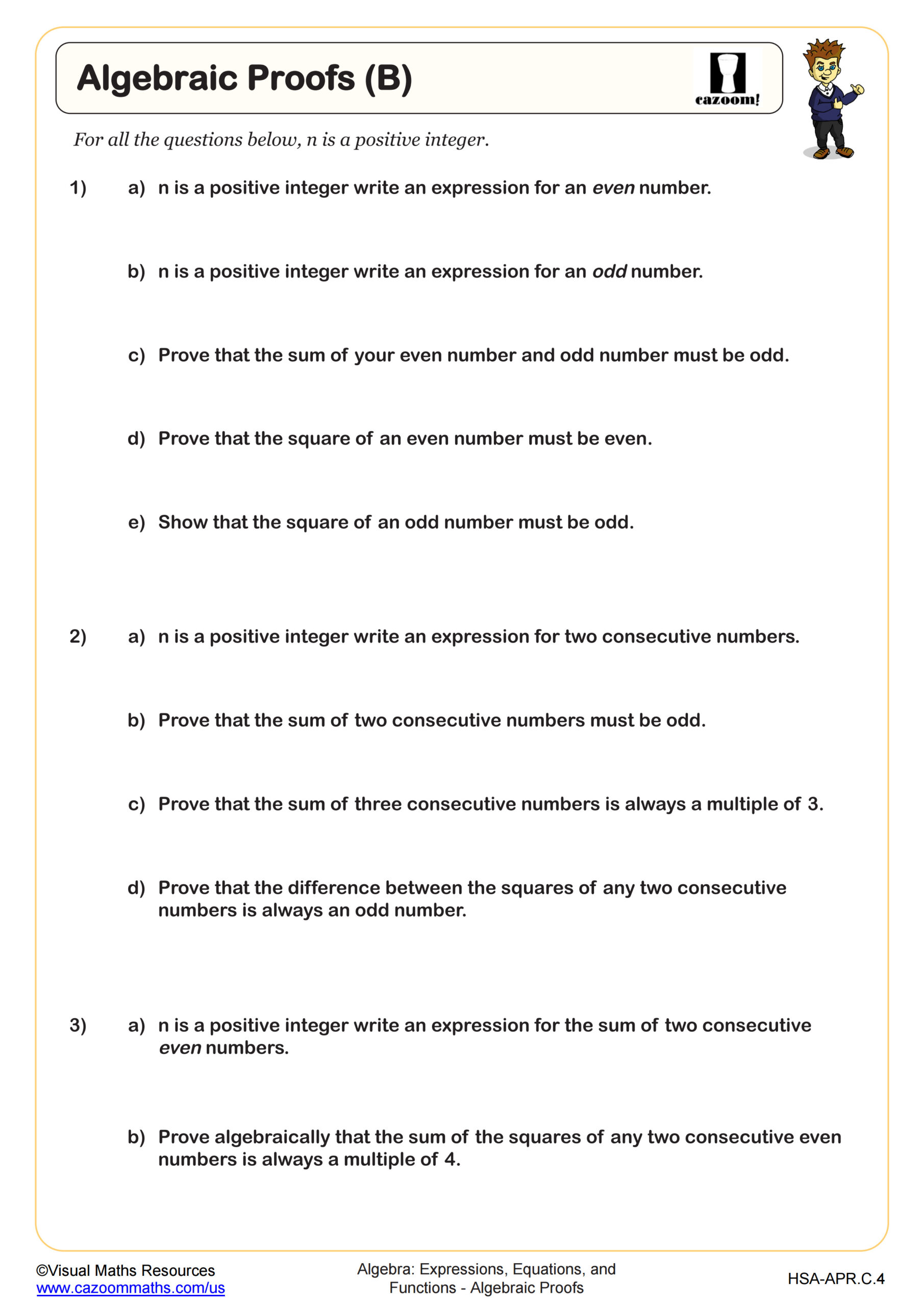
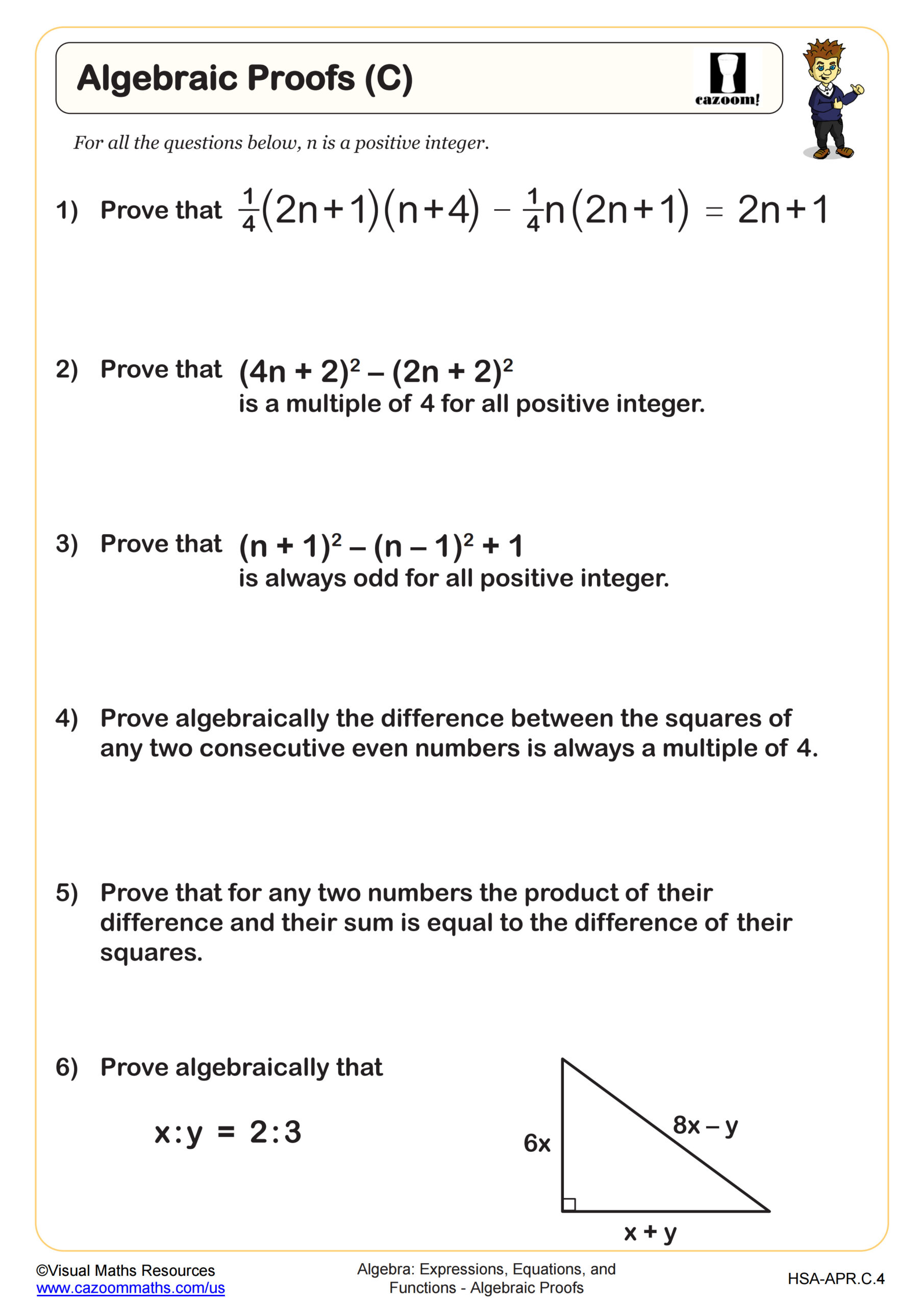
All worksheets are created by the team of experienced teachers at Cazoom Math.
What Are Algebraic Proofs and Why Do Students Need Them?
Algebraic proofs are step-by-step logical arguments that justify why algebraic statements are true using properties of real numbers, equality, and operations. Students must name the property or mathematical principle that validates each transformation, such as the distributive property, addition property of equality, or associative property. This formal reasoning appears throughout Algebra II and becomes foundational for geometry, trigonometry, and calculus.
A common error occurs when students confuse simplifying expressions with solving equations, writing incorrect property names for each context. Teachers observe that students often write "distributive property" for nearly every step until they practice distinguishing between properties of operations (distributive, commutative, associative) and properties of equality (addition, subtraction, multiplication, division). Standardized tests frequently include algebraic proof questions that require students to identify missing steps or justify why two expressions are equivalent.
Which Grade Levels Cover Algebraic Proofs?
These worksheets target Algebra II students in high school, typically grades 10-11, though some advanced ninth graders or students in accelerated tracks encounter algebraic proofs earlier. The Common Core State Standards address this formal reasoning within high school algebra standards that require students to explain each step in solving equations and to understand solving as a reasoning process rather than a mechanical procedure.
The difficulty progression across the worksheet collection moves from proofs involving basic equation solving with two or three steps to more complex proofs that incorporate multiple properties, including operations with rational expressions and radical equations. As students advance, they encounter proofs requiring them to recognize equivalent forms of expressions and justify transformations involving exponent rules, factoring, and combining like terms across multiple variables.
What Properties of Equality Do Students Apply in Algebraic Proofs?
Properties of equality form the logical foundation for solving equations and include the addition property (if a = b, then a + c = b + c), subtraction property, multiplication property, division property, reflexive property (a = a), symmetric property (if a = b, then b = a), and transitive property (if a = b and b = c, then a = c). Students must recognize which property justifies each step when transforming equations or expressions, distinguishing these from properties of operations like the distributive or commutative properties.
Computer programming and circuit design rely heavily on this logical reasoning, where engineers verify that code transformations or circuit modifications preserve intended functionality. Database query optimization uses algebraic properties to prove that different SQL statements produce identical results while improving performance. Students who master algebraic proofs develop the formal reasoning skills needed for computer science courses, where proving algorithm correctness requires similar step-by-step justification using logical rules.
How Do These Worksheets Help Students Learn Algebraic Proofs?
The worksheets provide structured practice where students complete two-column or flow proofs, filling in missing steps or identifying the properties that justify given transformations. This format helps students recognize patterns in logical reasoning and builds familiarity with mathematical language and notation. Answer keys show complete solutions with proper property names, allowing students to self-check their understanding and see correct mathematical communication modeled consistently.
Teachers use these worksheets for targeted intervention when students struggle with equation solving in other contexts, as the formal proof structure often clarifies why specific steps are valid. The worksheets work well for paired practice where students explain their reasoning to partners, reinforcing verbal communication of mathematical logic. Many teachers assign proof worksheets before introducing geometry proofs, establishing the reasoning framework in a familiar algebraic context before applying it to geometric relationships and triangle congruence.