Algebra II Circles Worksheets
All worksheets are created by the team of experienced teachers at Cazoom Math.
What Circle Concepts Do Algebra II Students Learn?
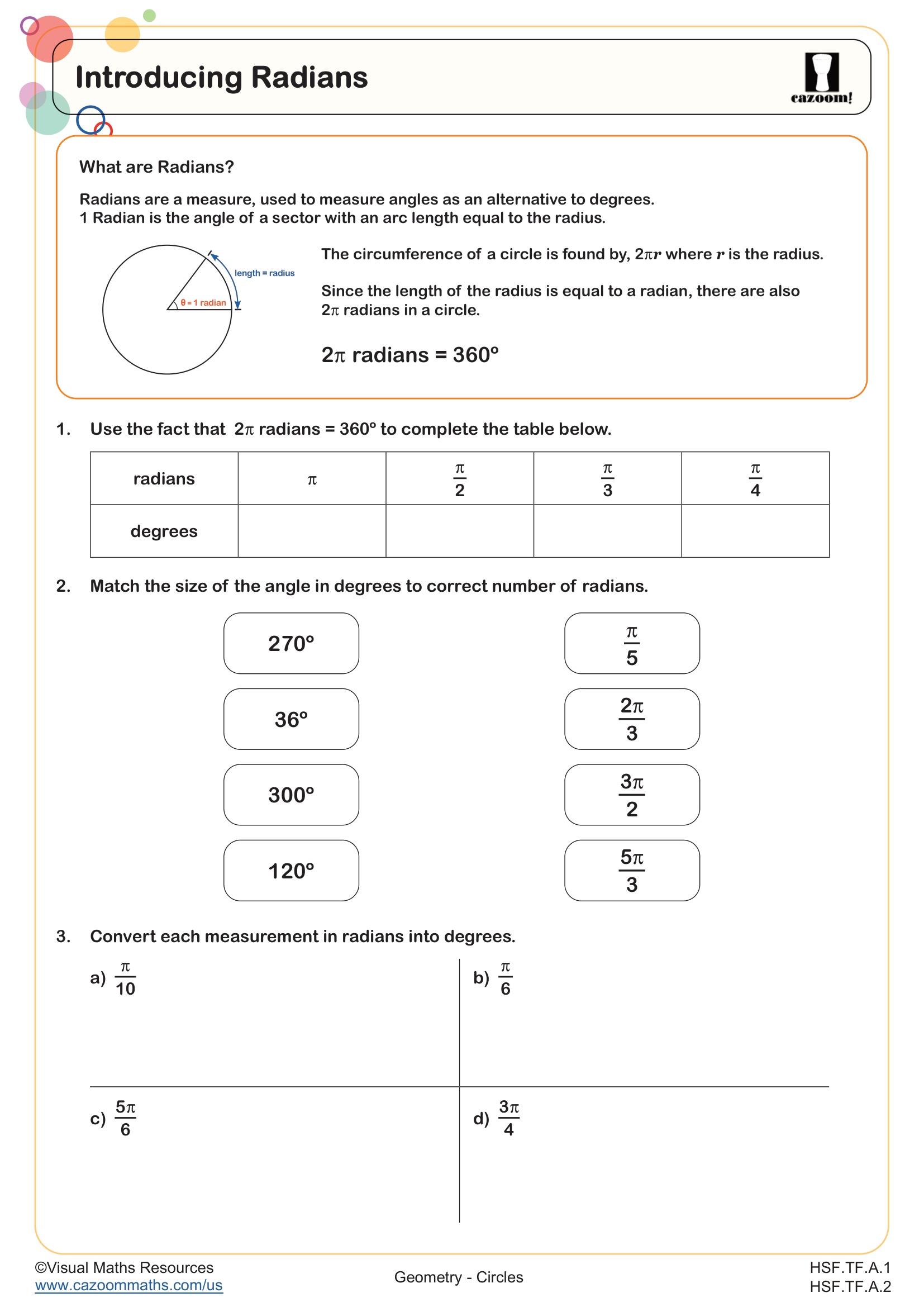
Algebra II students work with circles through the lens of radian measure, moving beyond the coordinate geometry of circle equations covered in earlier courses. The focus shifts to understanding radians as the ratio of arc length to radius, converting between degrees and radians, and developing fluency with special angles on the unit circle. Students also connect circular functions to periodic behavior that appears throughout advanced mathematics.
A common misconception emerges when students treat radians as just another unit like degrees, rather than recognizing them as dimensionless ratios. Teachers often help students overcome this by emphasizing that π radians equals 180 degrees because π represents the ratio of a semicircle's arc length to its radius. This foundational understanding prevents confusion when students encounter radian-based derivatives and integrals in calculus.
How Do Circles Appear on the SAT and ACT?
Standardized tests like the SAT and ACT assess circle concepts primarily through unit circle applications, angle conversions, and arc length problems. Students need to demonstrate fluency with special angles in both degrees and radians, recognize coterminal angles, and apply the relationship s = rθ to find arc lengths or central angles. These questions often appear in the calculator-permitted sections, though memorizing key radian values proves more efficient than converting every time.
Students lose points when they forget to verify their calculator is in the correct mode (degree versus radian) or when they struggle to visualize angle positions on the unit circle. Test questions frequently embed radian work within applied contexts like rotational motion or periodic functions, requiring students to extract the relevant circular relationship from a word problem before performing calculations.
Why Does the Radian System Matter in STEM Fields?
Radians provide the natural measurement system for calculus and physics because they create direct proportionality between angles, arc lengths, and areas without conversion factors. When angles are measured in radians, the derivative of sine equals cosine without requiring adjustment constants. This mathematical elegance makes radians indispensable in fields requiring rate-of-change calculations involving rotation or periodic motion.
Engineers rely on radian measure when analyzing rotating machinery, designing circular motion systems, or modeling wave phenomena. Physics students encounter radians immediately in rotational kinematics, where angular velocity in radians per second connects directly to linear velocity through v = rω. Computer graphics programmers use radians for all trigonometric calculations because programming libraries default to radian input, making this understanding non-negotiable for students pursuing computational fields.
How Should Teachers Use These Algebra II Circle Worksheets?
These worksheets provide structured practice with radian introduction and conversions, helping students develop the automaticity needed before tackling trigonometric functions. The progression supports conceptual understanding by connecting the definition of radians to their practical applications, with answer keys allowing students to self-check their conversion work and identify patterns in special angle relationships.
Teachers find these materials particularly valuable during the transition into trigonometry units, when students need concentrated practice with radian fluency before layering on sine, cosine, and tangent functions. The worksheets work well for targeted intervention with students who struggle to visualize angle positions or for test preparation focused on unit circle memorization. Many teachers assign portions as homework after introducing the radian definition, then use class time to address persistent conversion errors revealed in the answer-checked work.