Algebra II Functions Worksheets
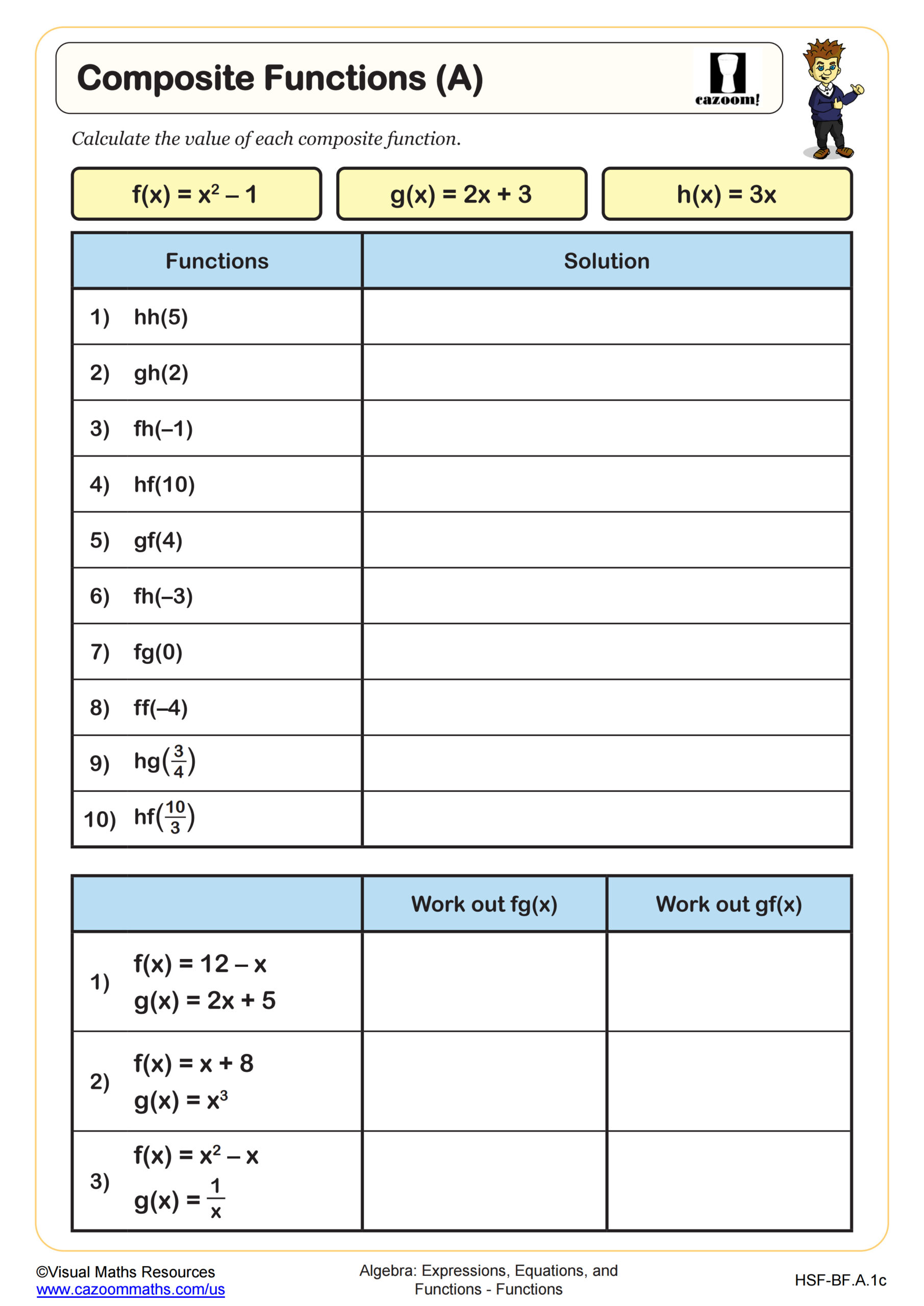
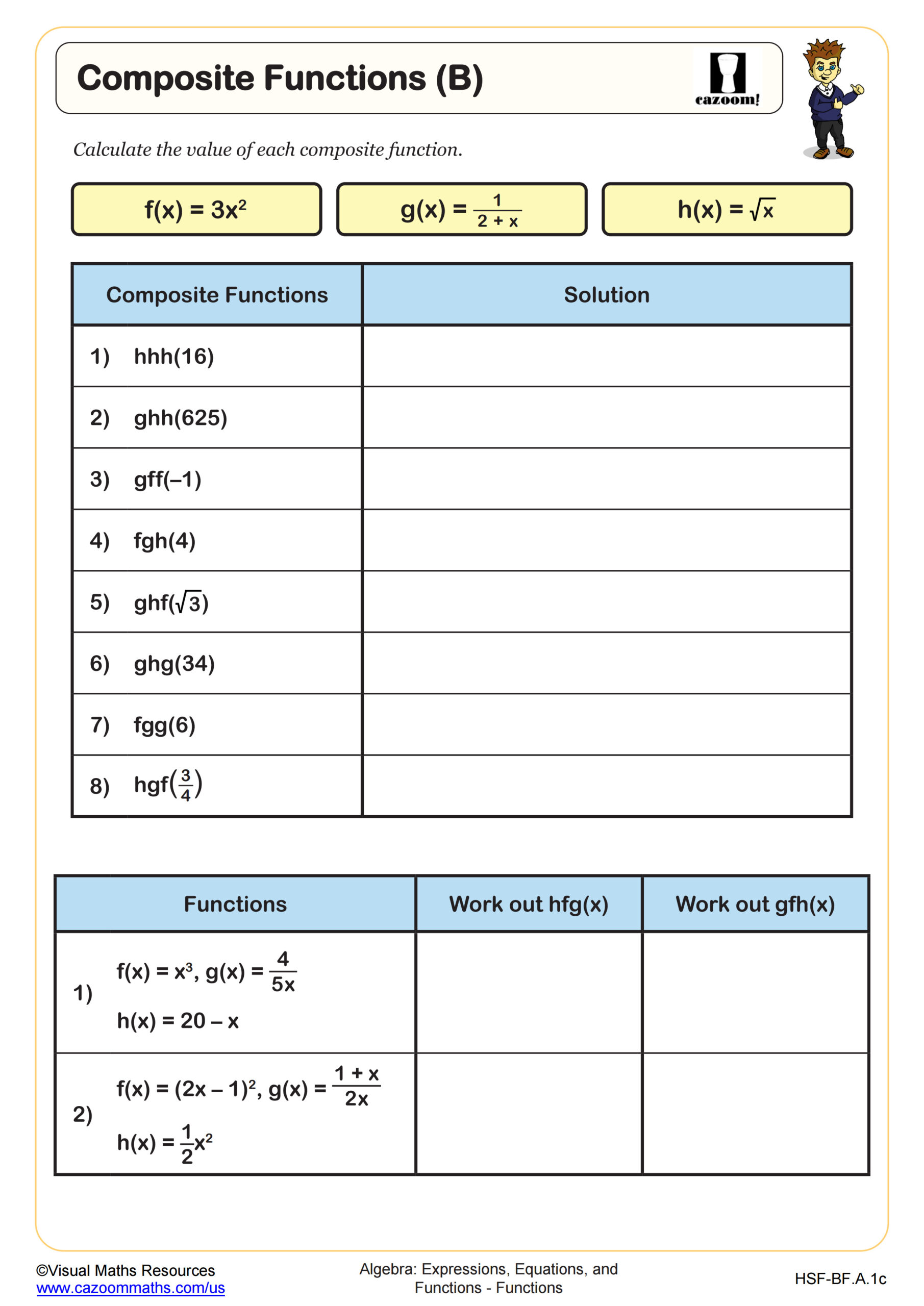
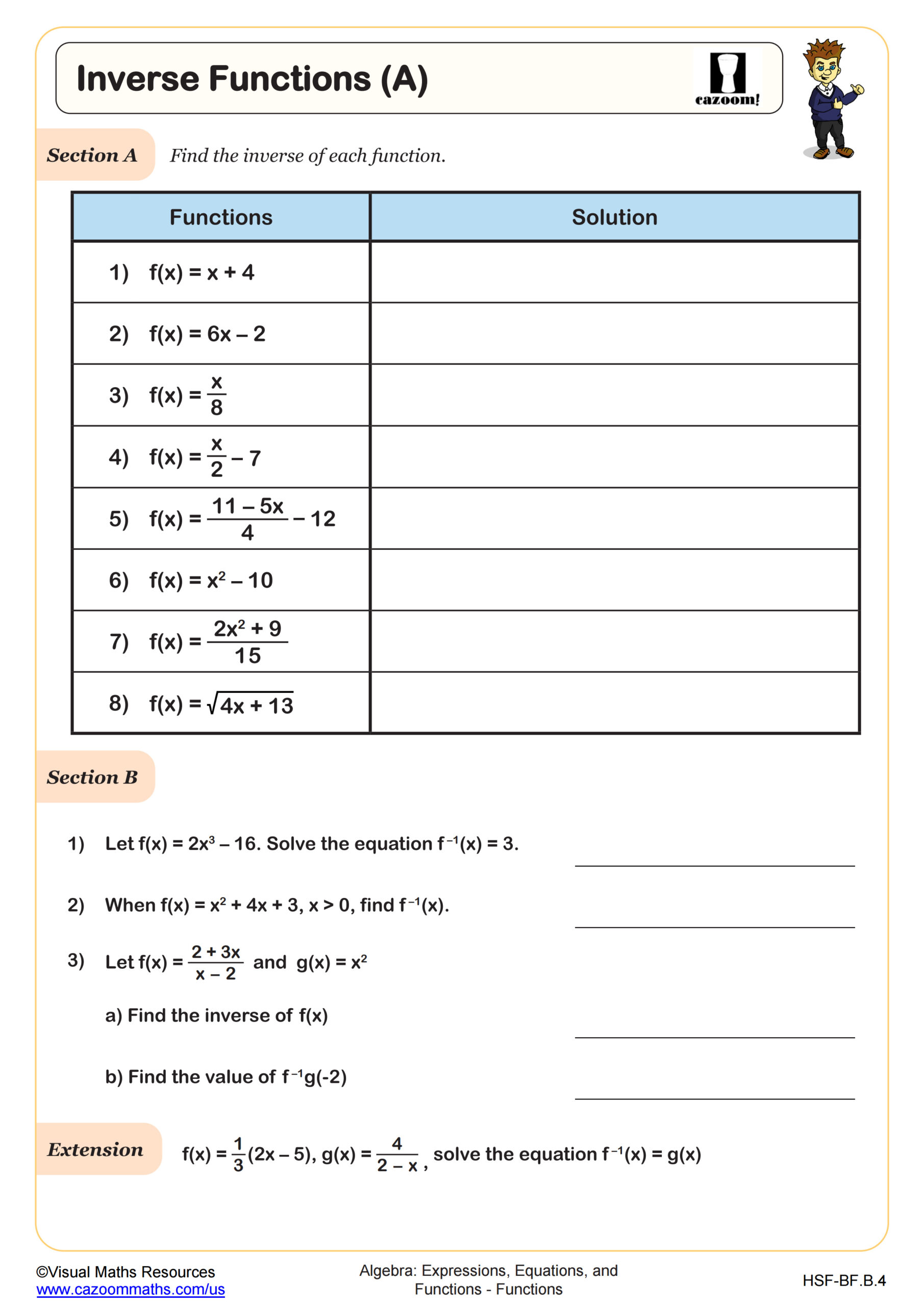
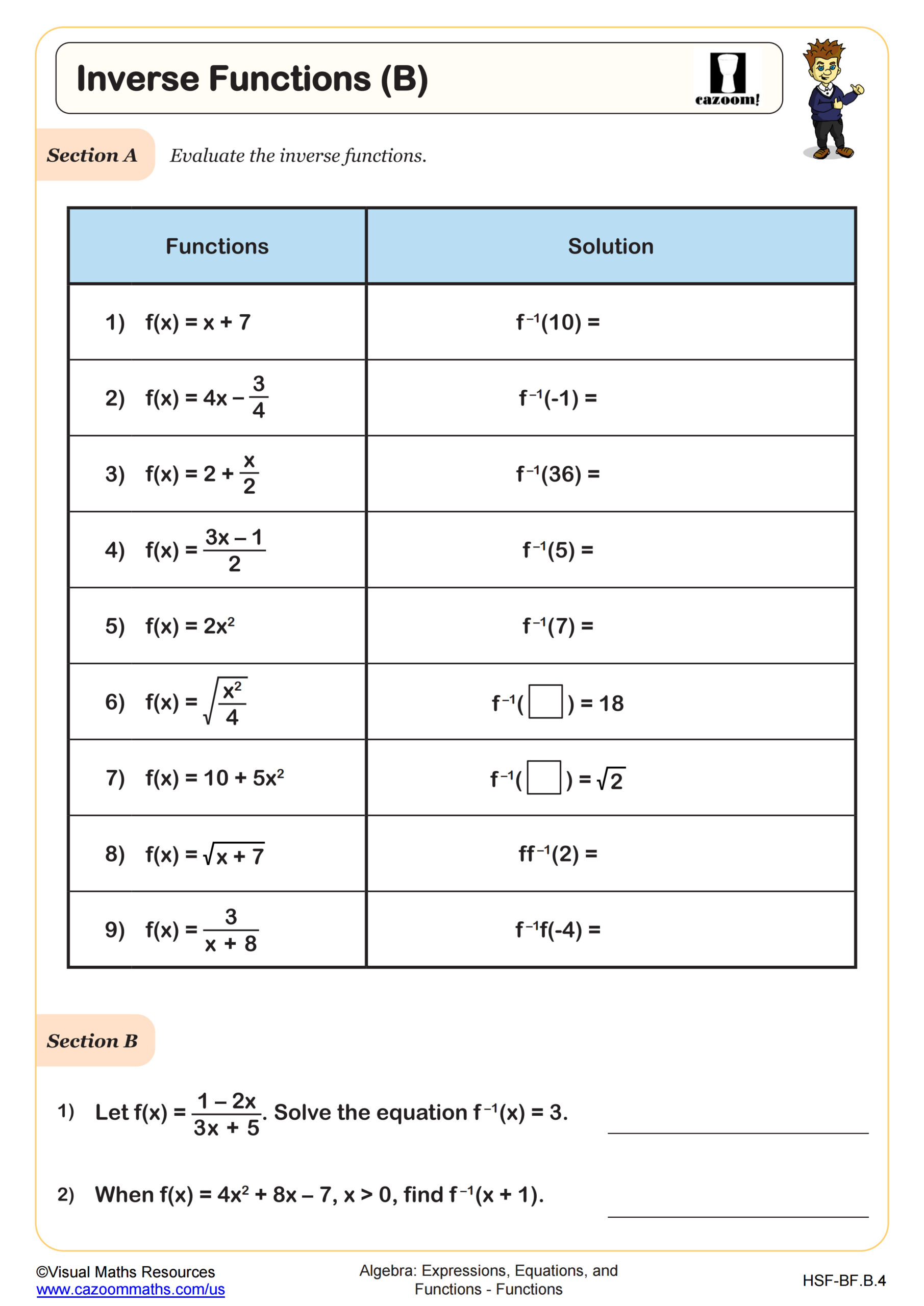
All worksheets are created by the team of experienced teachers at Cazoom Math.
What Do Algebra II Students Learn About Functions?
In Algebra II, students extend their understanding of functions beyond basic graphing and evaluation to include inverse and composite functions. The curriculum emphasizes function composition, where students combine functions by substituting one into another, and inverse functions, where students determine the function that reverses the original operation. These concepts align with Common Core standards for interpreting function structure and building new functions from existing ones.
Teachers frequently notice that students stumble when writing composite function notation correctly, often confusing f(g(x)) with multiplication or misunderstanding the order of operations. The key misconception involves treating composition as commutative when f(g(x)) rarely equals g(f(x)). Students who practice systematically with varied function types develop the pattern recognition needed to avoid these errors on assessments.
How Do Functions Appear on the SAT and ACT?
Standardized tests like the SAT and ACT regularly assess function composition and inverse functions through both computational and conceptual questions. Students need to evaluate composite functions, determine whether two functions are inverses by checking if f(g(x)) = x and g(f(x)) = x, and interpret function notation in context. The ACT particularly favors multi-step problems where students must compose functions and then evaluate at a specific value.
Students lose points when they rush through the order of operations in composite functions or forget to verify both compositions when proving inverse relationships. Another frequent error occurs when students attempt to find an inverse algebraically but fail to recognize domain restrictions that prevent certain functions from having inverses. Test preparation should include practice identifying when functions are one-to-one before attempting to find inverses.
What Are Inverse Functions and Why Do They Matter?
An inverse function reverses the input-output relationship of the original function, essentially undoing whatever operation the original function performed. If f(x) converts Celsius to Fahrenheit, then the inverse function f⁻¹(x) converts Fahrenheit back to Celsius. For a function to have an inverse, it must be one-to-one, meaning each output corresponds to exactly one input. Students find inverse functions algebraically by swapping x and y variables and solving for the new y.
Inverse functions appear throughout STEM fields wherever processes need reversing. Cryptography relies on inverse functions to encode and decode messages, making online banking and secure communication possible. Engineers use inverse functions when designing control systems that need to counteract or compensate for other processes. College-bound students encounter inverse functions again in trigonometry with arcsin, arccos, and arctan, and throughout calculus when working with logarithmic and exponential relationships.
How Can Teachers Use These Algebra II Functions Worksheets Effectively?
The worksheets provide scaffolded practice that builds from foundational inverse function problems to more complex composite function challenges. Each worksheet includes varied problem types that require students to evaluate compositions numerically, work with function notation algebraically, and verify inverse relationships symbolically. The complete answer keys allow students to check their work independently and identify specific steps where errors occurred, supporting self-correction and metacognitive development.
Many teachers use these worksheets during unit review sessions before chapter tests or as targeted intervention for students who struggled with initial instruction. The problems work well for paired practice where students compare solution methods and catch each other's notation errors. Teachers also assign specific worksheets as SAT prep since the problem formats mirror standardized test questions. The structured progression across worksheets helps students build procedural fluency while reinforcing the conceptual understanding needed for Pre-Calculus success.