Algebra II Indices Worksheets
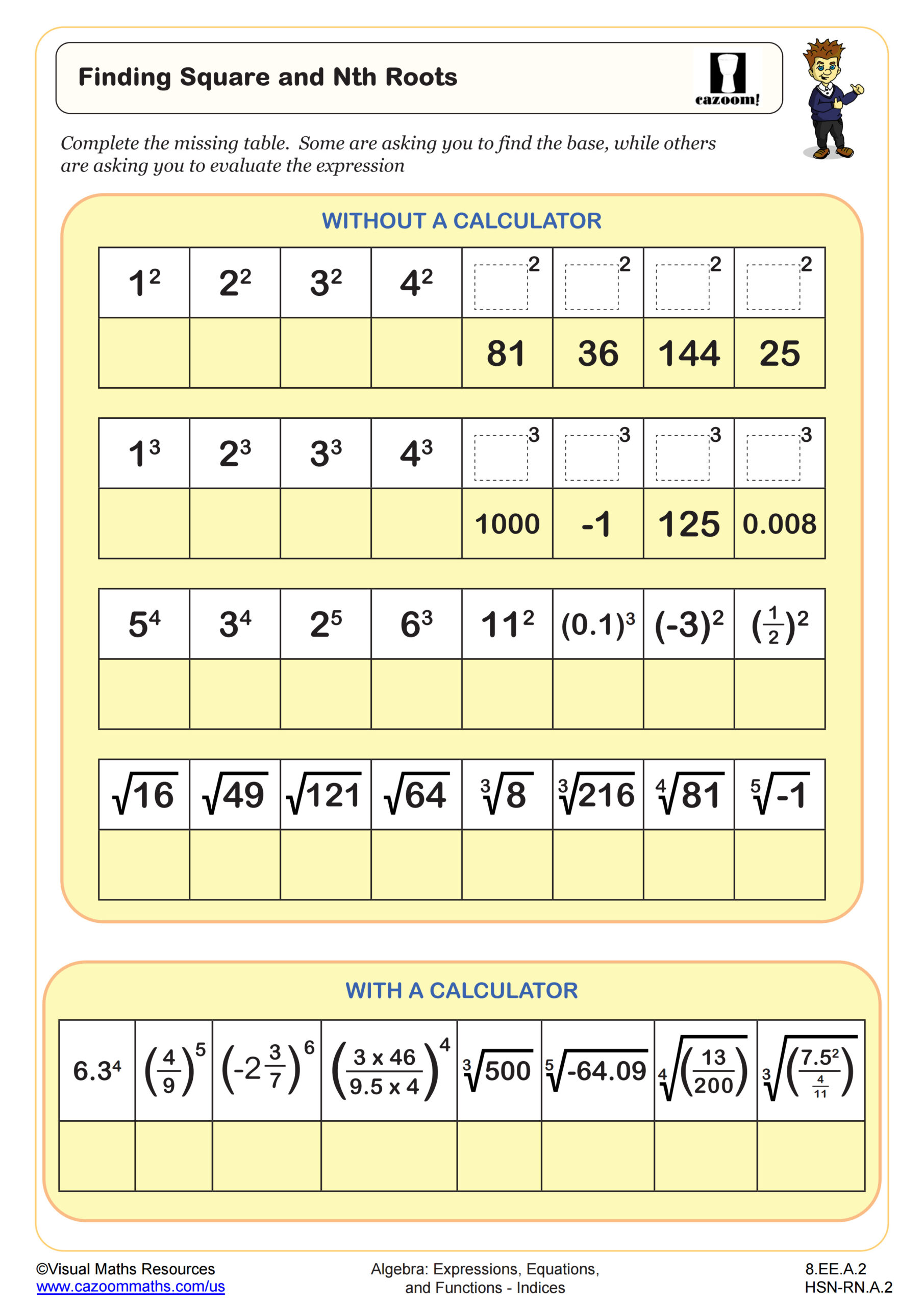
All worksheets are created by the team of experienced teachers at Cazoom Math.
What Do Algebra II Students Learn About Indices?
In Algebra II, indices work extends beyond basic exponent rules to include rational exponents, nth roots, and the connections between radical and exponential notation. Students learn to simplify expressions involving fractional exponents, evaluate roots of various orders, and understand that x^(1/n) represents the nth root of x. This topic builds directly on Algebra I exponent laws while preparing students for logarithmic and exponential functions that appear later in the curriculum.
A common error occurs when students attempt to find the fourth root of 81 and write 4.5 because they confuse root operations with division. Teachers often clarify this by having students verify their answers: if the fourth root of 81 is truly 3, then 3×3×3×3 should equal 81. This verification step helps students distinguish between the inverse nature of roots and exponents versus arithmetic operations like division.
How Are Indices Tested on the SAT and ACT?
Both the SAT and ACT assess indices through questions involving radical simplification, rational exponents, and exponential equations. Students need to convert between radical notation and fractional exponents, simplify expressions like (27)^(2/3), and solve equations where the variable appears in an exponent or under a radical. The calculator section allows students to verify numerical answers, but non-calculator questions test whether students truly understand the relationship between roots and powers.
Students lose points when they misapply exponent rules to radicals or forget that even roots of negative numbers are undefined in the real number system. For example, when simplifying √(-16), many students write -4 without recognizing this violates the definition of square root. Standardized tests deliberately include these traps, so students need practice identifying when expressions are undefined or require imaginary numbers.
What's the Relationship Between Radicals and Rational Exponents?
Radicals and rational exponents represent the same mathematical operations using different notation. The nth root of a number equals that number raised to the 1/n power, so ∛8 = 8^(1/3) = 2. This equivalence becomes particularly powerful when simplifying complex expressions because exponent rules are often easier to apply than radical rules. Students can rewrite ∜(x³) as x^(3/4), making multiplication and division of like terms more straightforward.
This concept appears throughout STEM fields, particularly in physics and engineering formulas involving inverse relationships. The intensity of light follows an inverse square law, written as I = k/d², but finding the distance that produces a specific intensity requires taking the square root: d = √(k/I). Understanding that this equals (k/I)^(1/2) allows scientists and engineers to manipulate these equations algebraically when solving for different variables in complex systems.
How Can Teachers Use These Indices Worksheets in Algebra II?
These worksheets provide targeted practice on finding square roots, cube roots, and higher-order roots with varying levels of complexity. The structured format allows teachers to assign specific problems that match students' current skill levels, whether they're just learning to evaluate perfect squares and cubes or working with more challenging non-perfect roots and rational exponents. The included answer keys let students self-check their work during independent practice, building the self-assessment skills they'll need for college math courses.
Many teachers use these worksheets as warm-up activities to maintain fluency throughout the year since indices skills resurface constantly in Algebra II topics like simplifying rational expressions, solving radical equations, and working with exponential functions. They're particularly valuable for intervention with students who missed foundational exponent concepts in Algebra I, for review before unit tests on exponential and logarithmic functions, or as extra practice for students preparing for standardized tests where indices questions appear without warning across multiple content domains.