Algebra II Percentages Worksheets
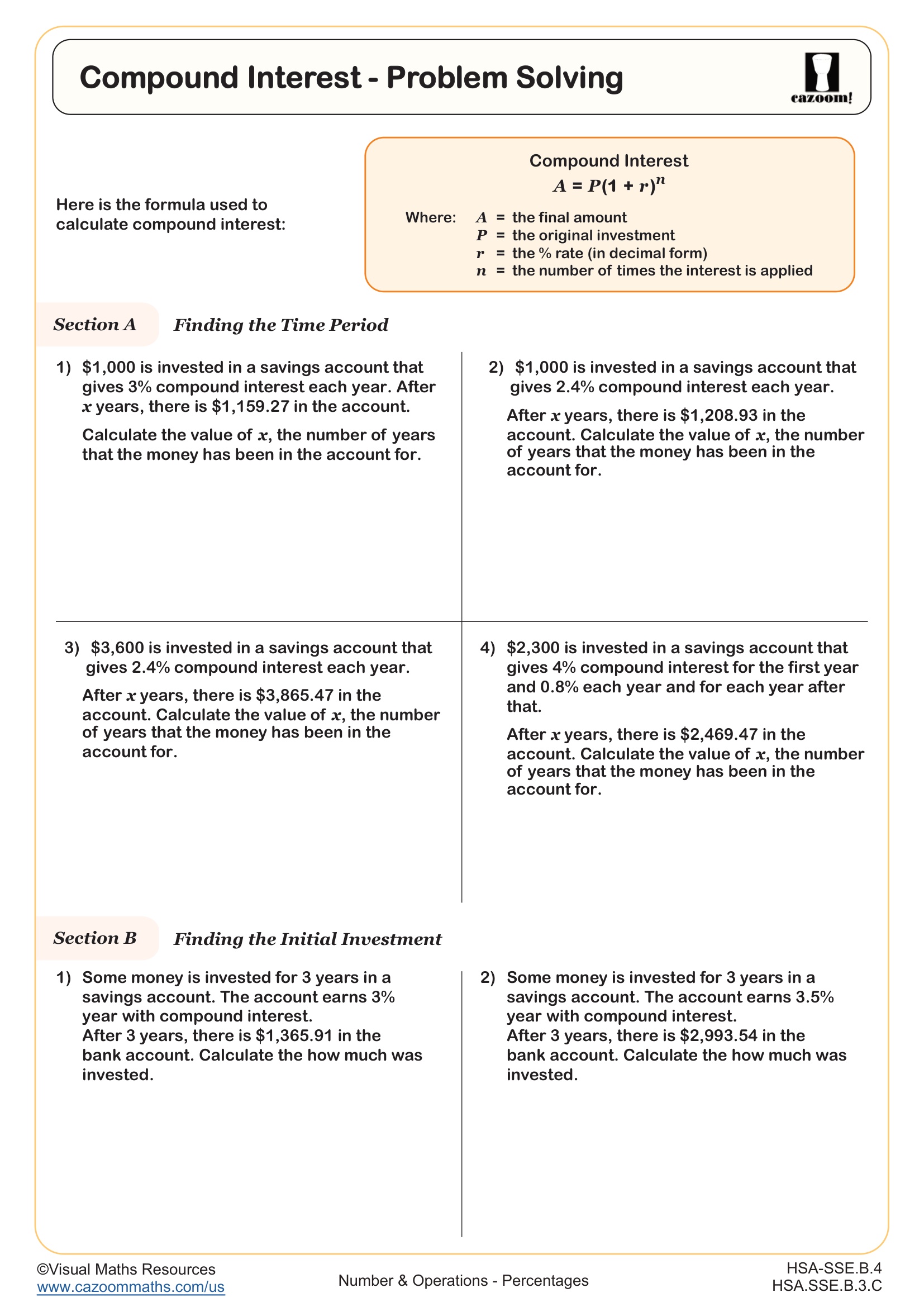
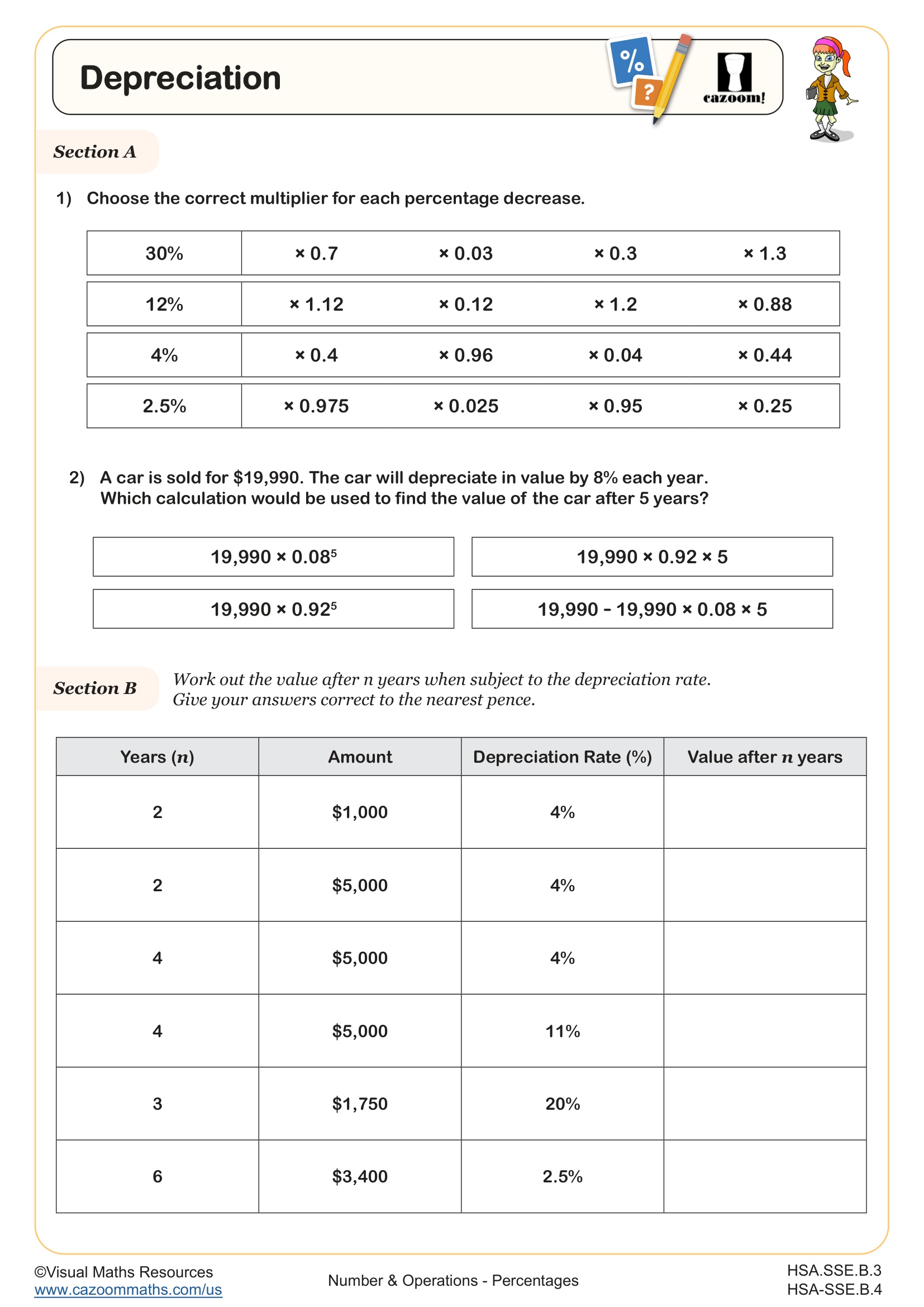
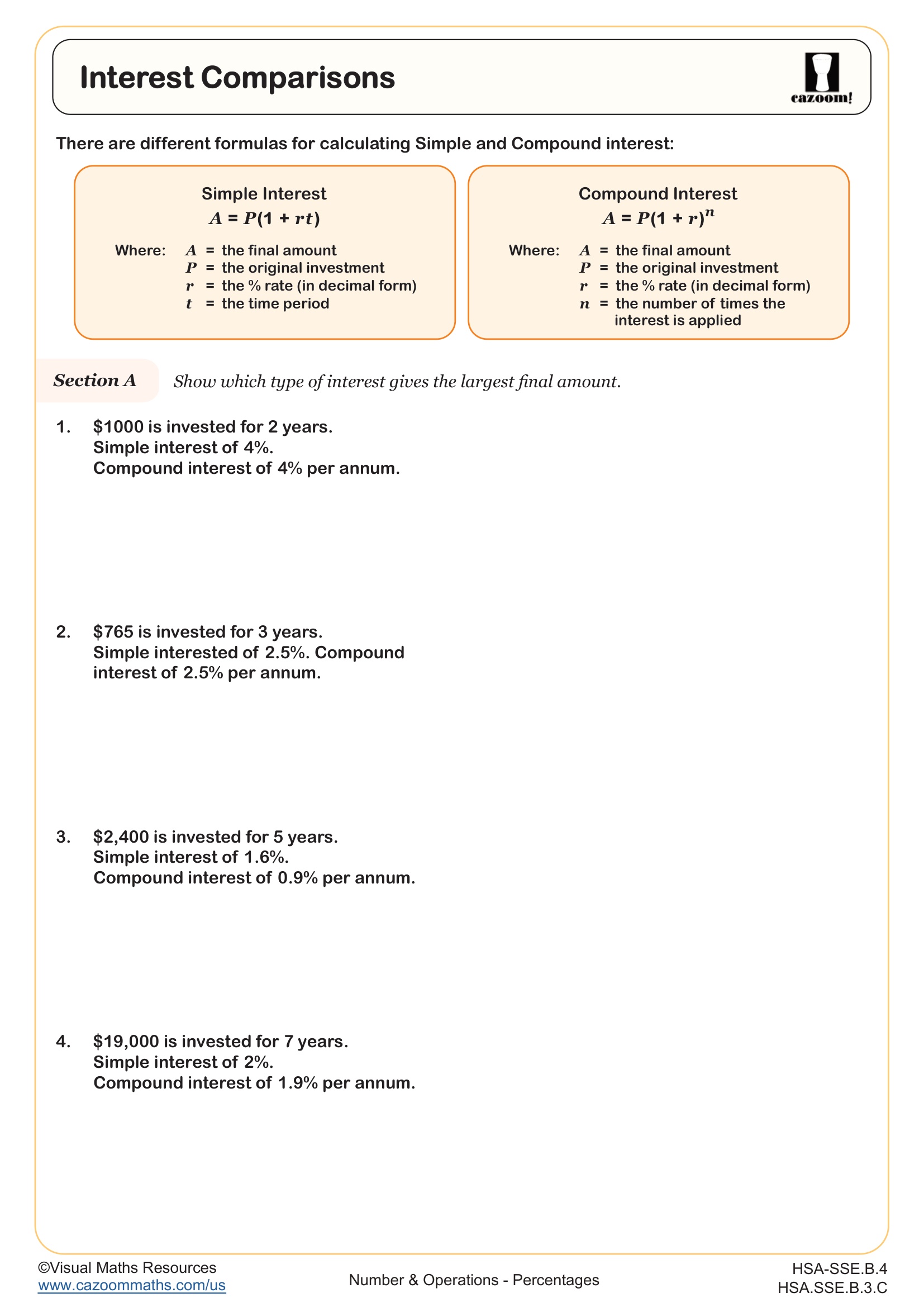
All worksheets are created by the team of experienced teachers at Cazoom Math.
Why Do Algebra II Students Review Percentages?
Algebra II courses revisit percentages because they form the mathematical foundation for exponential growth and decay, compound interest formulas, statistical analysis, and probability distributions. Students apply percentage concepts when solving real-world problems involving population modeling, financial literacy, and scientific data interpretation throughout the course.
Teachers frequently notice that students who never mastered mental percentage calculations in middle school struggle with word problems that embed percentages within algebraic contexts. A common error occurs when students confuse "50% of x" with "x + 50%", particularly in growth problems. The worksheets address this by reinforcing that percentages represent multiplication operations, helping students translate percentage language into algebraic expressions before tackling more complex applications.
What Grade Level Uses These Percentage Worksheets?
These worksheets target Algebra II students in high school, typically grades 9-11 depending on the student's math pathway. While percentages are introduced in elementary and middle school, Algebra II students work with them at a more sophisticated level, connecting percentage operations to algebraic thinking and preparing for calculus.
The progression within this collection moves from building percentages using benchmark values like 10%, 25%, and 50% to finding complements to 100% and mastering calculator techniques for any percentage. Students who confidently work with benchmark percentages mentally gain speed on standardized tests like the SAT and ACT, where calculator time management matters. The skills scaffold from conceptual understanding to computational efficiency, mirroring how percentages appear in higher-level math courses.
What Does Finding Percentages from Benchmark Values Mean?
Finding percentages from benchmark values means using known percentages like 5%, 10%, 25%, and 50% as building blocks to calculate other percentages mentally or with minimal calculation. For example, students find 15% by adding 10% and 5%, or calculate 75% by recognizing it as three times 25%. This method develops number sense and provides estimation strategies that make complex calculations more manageable.
This skill connects directly to financial literacy and consumer mathematics. When calculating sales tax, evaluating discounts during shopping, or determining tips at restaurants, benchmark percentage methods allow for quick mental estimates. Engineers and scientists use these same strategies when conducting field calculations without access to computational tools, or when quickly checking whether computer-generated results fall within reasonable ranges during data analysis and quality control processes.
How Do These Worksheets Support Percentage Mastery?
The worksheets build percentage fluency through carefully sequenced problems that progress from concrete benchmark calculations to more abstract applications. Students work through problems that require them to identify which benchmark percentages provide the most efficient solution path, reinforcing strategic thinking alongside computational skills. The complete answer keys allow students to check their work independently and identify specific calculation errors.
Teachers use these worksheets for differentiated instruction, assigning benchmark percentage practice to students who need foundational review while others work on calculator-based problems. They work well as warm-up activities before lessons on exponential functions or compound interest, as homework to reinforce classroom instruction, or as intervention materials for students who lose points on standardized tests due to percentage calculation errors. Paired work helps students articulate their problem-solving strategies and catch conceptual misunderstandings.