Algebra II Quadratic and Cubic Functions Worksheets
All worksheets are created by the team of experienced teachers at Cazoom Math.
What Do Students Learn About Quadratic and Cubic Functions in Algebra II?
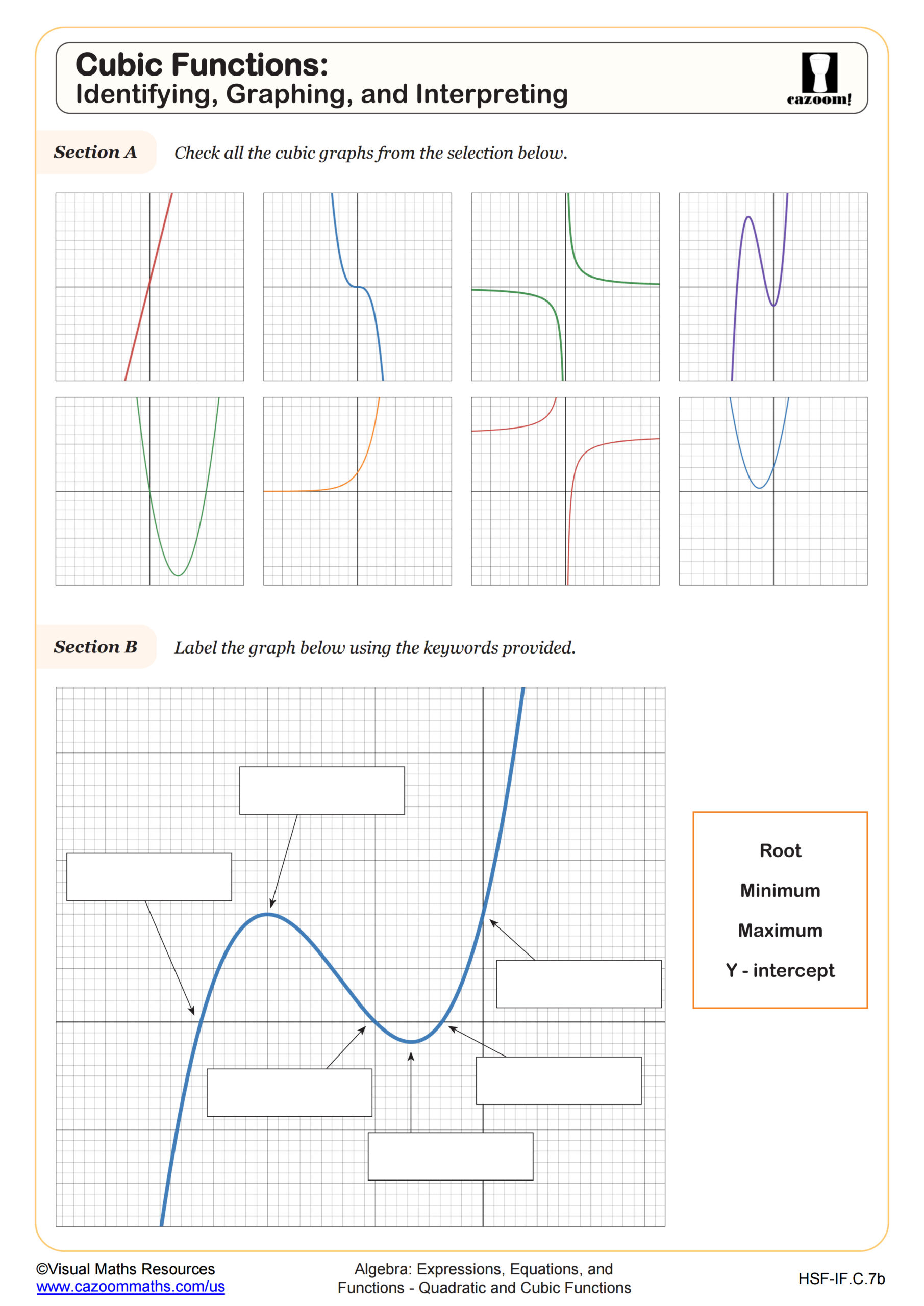
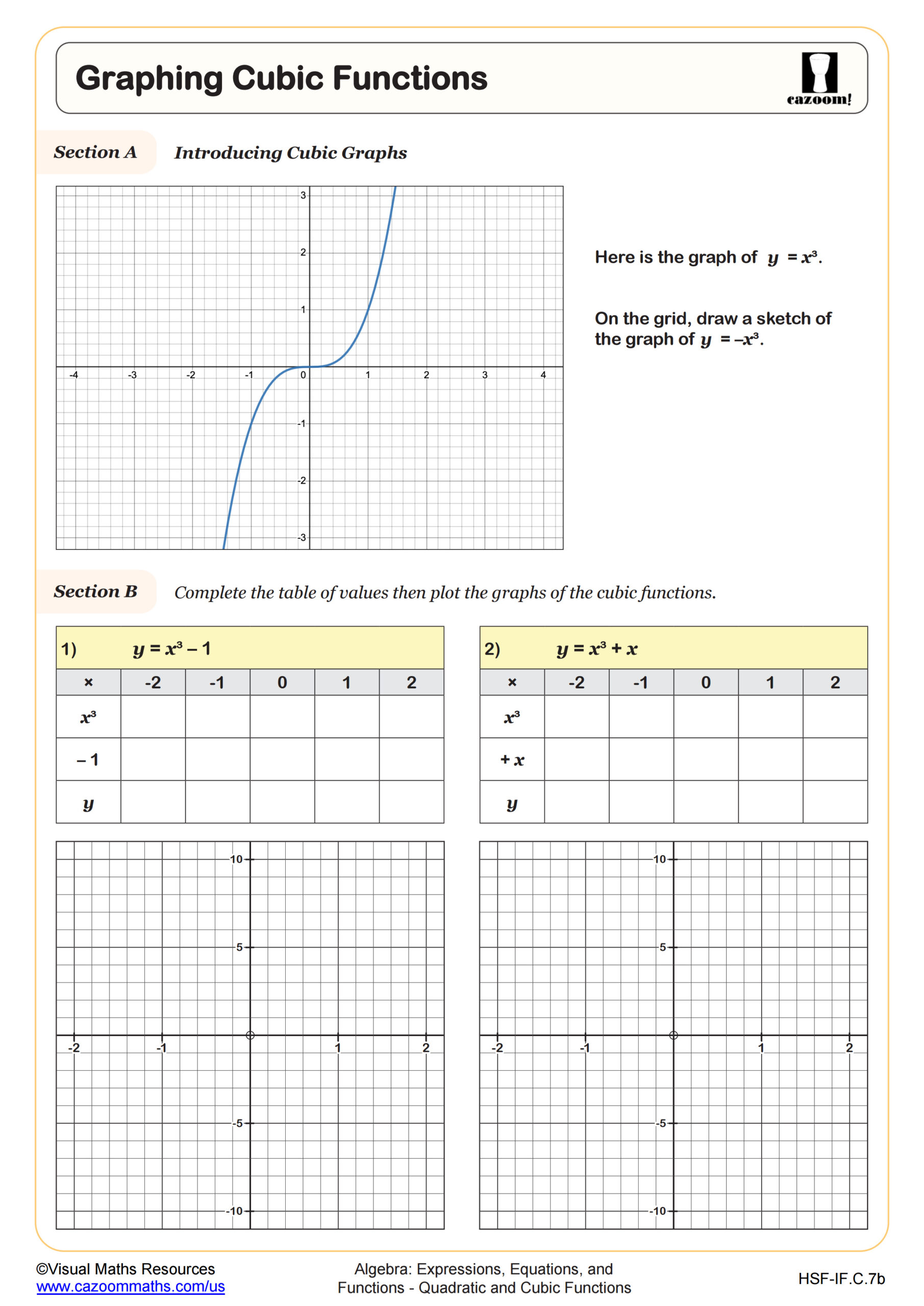
Students deepen their understanding of quadratic functions beyond Algebra I by exploring transformations, completing the square to identify vertex form, and analyzing the discriminant to predict the number and nature of solutions. The curriculum then extends to cubic functions, where students learn to identify local maxima and minima, determine end behavior using leading coefficients, and recognize that cubics always cross the x-axis at least once. This work aligns with Common Core standards for understanding function structure and interpreting key features from equations and graphs.
A common error occurs when students apply quadratic symmetry rules to cubic functions. Teachers often observe students searching for an axis of symmetry on cubic graphs when they should identify point symmetry about the inflection point. Helping students contrast these function families side by side clarifies why different polynomial degrees produce fundamentally different graph behaviors.
How Do Quadratic and Cubic Functions Appear on the SAT and ACT?
Standardized tests like the SAT and ACT regularly feature questions requiring students to match equations to graphs, identify transformations, and solve systems involving quadratic or cubic functions. Students must quickly recognize vertex form versus standard form for quadratics and determine how changing parameters affects graph position and shape. The SAT calculator section often includes questions where students analyze function intersections or identify maximum and minimum values from graphs or tables.
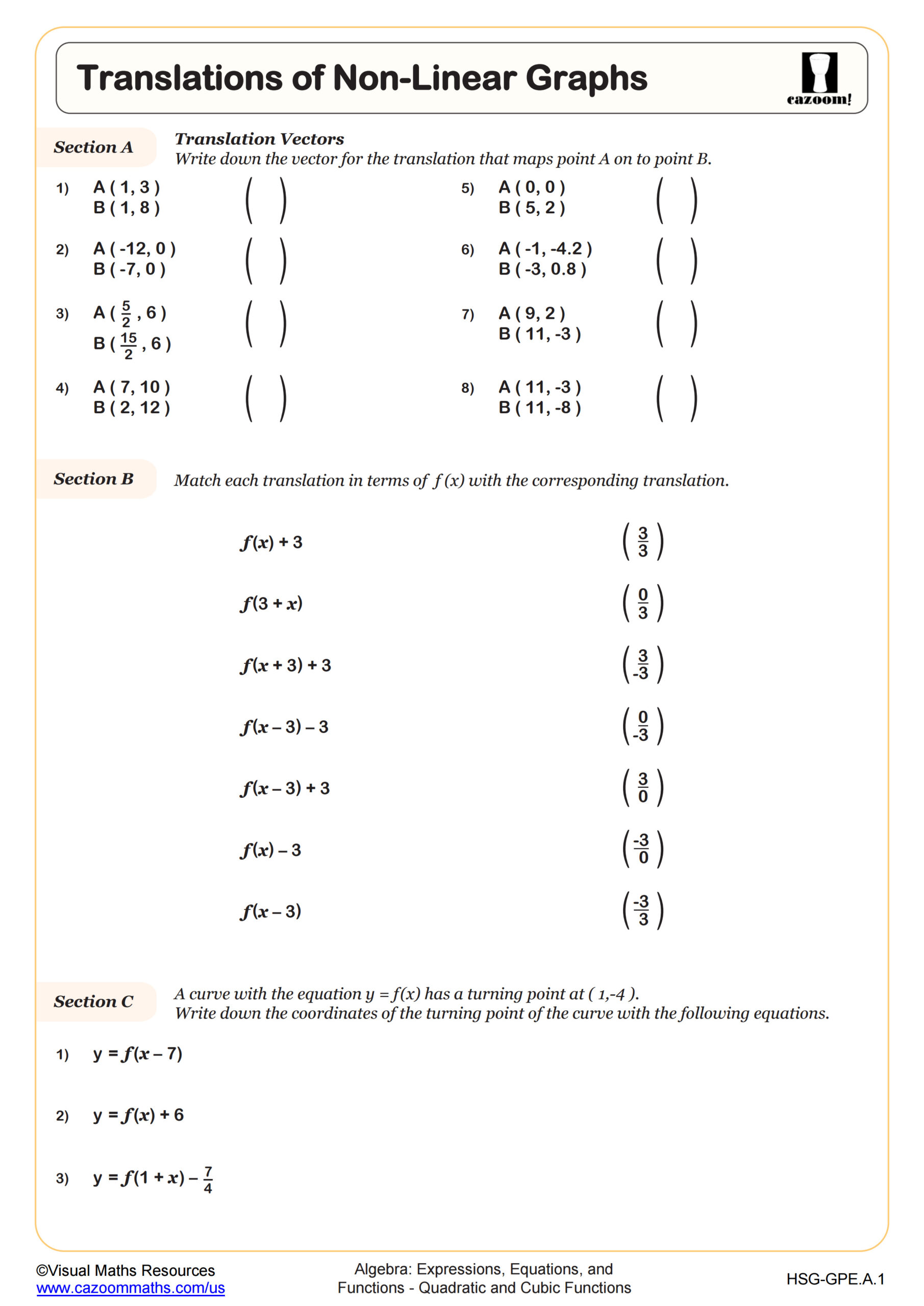
Students lose points when they confuse the direction of horizontal translations in vertex form or misidentify which coefficient controls vertical stretch. Another frequent mistake involves incorrectly determining the number of real solutions when a quadratic or cubic function intersects another graph. Teachers notice that students who regularly practice translating between algebraic and graphical representations perform significantly better on these standardized test questions.
What's the Difference Between Quadratic and Cubic End Behavior?
End behavior describes what happens to function values as x approaches positive or negative infinity. Quadratic functions with positive leading coefficients rise on both ends, while those with negative leading coefficients fall on both ends, creating the characteristic parabola shape. Cubic functions behave differently because their odd degree means the ends move in opposite directions. When the leading coefficient is positive, the left end falls and the right end rises; when negative, the pattern reverses.
This concept connects directly to population modeling and physics applications in STEM fields. Engineers use cubic functions to model relationships where continuous increase or decrease occurs rather than the bounded behavior quadratics produce. For example, the volume of a cube changes as a cubic function of its side length, while projectile motion follows a quadratic path. Understanding end behavior helps students predict long-term trends in real-world scenarios.
How Can Teachers Use These Quadratic and Cubic Functions Worksheets in Algebra II?
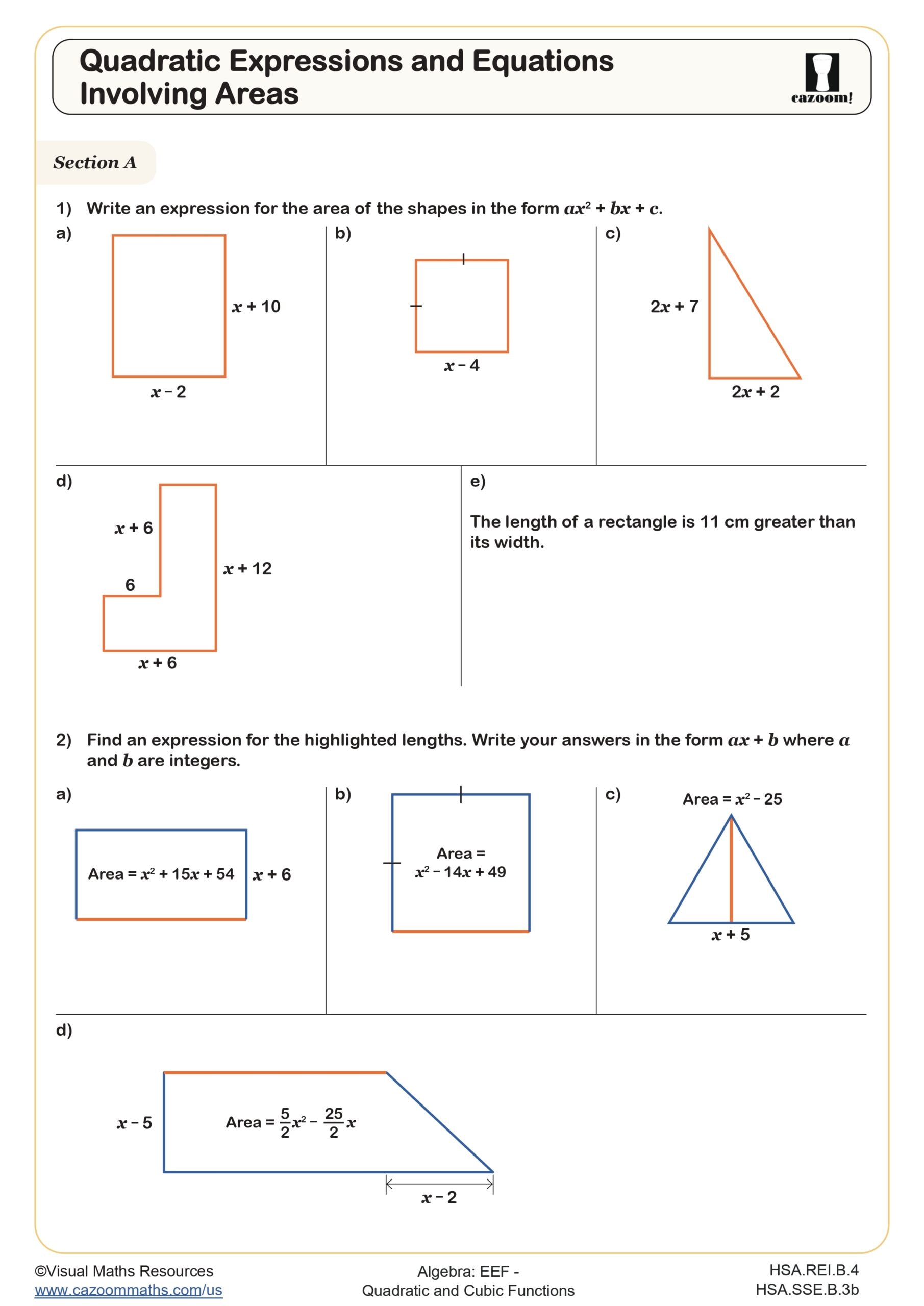
The worksheets provide structured practice that moves students from identifying function characteristics to applying transformations and solving problems involving both function types. Teachers find these resources particularly valuable after introducing new concepts, as the problems reinforce recognition of standard form, vertex form, and factored form while building graphing fluency. The answer keys allow students to self-check their work during independent practice, helping them identify misunderstandings before assessments.
Many teachers use these worksheets for differentiated instruction, assigning specific problems to students who need additional support with quadratics before advancing to cubics, or challenging advanced learners with all problems simultaneously. The worksheets work well for station rotations, test review sessions, or paired work where students compare graphs and justify their reasoning. Teachers also assign selected problems as homework to spiral previously taught material throughout the semester, ensuring students retain these foundational function concepts for subsequent topics like polynomial division and rational functions.