Function Machines Worksheets
All worksheets are created by the team of experienced teachers at Cazoom Math.
What topics are covered in a function machine worksheet?
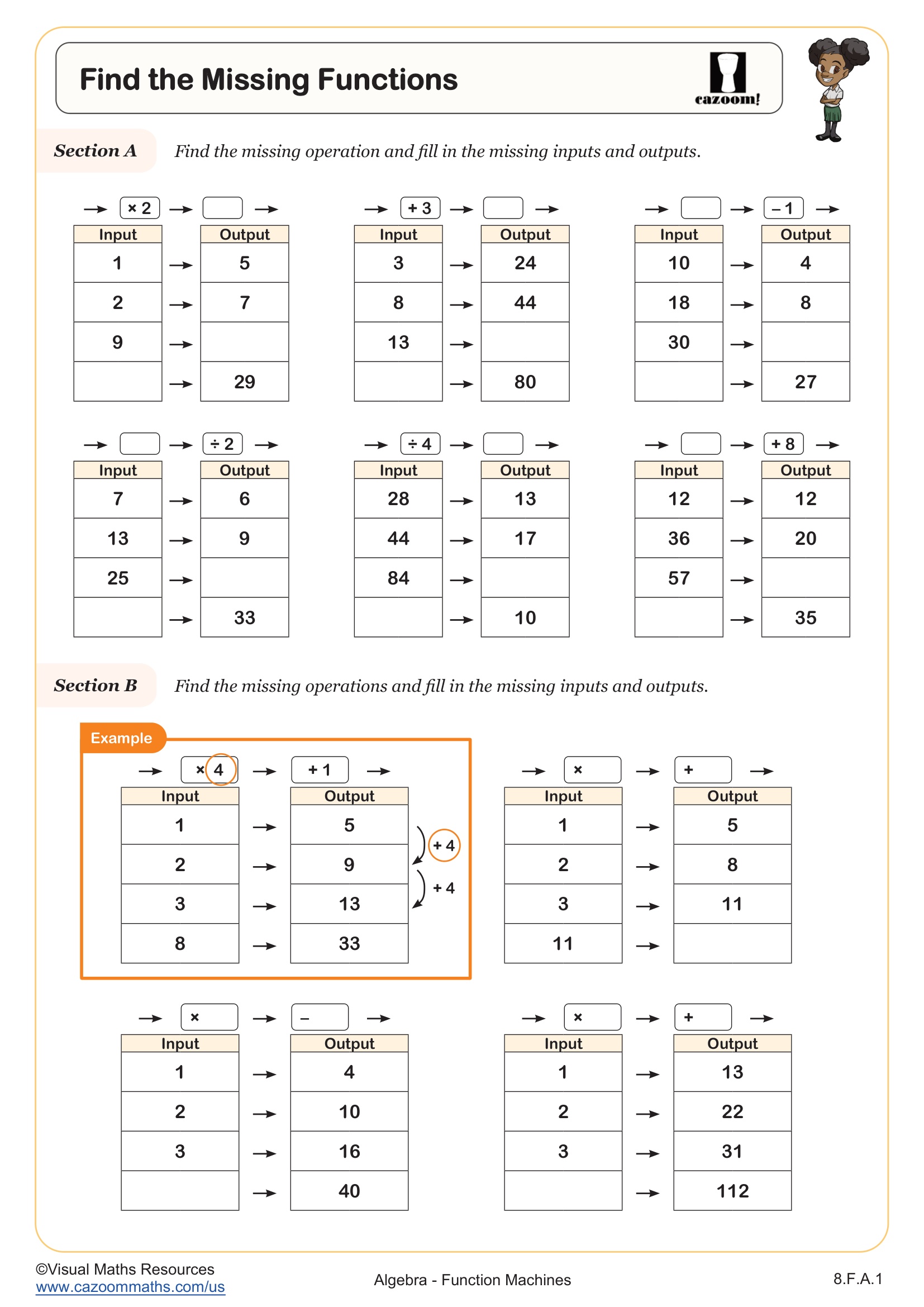
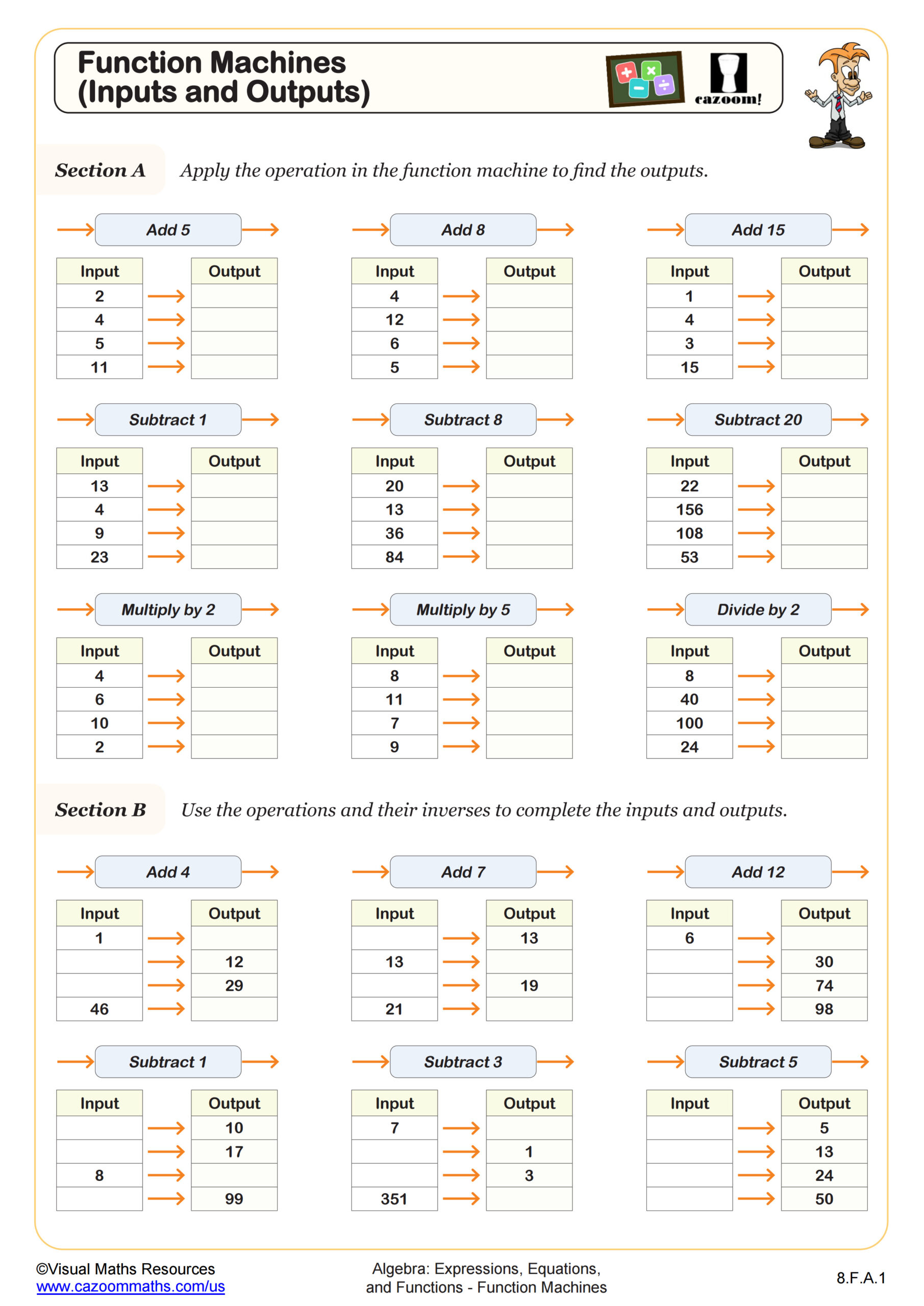
A typical function machine worksheet covers finding outputs when given inputs and rules, determining missing inputs when outputs are provided, and identifying the function rule from input-output pairs. These activities align with Common Core standards for algebraic thinking across elementary and middle school grades, particularly in understanding patterns and relationships.
Teachers notice students often confuse the direction of operations when working backwards from outputs to inputs. For example, if the rule is 'add 7' and the output is 15, students might incorrectly add 7 to 15 instead of subtracting 7 to find the input of 8. Function machines worksheet materials address this misconception through systematic practice with both forward and reverse operations.
Which grade levels benefit most from function machines worksheets?
Function machines worksheets span multiple grade levels, typically from 3rd grade through 8th grade, with complexity increasing as students advance. Elementary versions focus on simple addition and subtraction rules, while middle school materials incorporate multiplication, division, and multi-step operations. High school teachers sometimes use these as review tools for students struggling with linear functions.
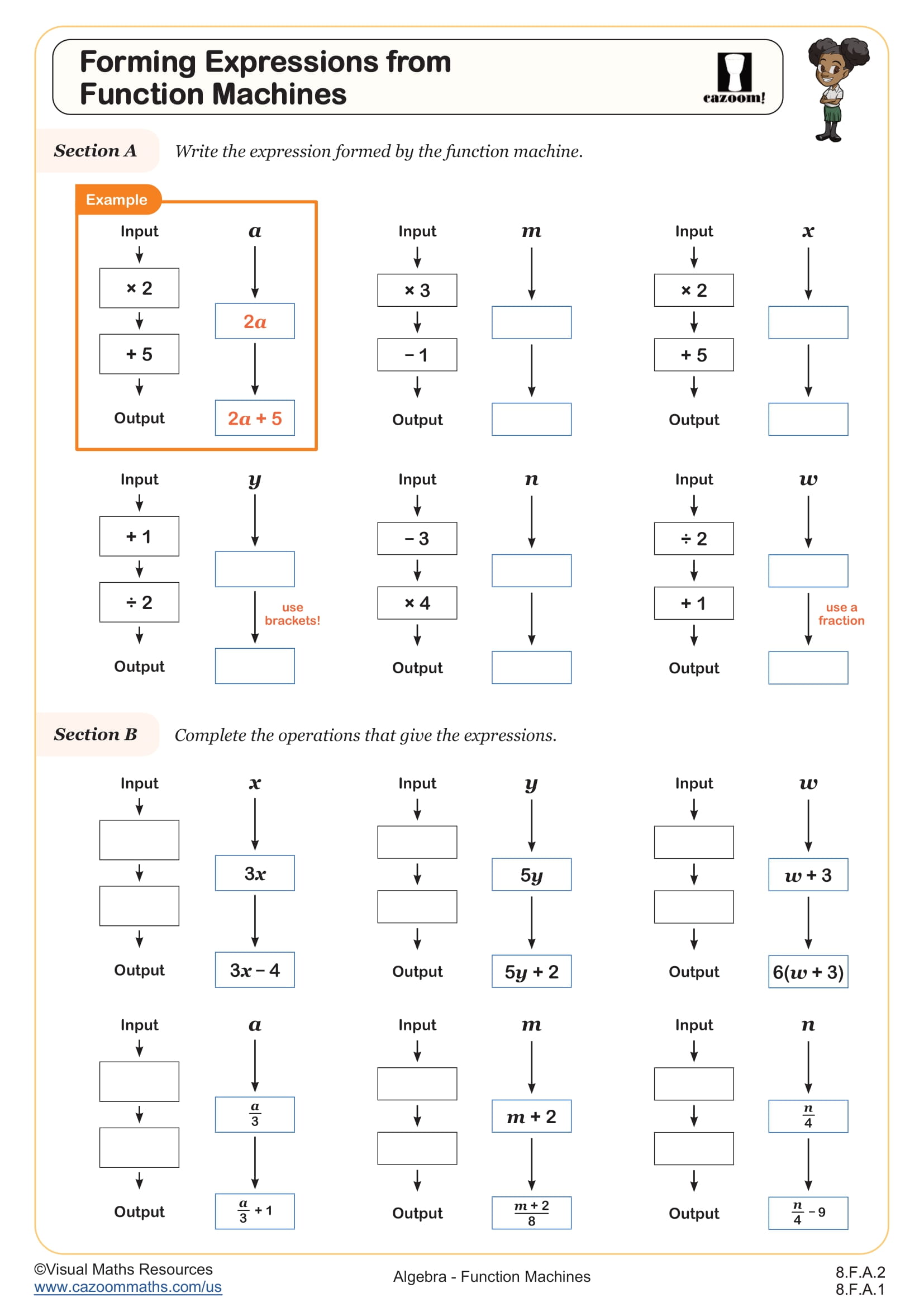
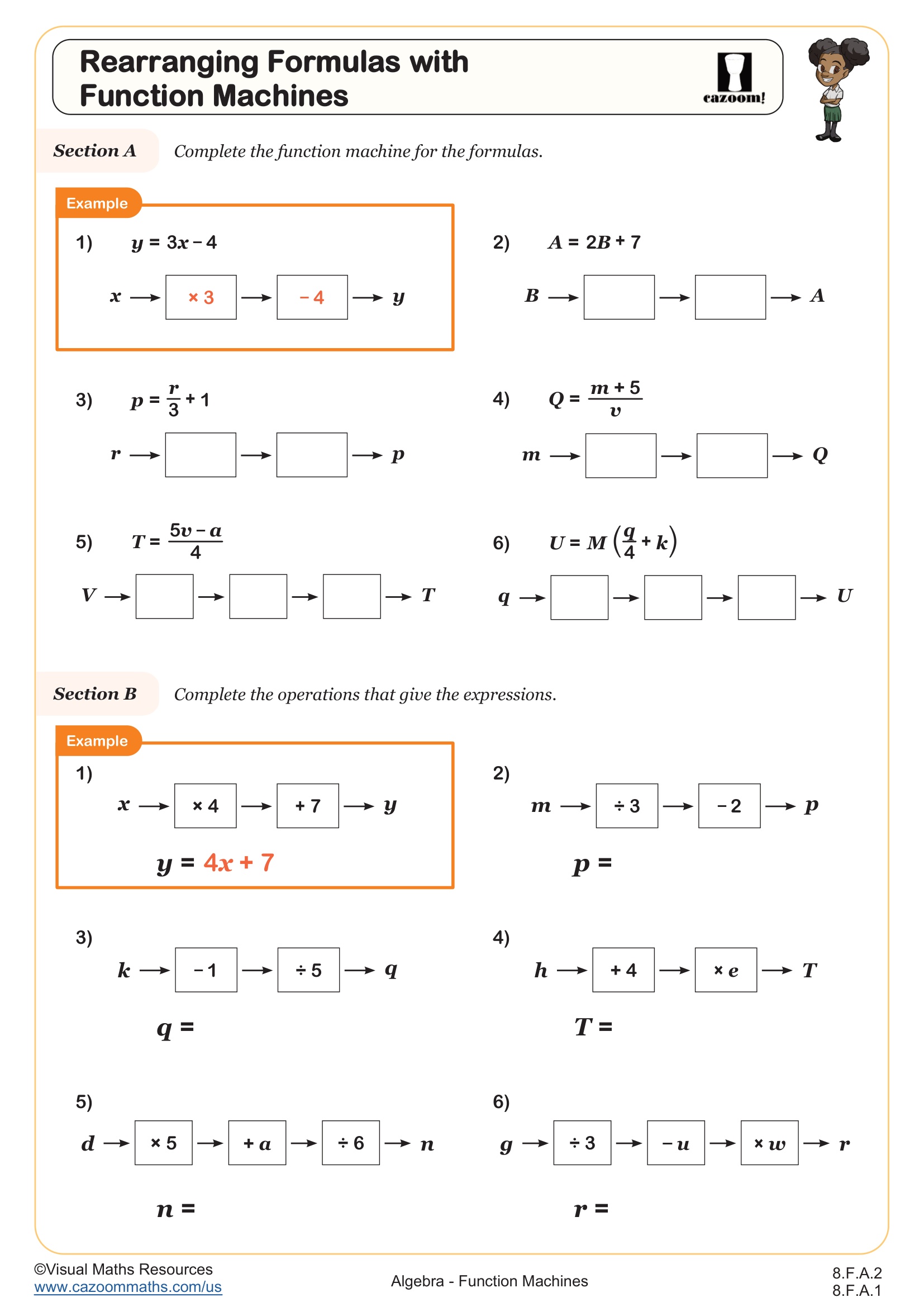
The progression moves from concrete examples with visual machine diagrams to more abstract algebraic notation. Teachers find that 6th and 7th graders particularly benefit from this bridge between arithmetic operations and formal algebra, as function machines provide a visual framework for understanding variables and equations before introducing y = mx + b notation.
How do function machine worksheets prepare students for linear equations?
Function machine worksheets establish the foundational concept that mathematical relationships follow consistent rules, which directly transfers to understanding linear equations. Students learn that input values (x) transform through operations to create output values (y), mirroring the structure of linear functions. This visual approach helps students grasp that equations represent relationships rather than just calculations.
Many teachers observe that students who struggle with algebraic concepts often lack understanding of function notation and variable relationships. Function machines bridge this gap by making the transformation process explicit and visual. Students see how x + 3 = y works as a consistent rule, preparing them for graphing linear functions and solving systems of equations in later courses.
How can teachers effectively use function machine worksheet PDF resources in class?
Teachers find success using function machine worksheet PDF materials as both guided practice and independent work, depending on student readiness levels. Starting with whole-class examples using projected worksheets helps establish the concept before releasing students to work independently. The PDF format allows teachers to print selected problems rather than entire sheets, customizing difficulty for different student groups.
Effective implementation often includes having students create their own function machines after completing worksheets, which deepens understanding through reverse engineering. Teachers report that pairing students to check each other's work using the provided answer keys builds collaborative problem-solving skills while reducing grading time. Many incorporate these materials into math centers or homework assignments to provide consistent practice with immediate feedback.
Real-Life Uses of Algebraic Proof
Algebraic proofs may seem academic, but they support valuable real-world thinking. Fields like engineering, computer science, and finance all rely on logic and step-by-step problem solving. Proofs teach students how to back up their answers, follow rules, and think clearly. These skills go beyond math and help with planning, critical thinking, and making smart choices in education, careers, and daily life.
What Should Students Know Before Starting Algebraic Proofs?
Before learning algebraic proofs, students should know how to: • Simplify algebraic expressions • Expand brackets • Work with variables and identities • Rearrange equations • Follow the order of operations A strong base in basic algebra makes learning algebraic proof easier and more meaningful.