Indices Math Worksheets
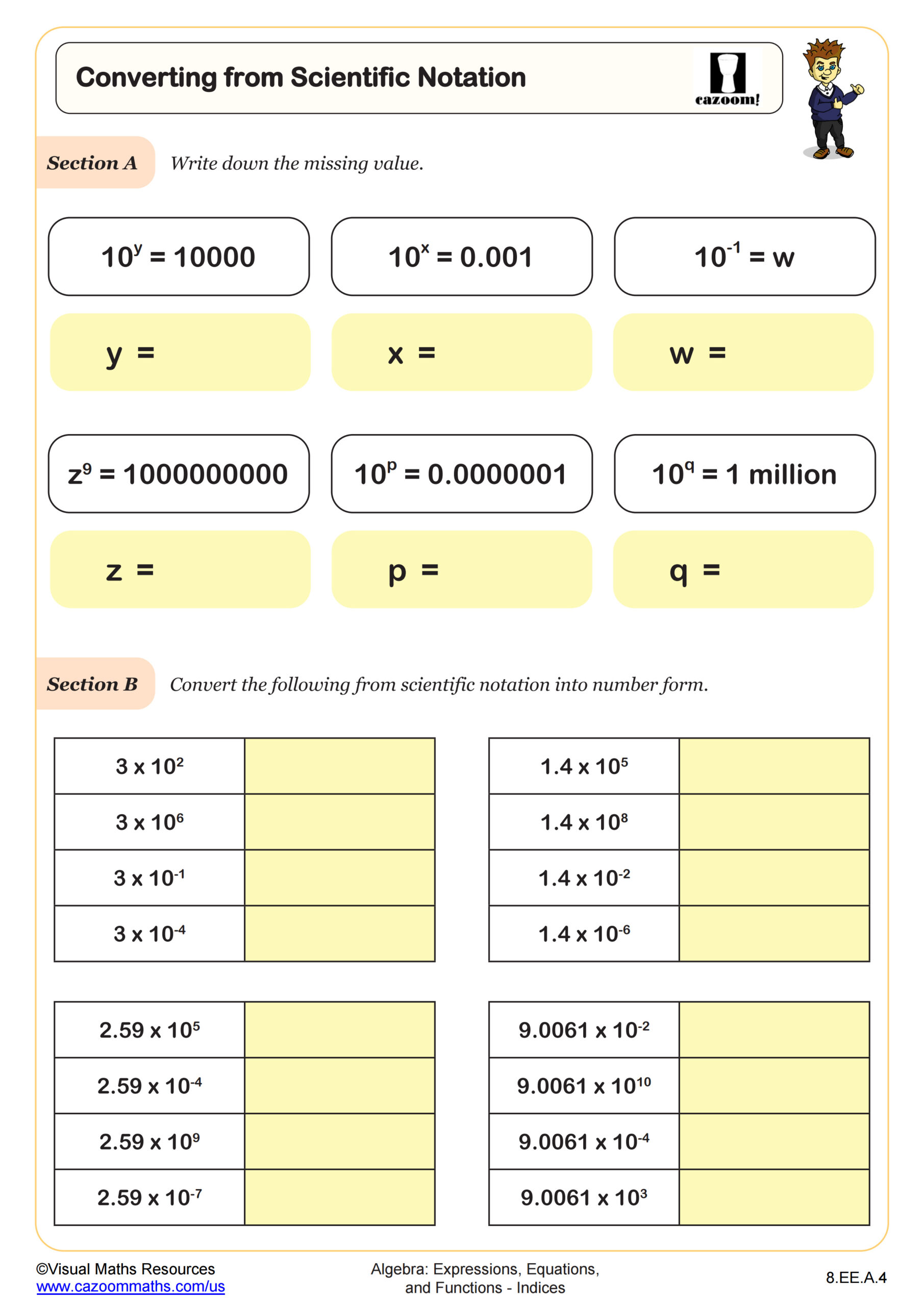
Converting from Scientific Notation
Grades: 8th Grade
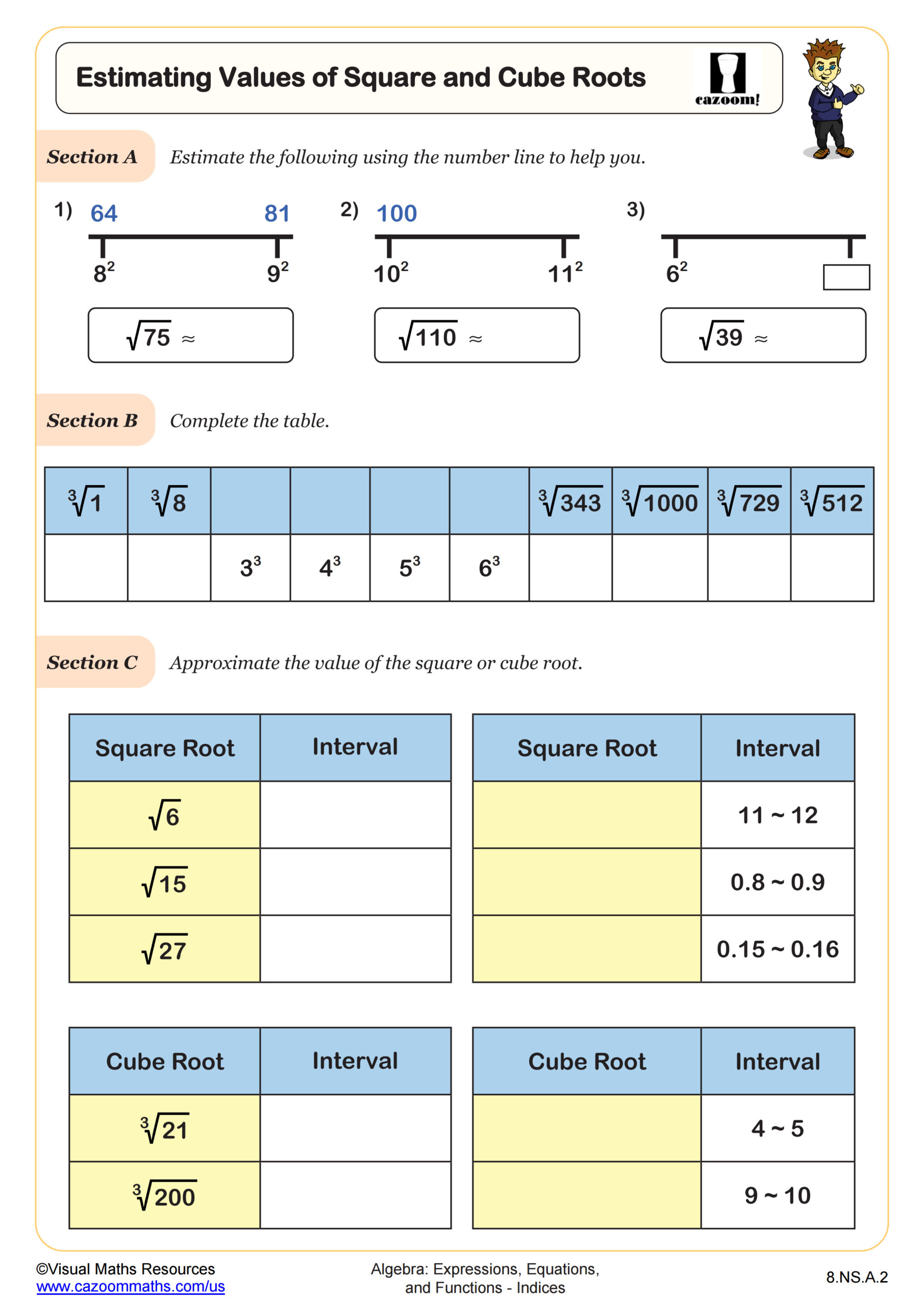
Estimating Values of Square and Cube Roots
Grades: 8th Grade
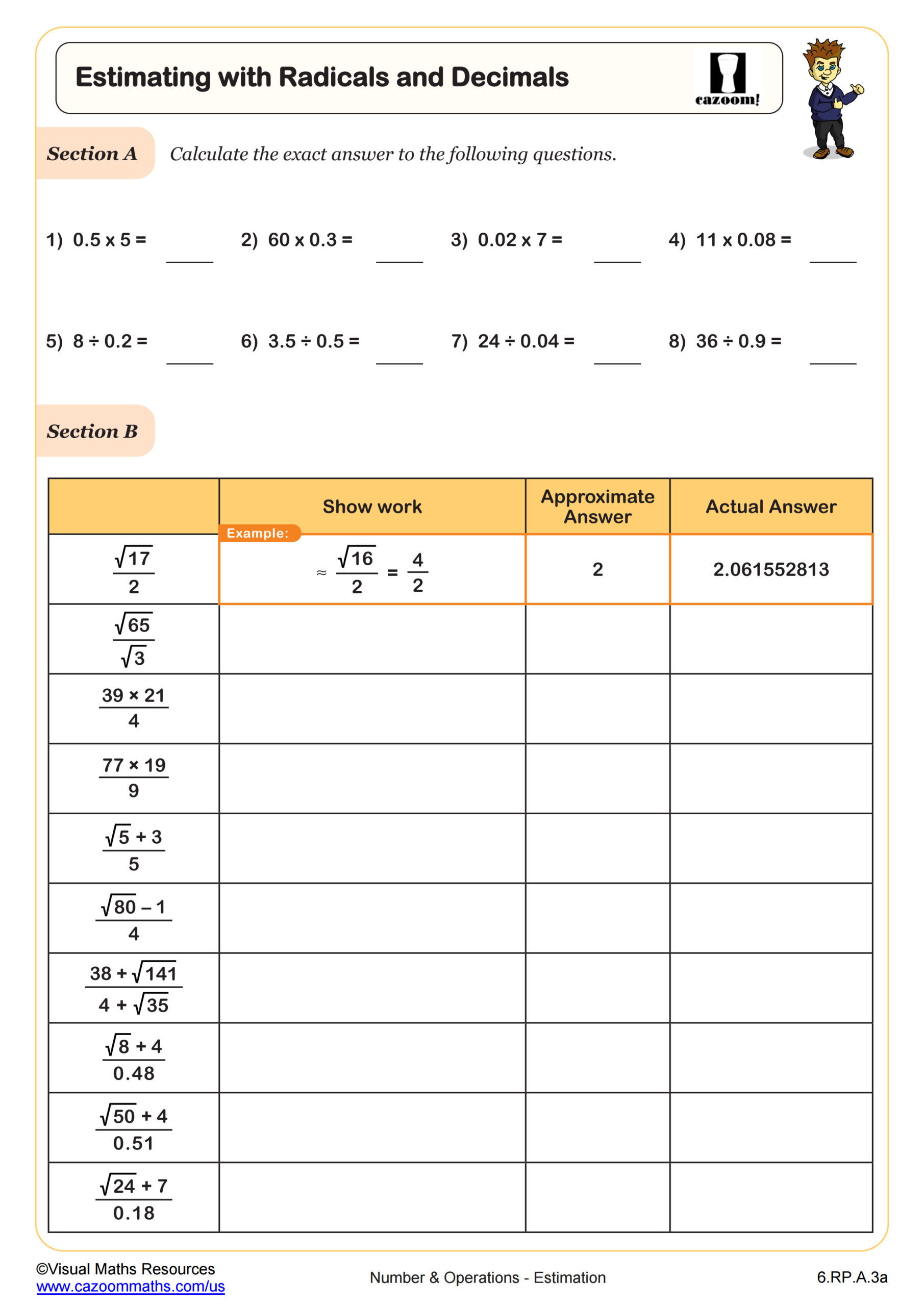
Estimating with Radicals and Decimals
Grades: 8th Grade
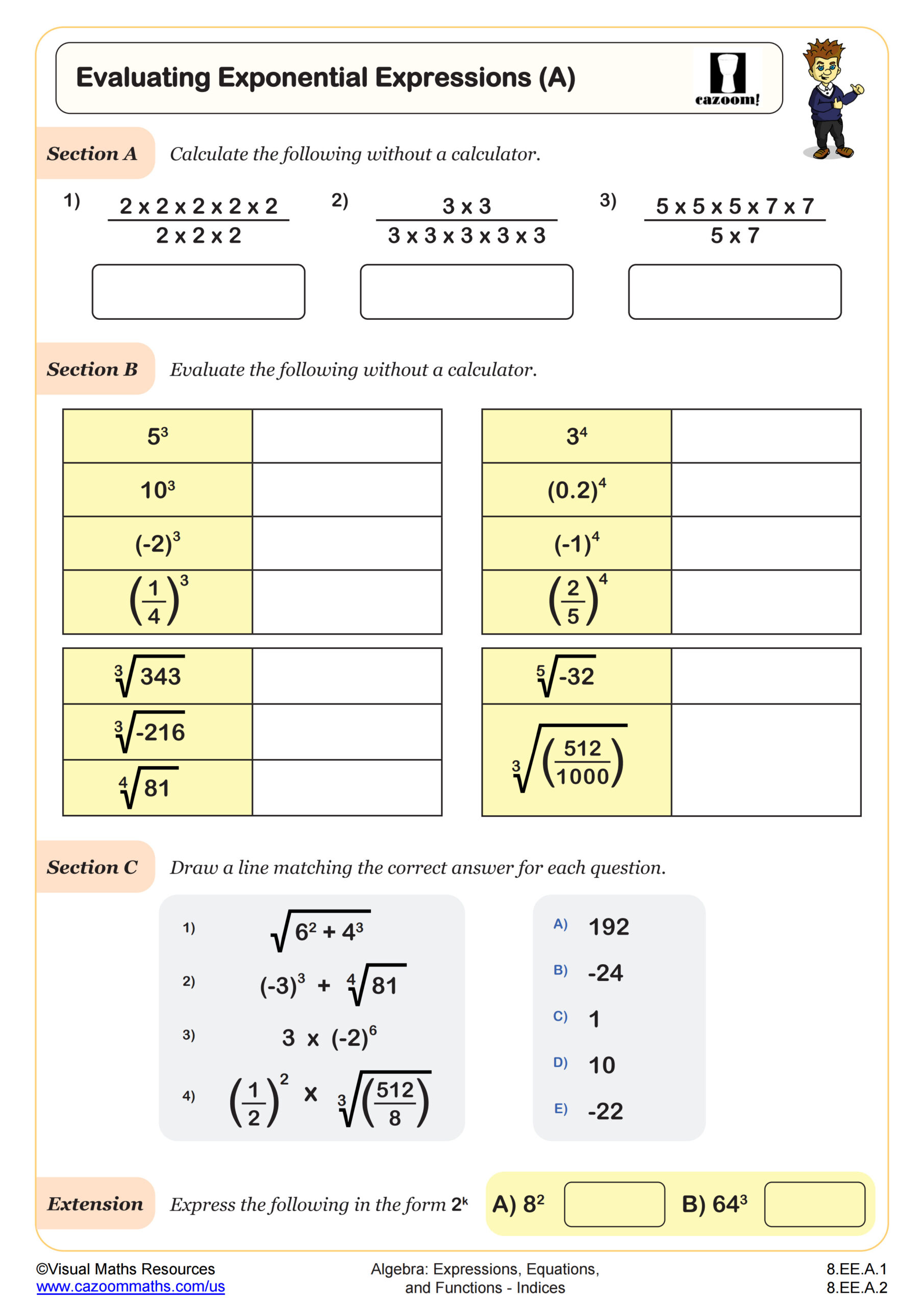
Evaluating Exponential Expressions (A)
Grades: 8th Grade
Evaluating Exponential Expressions (B)
Grades: 8th Grade
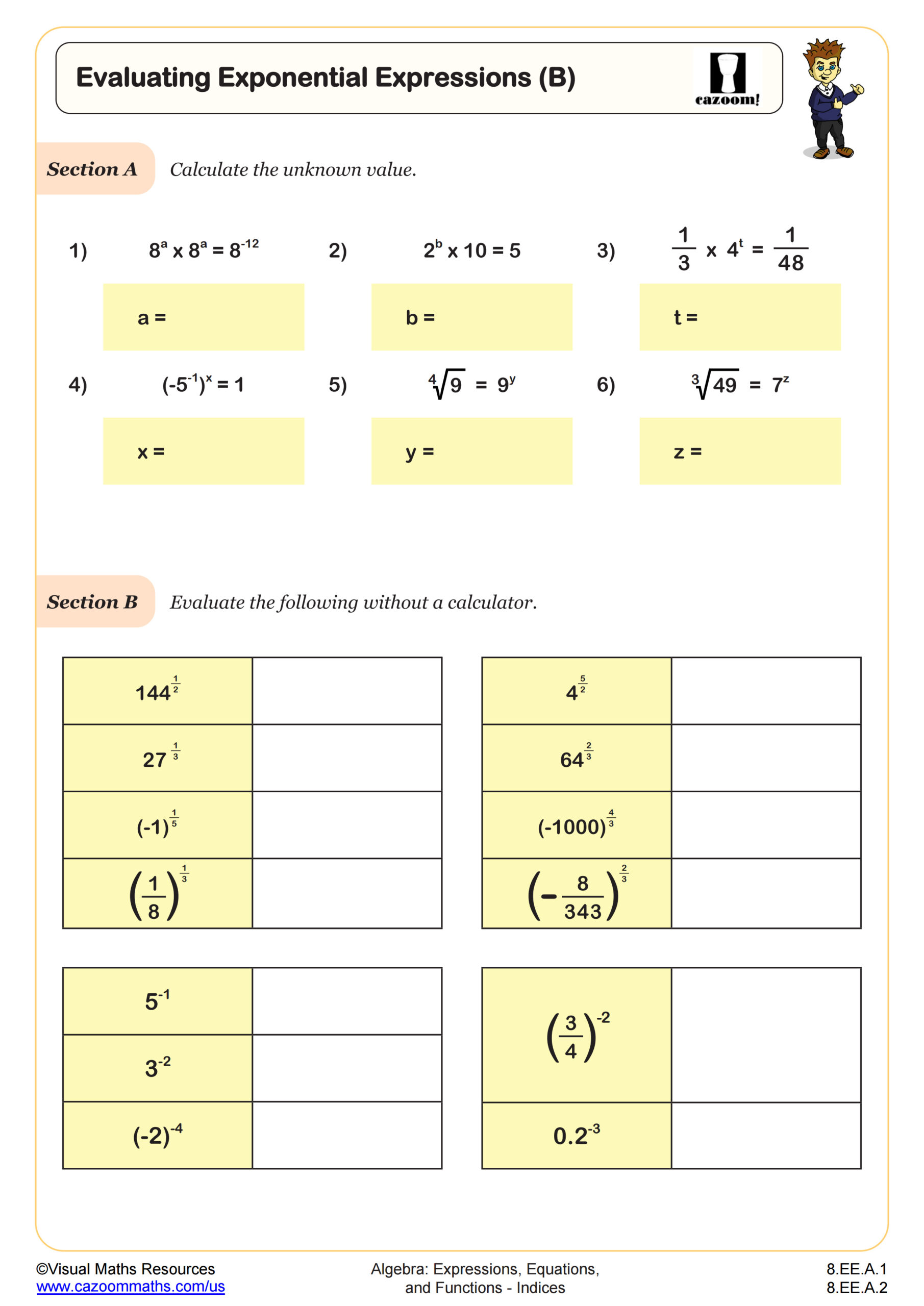
Finding Square and Nth Roots
Grades: 8th Grade, Algebra II
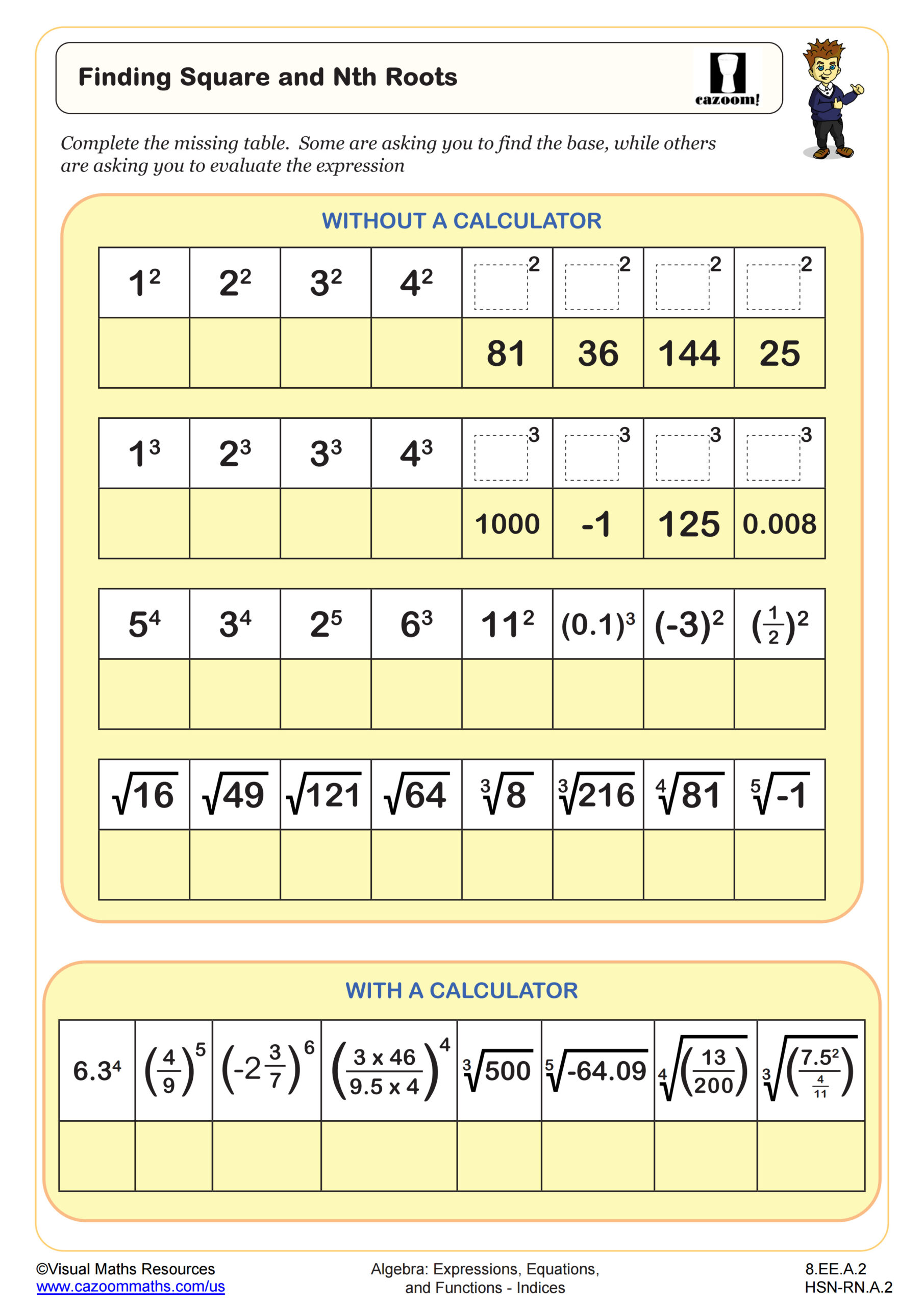
Fractional Indices
Grades: 8th Grade, IM 1
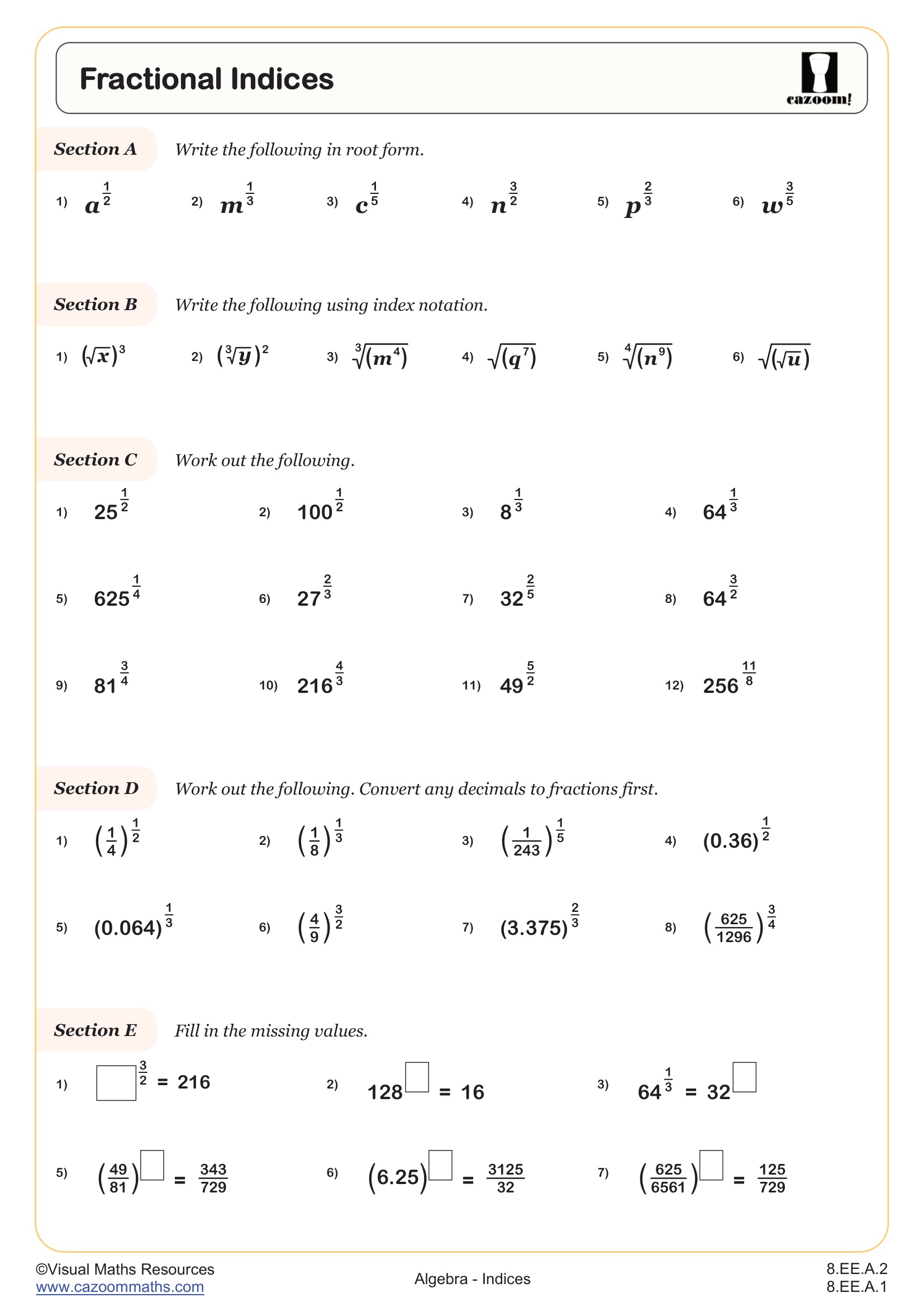
Indices - Changing the Base
Grades: 8th Grade, Algebra I, IM 1
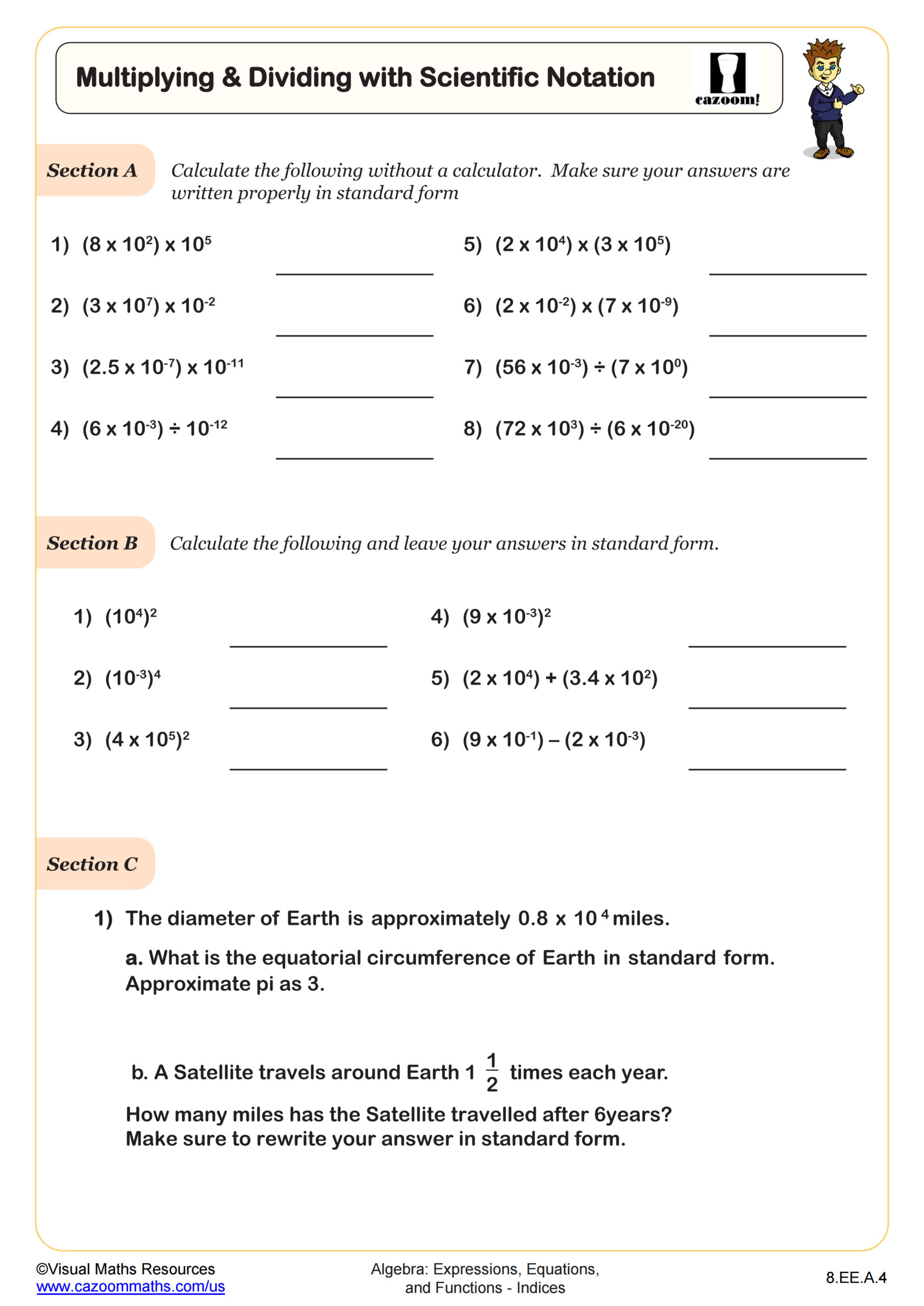
Multiplying and Dividing with Scientific Notation
Grades: 8th Grade
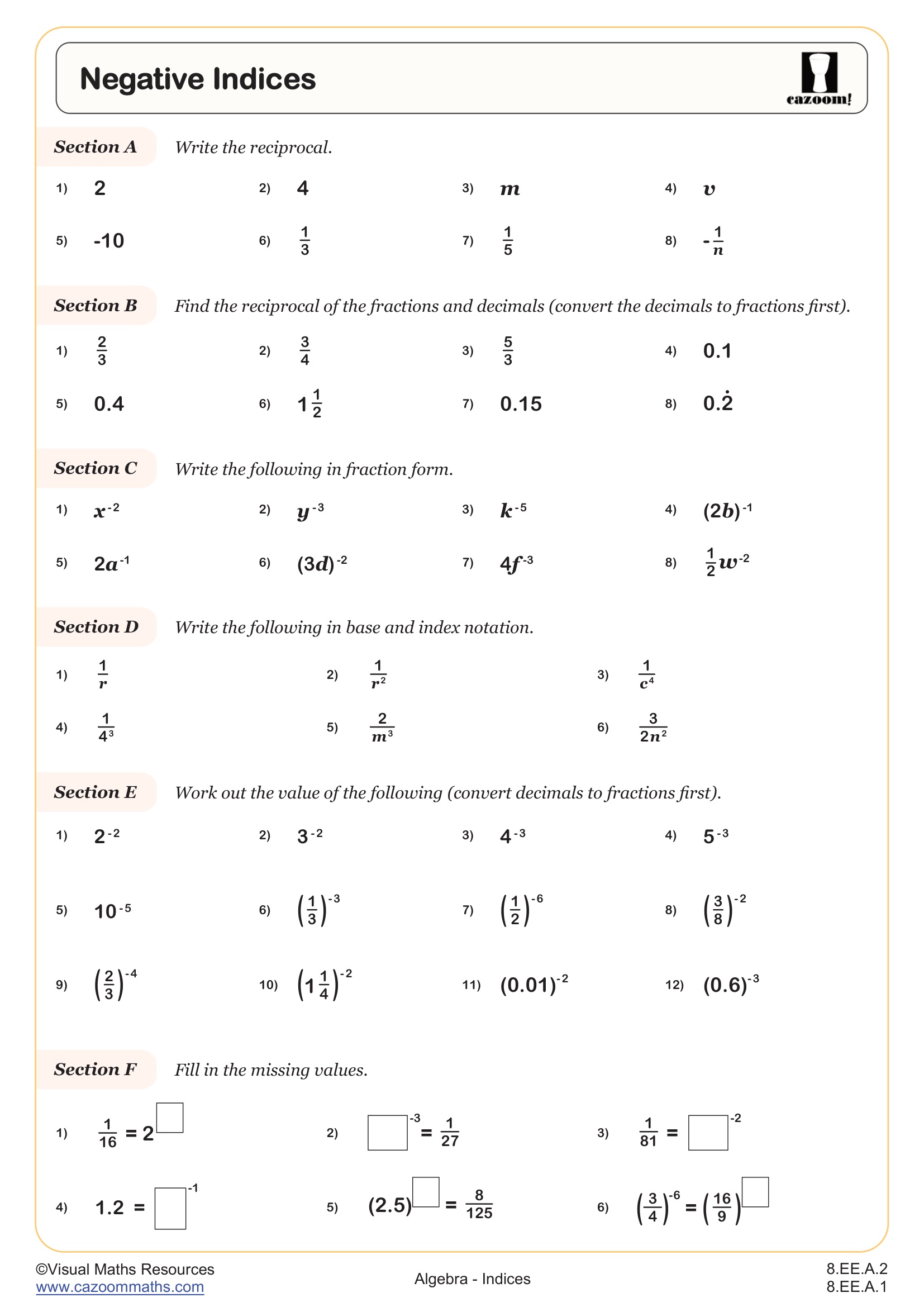
Negative Indices
Grades: 8th Grade, Algebra I, IM 1
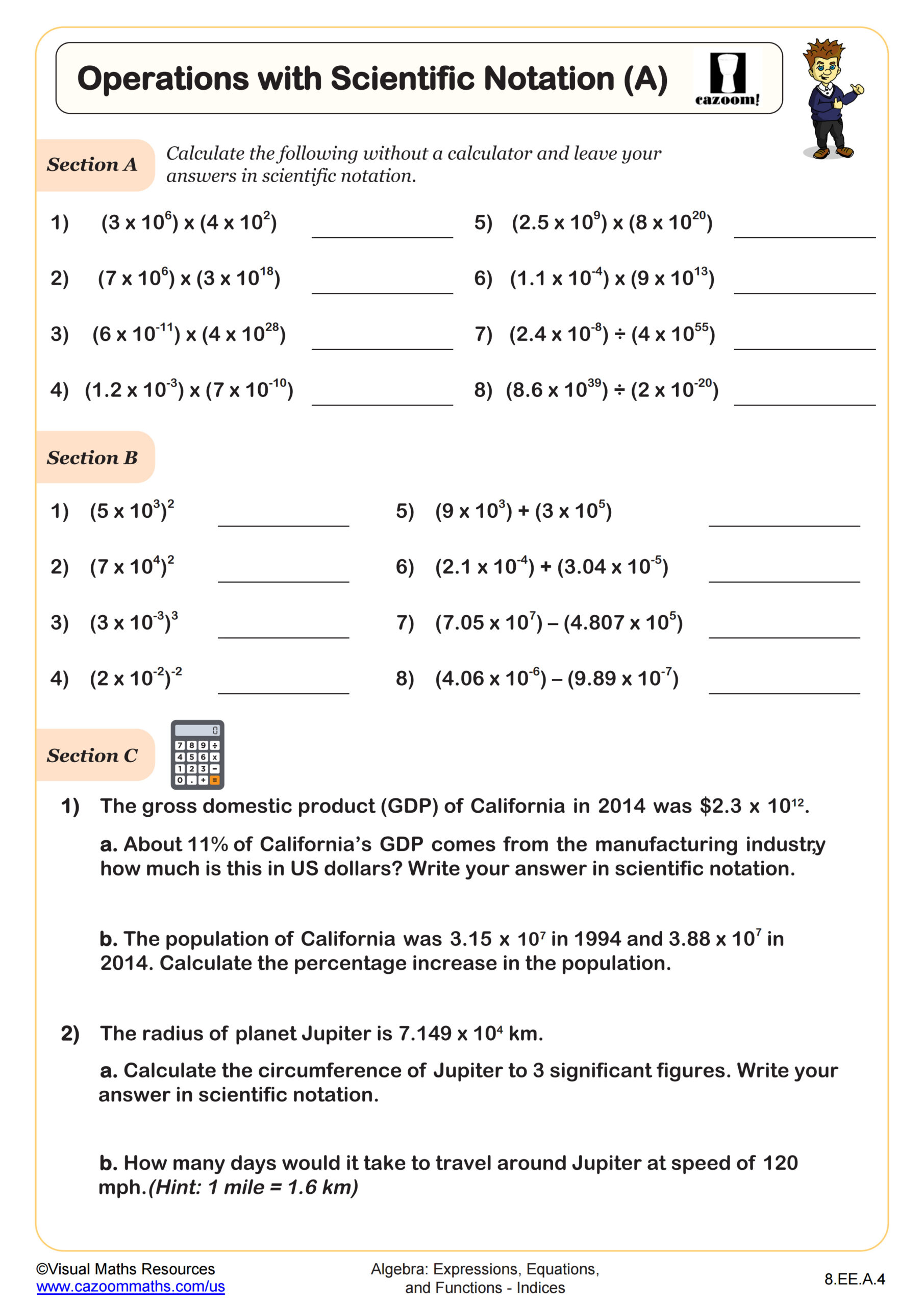
Operations with Scientific Notation (A)
Grades: 8th Grade
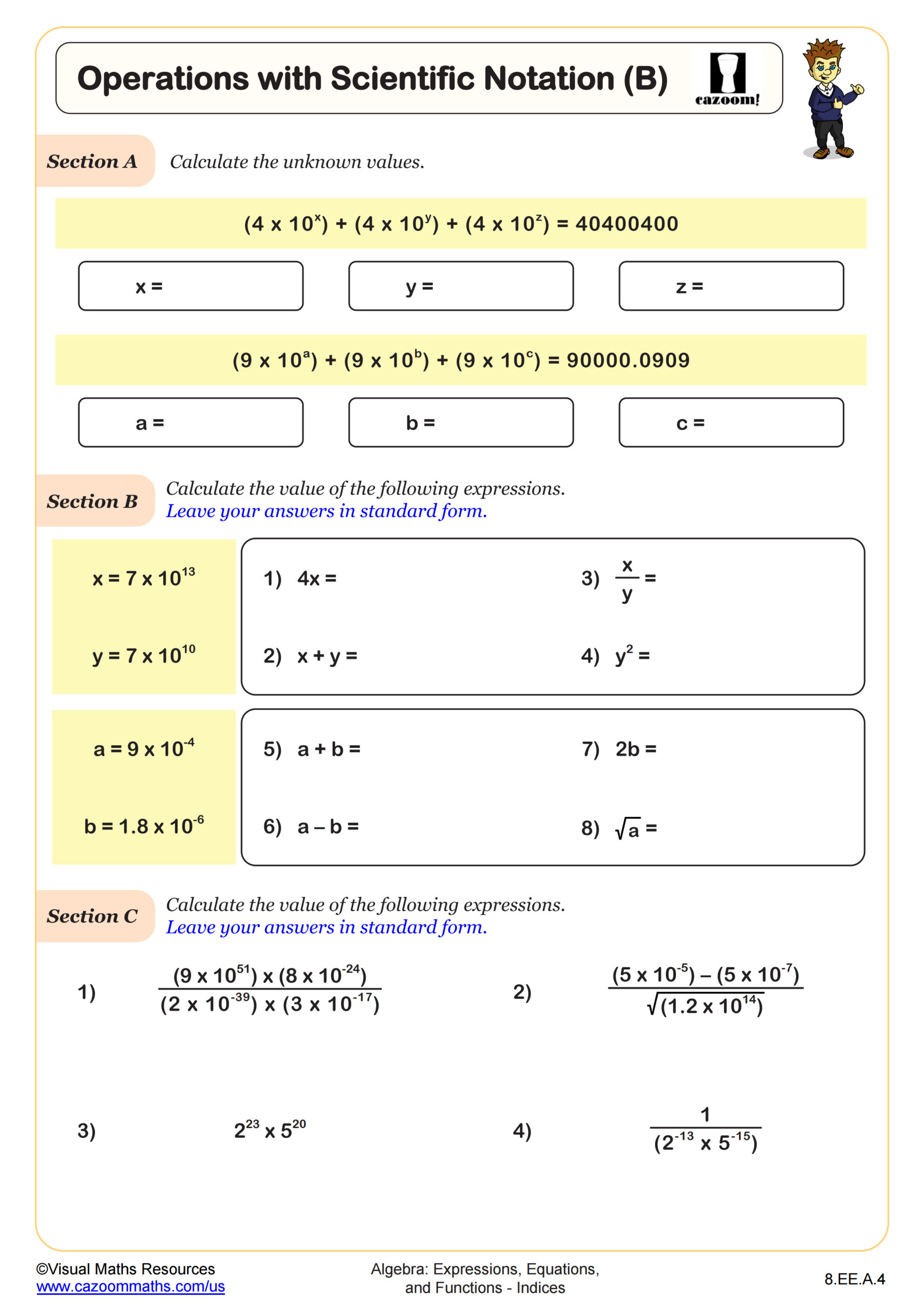
Operations with Scientific Notation (B)
Grades: 8th Grade
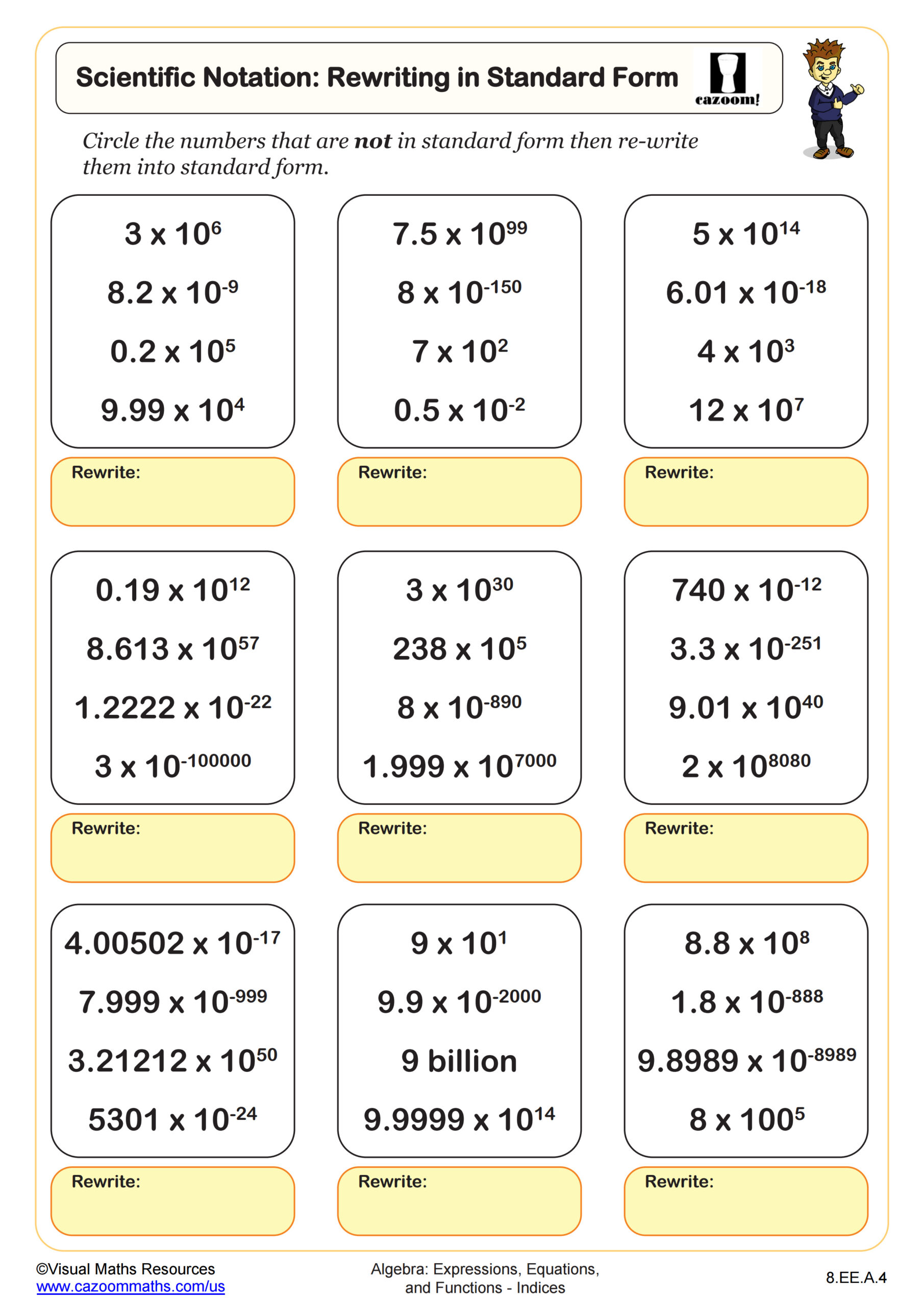
Operations with Scientific Notation Word Problems
Grades: 8th Grade
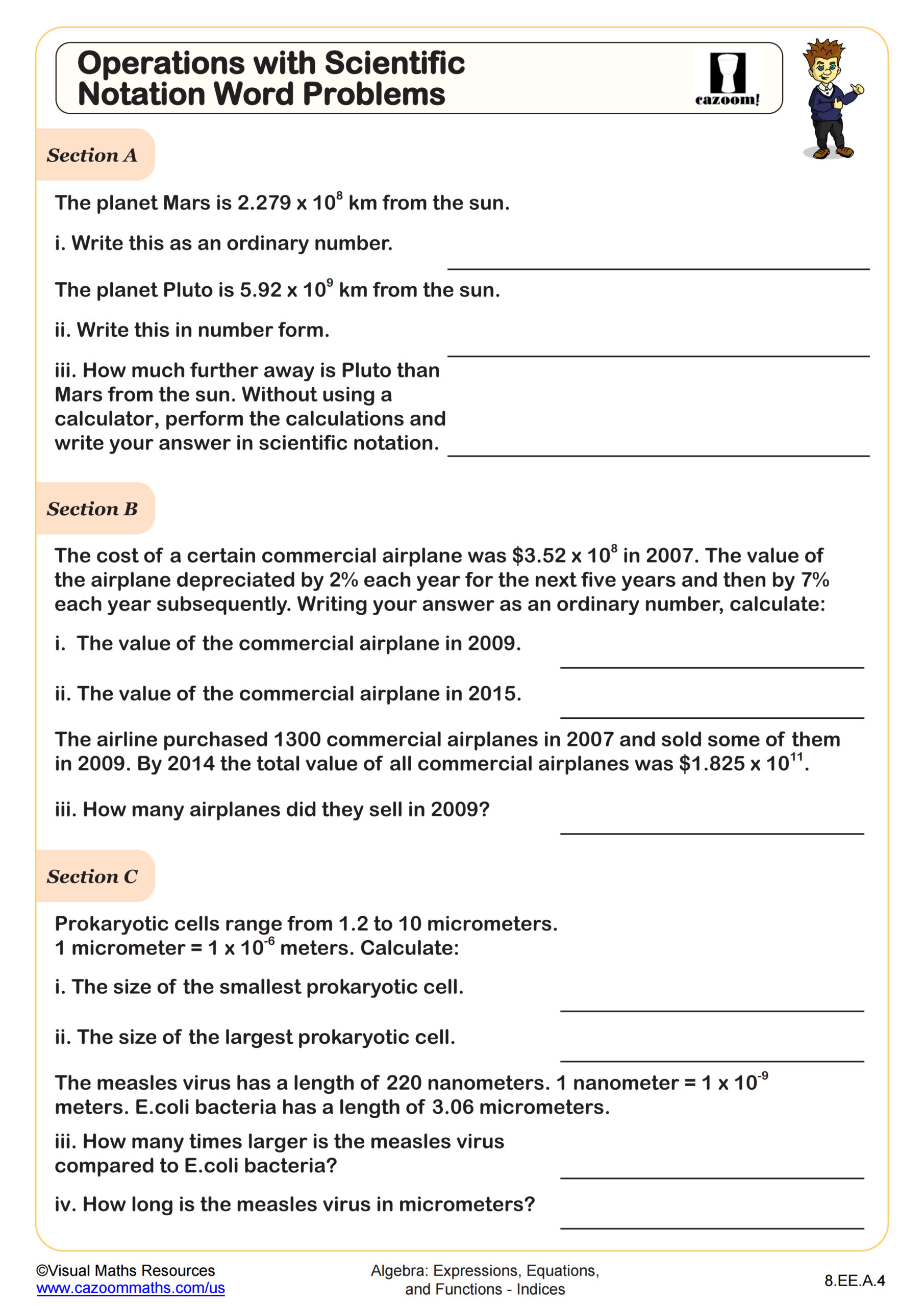
Representing Metric Units with Scientific Notation
Grades: 8th Grade
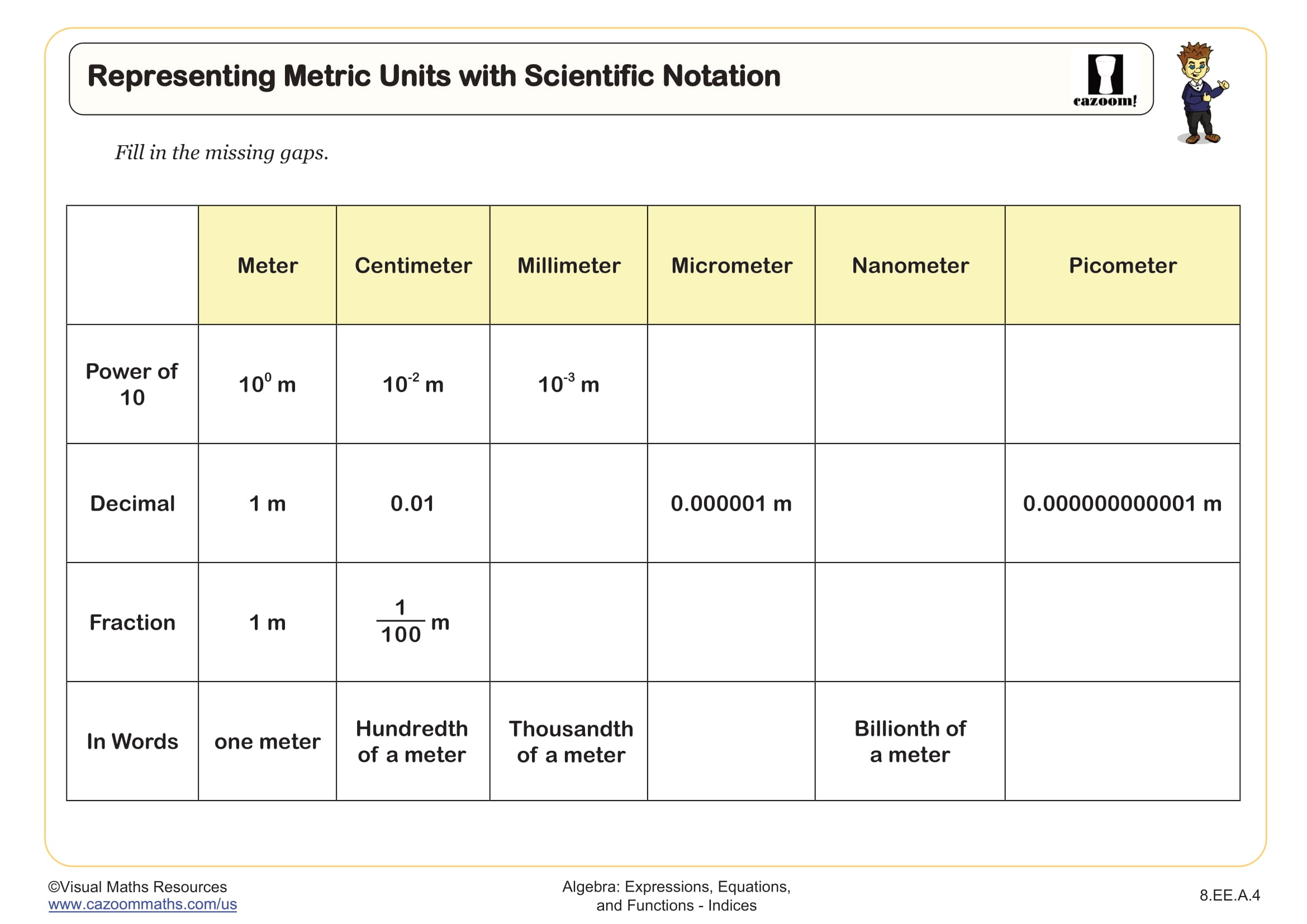
Scientific Notation Problem Solving
Grades: 8th Grade
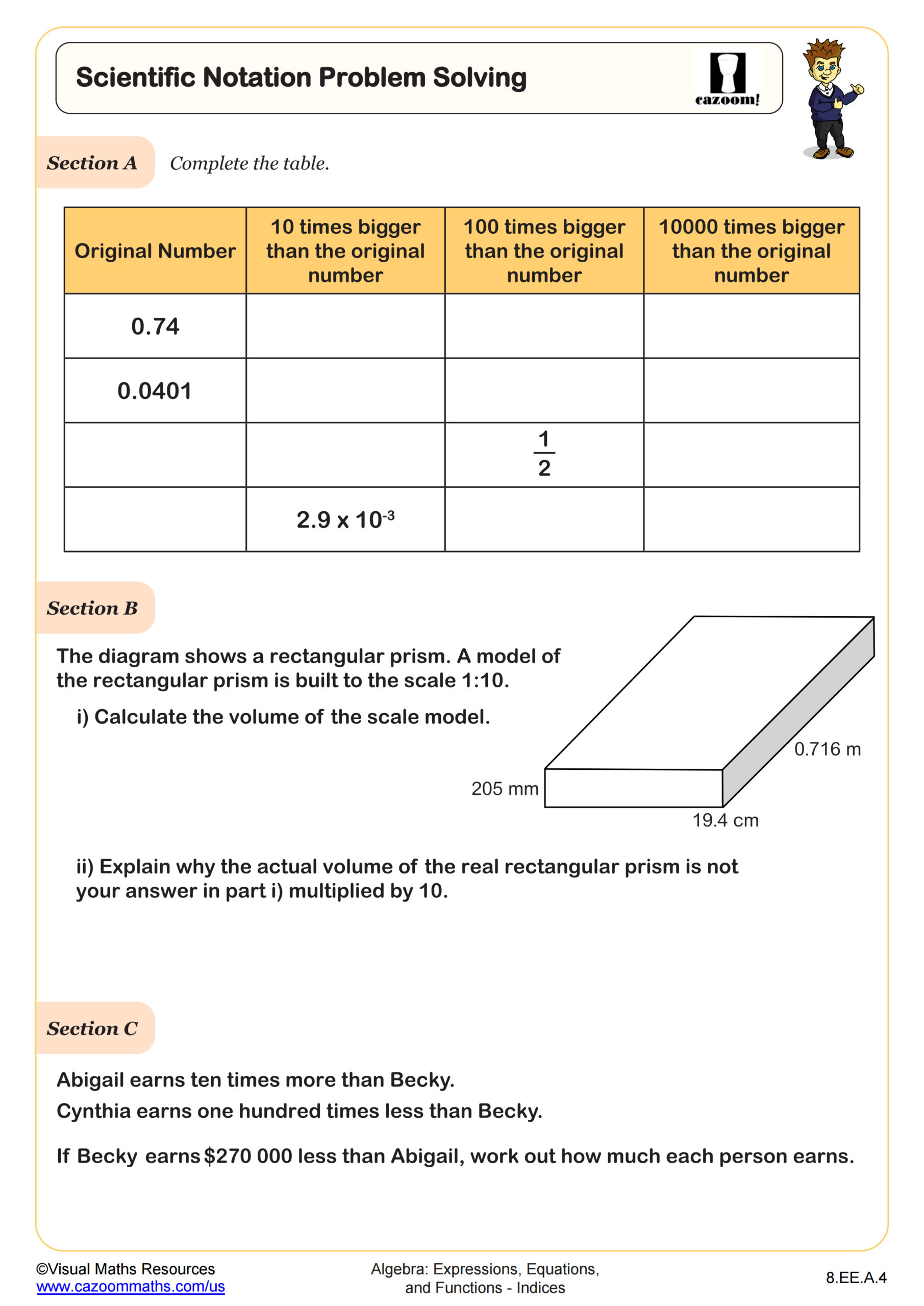
Scientific Notation: Rewriting in Standard Form
Grades: 8th Grade
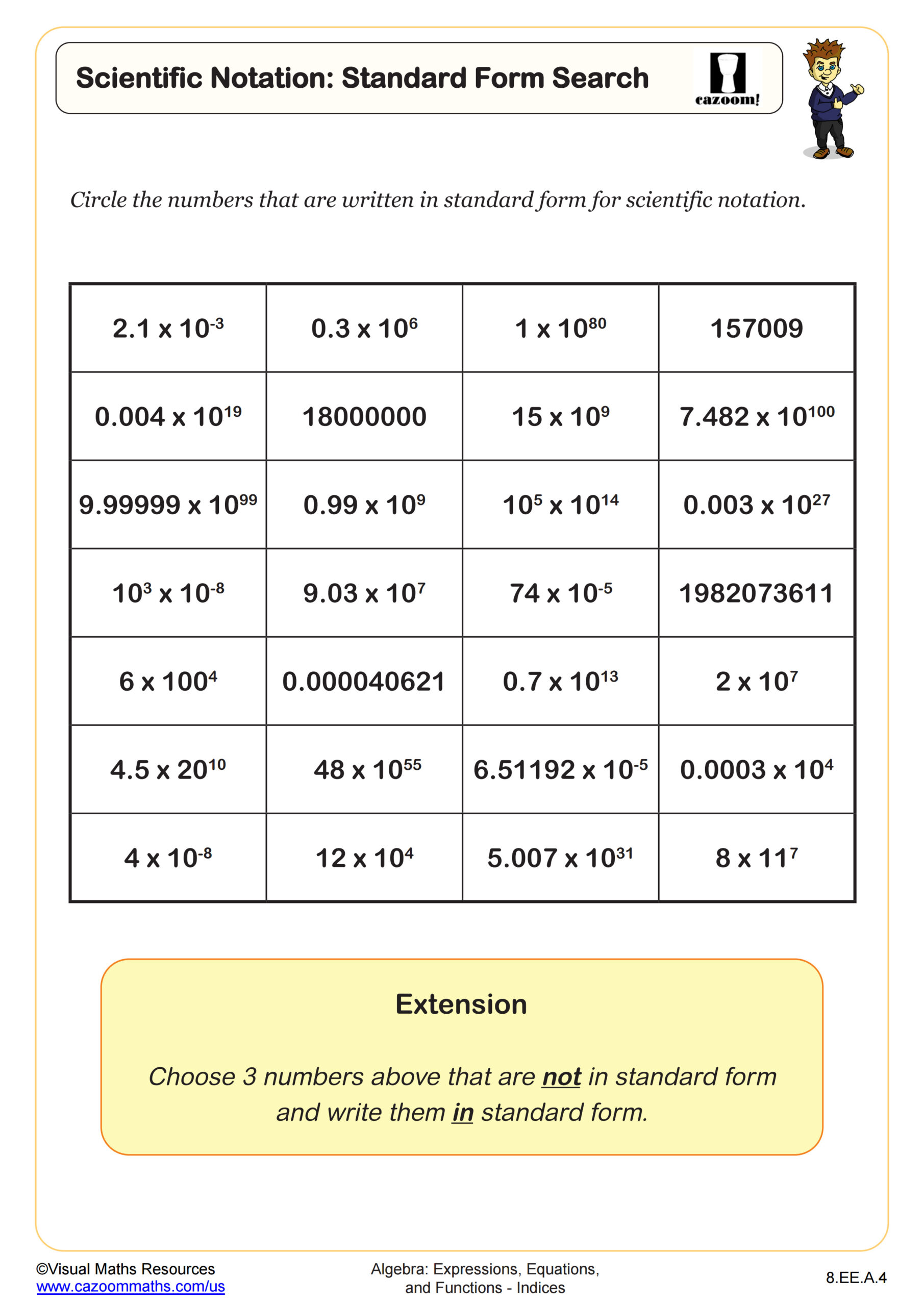
Scientific Notation: Standard Form Search
Grades: 8th Grade
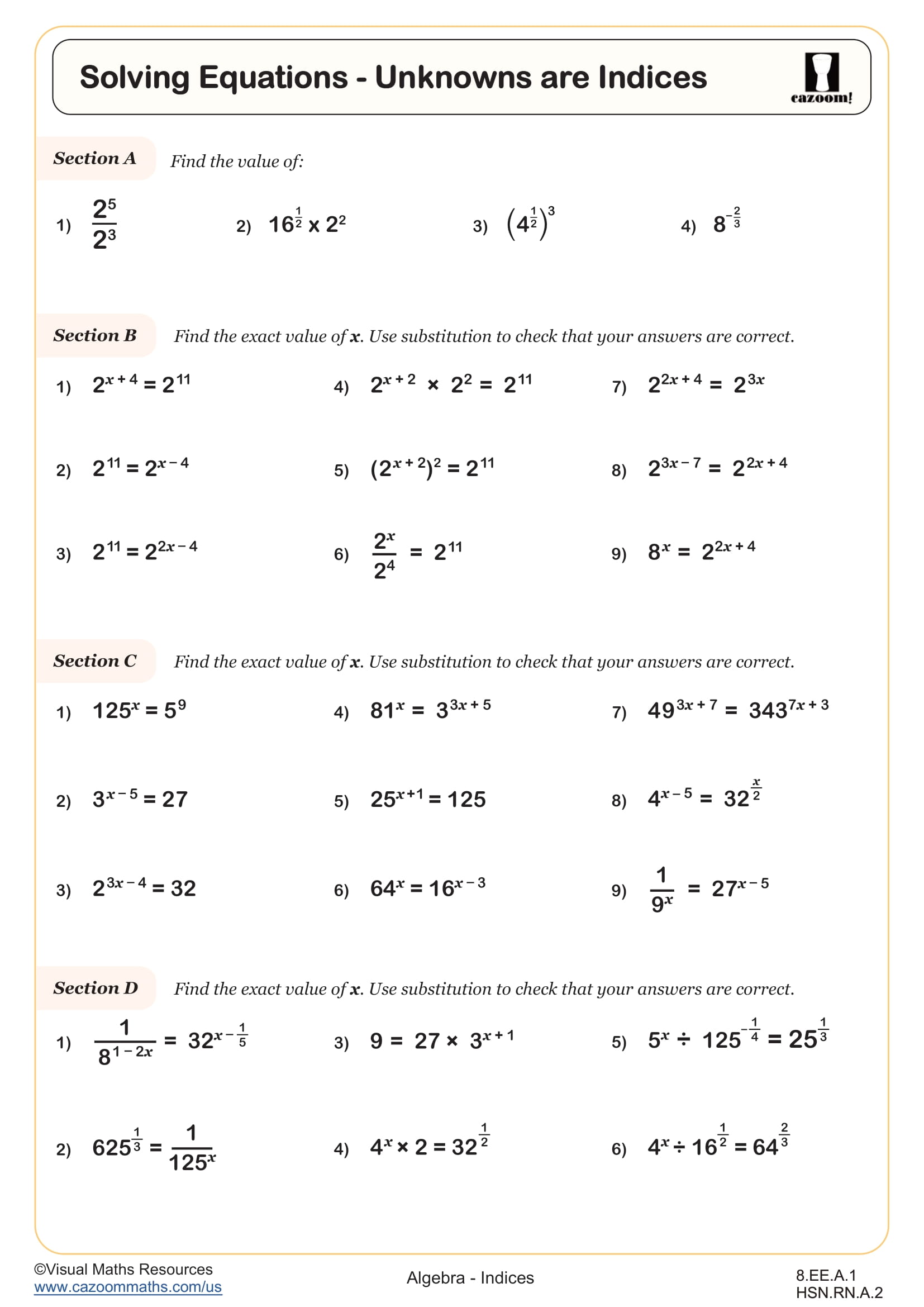
Solving Equations - Unknowns are Indices
Grades: 8th Grade, Algebra I, IM 1
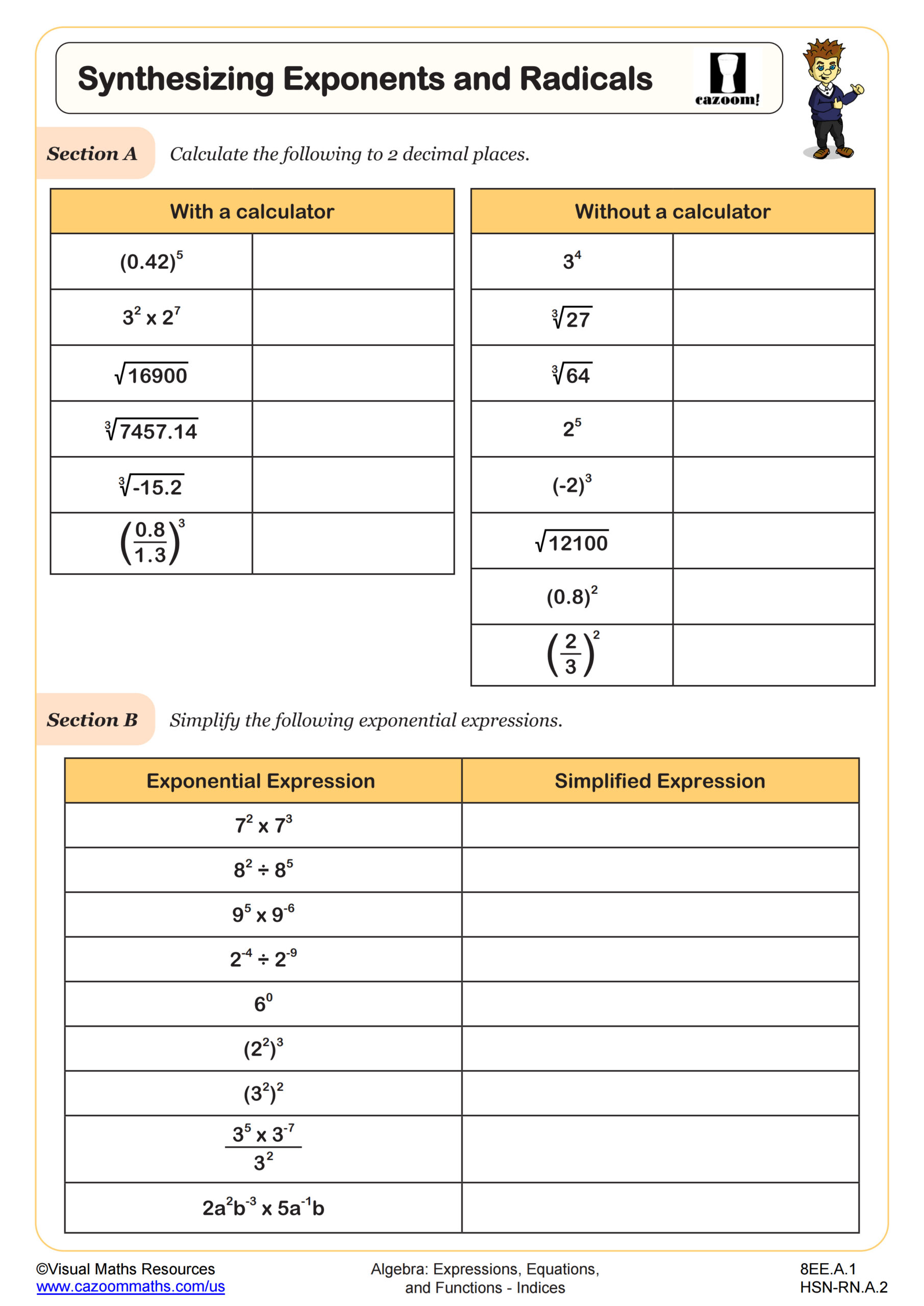
Synthesizing Exponents and Radicals
Grades: 8th Grade, Algebra I
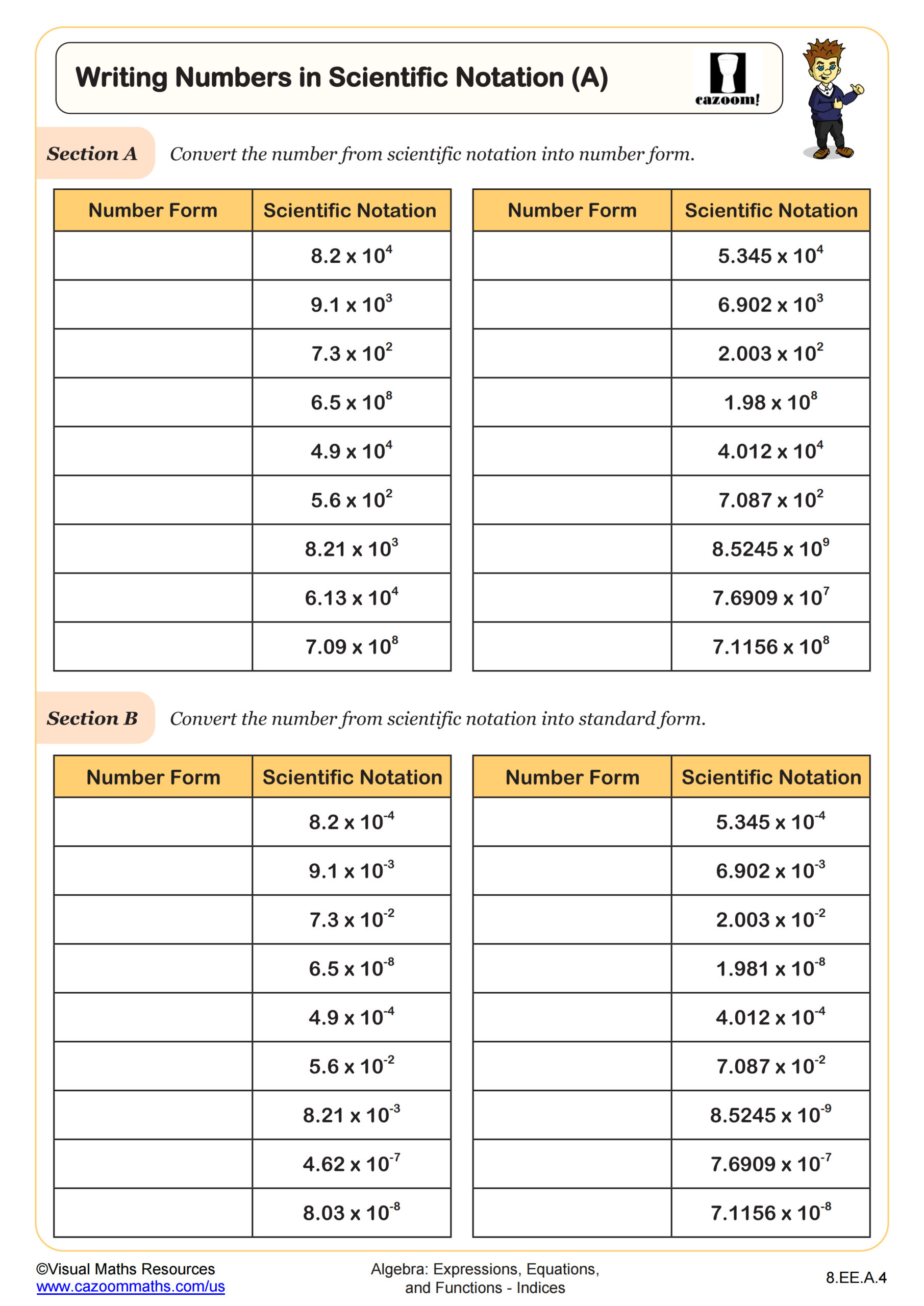
Writing Numbers in Scientific Notation (A)
Grades: 8th Grade
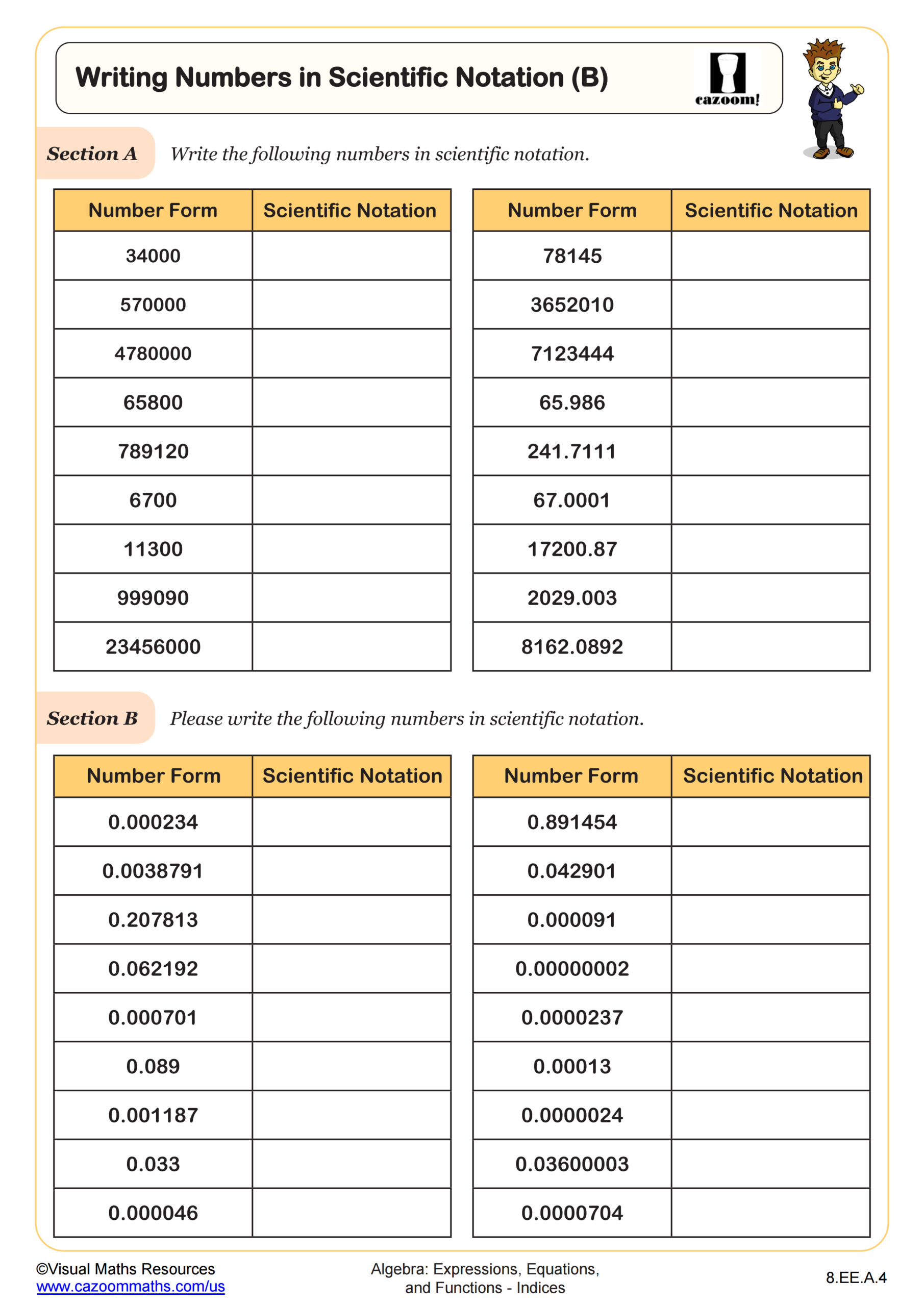
Writing Numbers in Scientific Notation (B)
Grades: 8th Grade
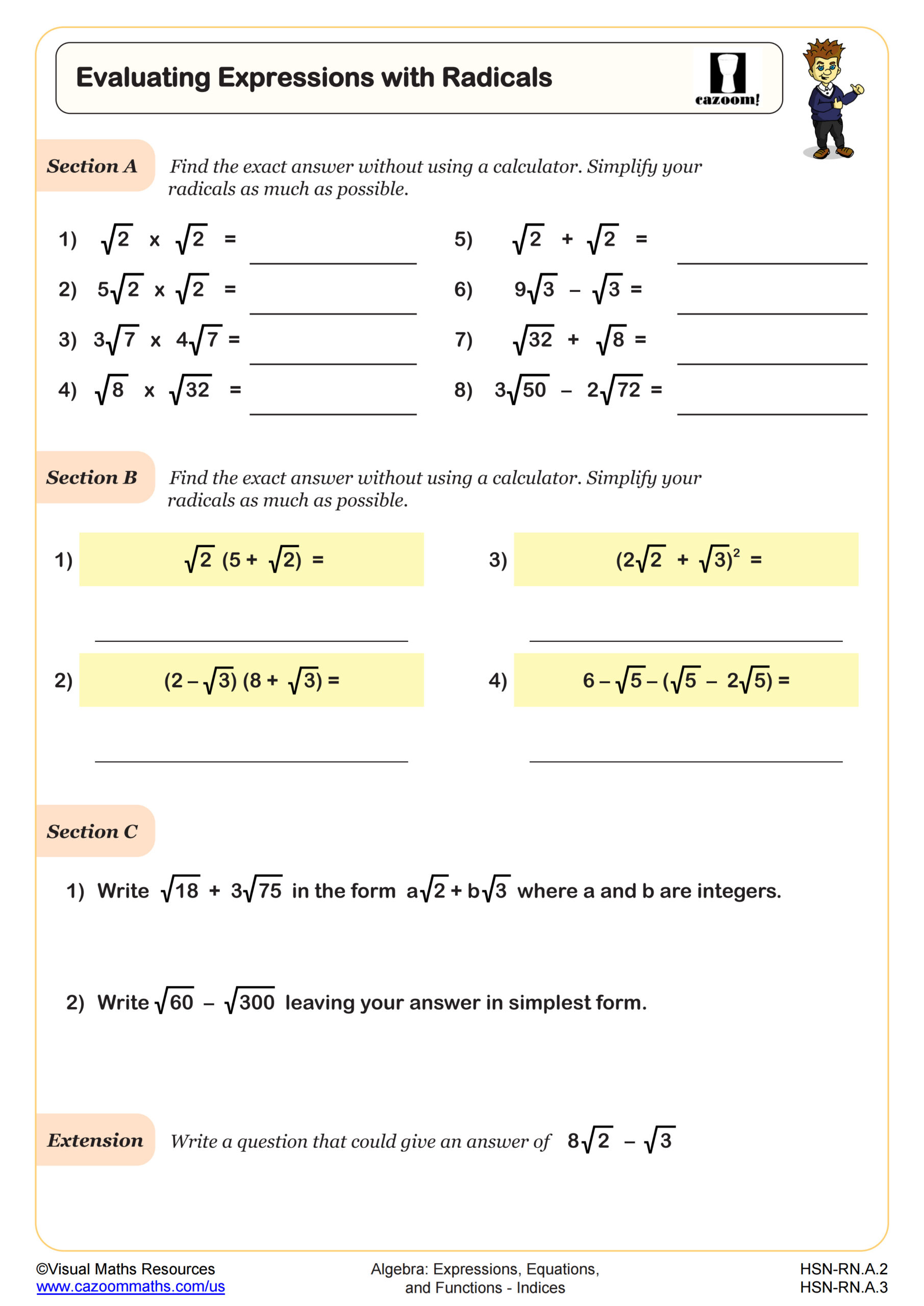
Evaluating Expressions with Radicals
Grades: Algebra I, IM 1
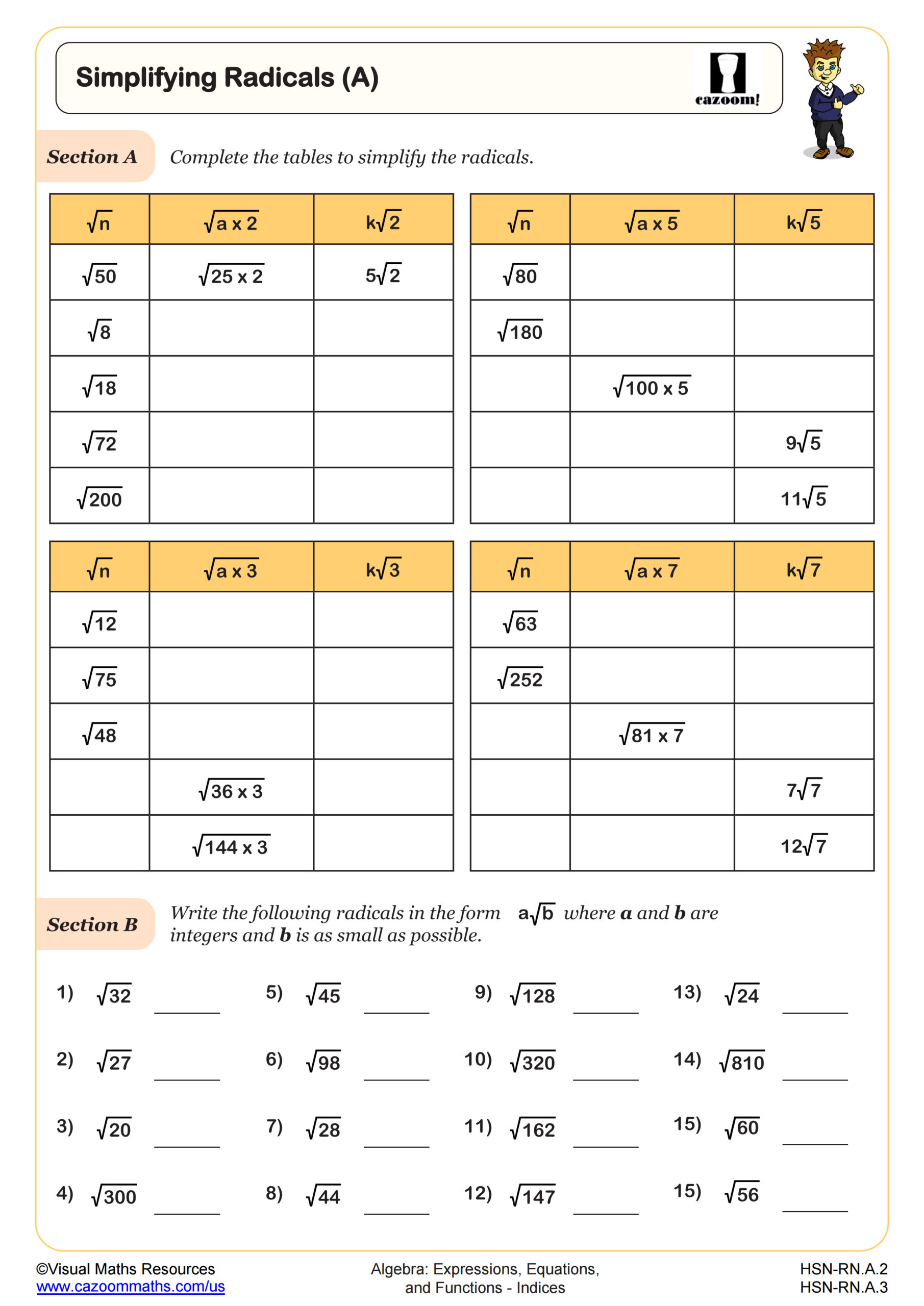
Simplifying Radicals (A)
Grades: Algebra I, IM 1
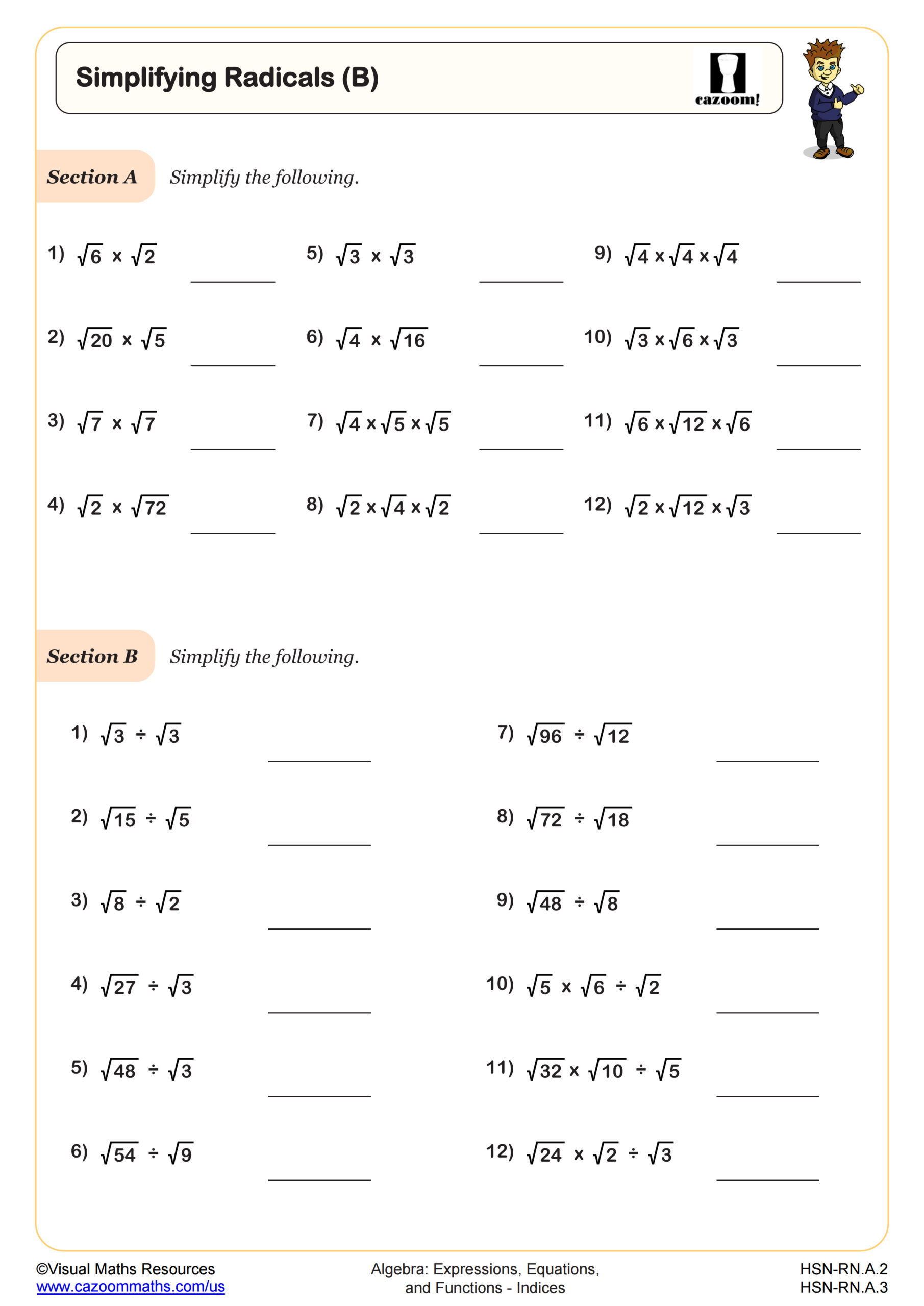
Simplifying Radicals (B)
Grades: Algebra I, IM 1
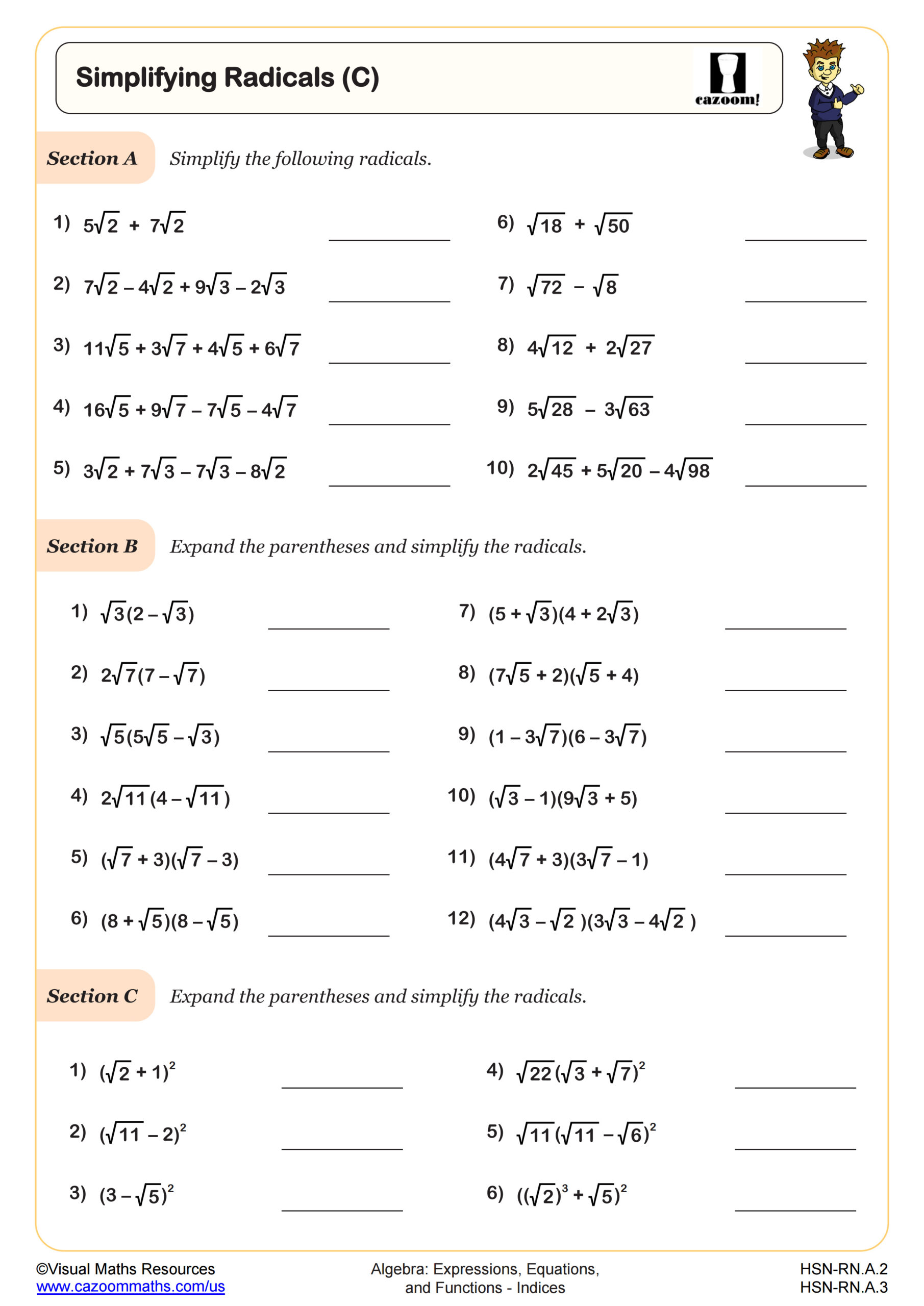
Simplifying Radicals (C)
Grades: Algebra I, IM 1
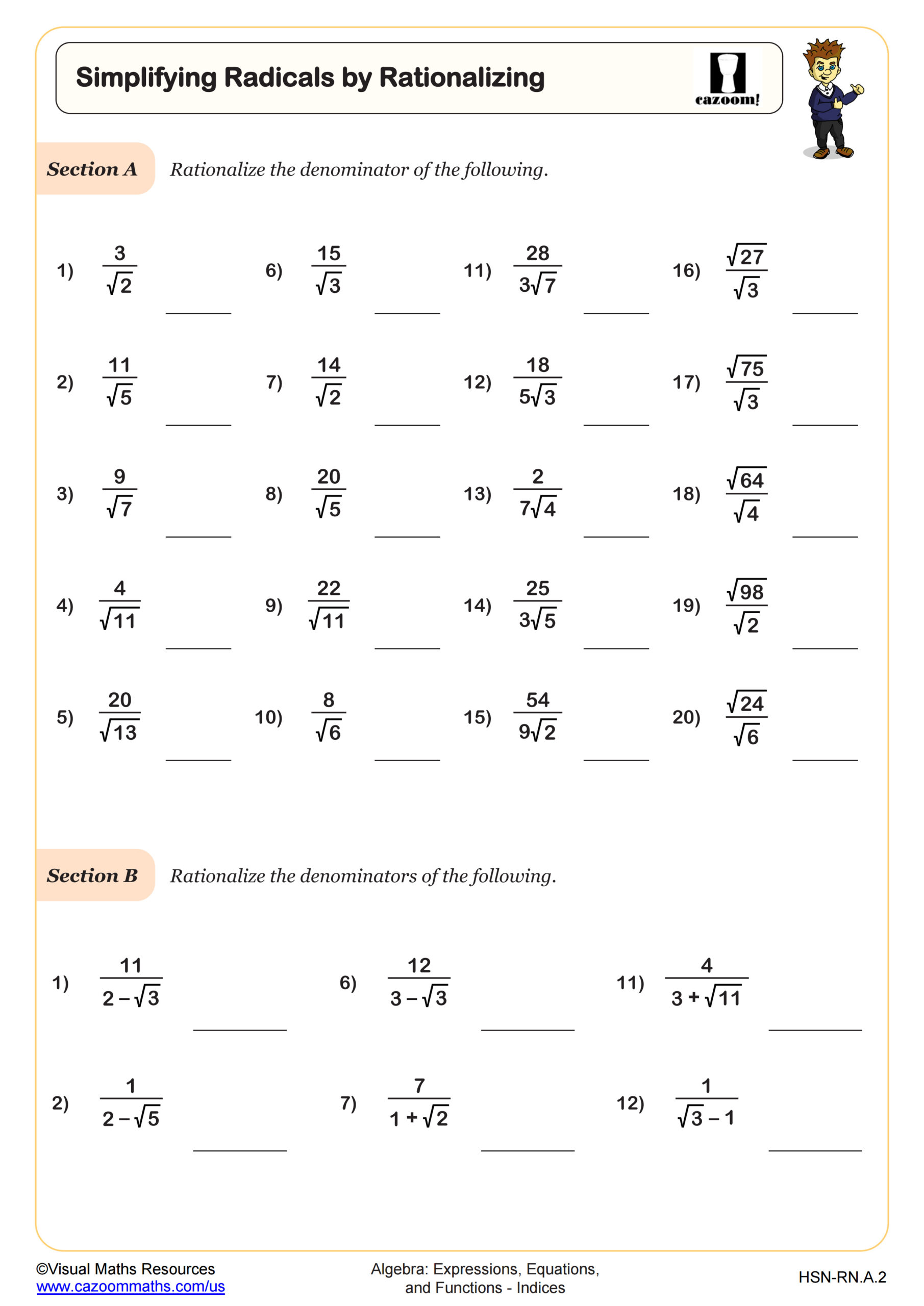
Simplifying Radicals by Rationalizing
Grades: Algebra I
All worksheets are created by the team of experienced teachers at Cazoom Math.
What makes an effective index notation worksheet for middle school students?
An effective index notation worksheet should progress systematically from basic positive exponents to more complex operations involving negative and fractional indices. The worksheets typically start with simple exercises like 2^3 or 5^4 before introducing index laws such as a^m × a^n = a^(m+n). Teachers find this scaffolded approach helps students understand the underlying patterns rather than memorizing isolated rules.
Successful indices worksheets include visual representations and real-world contexts, such as calculating compound interest or scientific notation problems involving cell division. Many teachers report that students benefit from worksheets that explicitly show the expanded form alongside the index form, helping them connect 2^5 with 2 × 2 × 2 × 2 × 2 before moving to abstract index manipulations.
Which grade levels typically cover indices worksheet content?
Indices worksheet grade 7 materials typically introduce basic positive exponents and simple multiplication rules, while indices worksheet grade 8 content expands to include negative exponents, zero exponents, and more complex index laws. Most state standards align with Common Core expectations, where students encounter exponents in Grade 6 as repeated multiplication and develop fluency with index notation through Grade 8. Teachers often use worksheet on indices for grade 7 as reinforcement after introducing the concept through hands-on activities.
High school algebra courses revisit indices with rational exponents and logarithmic relationships, building on the middle school foundation. Teachers notice that students who master basic index notation in grades 7-8 show significantly better performance in later topics like exponential functions, scientific notation, and polynomial operations that appear throughout high school mathematics and STEM applications.
How do students typically struggle with negative indices on worksheets?
Students consistently make the same error when first encountering negative indices, treating 4^-3 as -64 instead of recognizing it equals 1/64 or 1/4^3. Teachers observe this misconception stems from students' familiarity with negative numbers rather than understanding negative exponents as reciprocal operations. Effective worksheets address this by including problems that explicitly show the conversion process from negative index form to fraction form.
Many teachers find success using worksheets that pair positive and negative versions of the same base and exponent, such as showing 2^3 = 8 alongside 2^-3 = 1/8. This visual comparison helps students recognize the reciprocal relationship. Worksheets that include real-world applications, like calculating depreciation rates or bacterial decay, provide meaningful contexts where negative exponents naturally appear in scientific and financial calculations.
How can teachers maximize learning outcomes with indices worksheets?
Teachers report the best results when they use indices worksheets as guided practice immediately after demonstrating each index law, rather than assigning them as independent homework. The answer keys prove invaluable for quick formative assessment, allowing teachers to identify which specific index rules need reteaching. Many educators recommend having students work through the first few problems collaboratively before continuing independently, ensuring they understand the underlying reasoning rather than just applying memorized procedures.
Successful implementation involves connecting worksheet problems to calculator usage, where students can verify their index calculations using the exponent key. Teachers often incorporate error analysis activities using the answer keys, where students identify and correct common mistakes found in sample student work, reinforcing proper understanding of index notation rules and their applications in algebra.
Real-Life Uses of Indices
Exponents are used in everyday life more often than you may think. Students may encounter them in population growth models, financial calculations, physics formulas, and computer algorithms. Knowing how to work with indices helps them solve real-world problems more effectively and understand concepts that go beyond the classroom.
What Should Students Know Before Starting Indices?
Before working with indices, students need to master some basic learning. For Example–
• They must be confident in multiplication and division
• Your students should understand the concept of repeated multiplication
• Your students should be familiar with algebraic variables and expressions
• They should know how to simplify and evaluate simple equations
These basic math skills provide a strong foundation for understanding exponent rules. Our worksheets build on this knowledge and introduce each concept step by step.