Linear Functions Worksheet
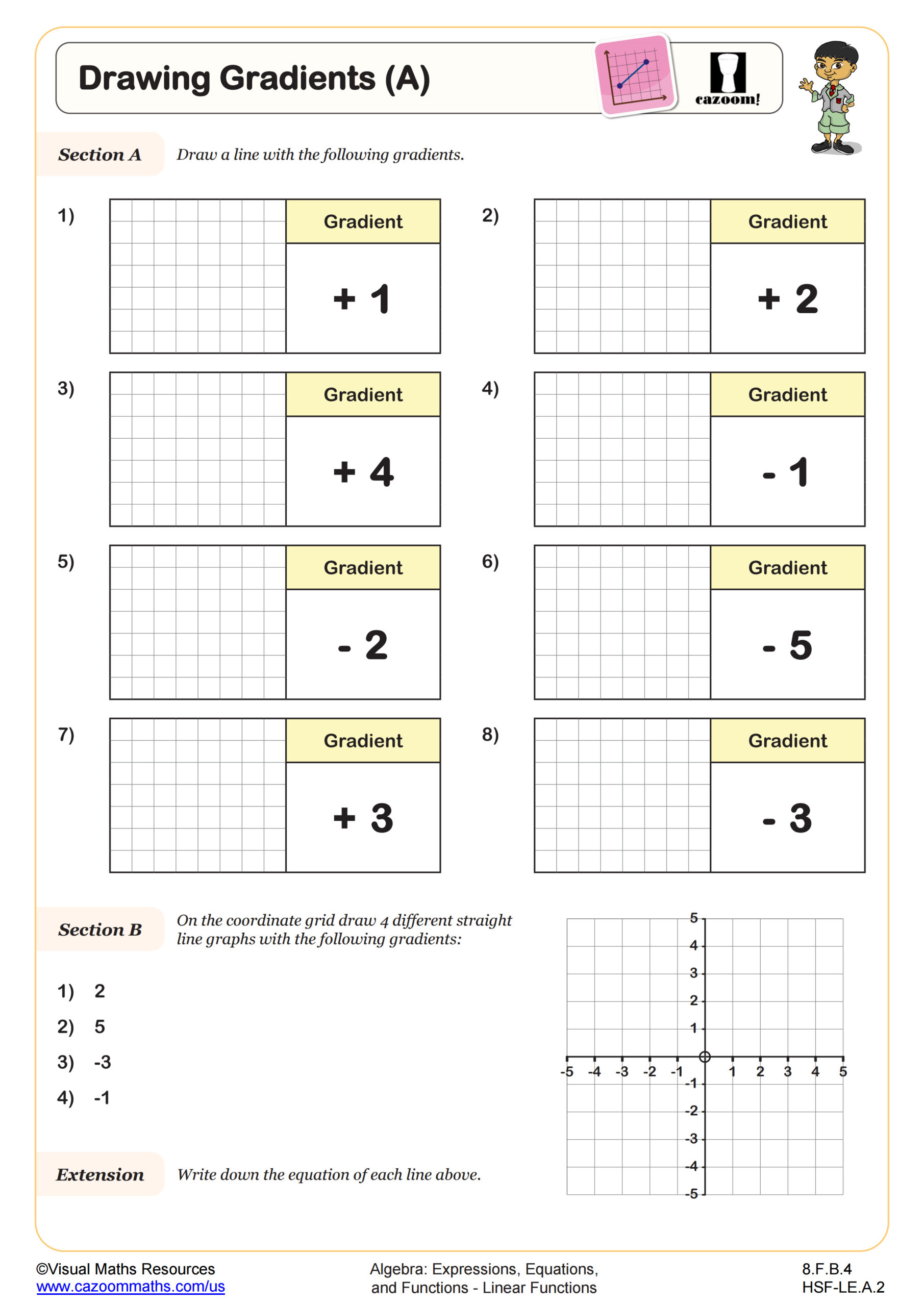
Drawing Gradients (A)
Grades: 8th Grade, Algebra I
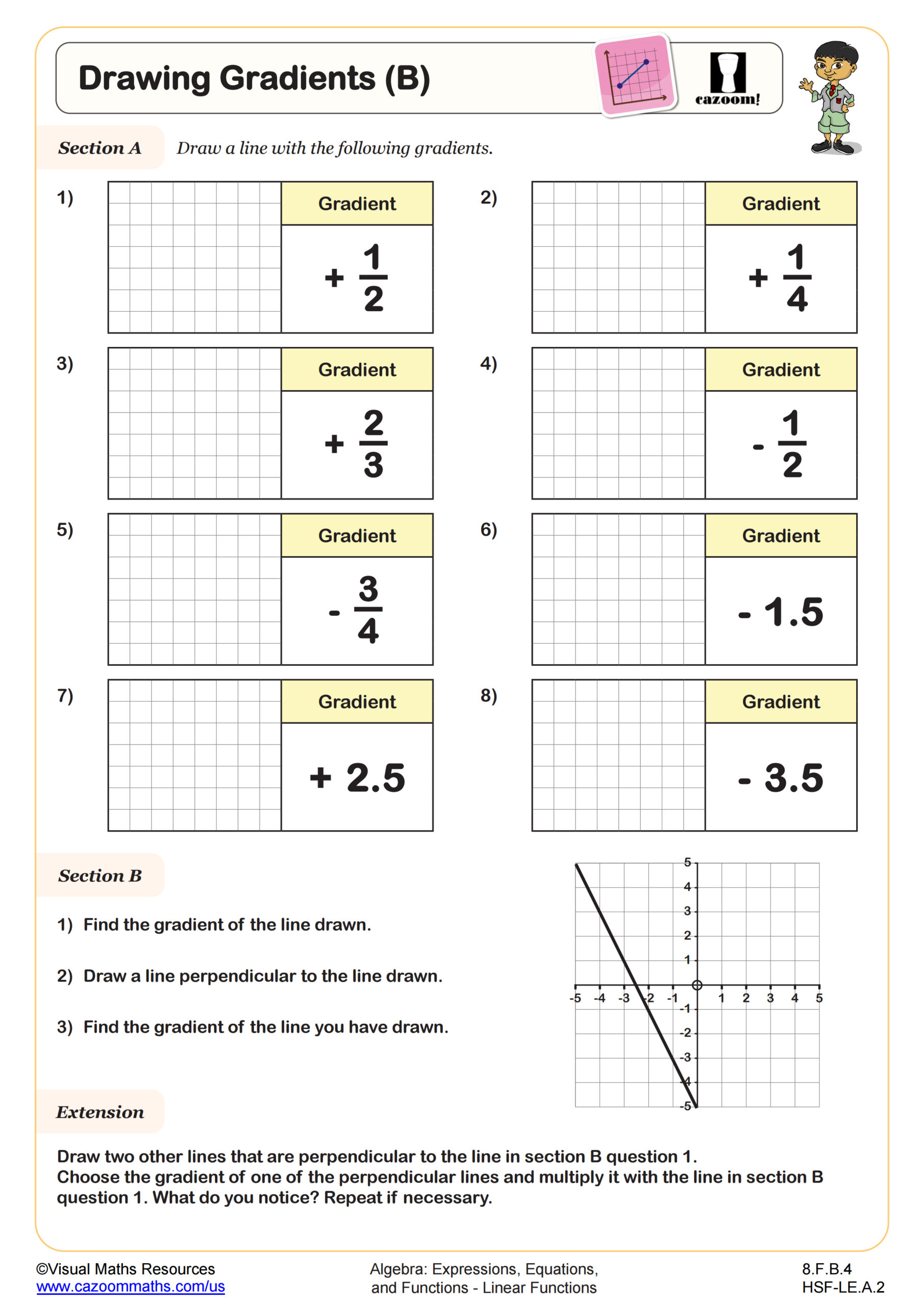
Drawing Gradients (B)
Grades: 8th Grade, Algebra I
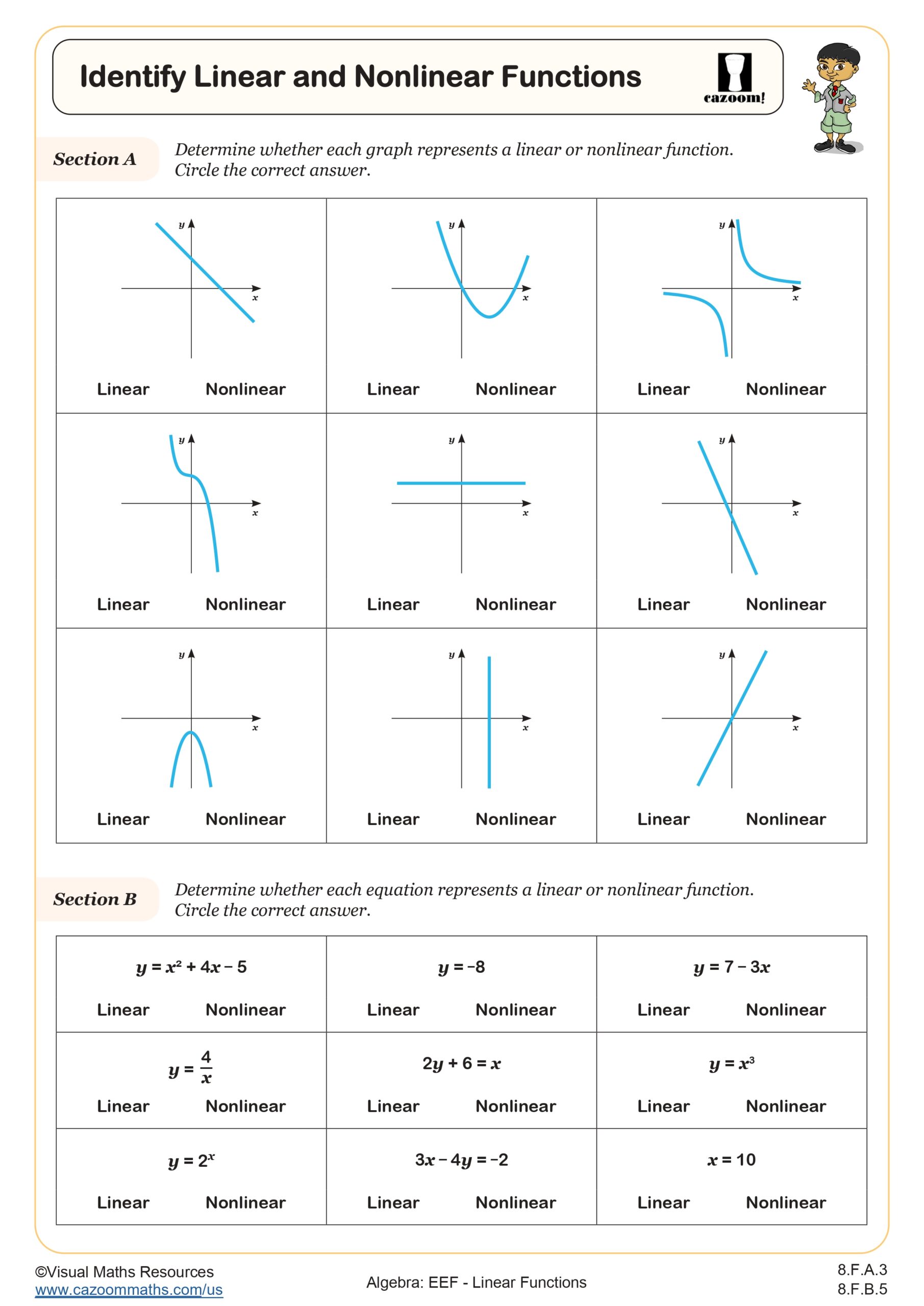
Identify Linear and Non Linear Functions
Grades: 8th Grade
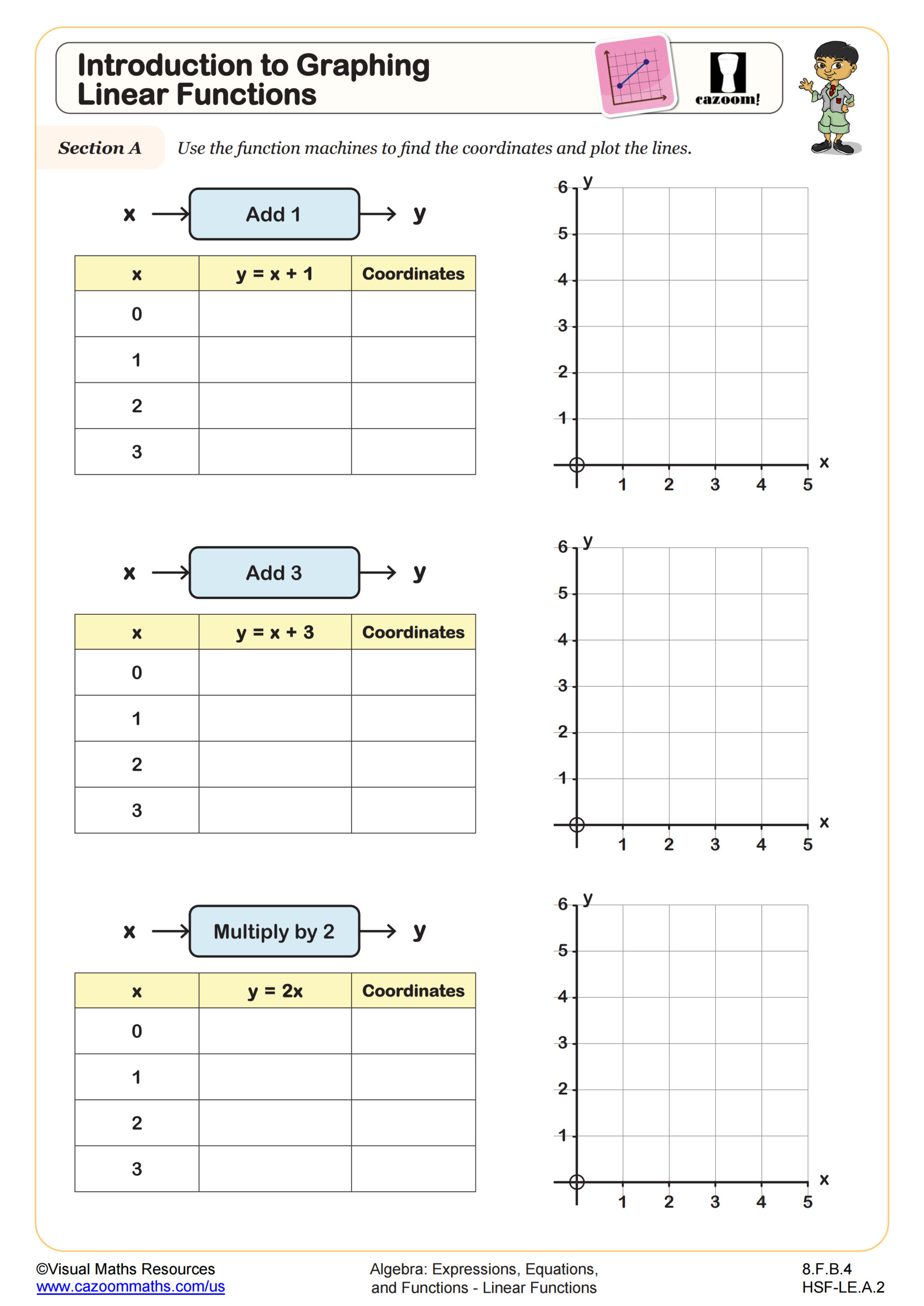
Introduction to Graphing Linear Functions
Grades: 8th Grade, Algebra I
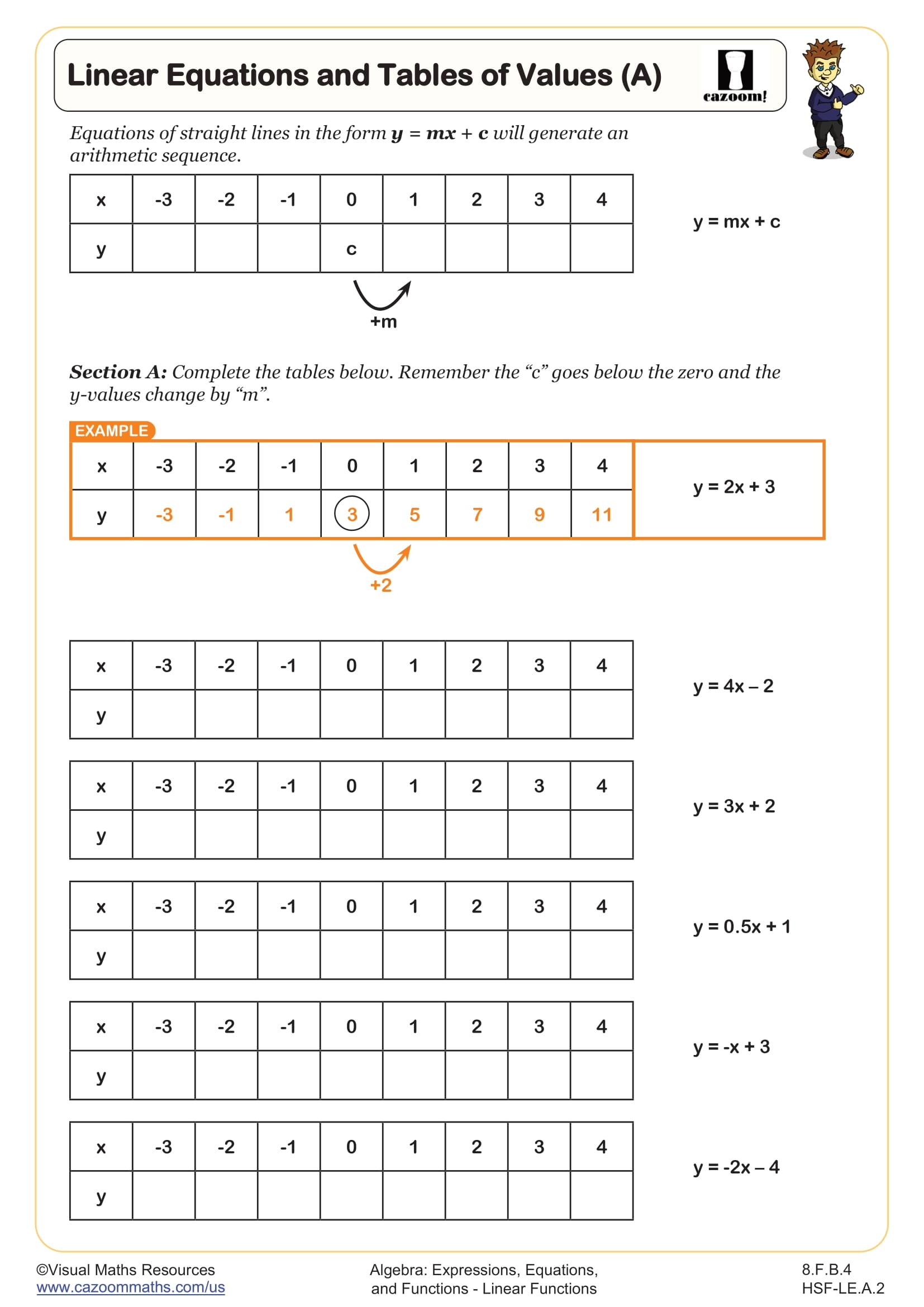
Linear Equations and Tables of Values (A)
Grades: 8th Grade, Algebra I
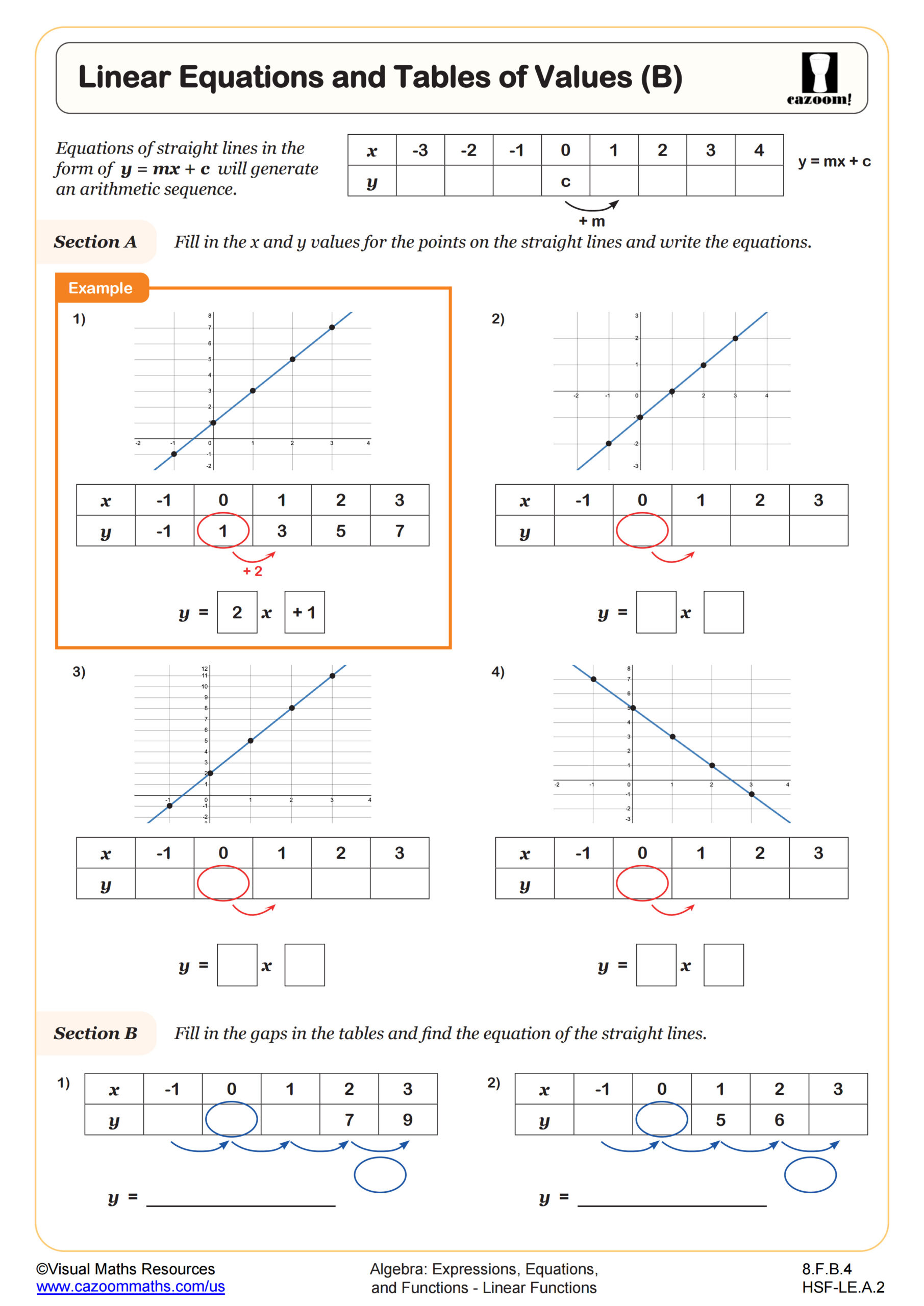
Linear Equations and Tables of Values (B)
Grades: 8th Grade, Algebra I
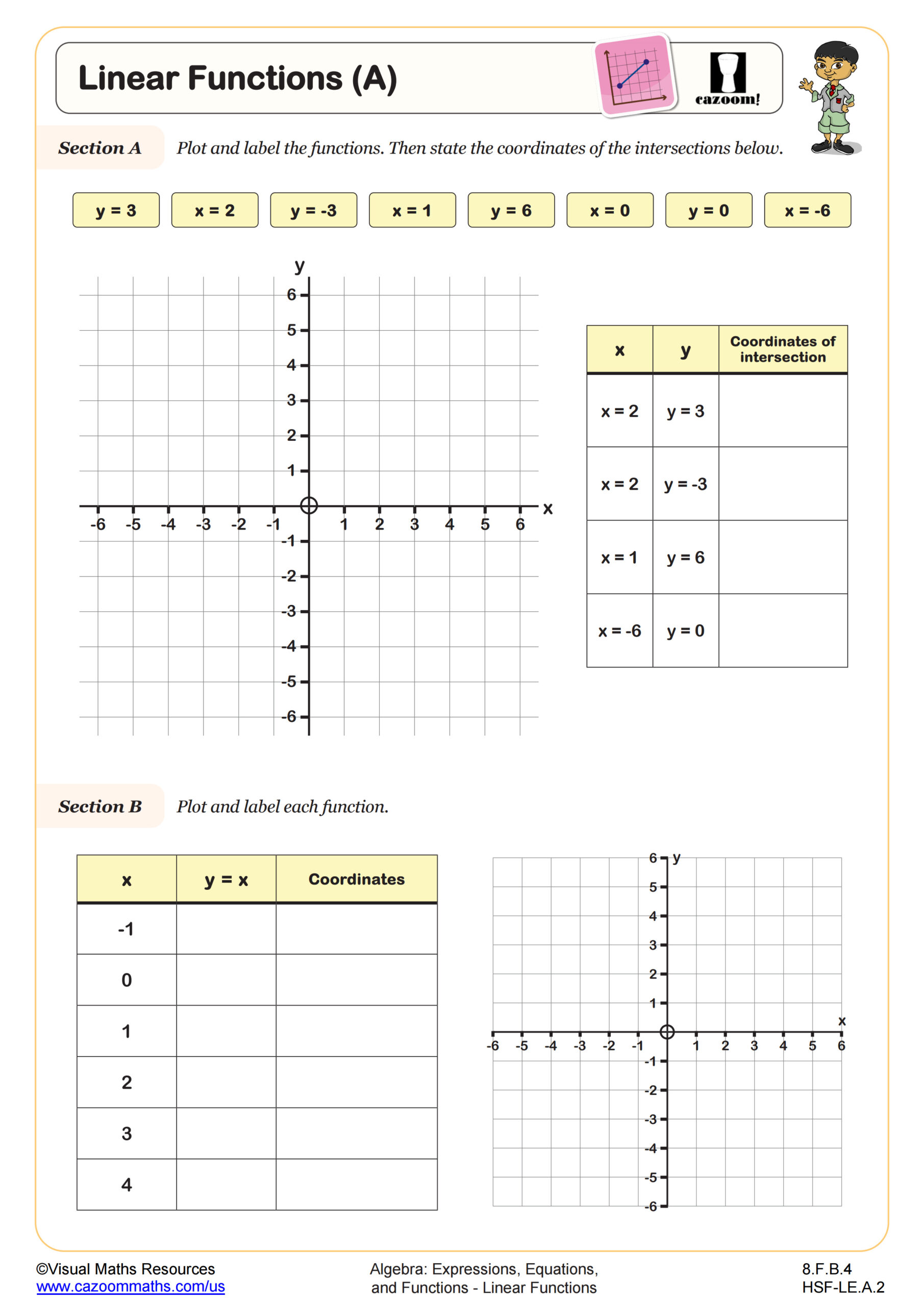
Linear Functions (A)
Grades: 8th Grade, Algebra I
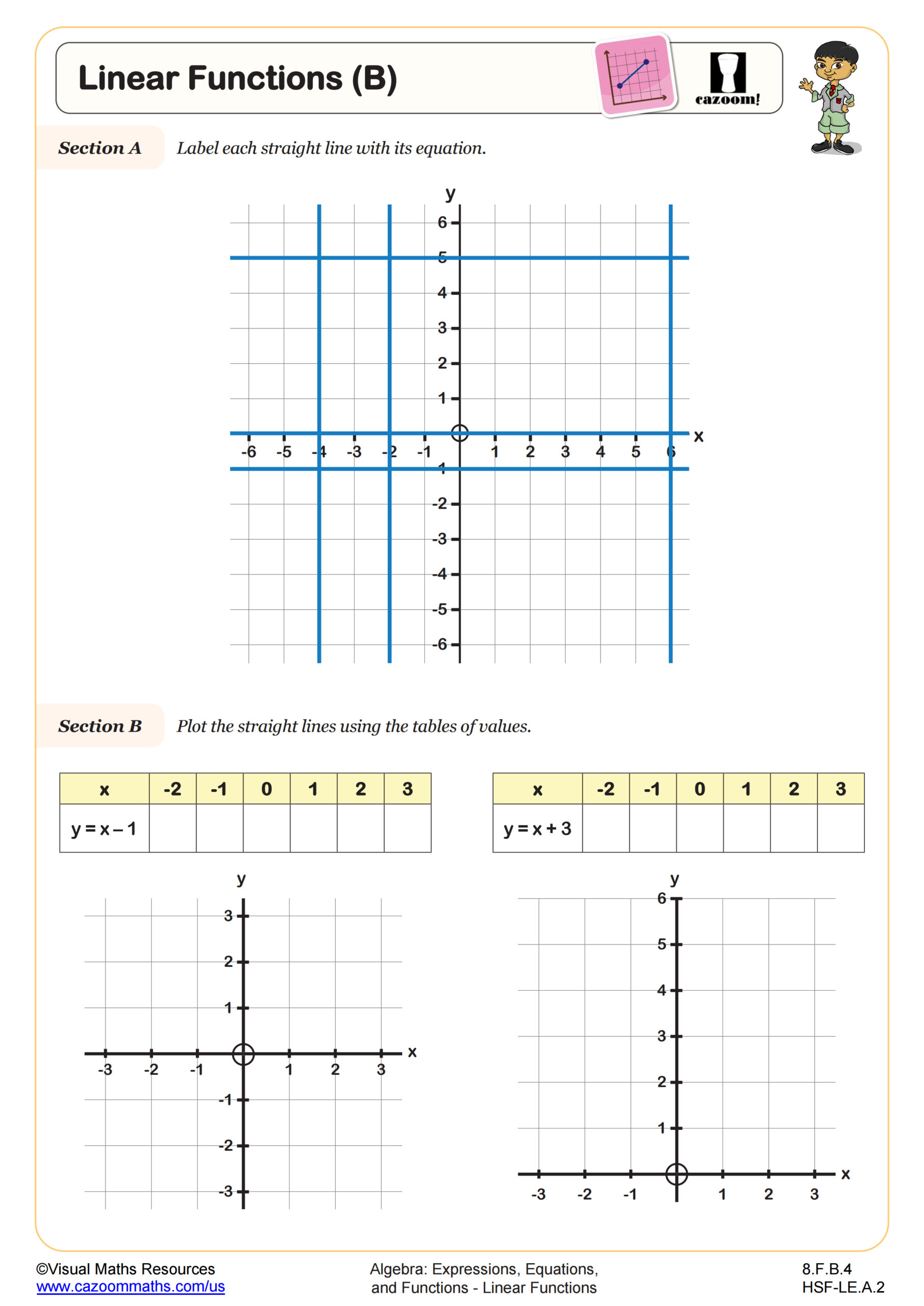
Linear Functions (B)
Grades: 8th Grade, Algebra I
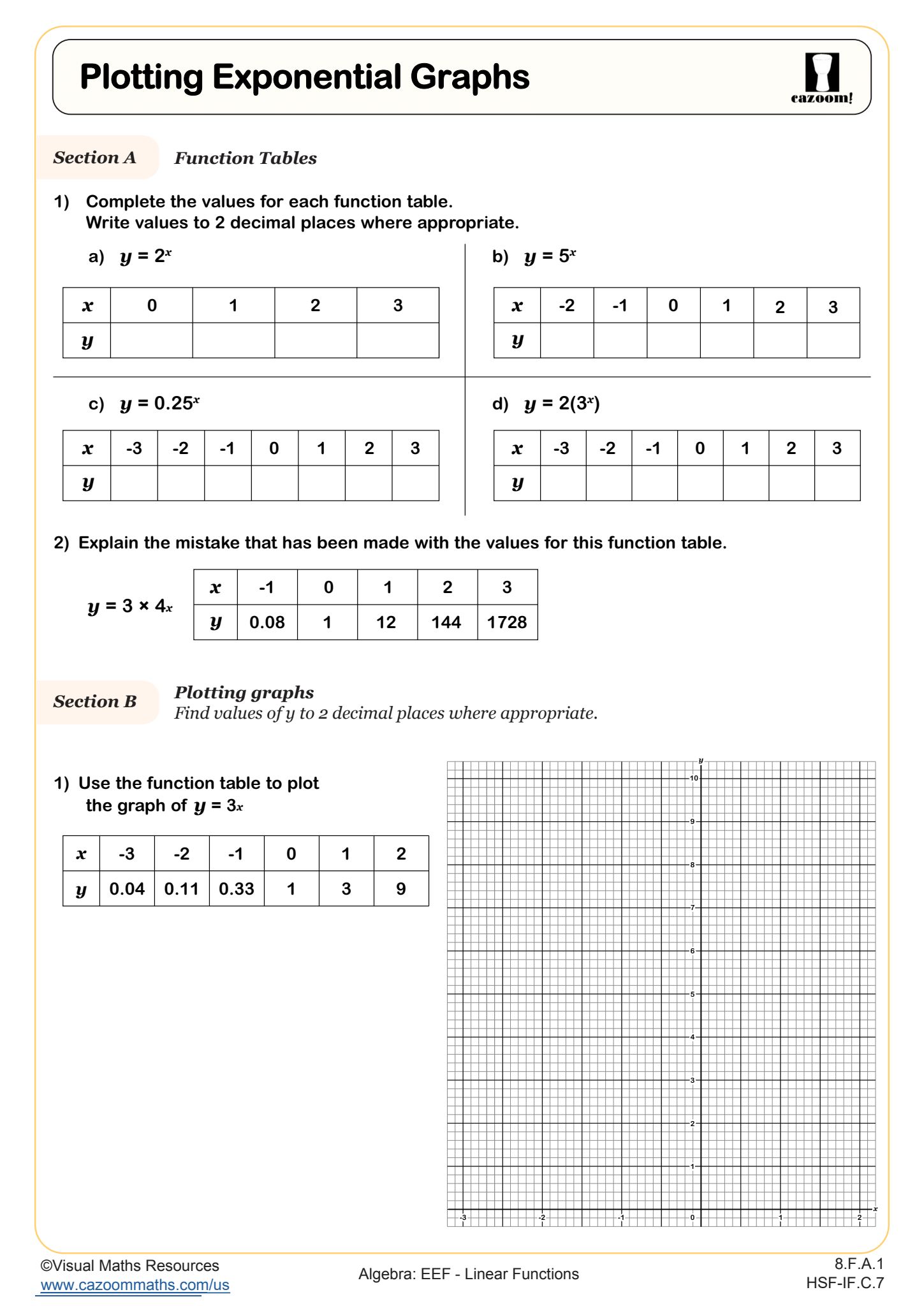
Plotting Exponential Graphs
Grades: 8th Grade, Algebra I, IM 1
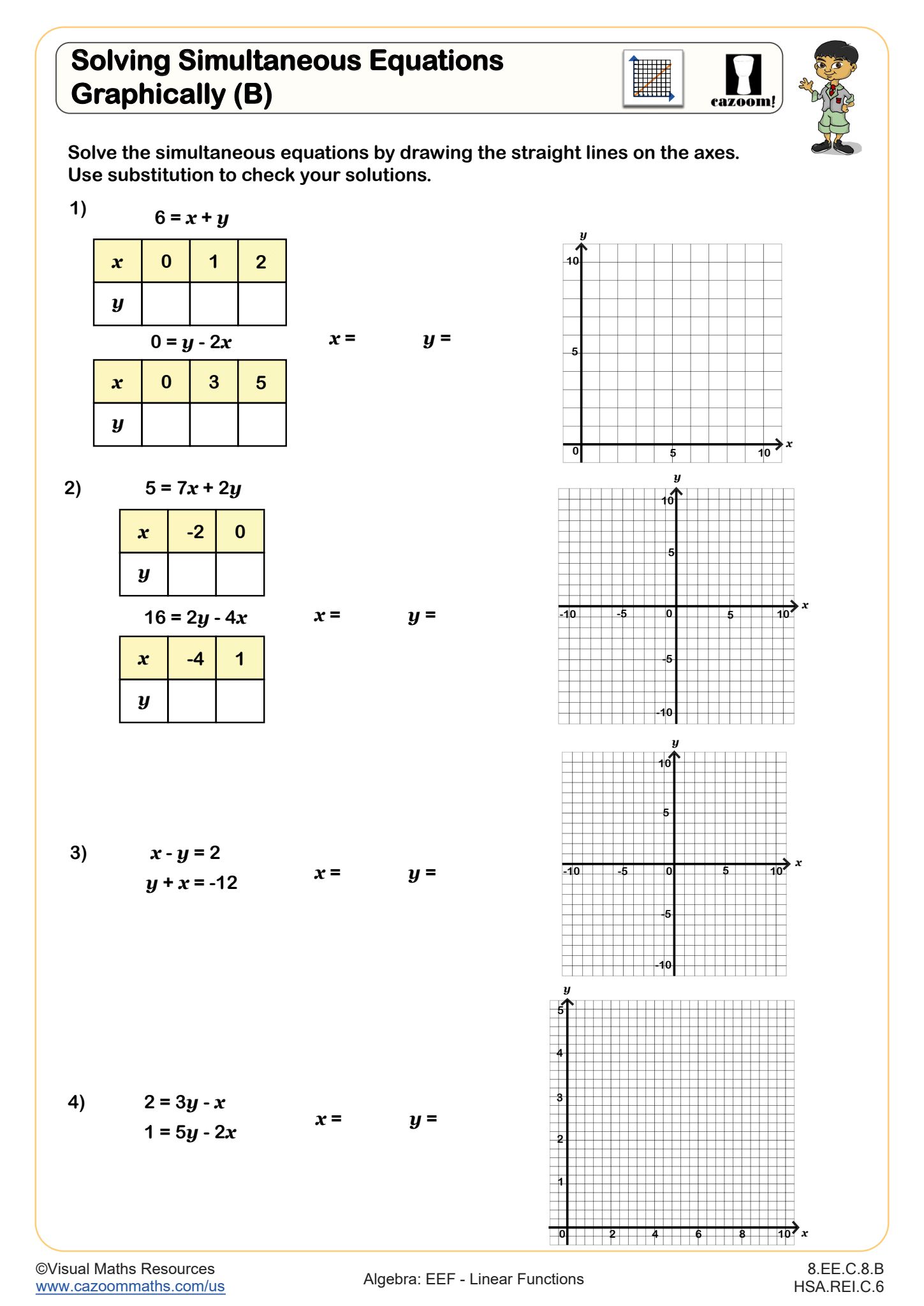
Solving Simultaneous Equations Graphically (B)
Grades: 8th Grade, Algebra I, IM 1
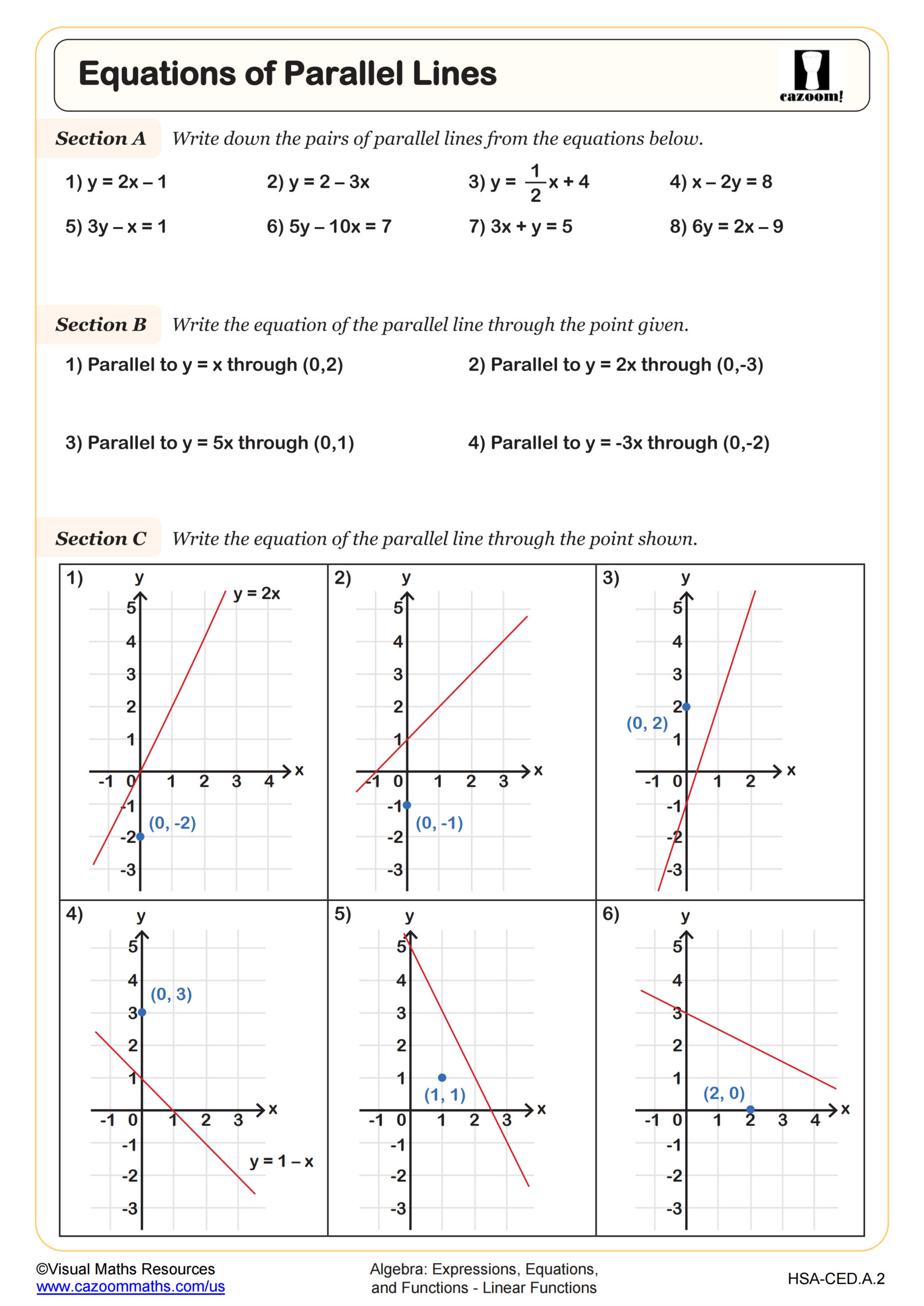
Equations of Parallel Lines
Grades: Algebra I, IM 1
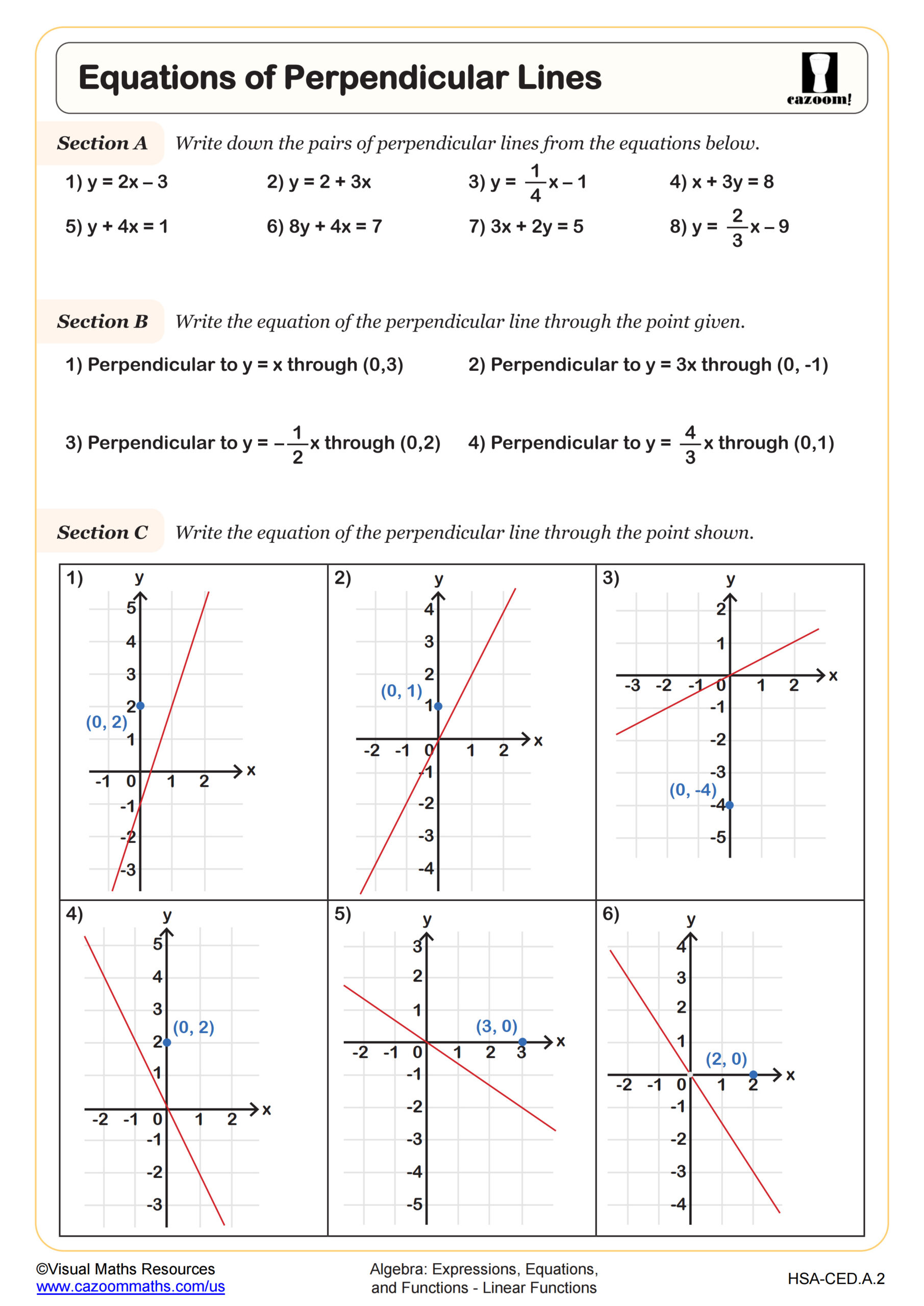
Equations of Perpendicular Lines
Grades: Algebra I, IM 1
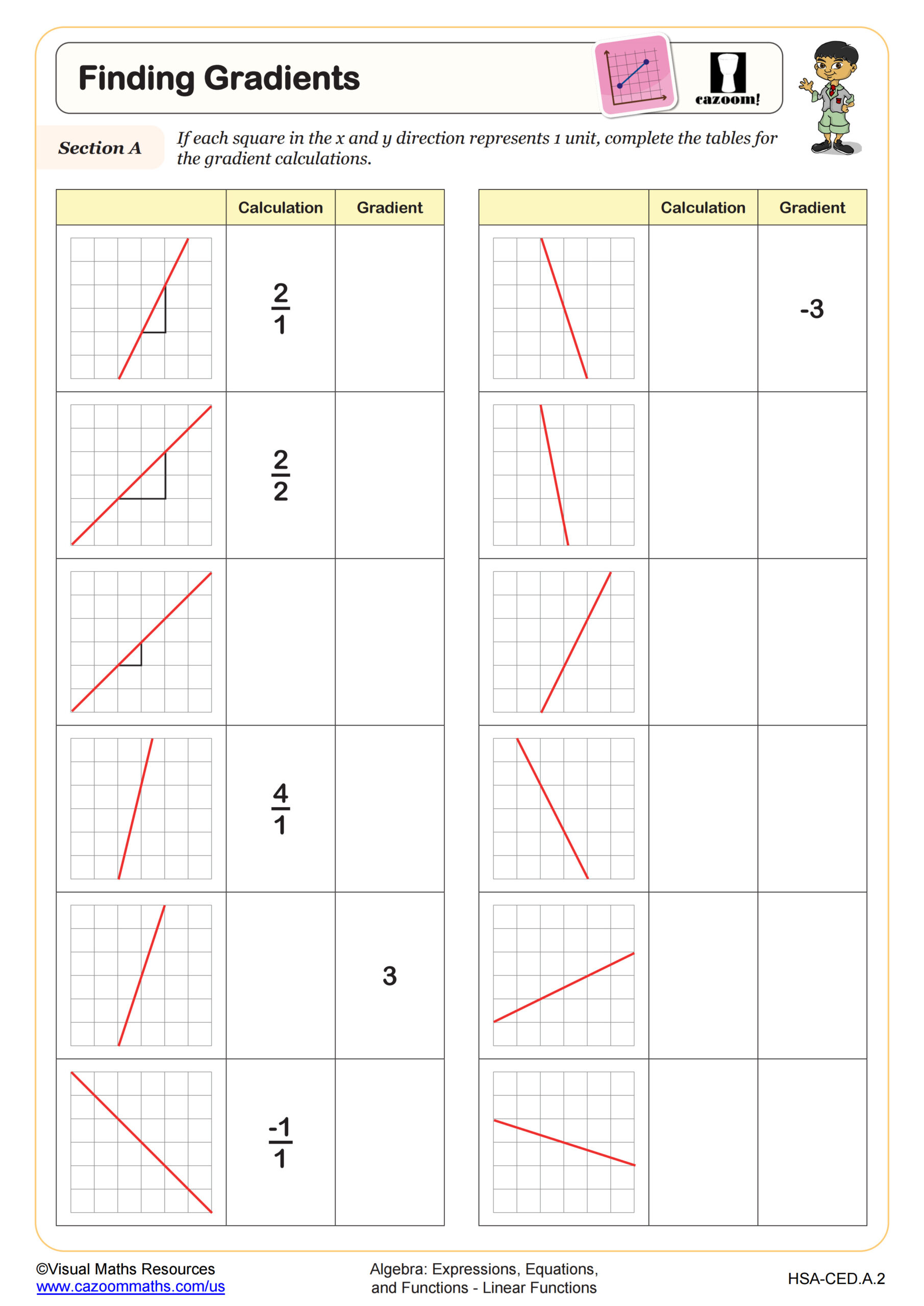
Finding Gradients
Grades: Algebra I, IM 1
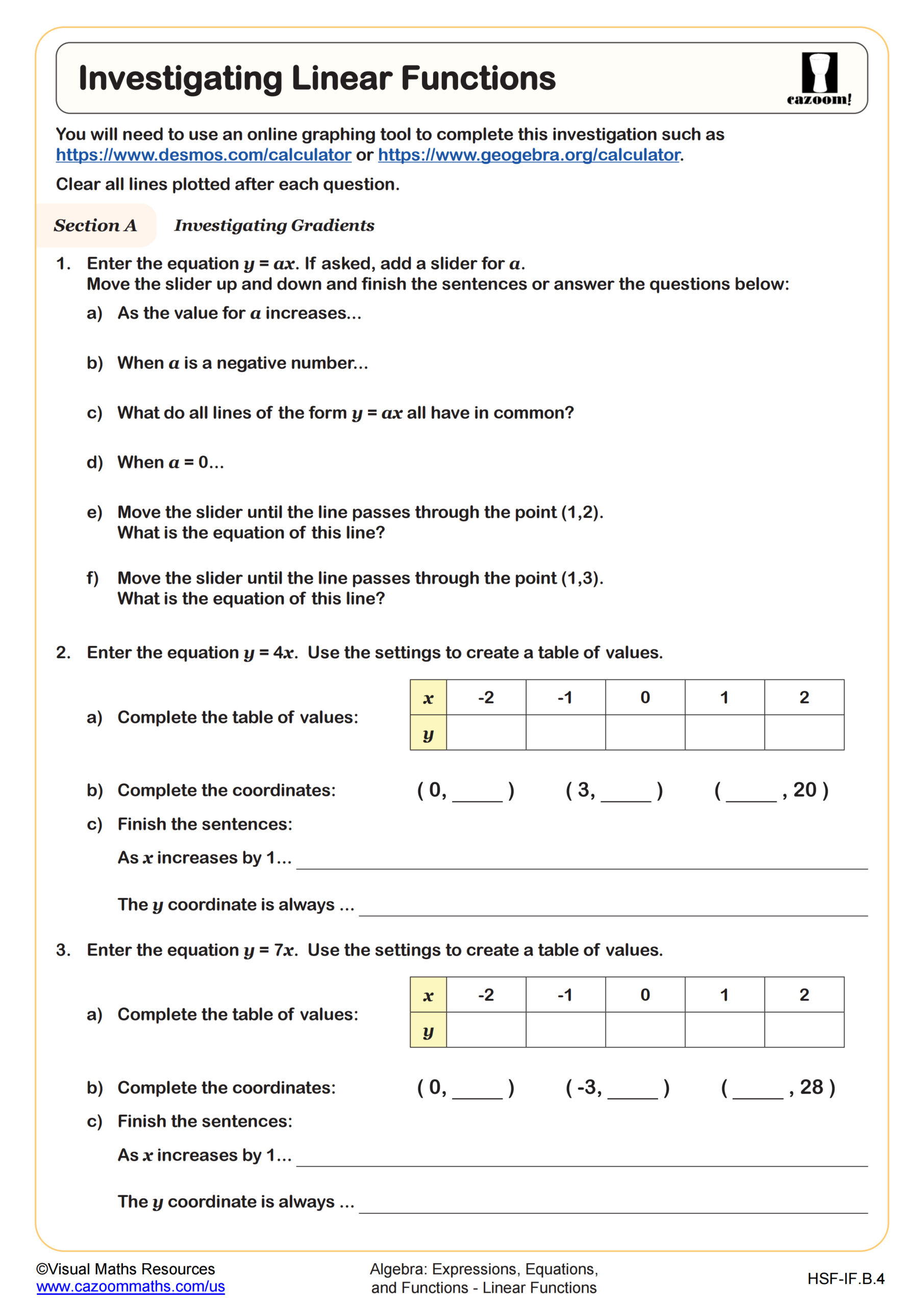
Investigating Linear Functions
Grades: Algebra I, IM 1
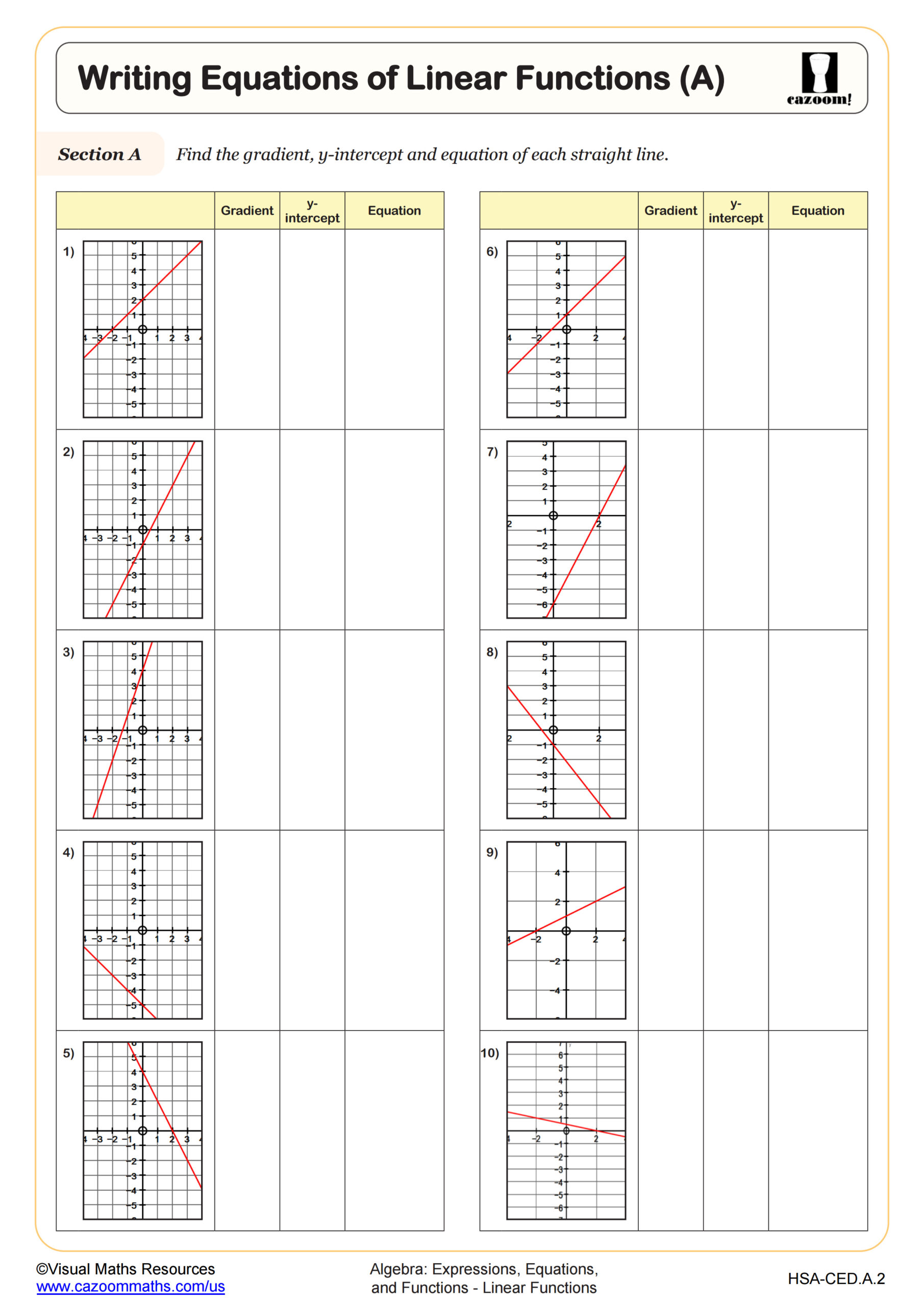
Writing Equations of Linear Functions (A)
Grades: Algebra I, IM 1
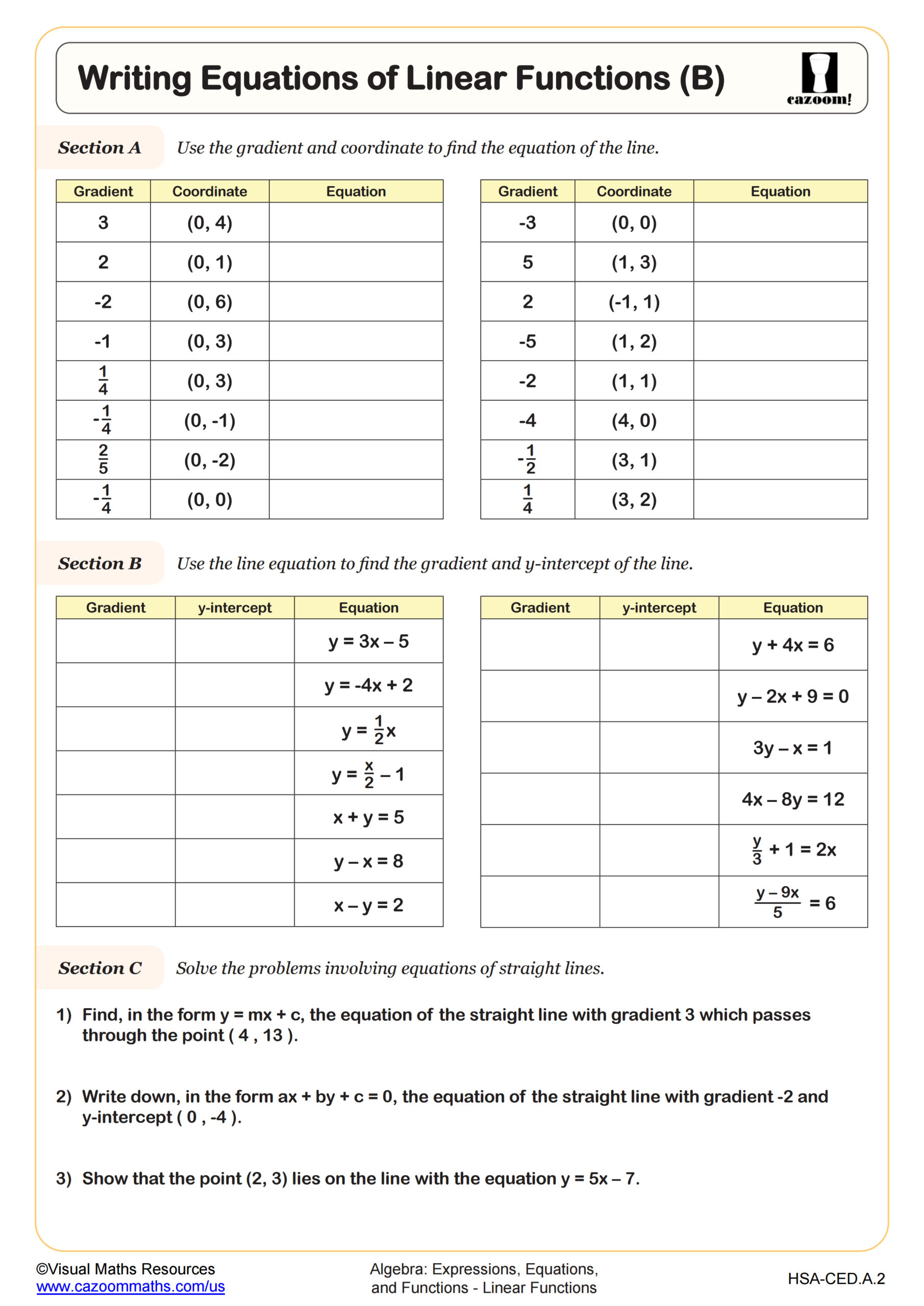
Writing Equations of Linear Functions (B)
Grades: Algebra I, IM 1
All worksheets are created by the team of experienced teachers at Cazoom Math.
What topics are covered in linear functions worksheets?
Linear functions worksheets typically cover slope-intercept form, point-slope form, standard form, graphing linear equations, finding slope from two points, and determining y-intercepts. Students practice converting between different representations including tables, graphs, and equations while developing understanding of rate of change and initial values.
Teachers notice that students often confuse the roles of m and b in y = mx + b, frequently plotting the slope as a point rather than using it as a rate of change. This misconception becomes particularly evident when students attempt to graph the linear equation worksheet problems that require them to start from the y-intercept and use slope to find additional points.
Which grade levels use linear functions worksheets?
Linear functions appear prominently in 8th grade Algebra courses and continue through high school Algebra 1, typically aligning with Common Core standards 8.F.A.3 and A-REI.D.10. Middle school students focus on recognizing linear patterns and basic graphing, while high school learners tackle more complex applications and systems of equations.
The progression builds systematically, with 8th graders starting with simple linear graph worksheet problems that use integer slopes and y-intercepts. High school students advance to analyzing linear functions in context, such as calculating cell phone plan costs or determining break-even points in business scenarios, connecting algebraic concepts to STEM applications.
How do students identify linear functions from tables and graphs?
Students learn to identify linear functions by checking for constant rates of change in tables and straight-line patterns in graphs. In tables, they calculate differences between consecutive y-values and verify these differences remain constant when x-values increase by the same amount. On graphs, linear functions create straight lines that pass the vertical line test.
A common error occurs when students encounter tables where x-values aren't in order or don't increase by 1. Teachers find that providing an identifying linear functions worksheet with mixed formats helps students develop stronger pattern recognition skills and avoid assuming non-consecutive data represents non-linear relationships.
How can teachers use linear functions worksheets most effectively?
Teachers achieve better results by starting with concrete examples before moving to abstract algebraic manipulation. Beginning with real-world contexts like distance-time relationships or cost calculations helps students understand why linear functions matter. The math worksheet answers provide teachers with step-by-step solutions to guide instruction and identify common misconceptions.
Experienced teachers recommend using the worksheets for both independent practice and collaborative problem-solving. Students benefit from explaining their reasoning to peers, particularly when working through multi-step problems that require converting between tables, graphs, and equations within the same linear function worksheet.
What is a Linear Function?
A linear function, in its most basic form, is a function that can be graphed as a straight line. According to math experts at Columbia University, they are easy to work with and can be applied in many ways. (1) They are generally used to show data and how it changes, such as showing how something increases or decreases with time.
Understanding Linear Functions
Linear functions are equations that can be written in different forms or plotted on a graph, where they will appear as a straight line. However, they cannot be a vertical line. They can be a horizontal line, but it is more likely the linear function will appear as a slanted line on a graph.
How Do You Know if It’s a Linear Function?
There are a few ways to determine if a function is a linear function. The most common way is to rearrange the formula to slope-intercept form. If it can be put into slope-intercept form, it is a linear function.
What is the Formula for Linear Functions?
Linear functions are written as f(x)=mx+b. The letters m and b stand for constants, and the f(x) and (x) are variables. In a linear function, m would be the slope of the line and b would be the y-intercept of the line on the graph.
What is an example of a Linear Function?
An example of a linear function would be f(x)=2x+3. In this example, the slope would be 2 while the y-intercept would be 3
Graphing Linear Equations
Graphing linear equations can be done doing two different methods.
How Do You Graph Linear Functions?
One way to graph the linear function is to find the y-intercept, then use the slope to find another point on the graph and draw a line between them. Another is to solve the equation to find two different points on the graph, then plot them and draw a line between them.
How Do You Know Which Method to Use?
Use the method based on the type of information provided. If the linear function is in slope-intercept form, find the y-intercept and the slope to graph the function. If the linear function isn’t in slope-intercept form or one point is already known, use the other method.
Graphing Linear Function Worksheets
Graphing linear function worksheets have been designed to help students practice solving linear functions and learning how to graph them.
How Can Graphing Linear Function Worksheets Help?
Functions worksheets allow students to learn more about the equations that can be linear functions, how to solve the equations, and how to graph linear functions.
What Worksheets are Available?
There are functions worksheets available that review drawing linear functions, drawing slopes, finding slopes, slope-intercept form, and more.
Writing Linear Equations
If a graph or two points are given, it is possible to write out the linear function using information from the graph.
What are the Methods for Writing Linear Equations?
There are a couple of methods for writing linear equations. The first method is to find one point, and the slope on a graph then put the information in an equation in slope-intercept form. Another is to use two points on the graph or points that are given to create the linear equation.
What Do You Need to Write Linear Equations?
To write a linear equation, you need a graph, two points that can be plotted on a graph, or one point along with a slope.
Word Problems for Linear Functions
Word problems that involve linear functions can be solved by looking for the right information, then plotting it on a graph or using the information to create the equation.
What Information Do You Look for in Word Problems?
In a word problem, look for two points that can be plotted on a graph or determine the y-intercept and the slope. If possible, go ahead and plot these on the graph to make it easier to see the function.
How Do You Solve Word Problems?
Solve word problems by finding the information needed then writing the equation. Plot the function if possible, to make sure the answer is correct.
Cazoom Maths Linear Function Worksheets Are Easy to Understand
Linear functions are considered easy to understand because they are just a straight line on a graph. Use the linear function worksheets available to learn how to write, solve, and plot linear functions to get a better understanding of how they work and be able to solve them easily in any format.
Resource
1. Columbia University
http://www.columbia.edu/itc/sipa/math/linear.html