Quadratic and Cubic Functions Worksheets
Calculating with Bounds
Grades: Algebra I, IM 1
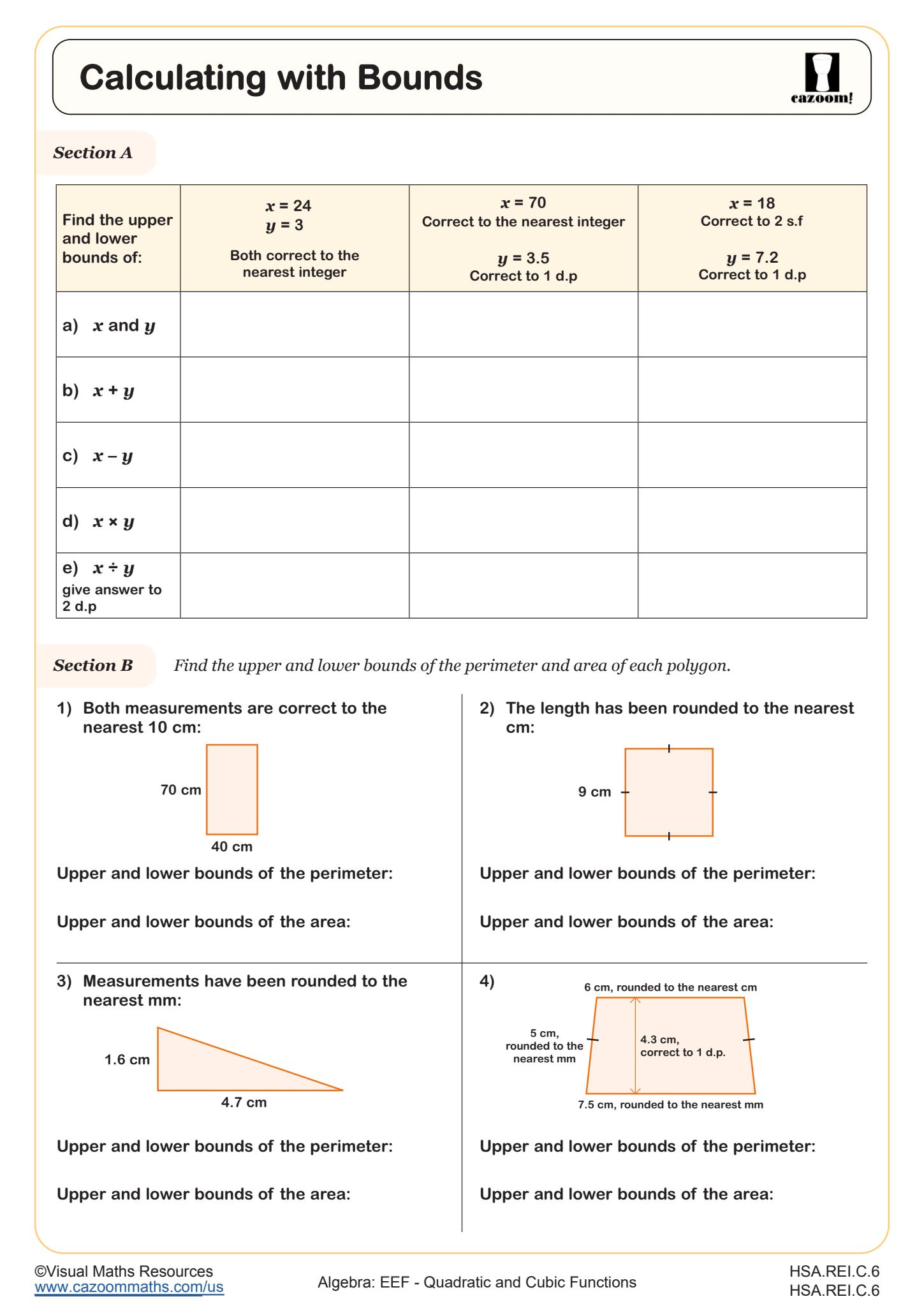
Completing the Square
Grades: Algebra I, IM 1
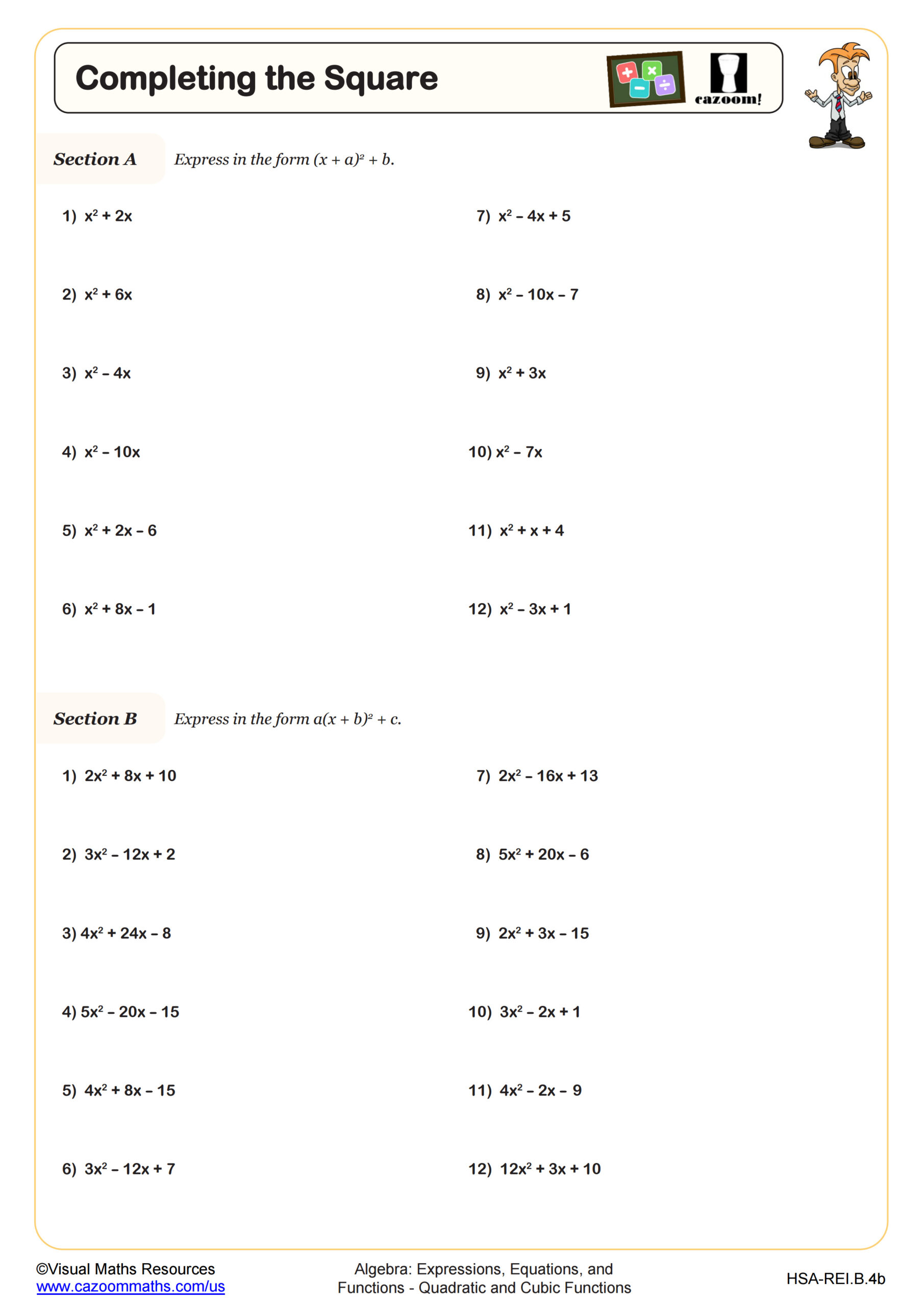
Completing the Square using Algebra Tiles
Grades: Algebra I, IM 1
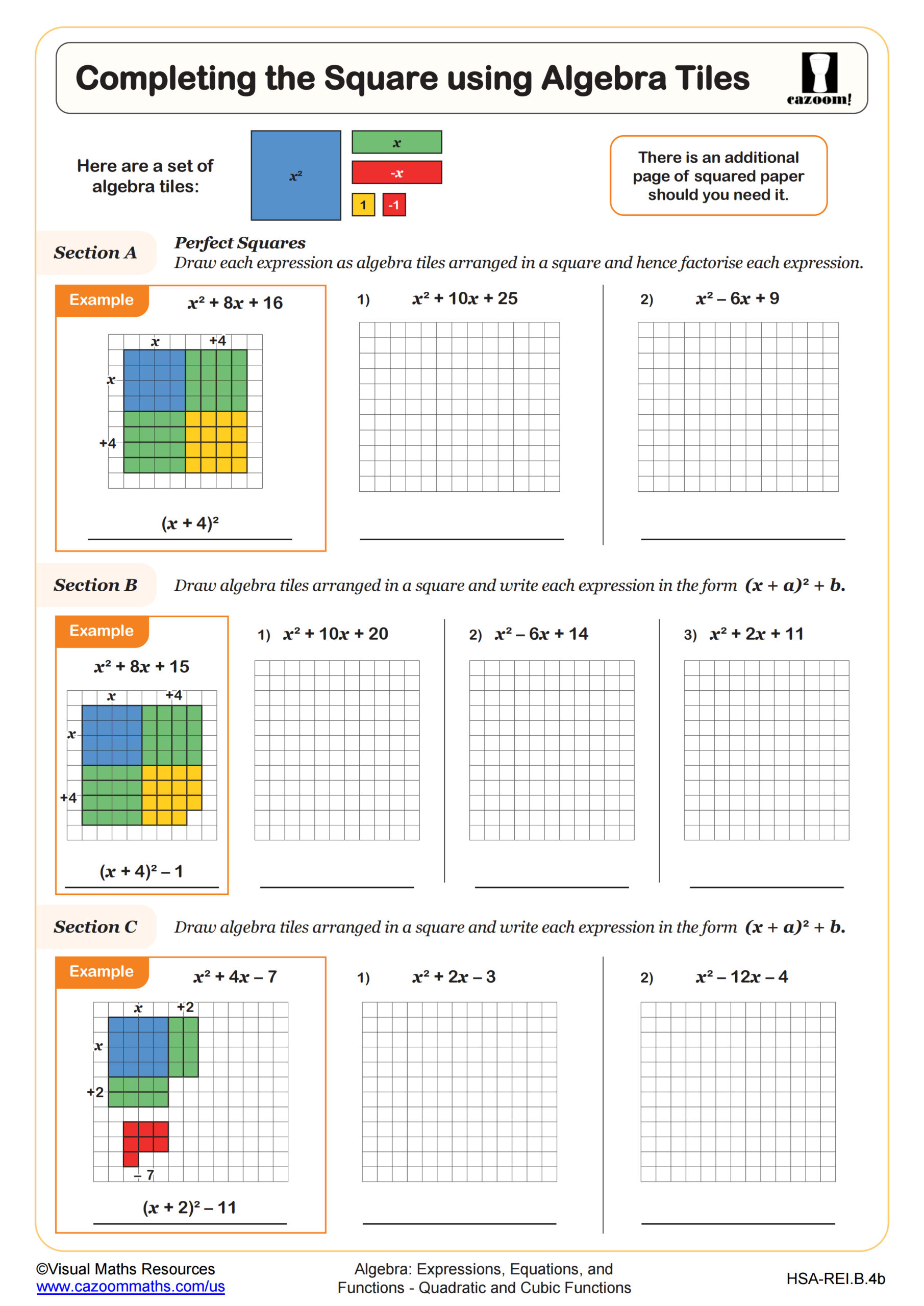
Factorising Quadratic Expressions - Using the Area Model
Grades: Algebra I, IM 1
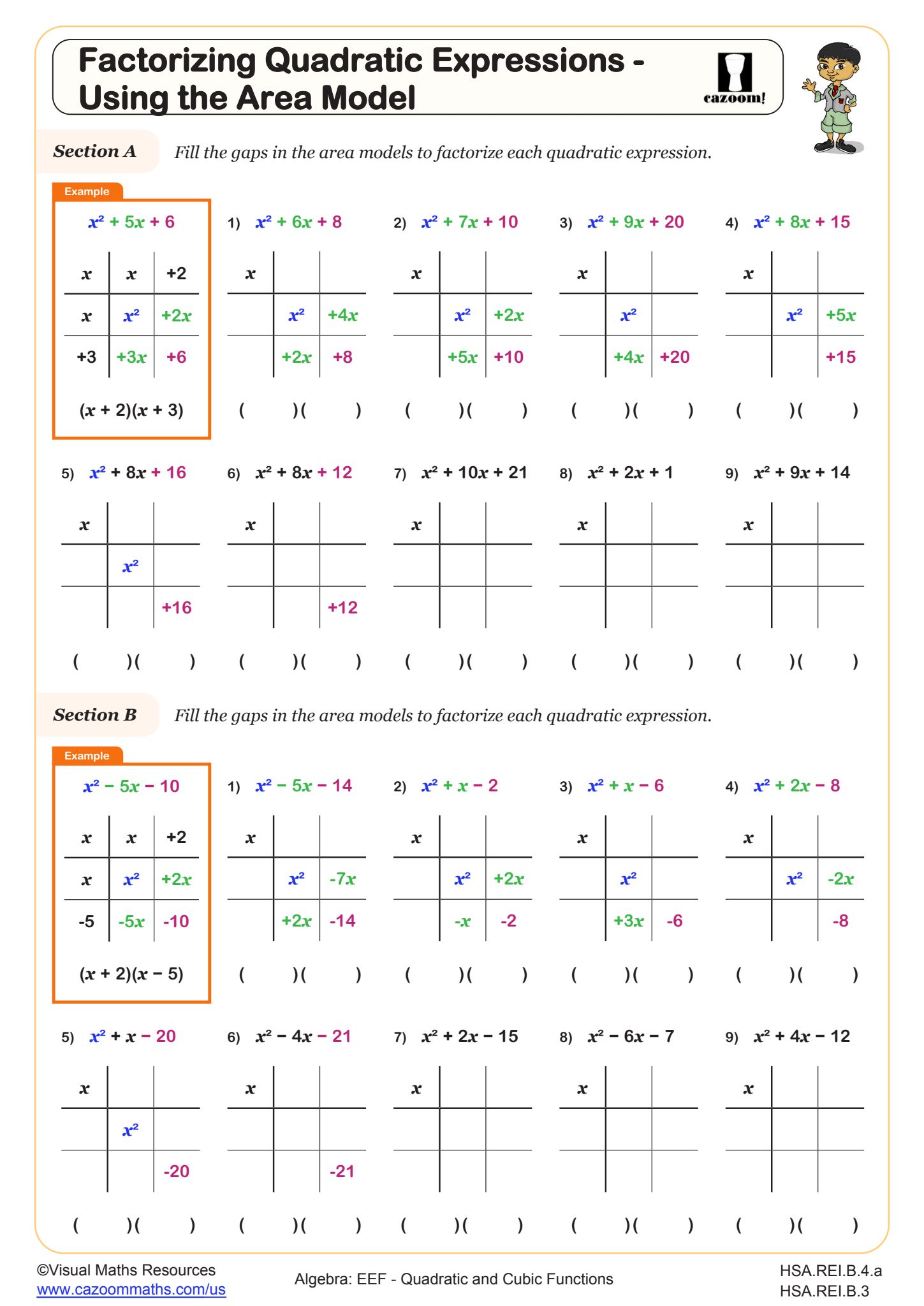
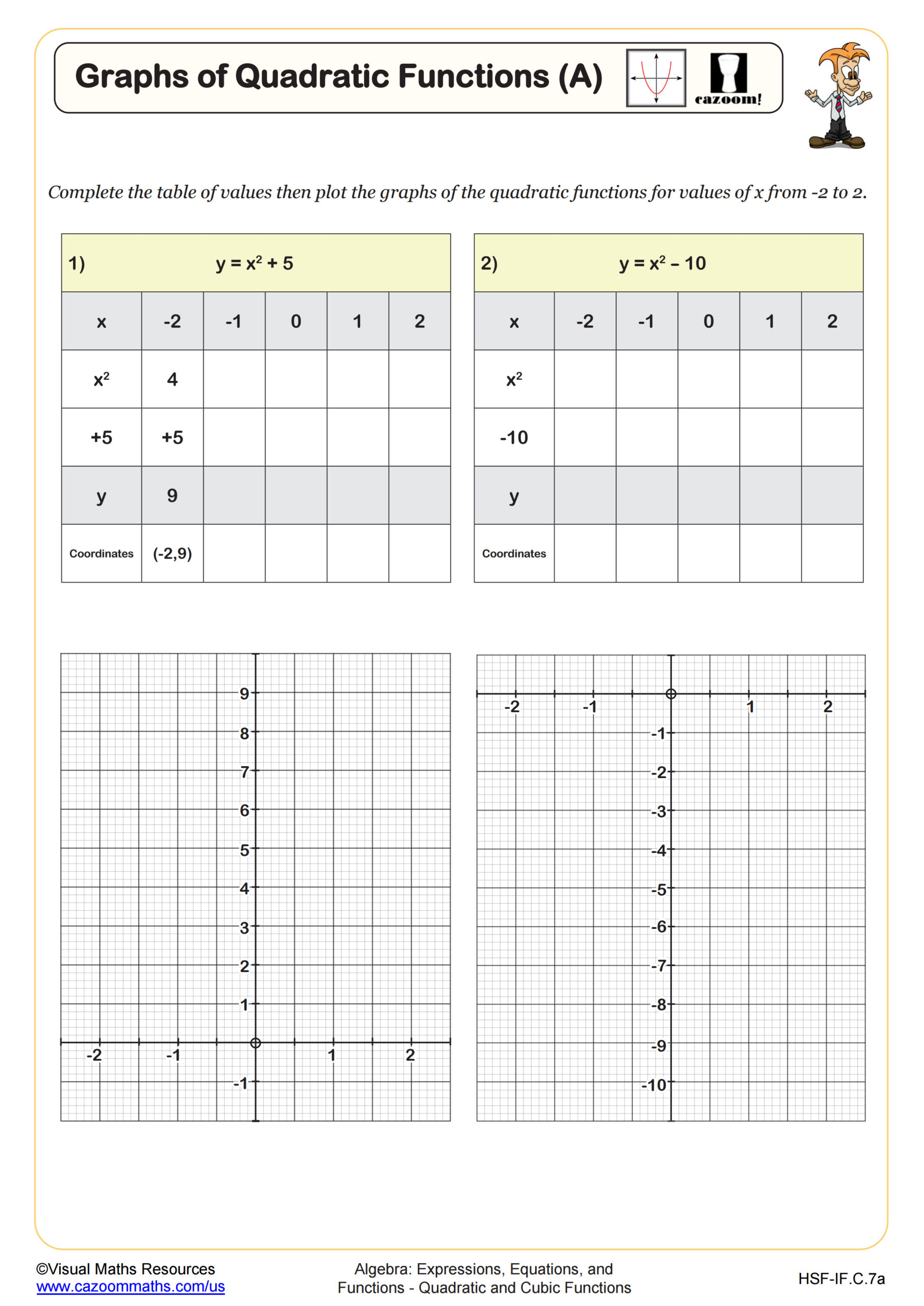
Graphs of Quadratic Functions (A)
Grades: Algebra I, IM 1
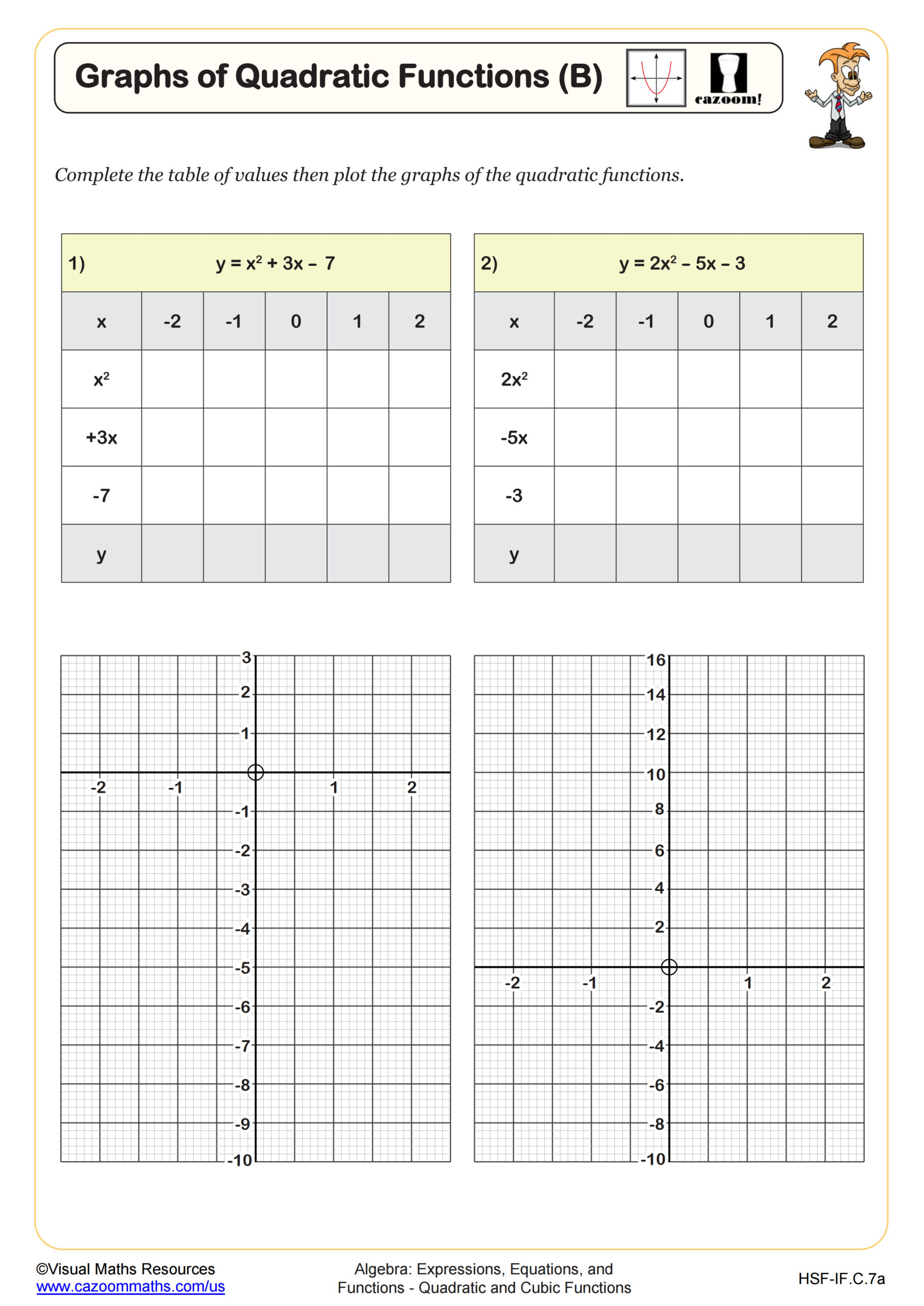
Graphs of Quadratic Functions (B)
Grades: Algebra I, IM 1
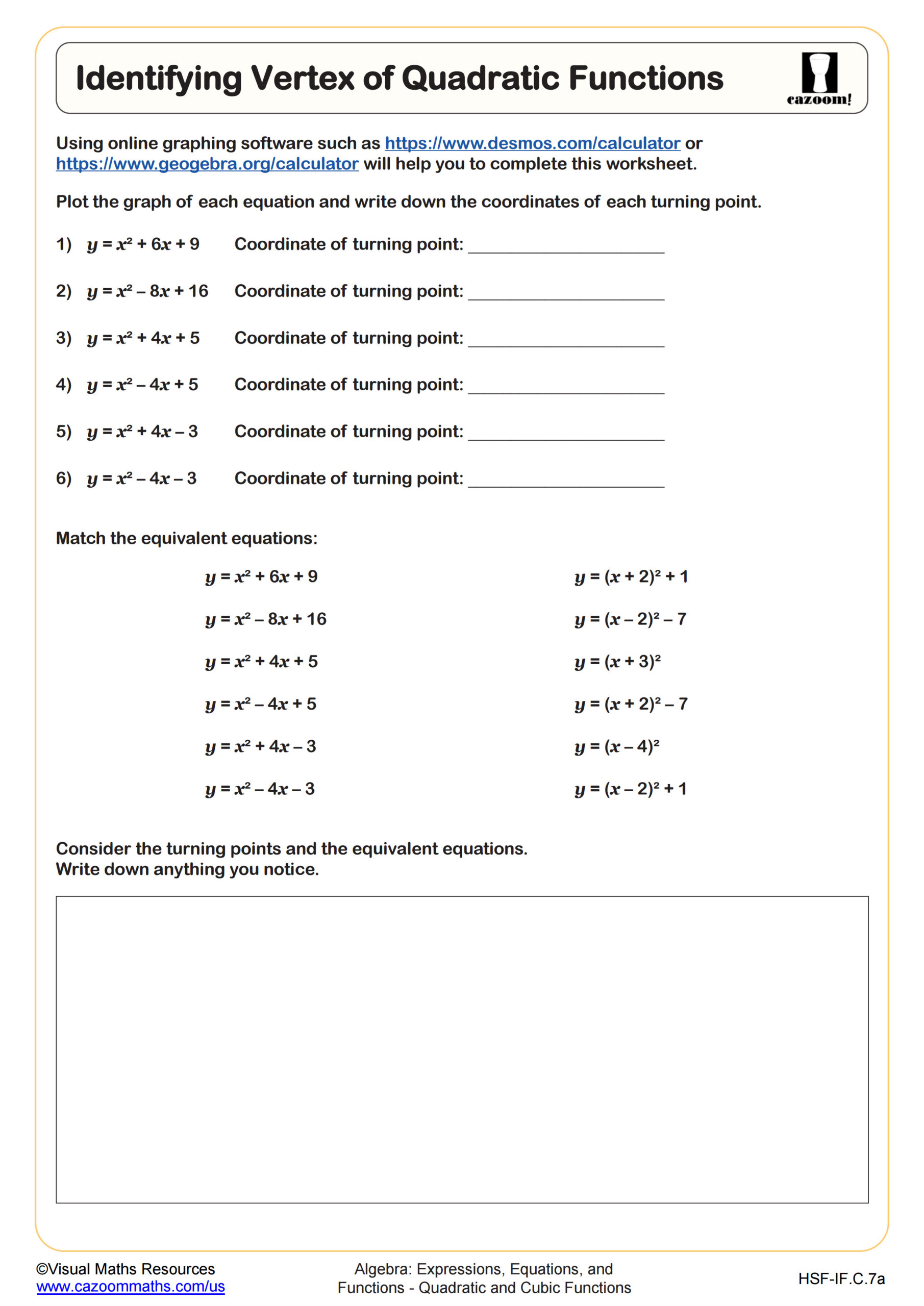
Identifying Vertex of Quadratic Functions
Grades: Algebra I, IM 1
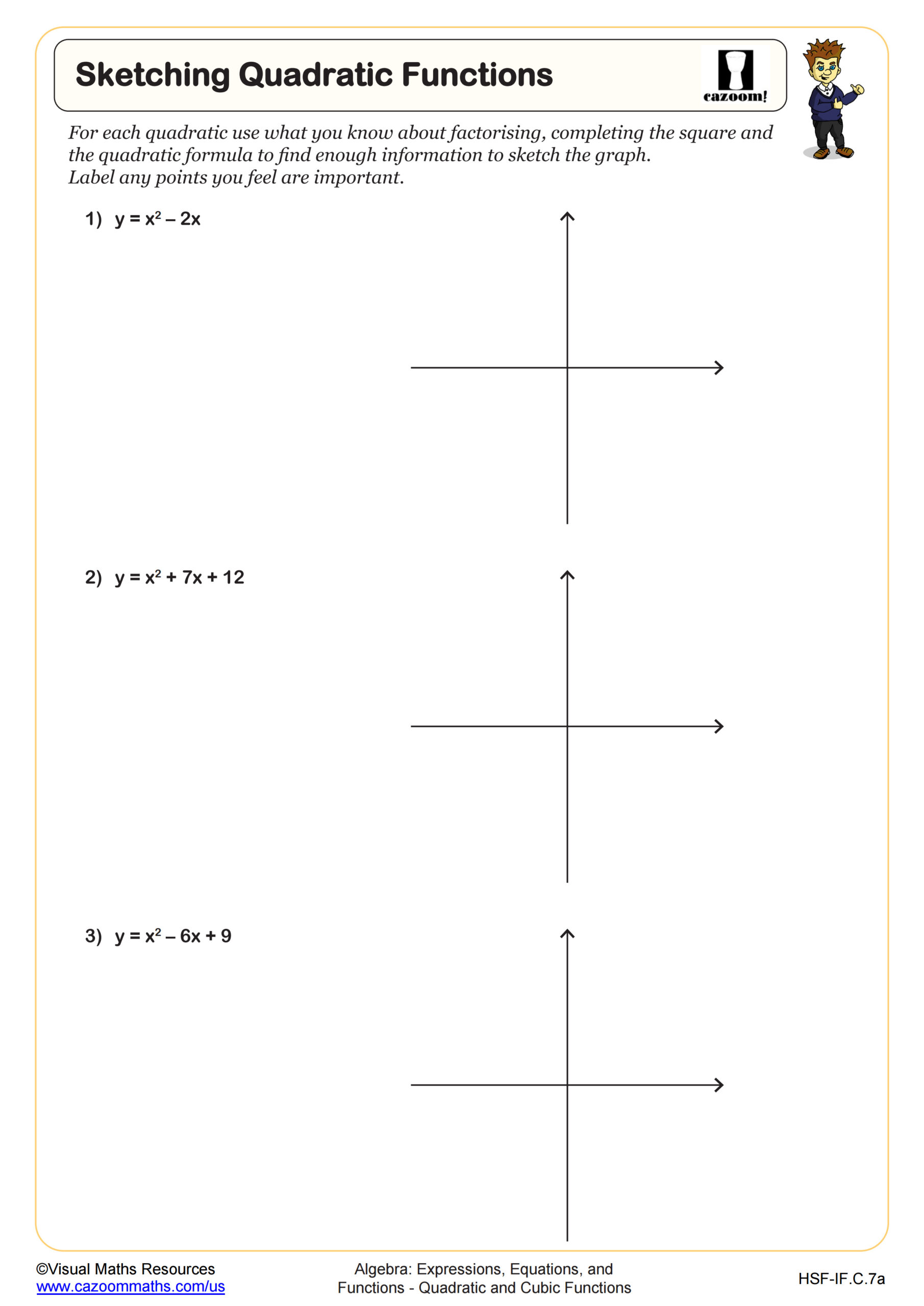
Sketching Quadratic Functions
Grades: Algebra I, IM 1
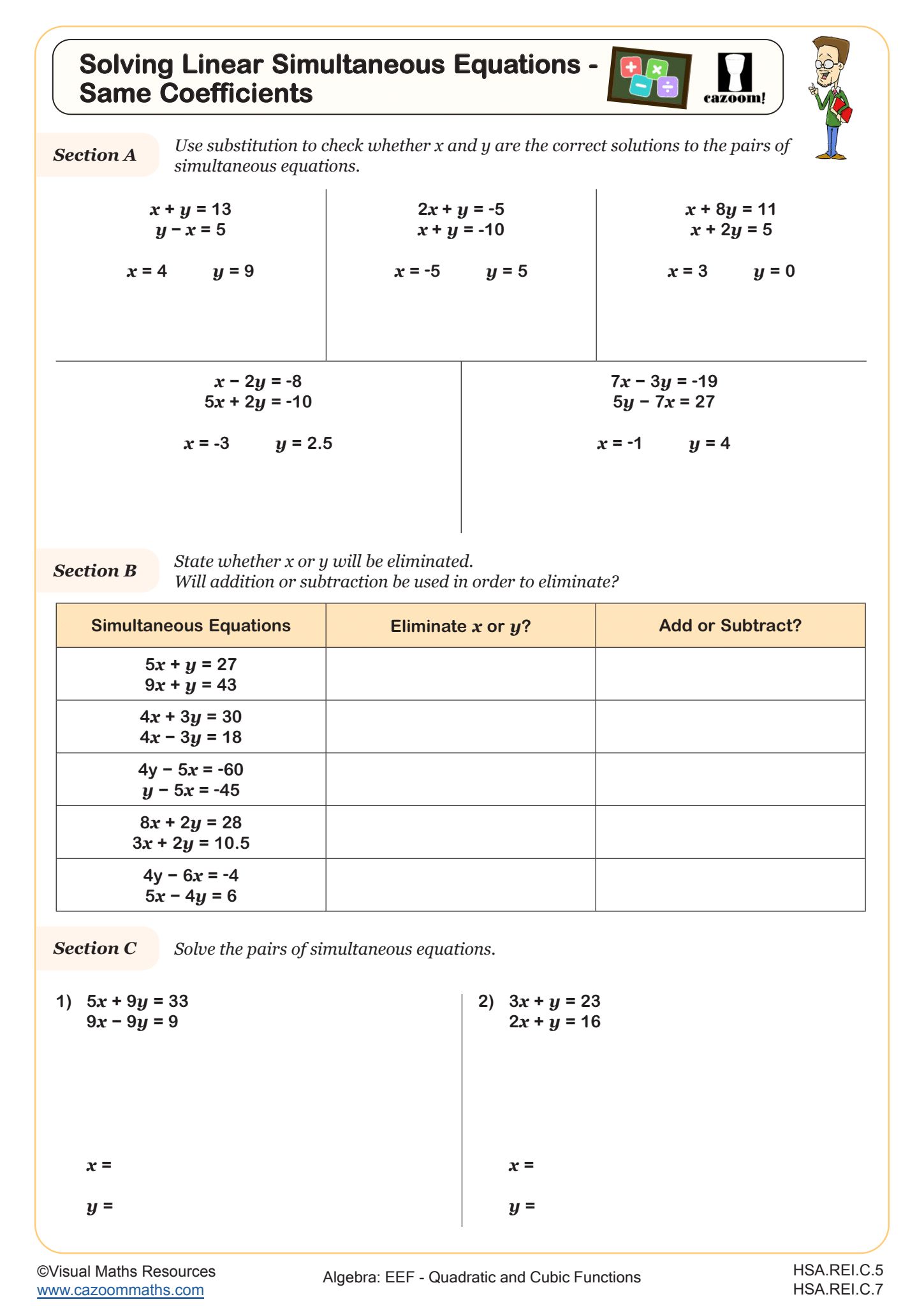
Solving Linear Simultaneous Equations - Same Coefficients
Grades: Algebra I, IM 1
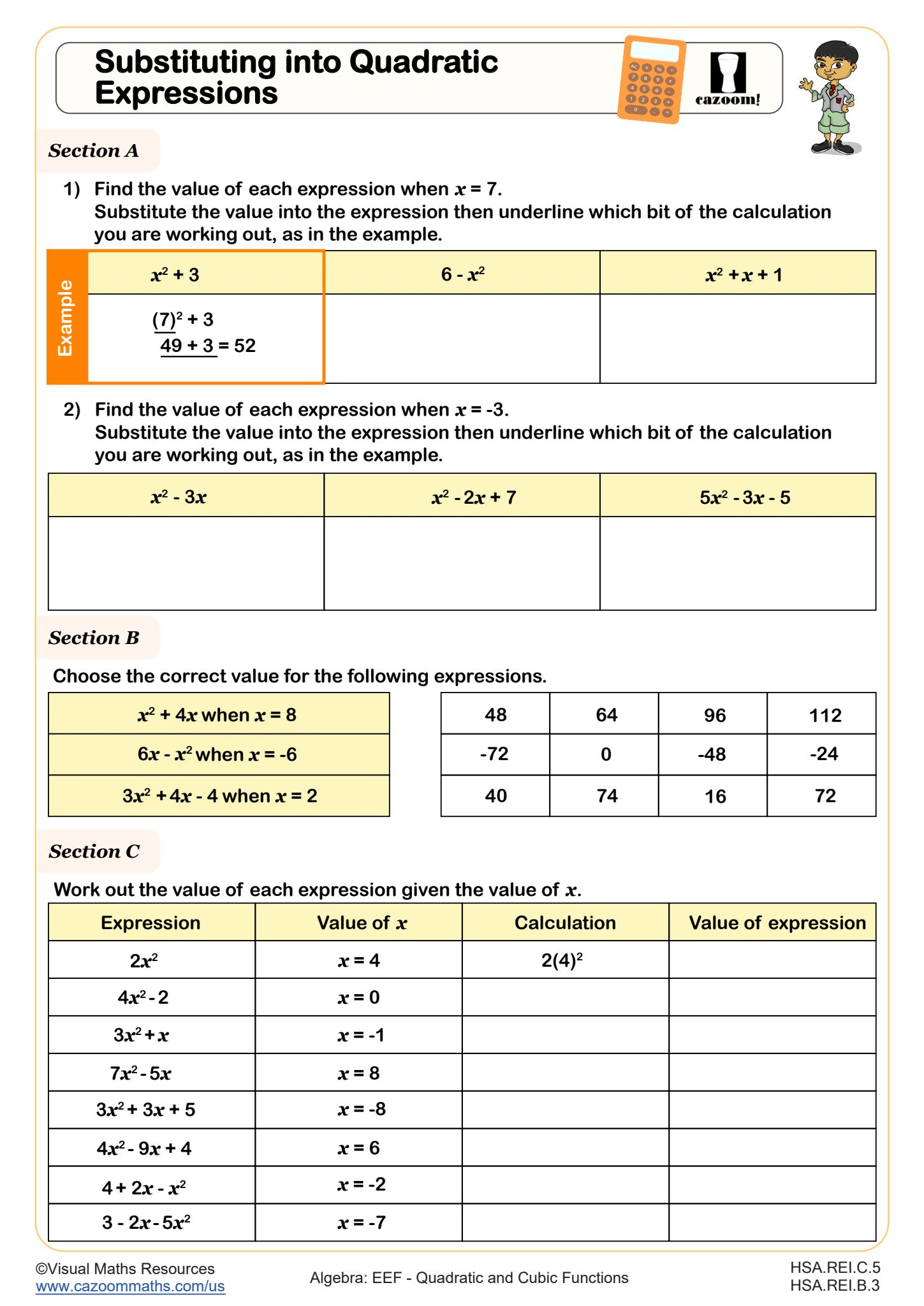
Substituting into Quadratic Expressions
Grades: Algebra I, IM 1
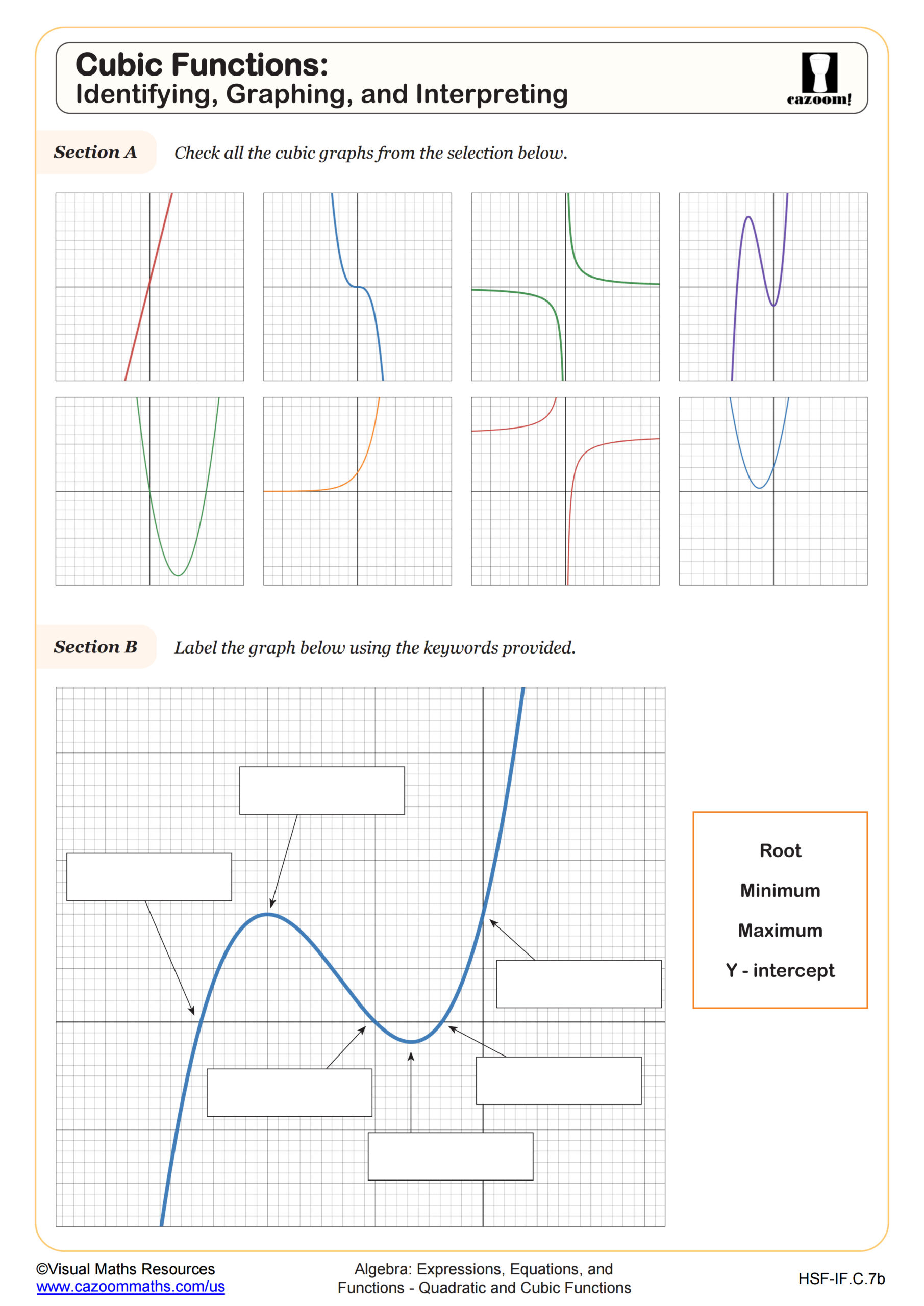
Cubic Functions: Identifying, Graphing, and Interpreting
Grades: Algebra II, IM 3
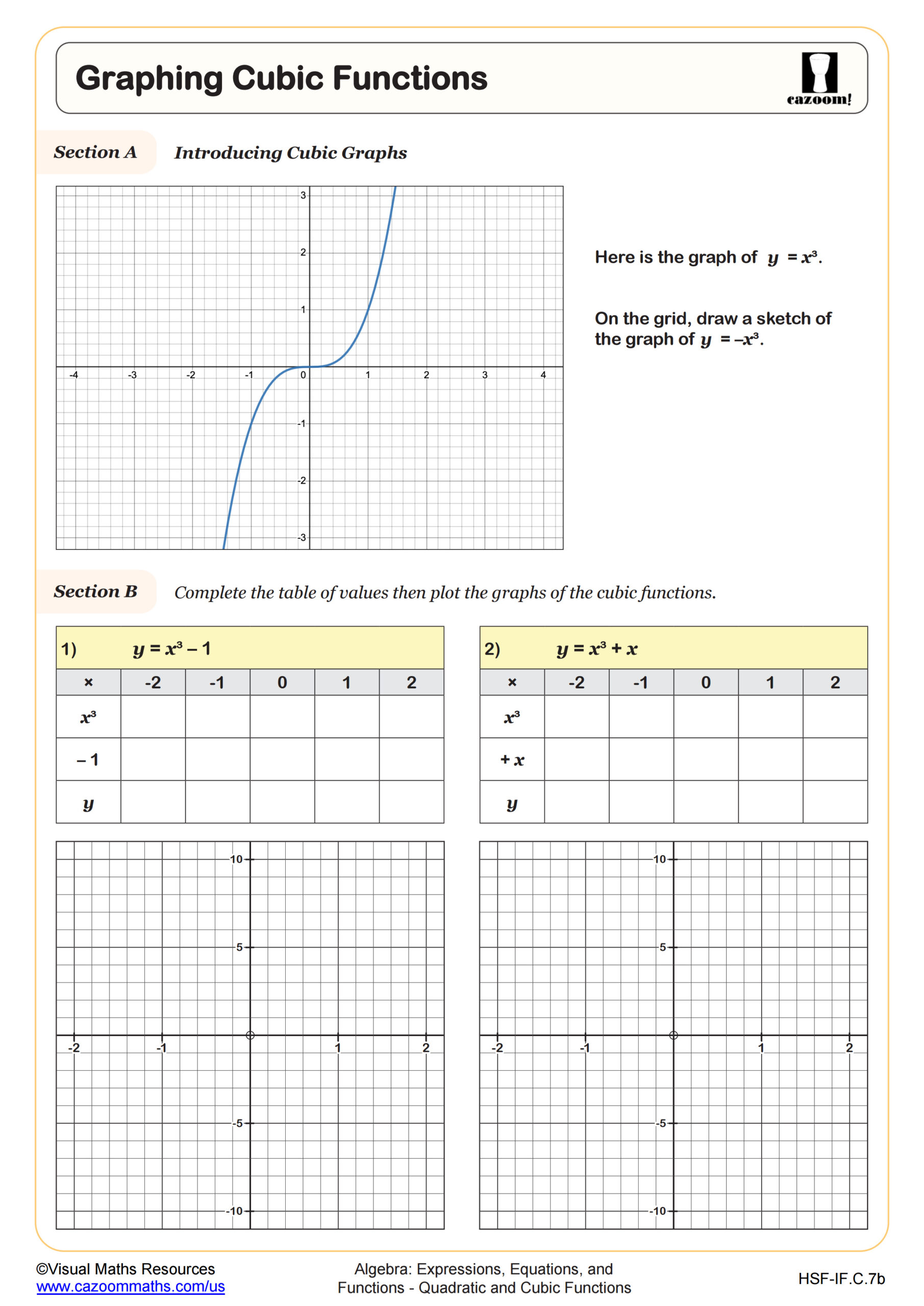
Graphing Cubic Functions
Grades: Algebra II, IM 3
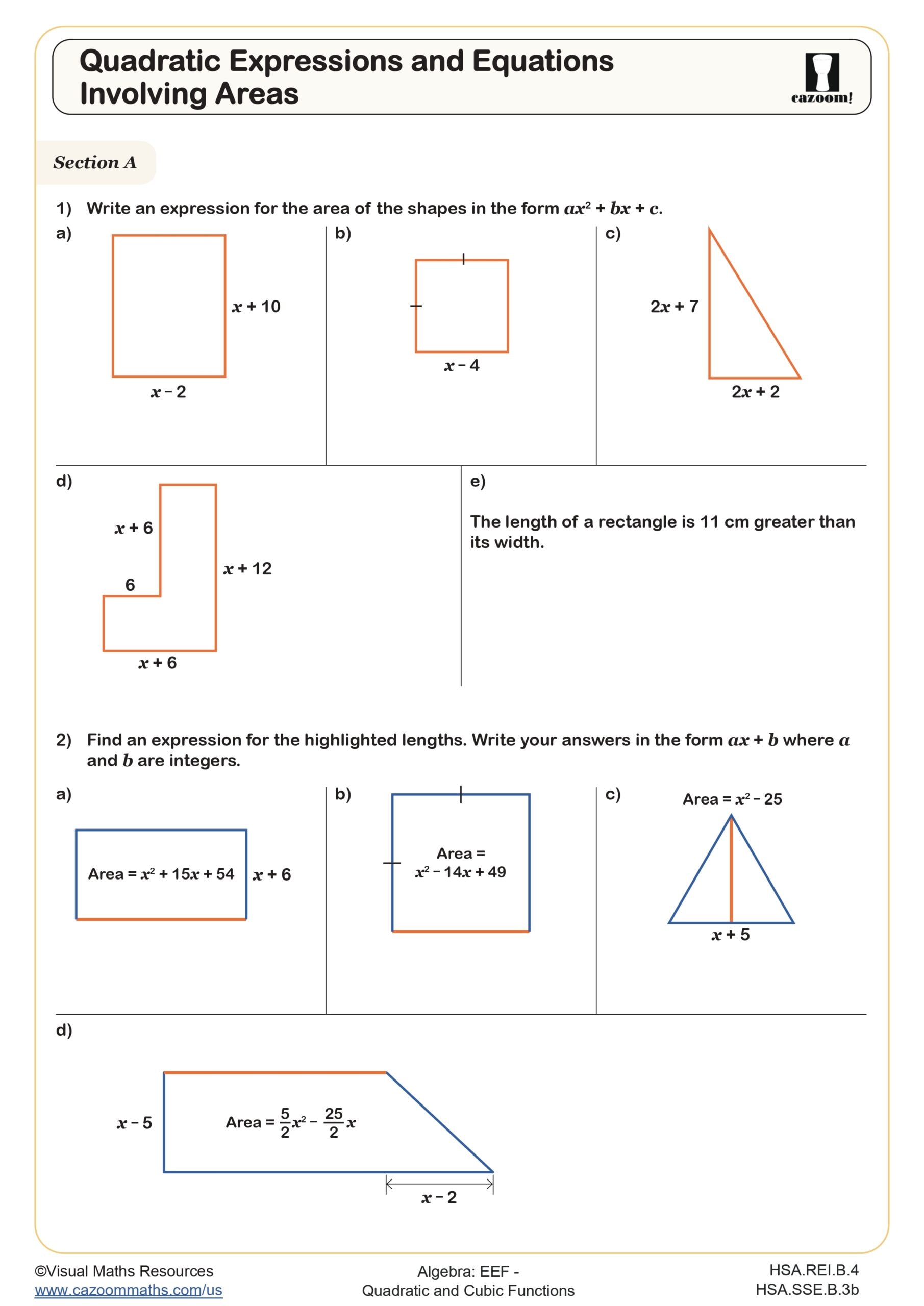
Quadratic Expressions and Equations Involving Areas
Grades: Algebra II, IM 2
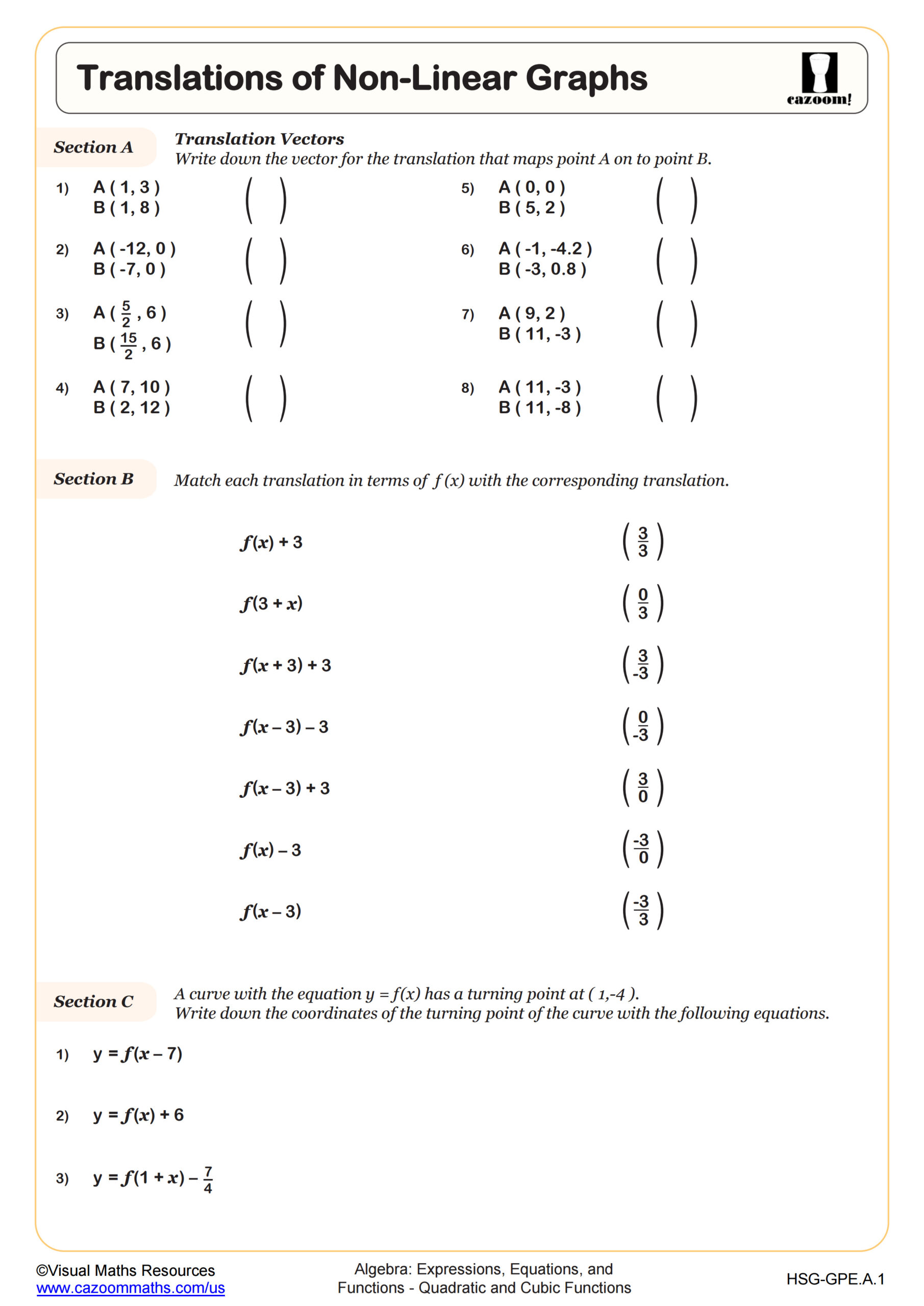
Translations of Non-Linear Graphs
Grades: Algebra II, IM 3
All worksheets are created by the team of experienced teachers at Cazoom Math.
What should teachers look for in a graphing quadratics worksheet?
Effective graphing quadratics worksheets should include problems covering all three forms of quadratic functions: standard form (ax² + bx + c), vertex form (a(x - h)² + k), and factored form (a(x - p)(x - q)). Teachers need materials that require students to identify key features like vertex, axis of symmetry, y-intercept, and x-intercepts across different representations.
Many teachers observe that students memorize graphing procedures without understanding the connection between algebraic and graphical representations. The strongest worksheets include problems requiring students to match equations to graphs, determine transformations from parent functions, and interpret real-world contexts. This approach helps students recognize that changing coefficients in quadratic equations creates predictable changes in the parabola's shape and position.
Which grade levels typically use quadratic and cubic functions worksheets?
Quadratic functions typically appear in Algebra 1 courses, usually taught in 9th or 10th grade, while cubic functions are introduced in Algebra 2 or Pre-Calculus classes. However, gifted 8th-grade students often encounter quadratic functions in accelerated programs, and some states include basic quadratic concepts in their 8th-grade standards under nonlinear relationships.
Teachers notice significant variation in student readiness even within the same grade level. Some students master factoring and solving quadratic equations but struggle with graphing transformations, while others excel at visual pattern recognition but need additional support connecting graphs to algebraic forms. This variation makes differentiated practice materials particularly valuable for addressing diverse learning needs within a single classroom.
How do graphing quadratic functions worksheets address different algebraic forms?
Quality graphing quadratic functions worksheets systematically address each form of quadratic equations with targeted practice problems. Students work with standard form to identify direction of opening and y-intercept, vertex form to determine transformations from the parent function, and factored form to locate x-intercepts quickly. The progression helps students recognize advantages of each form for different types of problems.
Teachers frequently observe that students struggle most with graphing quadratics in all three forms when they treat each form as completely separate concepts rather than different representations of the same function. Effective worksheets include comparison problems where students graph the same quadratic function written in different forms, helping them recognize the underlying connections and choose the most efficient form for specific tasks.
How can teachers use these worksheets to address common student misconceptions?
Teachers can use these worksheets strategically to address the most persistent misconceptions about quadratic and cubic functions. Many students incorrectly assume all parabolas have the same width or that negative leading coefficients only affect direction, not steepness. Worksheets with side-by-side graphing problems help students visualize how coefficient changes affect graph characteristics systematically.
The answer keys become valuable teaching tools when teachers review common errors with the whole class. Many educators find that projecting worksheet solutions and discussing incorrect approaches helps students recognize their own misconceptions. This approach works particularly well with cubic function worksheets, where students often struggle to predict the number and location of x-intercepts based on the algebraic form alone.
Prerequisite Knowledge to Learn Quadratic Functions
Before learning quadratic functions, students should understand:
• How to plot points and graph linear equations
• The basic forms of algebraic expressions
• How to factor simple quadratics
• Solving equations using inverse operations
• Properties of exponents and order of operations
Our worksheets reinforce these concepts and gently introduce more advanced skills as students progress.
FAQs: Quadratic Functions Worksheets
Q: What grade level are these worksheets for?
A: These are best for 8th grade, Algebra 1, Algebra 2, and high school math students.
Q: Do these worksheets include graphing activities?
A: Yes, many worksheets include graphing quadratics and interpreting graphs.
Q: Can students use these for test review?
A: Absolutely. These are ideal for test prep, classwork, or extra homework.
Q: Are the worksheets aligned with the Common Core?
A: Yes, the content matches Common Core standards for algebra and functions.