Bearings Scale and Loci Worksheets
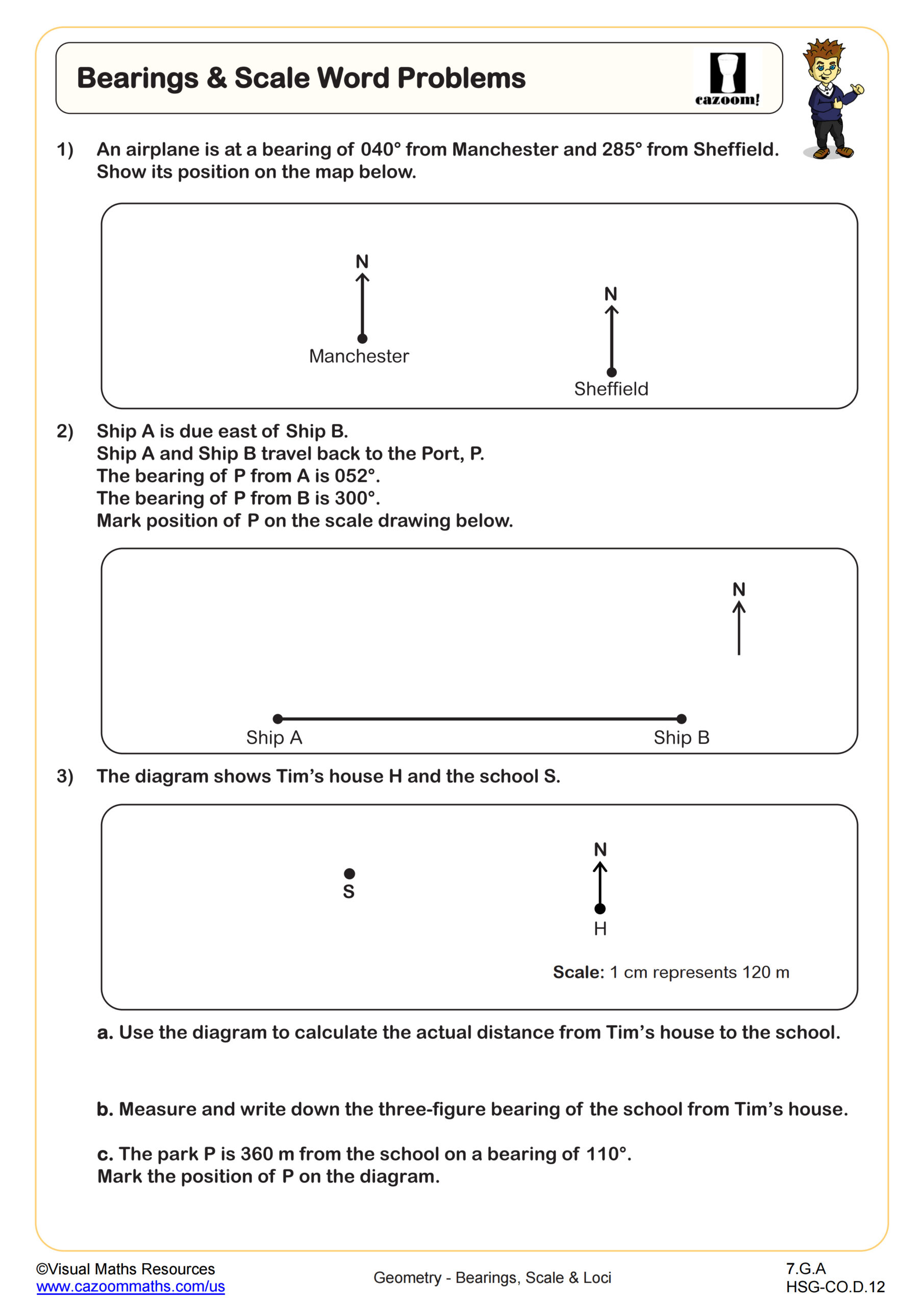
Bearings and Scale Word Problems
Grades: 7th Grade, Geometry
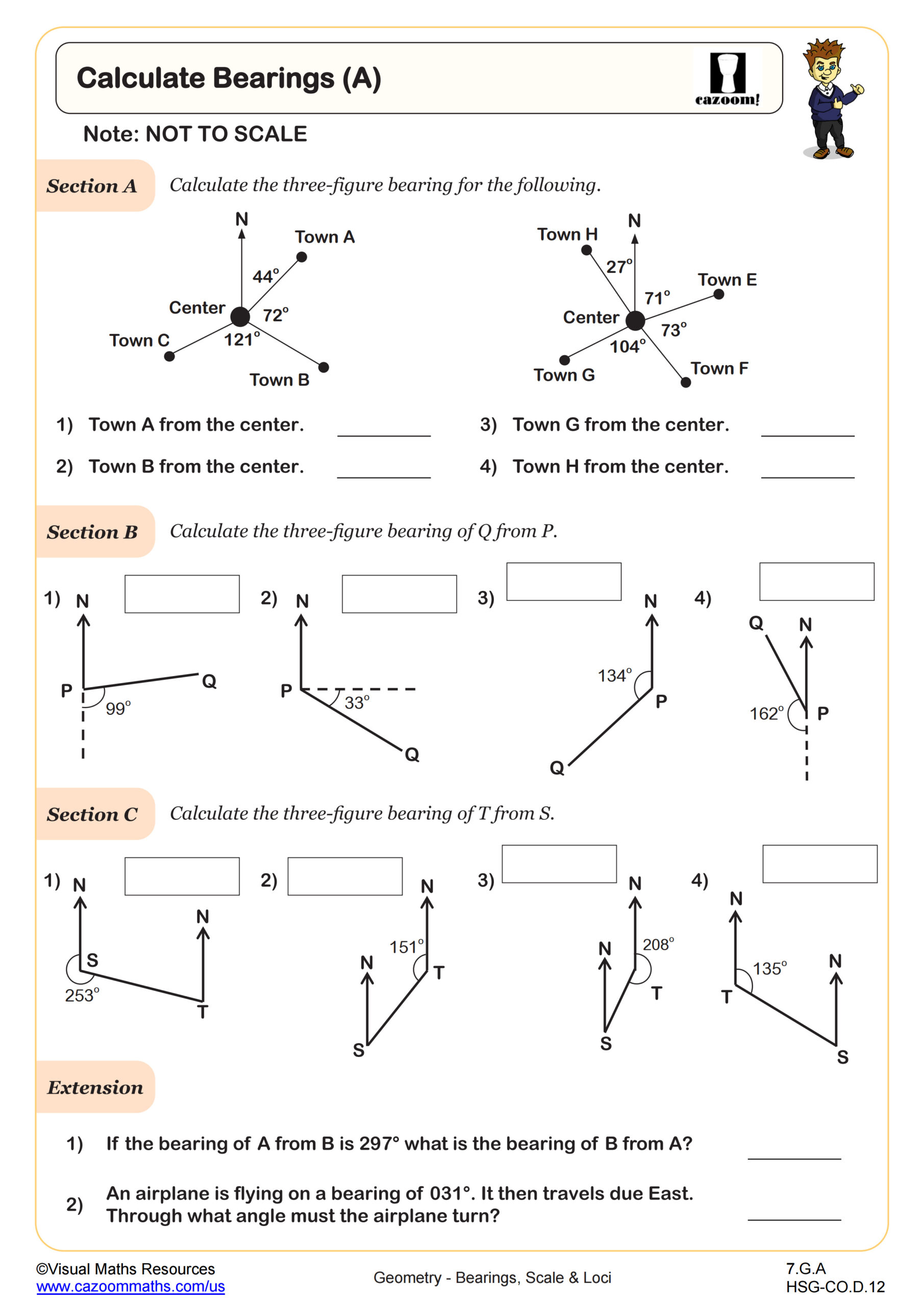
Calculating Bearings (A)
Grades: 7th Grade, Geometry
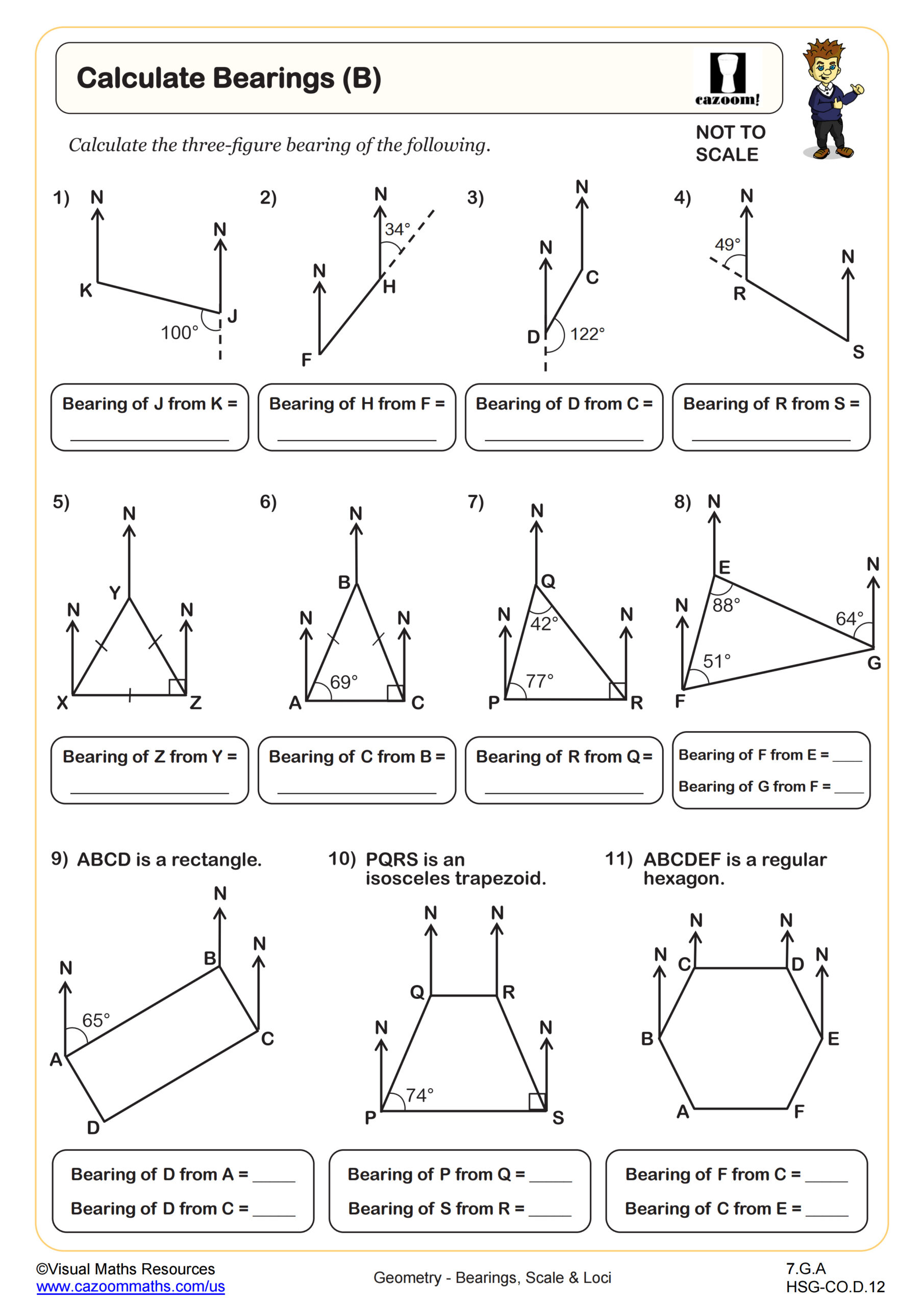
Calculating Bearings (B)
Grades: 7th Grade, Geometry
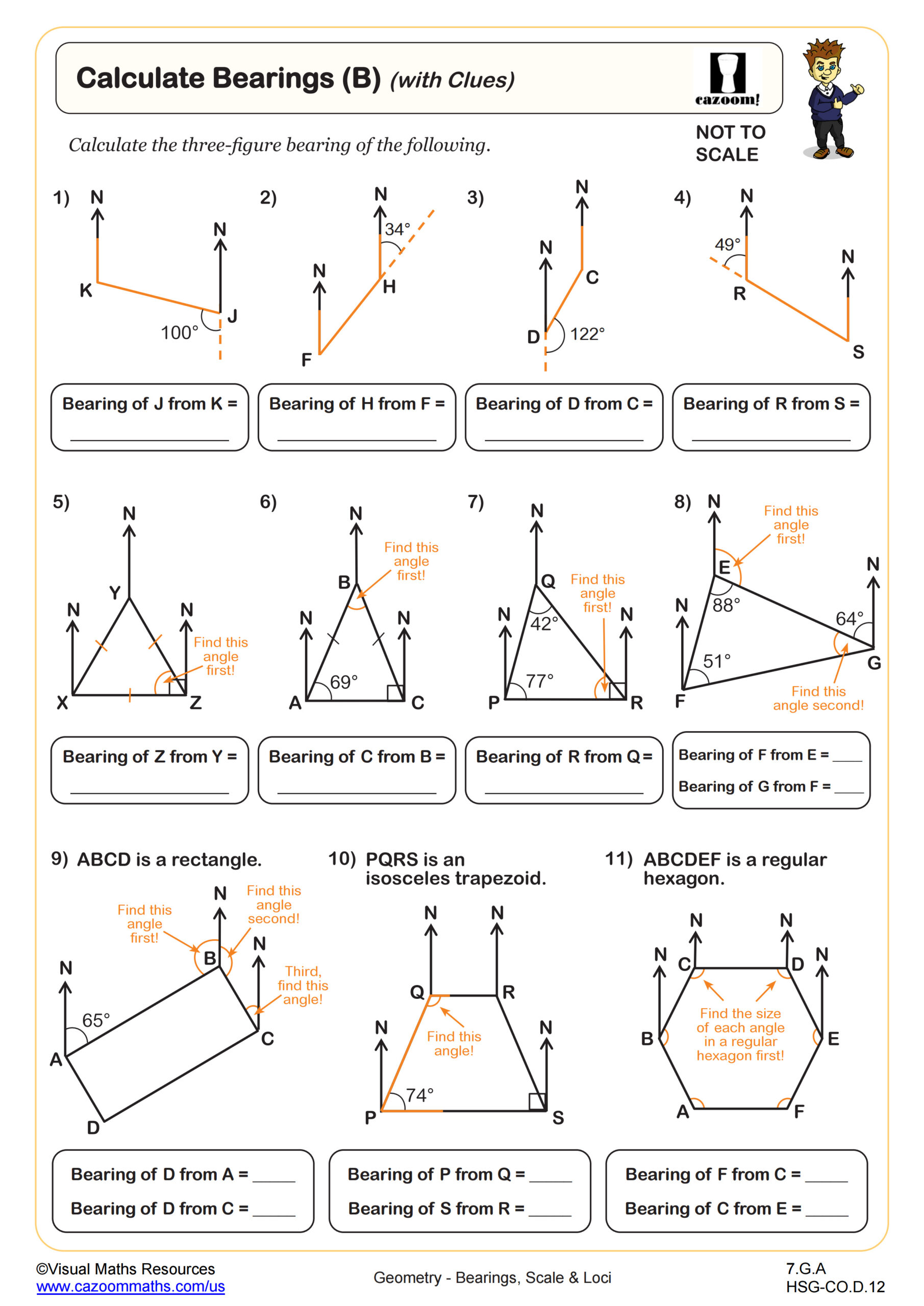
Calculating Bearings (B) (With Clues)
Grades: 7th Grade, Geometry
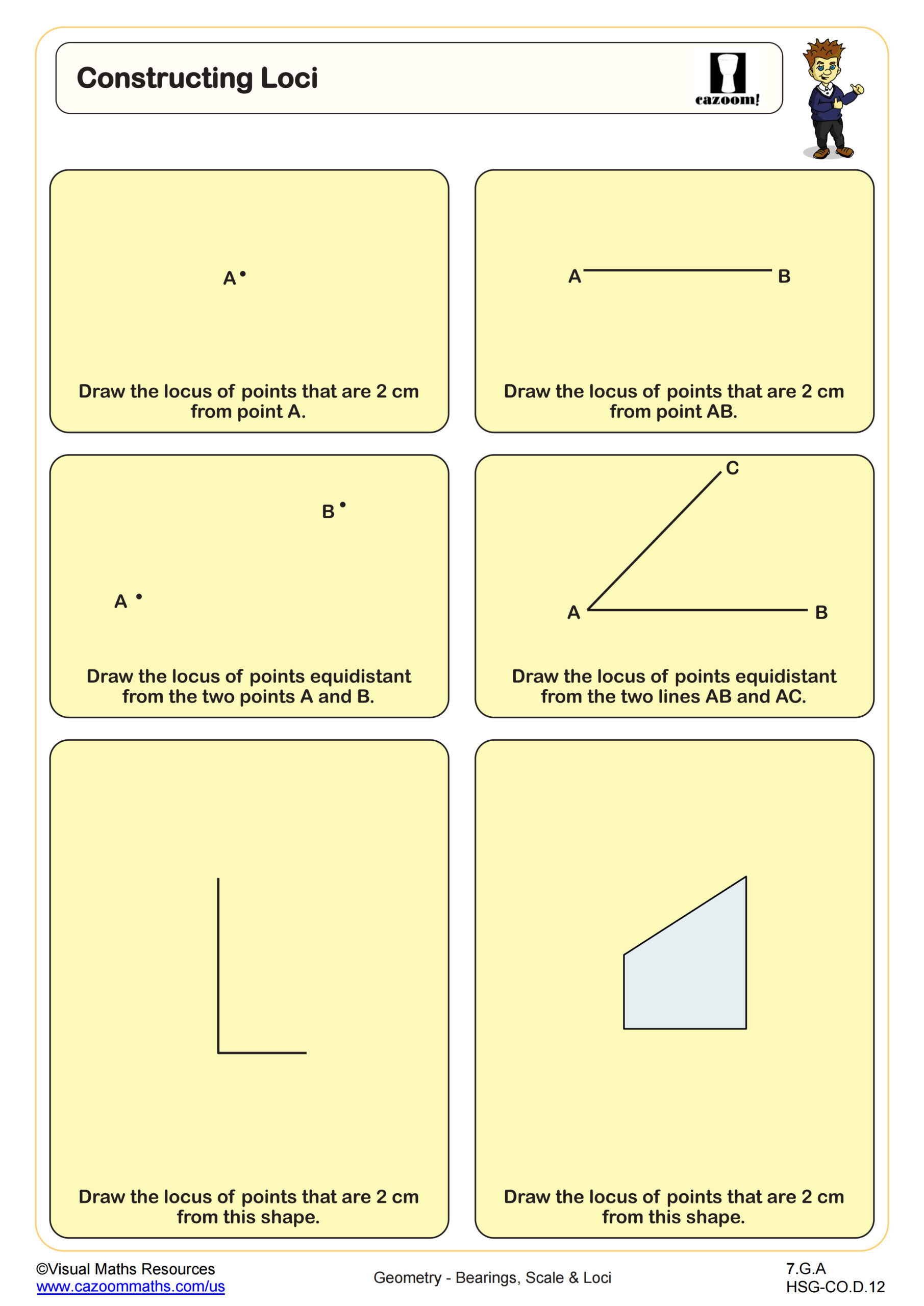
Constructing Loci
Grades: 7th Grade, Geometry
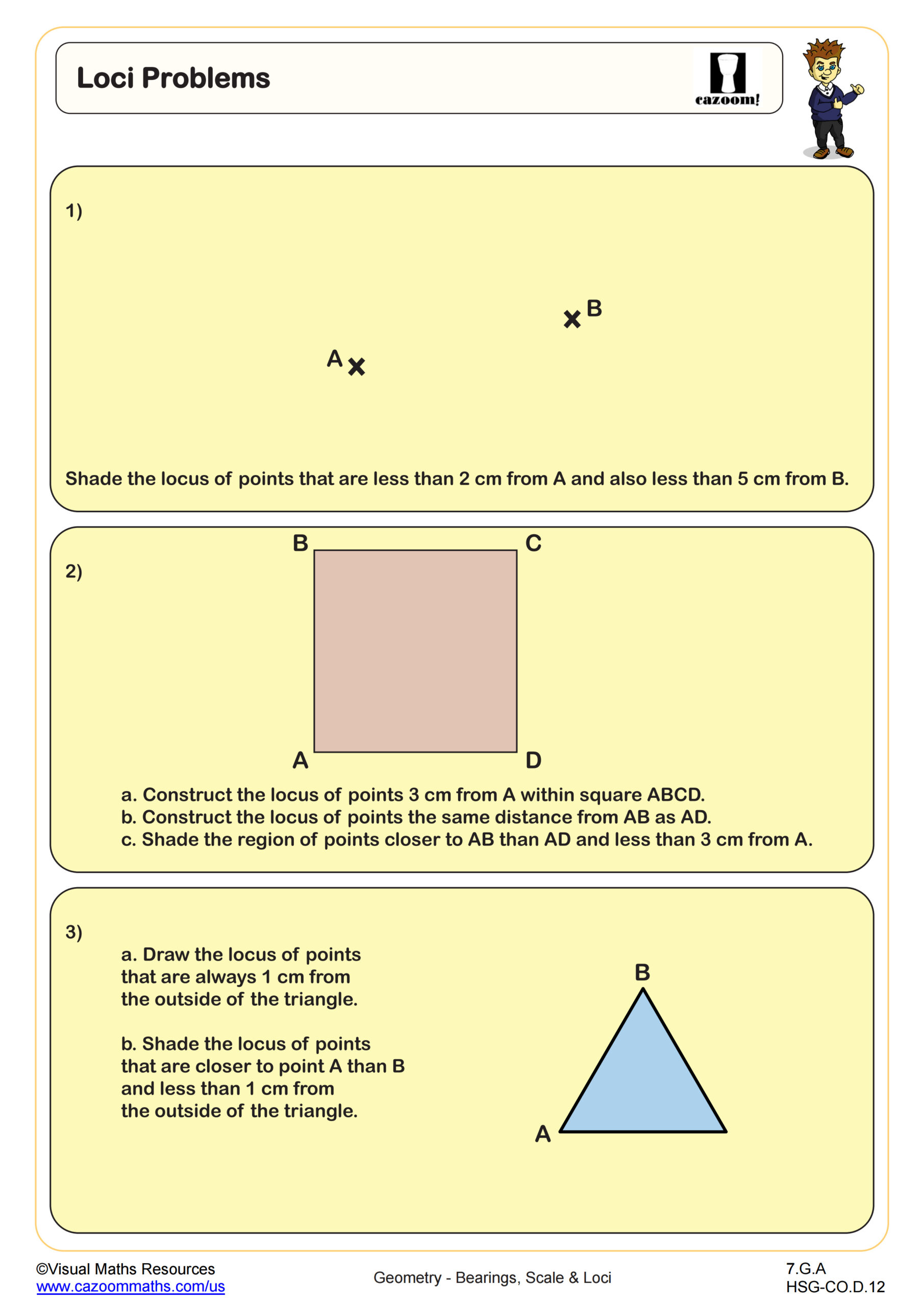
Loci Problems
Grades: 7th Grade, Geometry
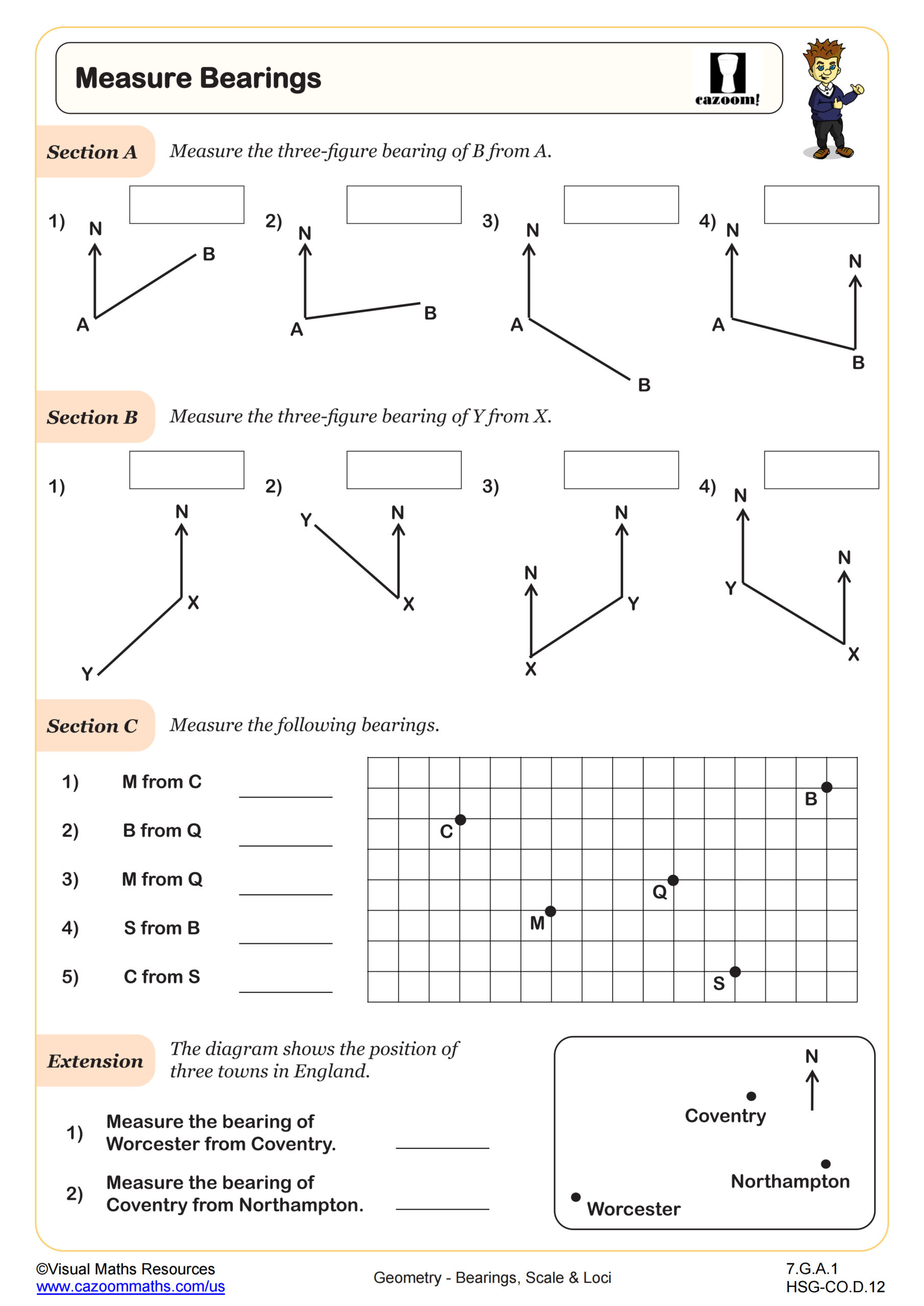
Measuring Bearings
Grades: 7th Grade, Geometry
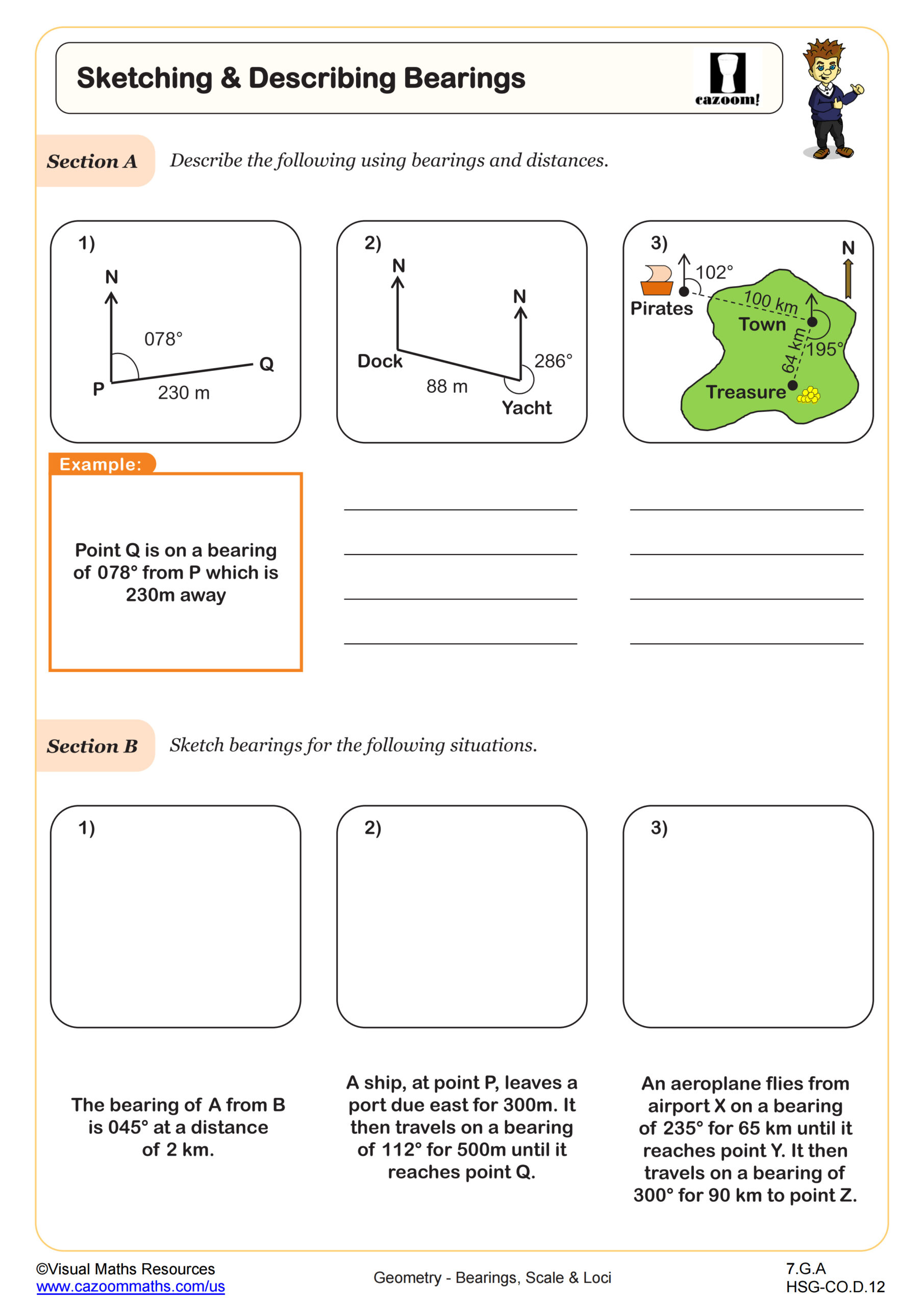
Sketching and Describing Bearings
Grades: 7th Grade, Geometry
All worksheets are created by the team of experienced teachers at Cazoom Math.
How do scale drawing and bearing problems connect in geometry?
Scale drawing and bearing problems combine when students must interpret maps, architectural plans, or navigation charts where distances are proportionally reduced and directions are given as precise angular measurements. These integrated problems appear frequently in Common Core geometry standards and state assessments, requiring students to convert between different scales while maintaining accurate bearing calculations.
Teachers observe that students often struggle when switching between map scales and real-world distances within the same problem, particularly when bearings must be measured from scaled reference points. The most effective approach involves having students first establish the scale relationship, then plot bearings from the correct scaled positions before calculating actual distances or final coordinates.
Which grade levels typically work with bearings and loci?
Bearings and loci concepts typically begin in middle school grades 6-8 with basic compass directions and simple distance relationships, then advance to high school geometry and trigonometry courses where three-figure bearings and complex loci construction become standard topics. Advanced placement courses and college-prep geometry classes emphasize real-world applications in surveying, navigation, and engineering contexts.
The progression moves from plotting basic compass bearings to constructing perpendicular bisectors and angle bisectors as loci, then to solving problems involving multiple geometric constraints. Teachers find that students benefit from hands-on compass and straightedge work before transitioning to coordinate-based loci problems, as the physical construction reinforces the underlying geometric relationships.
What makes three-figure bearing problems challenging for students?
Three-figure bearing measurements require students to understand that all angles are measured clockwise from north, expressed as three digits even when less than 100 degrees. This differs significantly from standard coordinate plane angle measurement, where positive angles typically move counterclockwise from the positive x-axis, creating confusion when students apply familiar angle concepts.
Teachers consistently observe errors when students attempt to convert between bearing notation and standard angle measures, particularly in problems involving vectors or coordinate geometry. The key breakthrough occurs when students practice drawing compass roses and physically rotating from north to visualize the clockwise measurement system, rather than relying solely on algebraic conversion formulas.
How can teachers use these worksheets most effectively in class?
Teachers achieve better results when they begin each worksheet session with a brief compass and protractor demonstration, showing how bearings relate to physical navigation tools before students tackle abstract problems. The answer keys allow for immediate verification of geometric constructions, which is crucial since small errors in compass work compound quickly in multi-step loci problems.
The most successful classroom approach pairs individual worksheet practice with collaborative problem-solving, where students compare their loci constructions and discuss different valid approaches to compound geometric constraints. Teachers report that having students explain their reasoning aloud while reviewing answer keys helps identify conceptual gaps that might otherwise go unnoticed in traditional paper-and-pencil assessment.