Estimation Worksheets With Answers
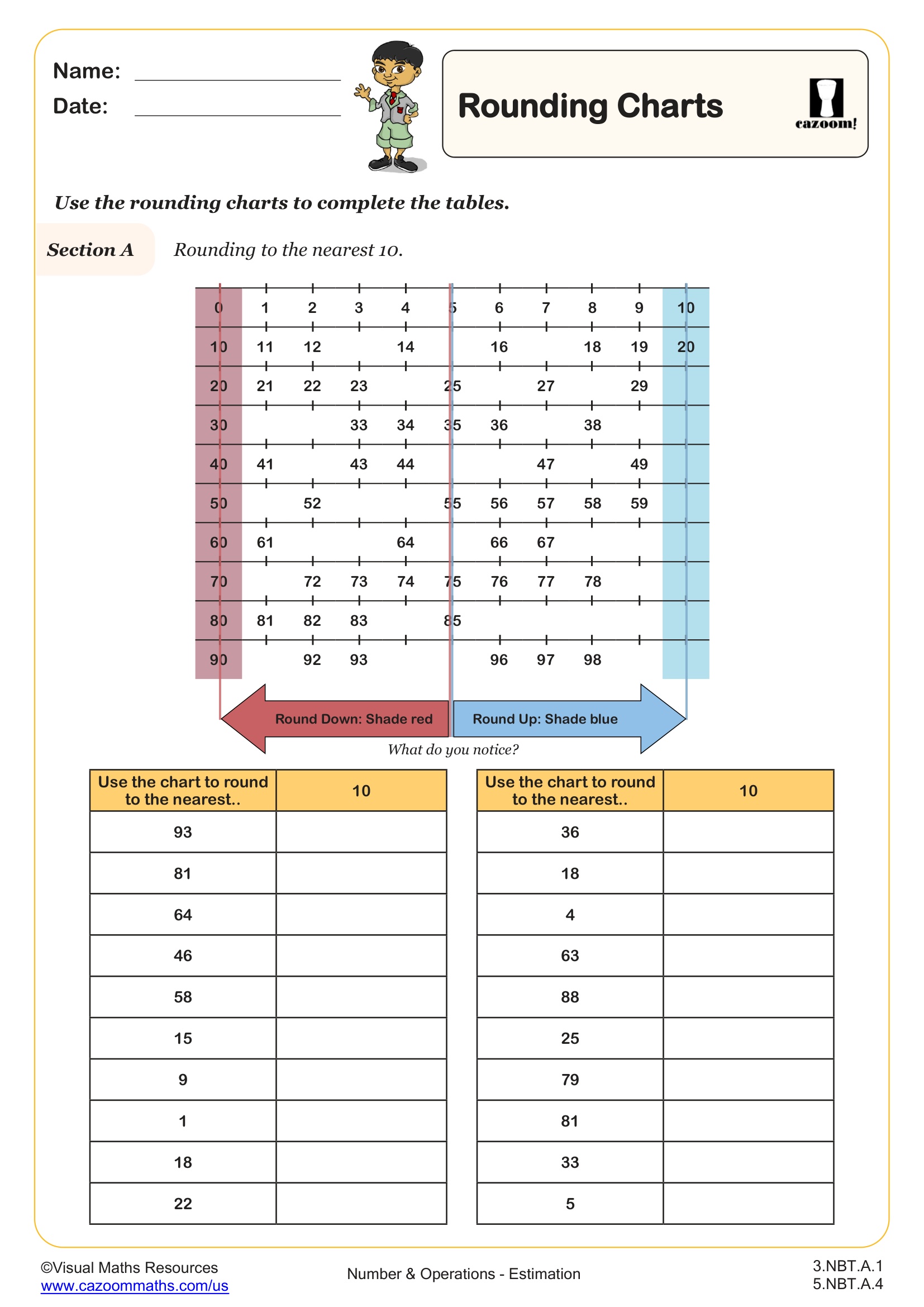
Rounding Charts
Grades: 3rd Grade, 5th Grade
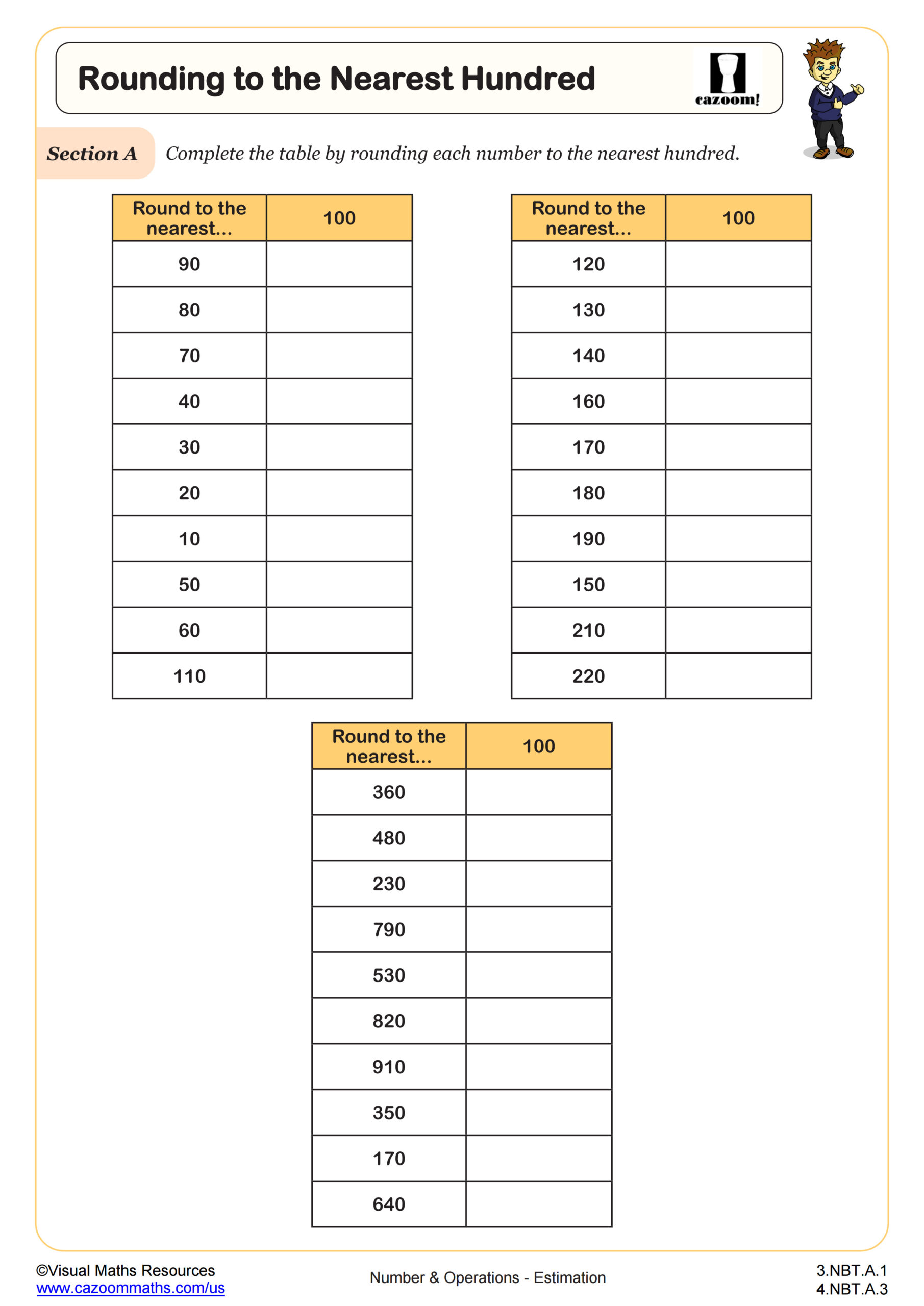
Rounding to the Nearest Hundred
Grades: 3rd Grade, 4th Grade
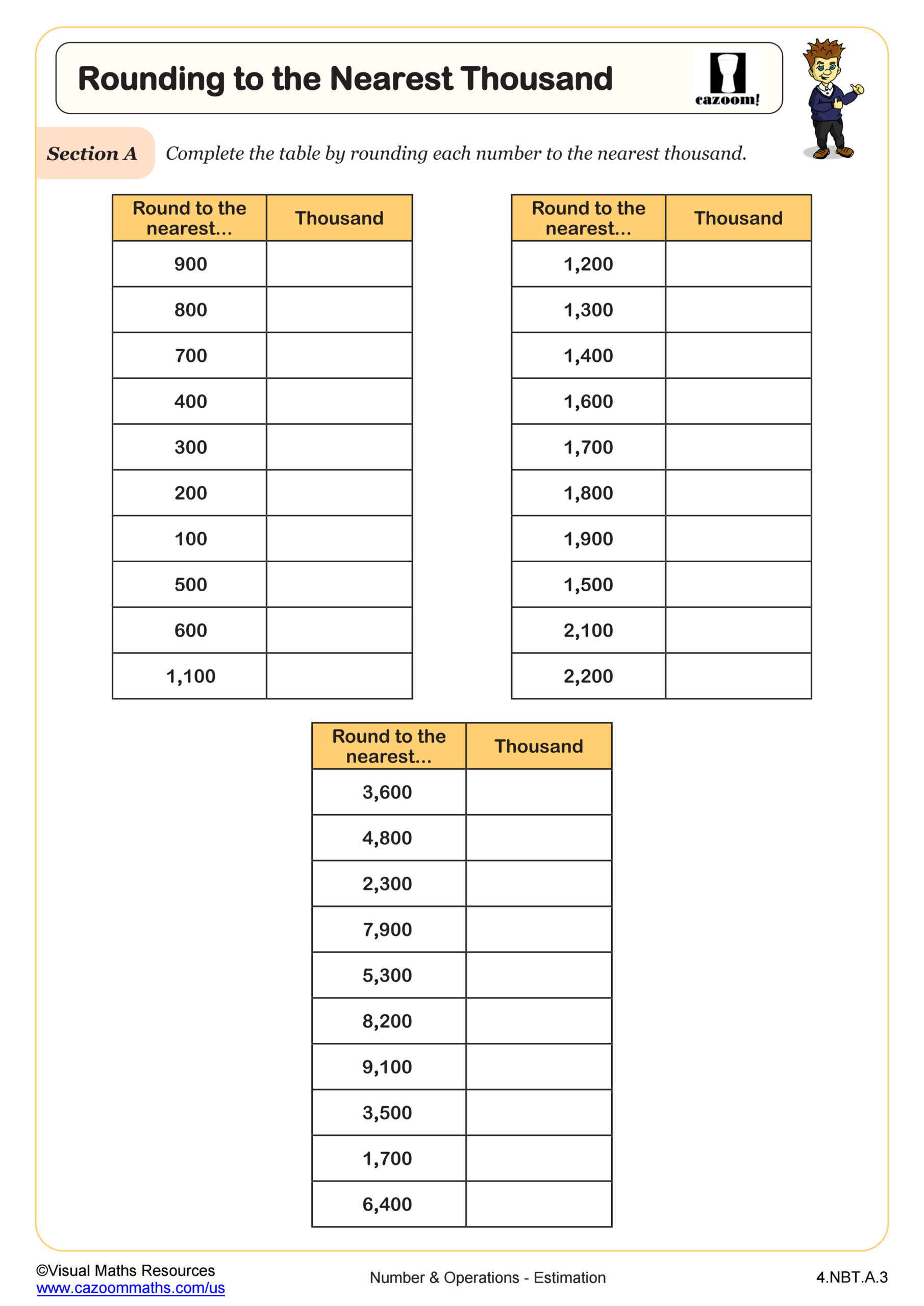
Rounding to the Nearest Thousand
Grades: 4th Grade
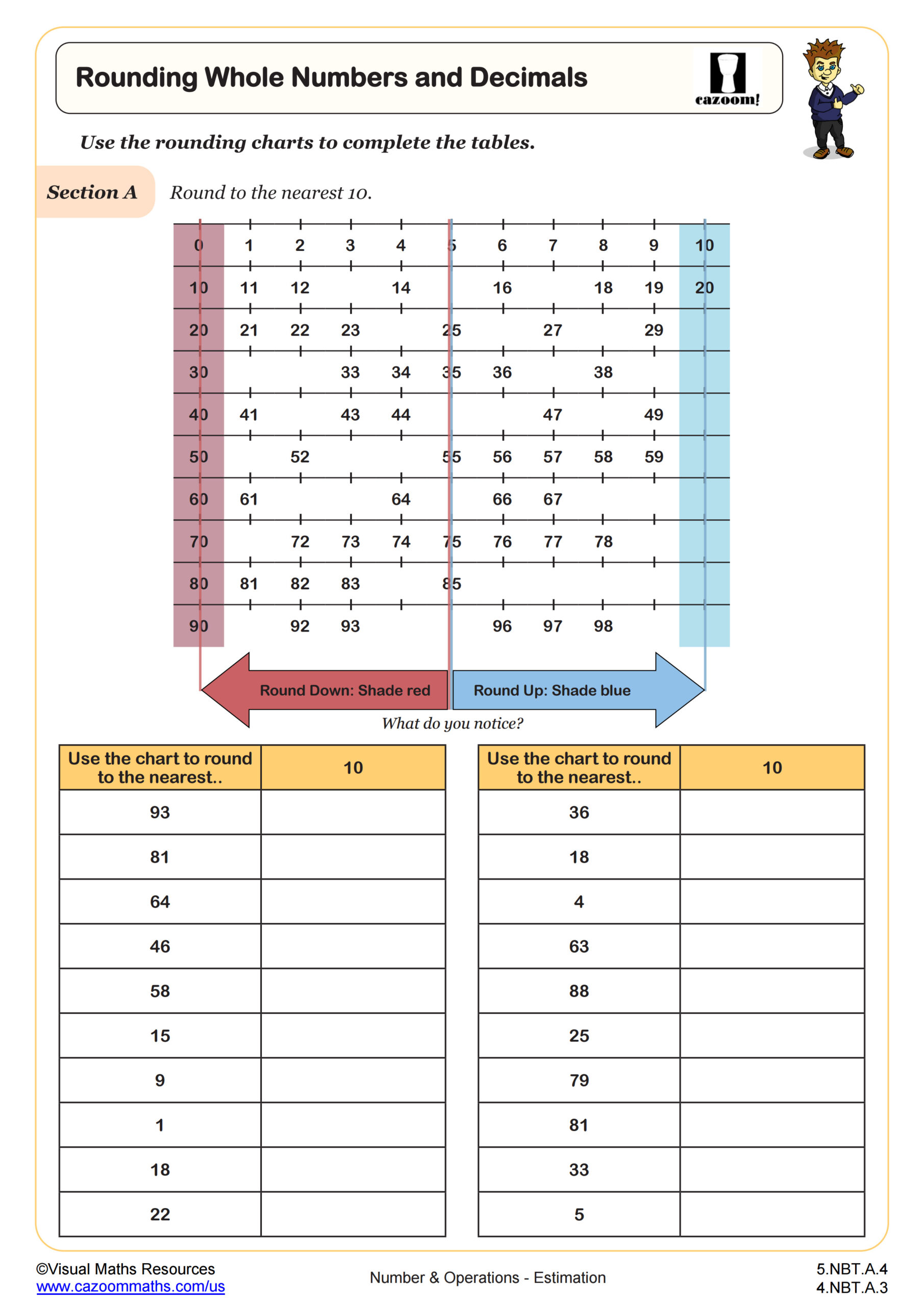
Rounding Whole Numbers and Decimals
Grades: 4th Grade, 5th Grade
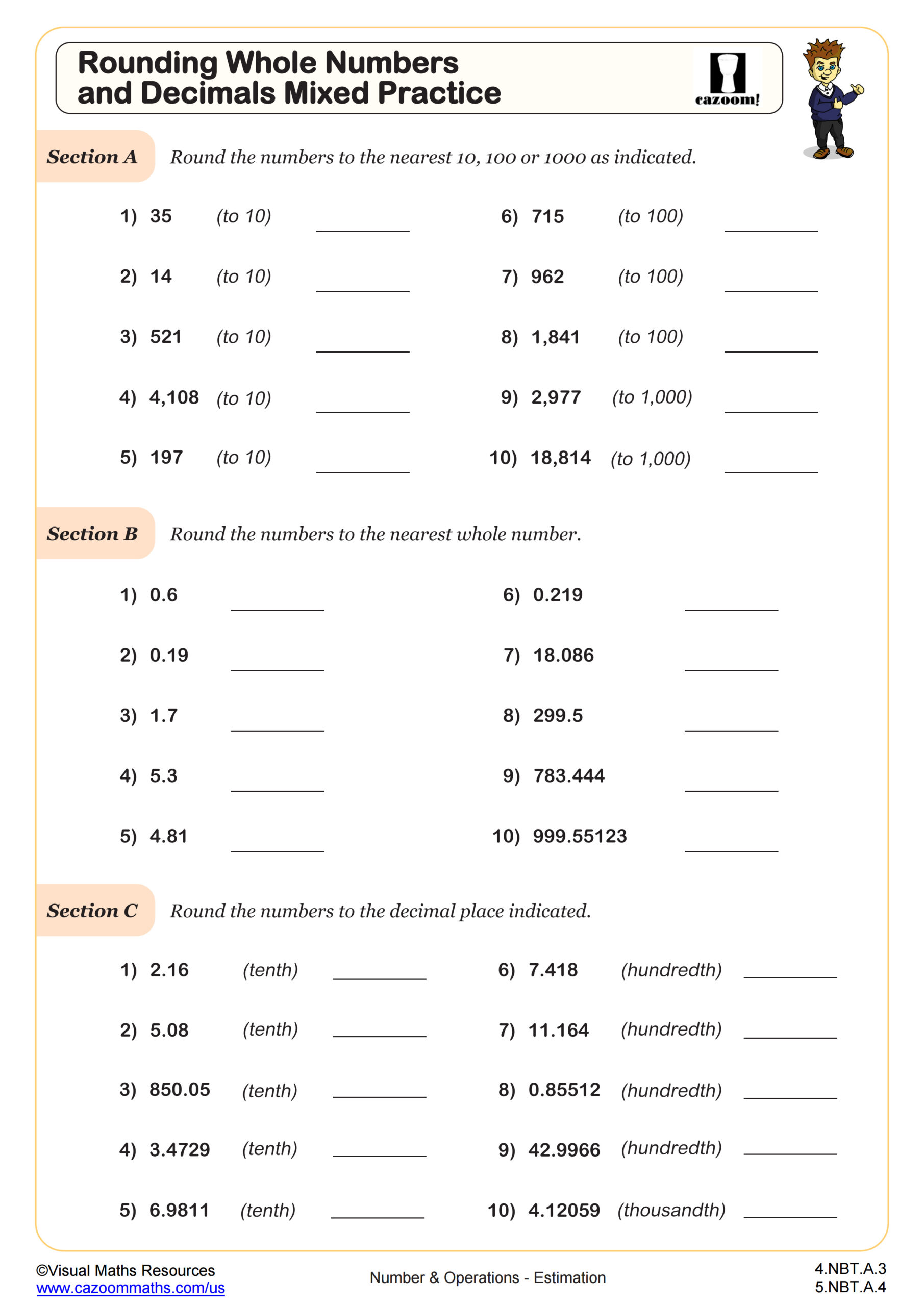
Rounding Whole Numbers and Decimals Mixed Practice
Grades: 4th Grade, 5th Grade
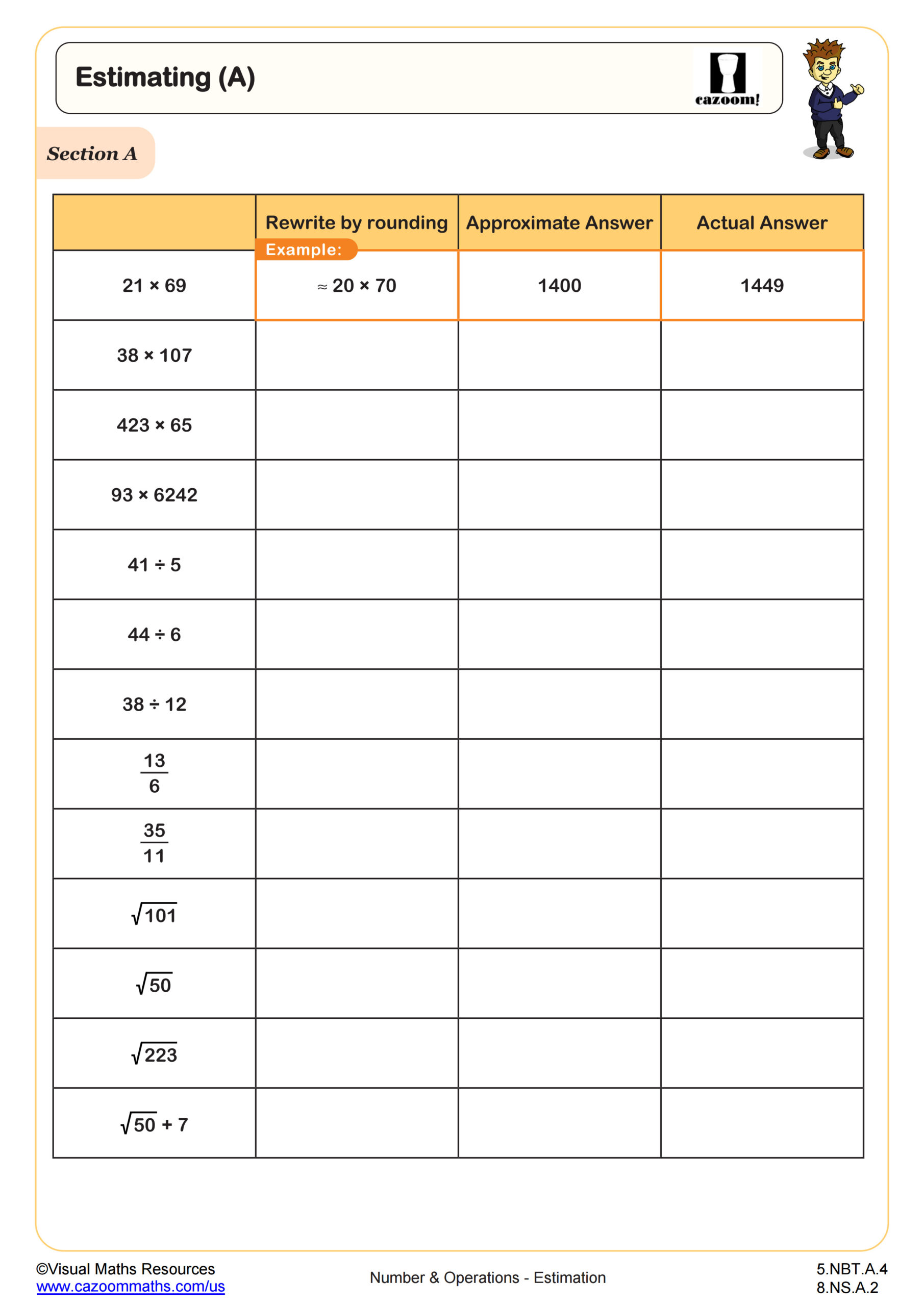
Estimating (A)
Grades: 5th Grade, 8th Grade
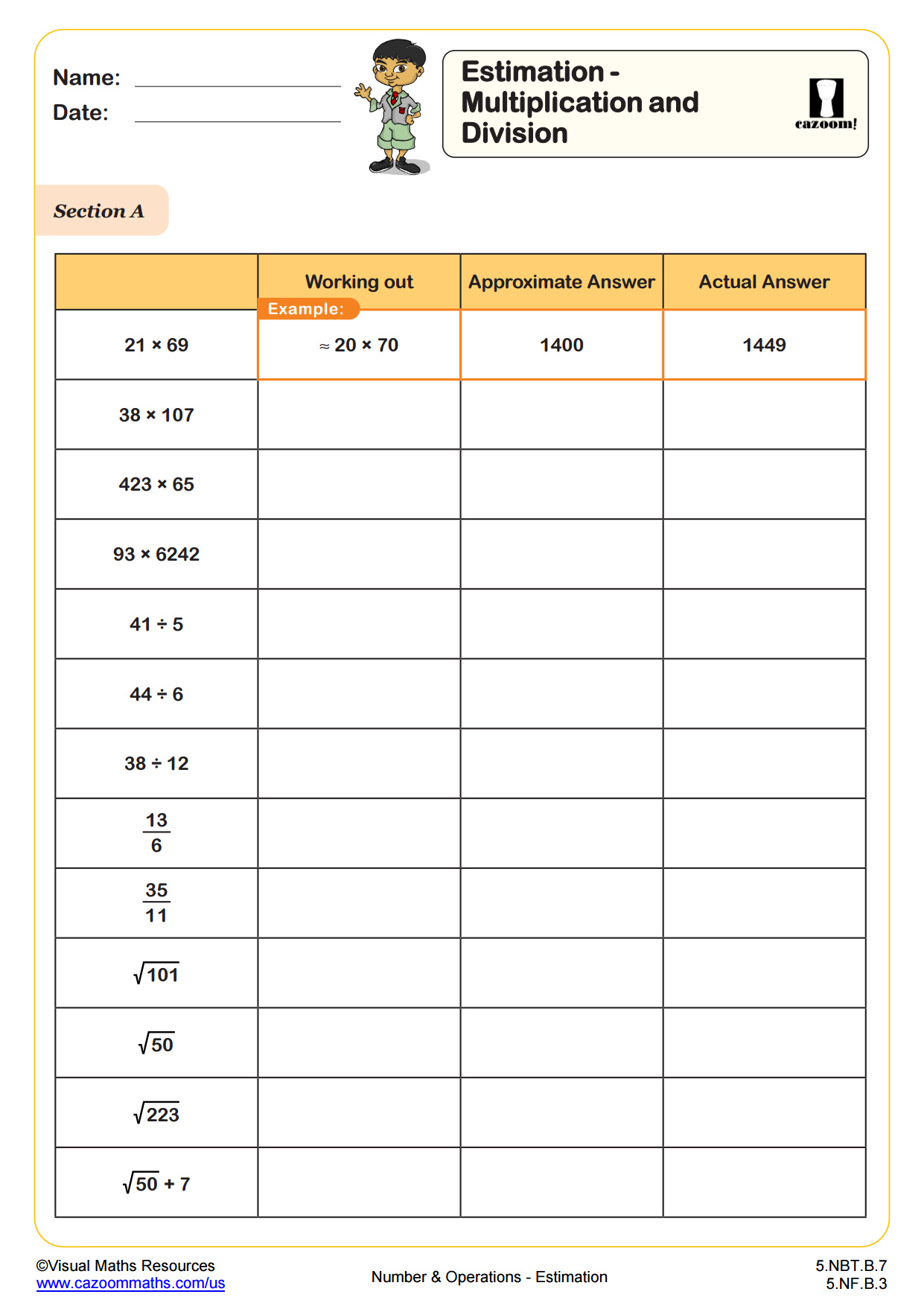
Estimation - Multiplication and Division
Grades: 5th Grade
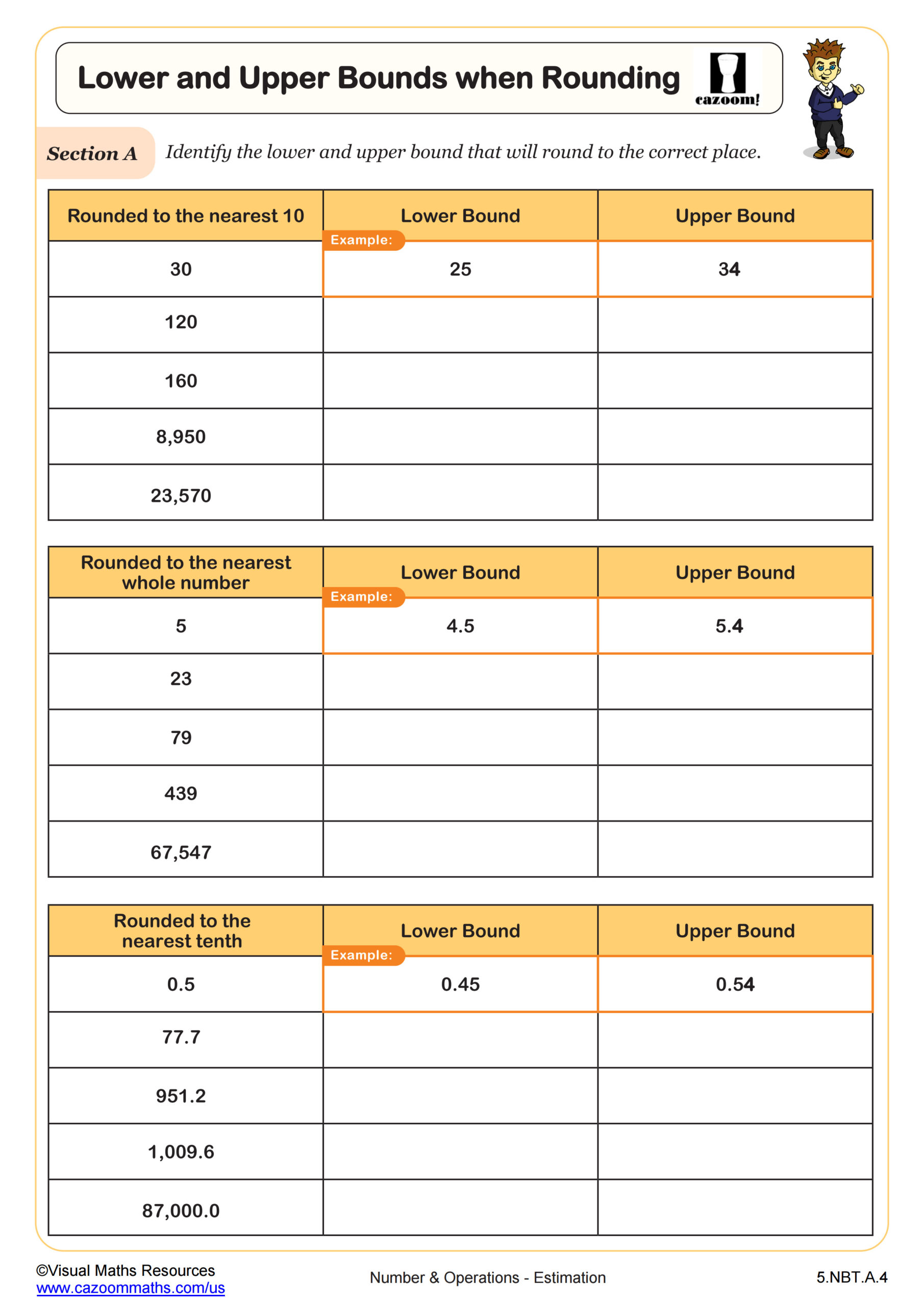
Lower and Upper Bounds when Rounding
Grades: 5th Grade
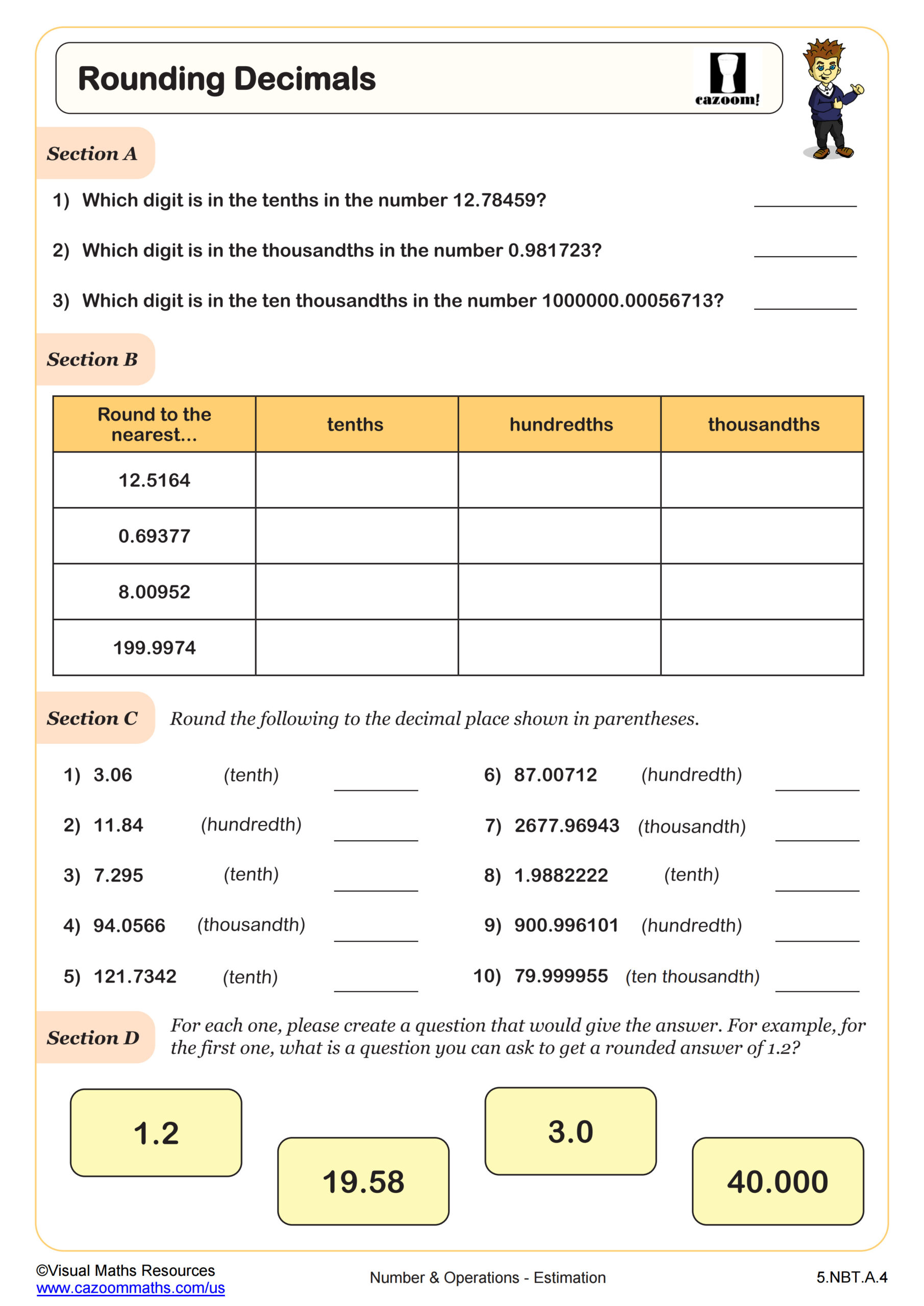
Rounding Decimals
Grades: 5th Grade
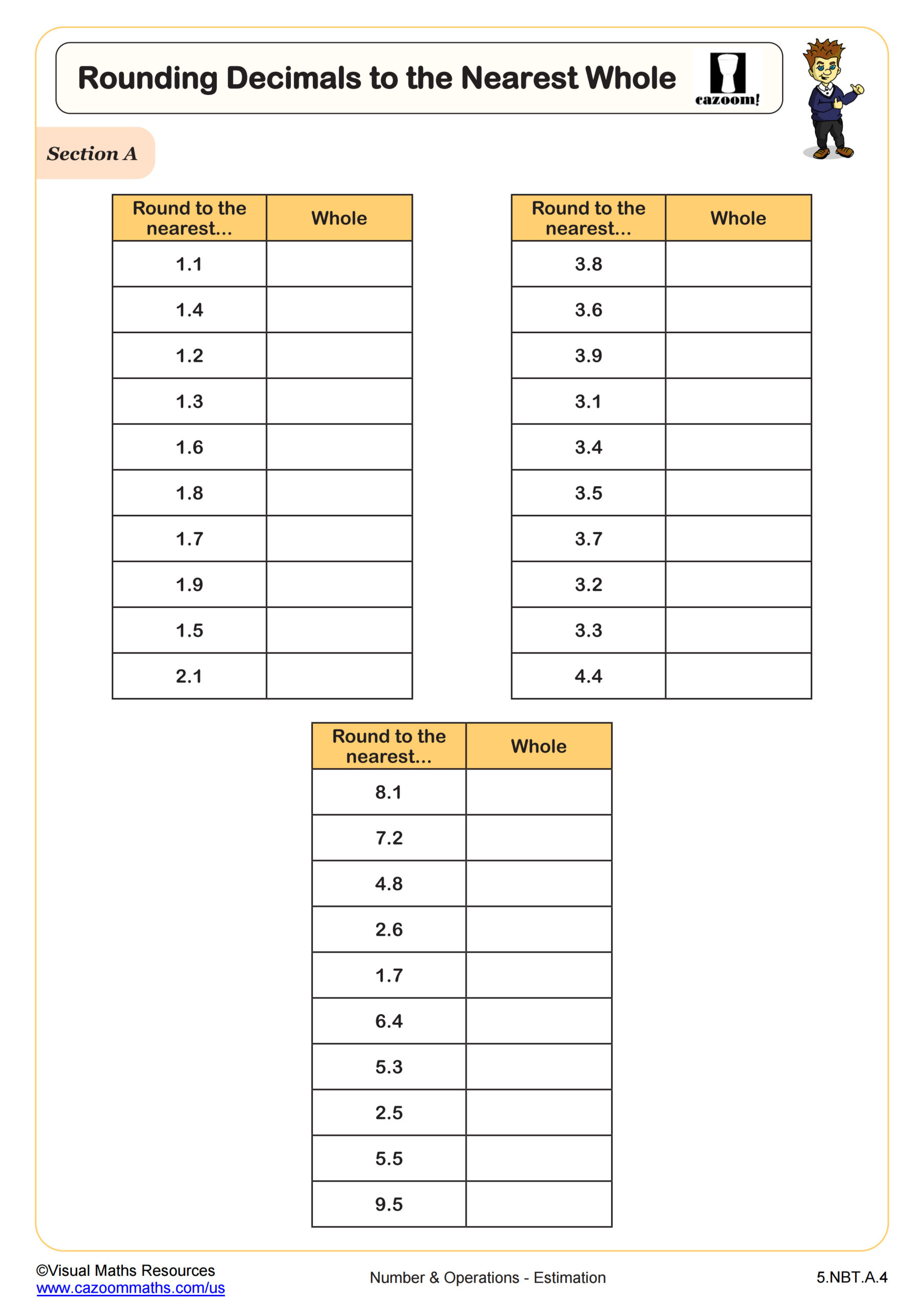
Rounding Decimals to the Nearest Whole
Grades: 5th Grade
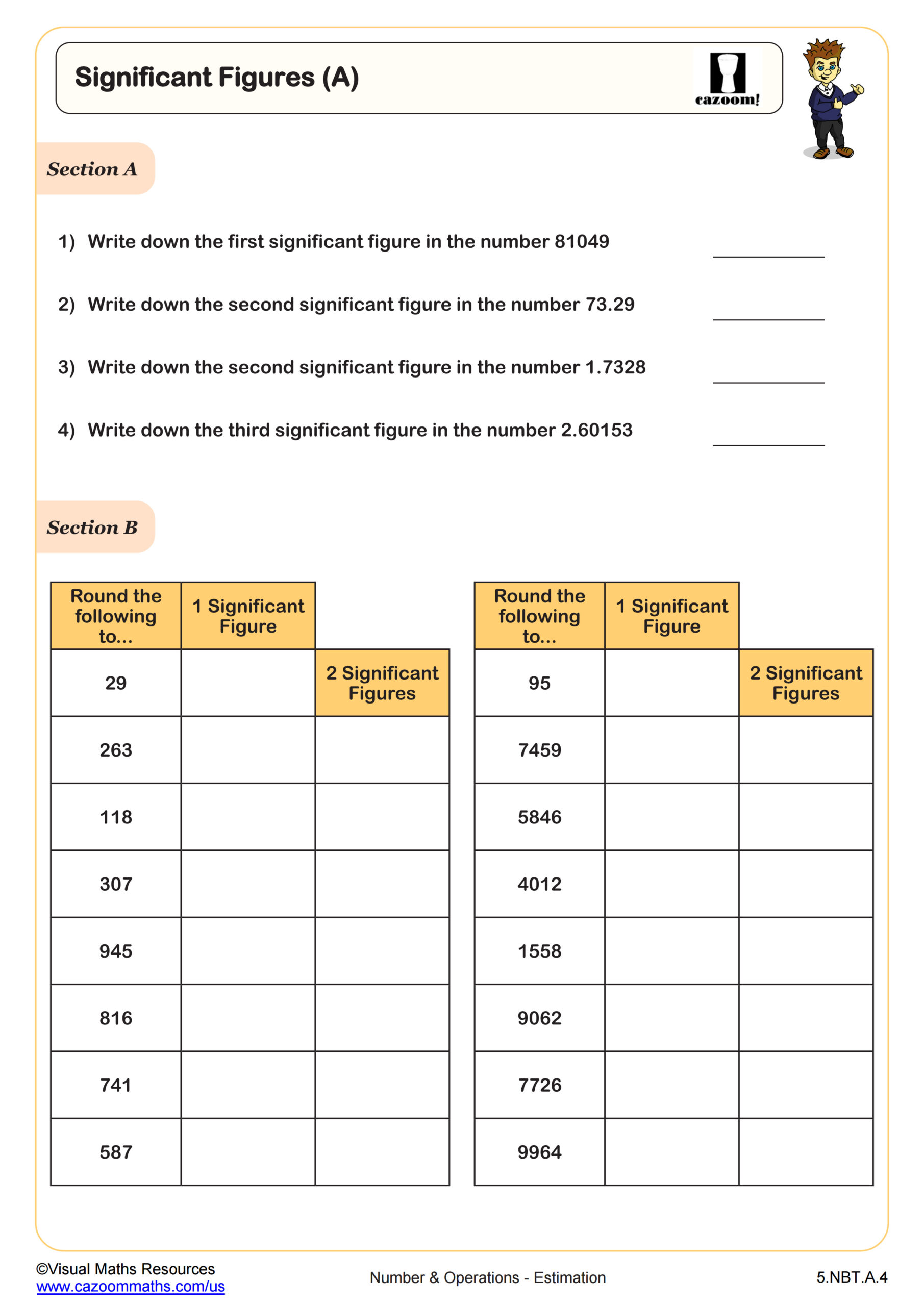
Significant Figures (A)
Grades: 5th Grade
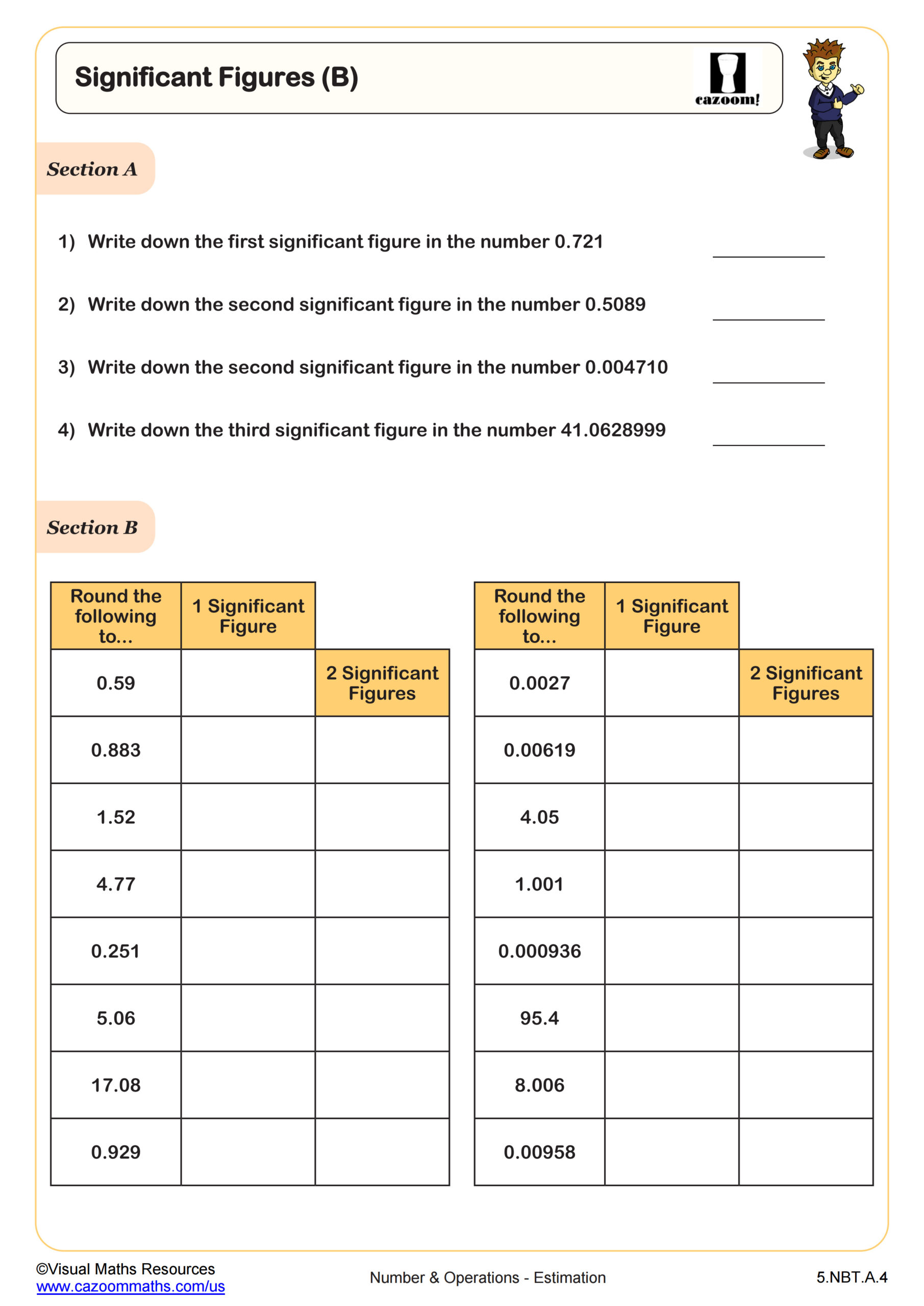
Significant Figures (B)
Grades: 5th Grade
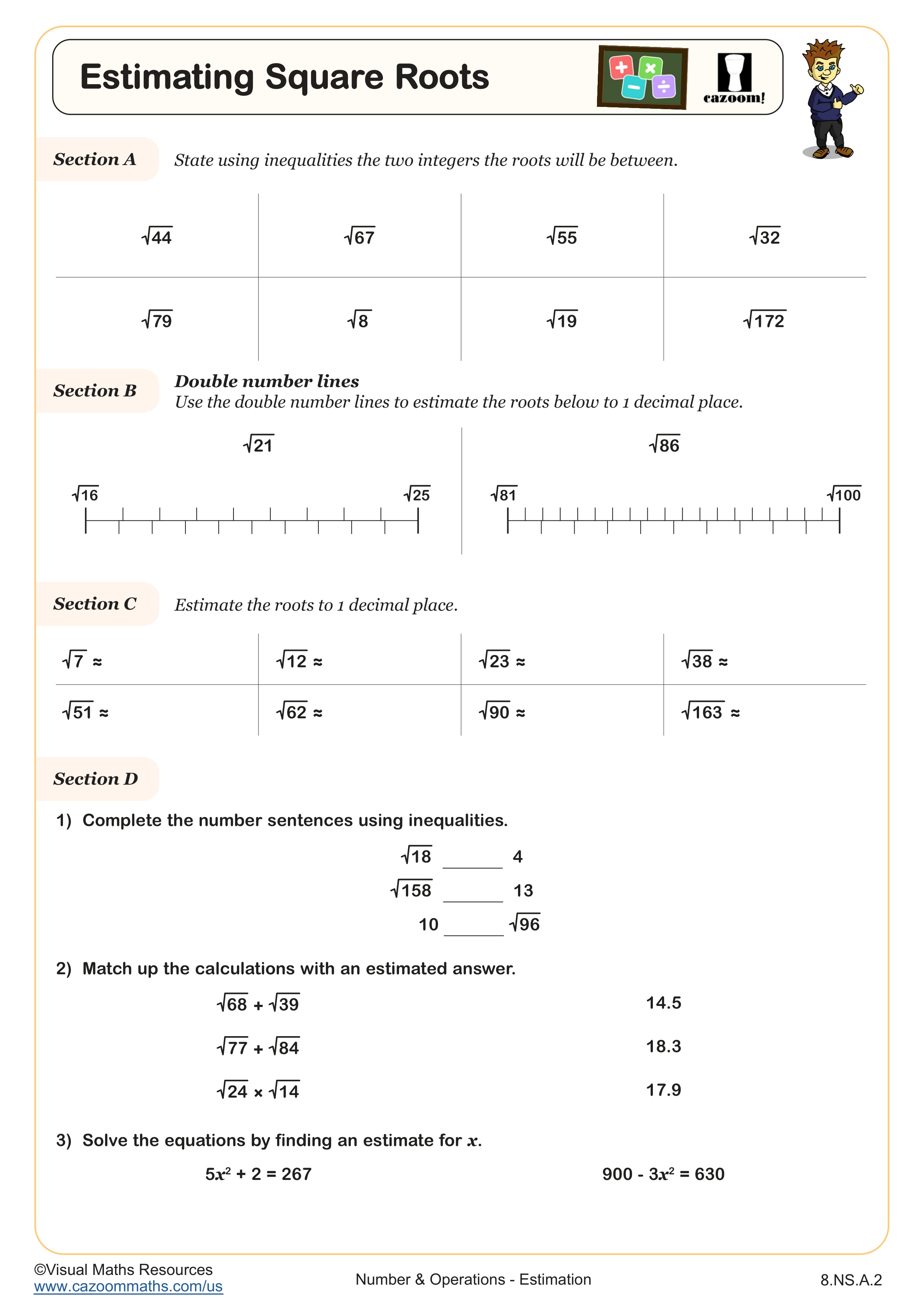
Estimating Square Roots
Grades: 8th Grade, IM 1
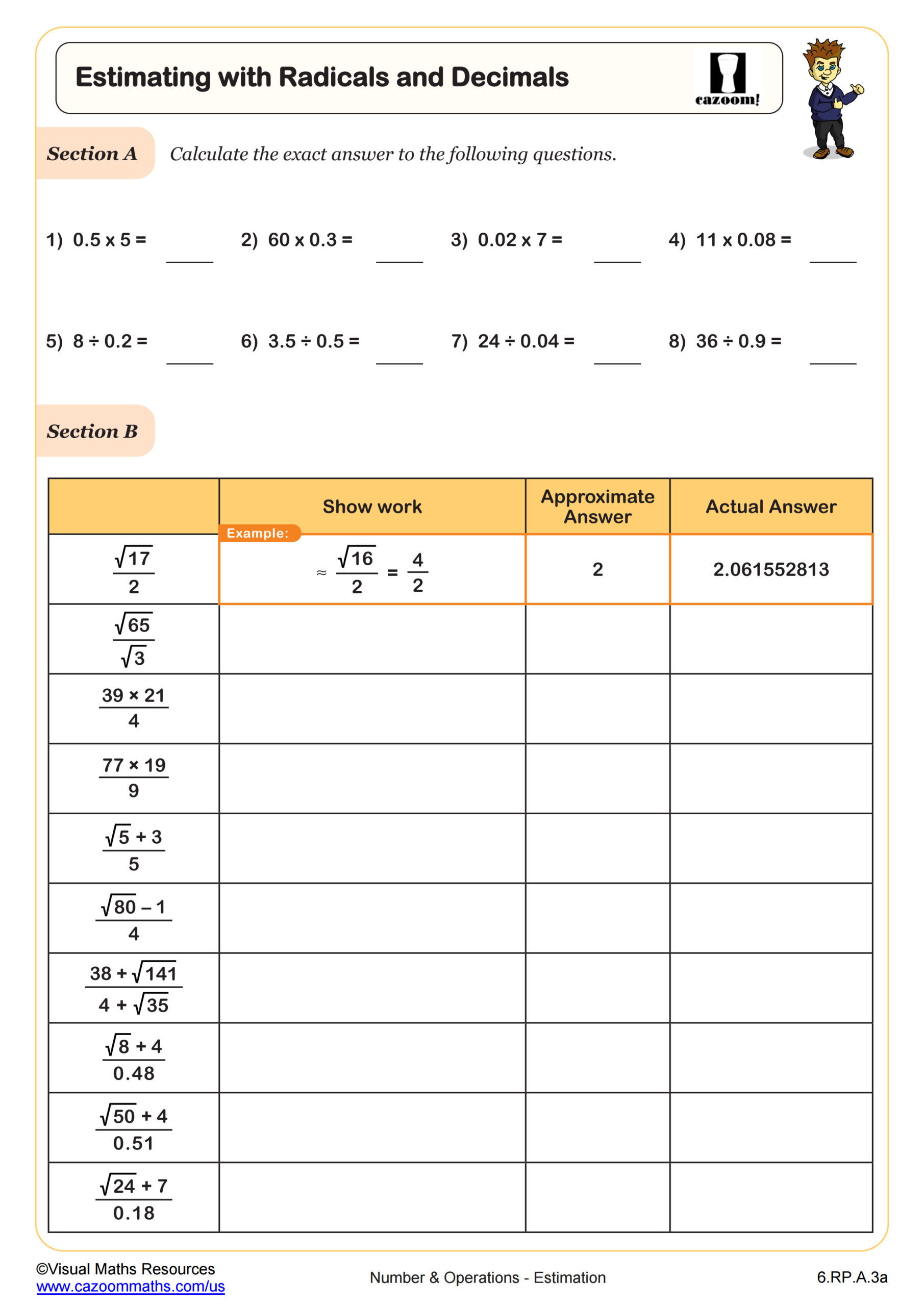
Estimating with Radicals and Decimals
Grades: 8th Grade
All worksheets are created by the team of experienced teachers at Cazoom Math.
What skills do estimation worksheets help students develop?
Estimation worksheets build critical number sense skills that align with Common Core standards across elementary and middle grades. Students learn to round numbers to appropriate place values, make reasonable predictions about calculation results, and develop mental math strategies that support problem-solving efficiency.
Teachers frequently observe that students who struggle with estimation often lack flexibility in their thinking about numbers. These worksheets help students move beyond rigid calculation methods by providing structured practice with different estimation strategies, from front-end estimation to compatible numbers, helping them choose the most effective approach for different problem types.
How do estimation skills progress across different grade levels?
Estimation skills develop systematically from kindergarten through middle school, with each grade level building complexity. Early elementary students begin with visual estimation and rounding to tens, while upper elementary students work with larger numbers and multiple operations. Middle school students apply estimation to decimals, fractions, and real-world scenarios.
Grade 3 estimation worksheets typically focus on rounding two-digit and three-digit numbers to estimate sums and differences, which teachers find crucial for building confidence before introducing multi-digit algorithms. By fifth grade, students estimate products and quotients while working with larger numbers, preparing them for more sophisticated mathematical reasoning in higher grades.
Why do rounding and estimating worksheets often appear together?
Rounding serves as the foundation for most estimation strategies, making these skills naturally interconnected in mathematics instruction. Students must master place value concepts and rounding rules before they can effectively estimate calculation results, which is why many worksheets combine both skills in progressive sequences.
Teachers notice that students who separate these concepts often struggle to see the purpose behind rounding rules. When worksheets present rounding as a tool for estimation rather than an isolated skill, students better understand why they round 47 to 50 when estimating 47 + 23, connecting the mechanical process to practical mathematical reasoning.
How can teachers use these worksheets most effectively in their classrooms?
Effective implementation involves starting with concrete examples and gradually moving to abstract problems, allowing students to discuss their reasoning before checking against answer keys. Teachers find success when they model thinking aloud during estimation problems, showing students how to choose appropriate rounding strategies based on the numbers involved.
Many teachers use these worksheets as warm-up activities or exit tickets, particularly when introducing new calculation algorithms. The immediate feedback from answer keys helps students self-assess their estimation strategies, while teachers can identify common misconceptions and address them through targeted instruction during subsequent lessons.
Real-Life Uses of Estimation
Estimation is used in many daily situations. Children estimate how many minutes are left in class, how much change they’ll get, or whether they have enough space in their backpack. It’s useful in cooking, measuring, shopping, and travelling. These worksheets help students practice skills that apply to real-life decisions and everyday math situations. With regular use, they’ll become faster and more accurate at estimating in any context.
What Should You Know Before Starting Estimation?
Before beginning estimation worksheets, students should:
• Understand place value (ones, tens, hundreds, thousands)
• Know how to round whole numbers
• Be comfortable with basic addition, subtraction, multiplication, and division
• Recognize the difference between exact and approximate answers
These core skills make learning estimation much easier. Our worksheets build on this foundation and guide students through the process step by step.